This candid WWI memoir takes readers inside the cockpit with an RAF officer on the Western Front from the outbreak the Great War until its end in 1918.
Louis Arbon Strange was at the Royal Air Force's Central Flying School when war broke out in 1914. He immediately reported to Royal Flying Corps headquarters and joined No. 5 Squadron. Strange remained on active duty throughout the war, serving his country over the Western Front from August of that year until the enemy's surrender.
Strange transferred to No. 6 Squadron in 1915 and went on to form and command No. 23 Squadron. Due to illness, he did not accompany his squadron to France, but spent that time training others. He took charge of the Machine-Gun School at Hythe and other schools of aerial gunnery before returning to the Front. There he commanded the 23rd Wing and finally took command of the 80th Wing from June 1918 until the end of the war. As Strange chronicles his experiences, he provides unique insight into how and why the Allied airmen eventually prevailed.
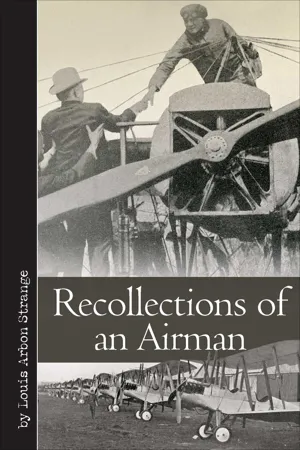
- 224 pages
- English
- ePUB (mobile friendly)
- Available on iOS & Android
eBook - ePub
Recollections of an Airman
About this book
Information
CHAPTER 1
EARLY DAYS
Perhaps the most vivid of my childhood’s memories is that of a freshly ploughed field between a farmhouse and a mill, close by the river Stour, in Dorsetshire. On a pony which my father had just bought for us I sat bareback behind my eldest brother, Ronald, whose waist I clutched frantically. I suppose I must have been about six years old at the time.
My father held the pony on a long rein and was making it trot and canter round. He knew that we would come to no harm on the soft ploughed soil when we fell off, as we were bound to do sooner or later. All the same we were both thoroughly frightened when it happened, and I believe that this incident made Ronald decide to become a sailor. Often a trivial occurrence can be the turning point in a man’s life, and the event which ultimately launched me off into the air was a kick from an old sheep with foot-rot, which I was trying to cure.
Both my father and mother came from families that had been on the land for many generations. My mother used to tell us stories of the days when her grandfather hunted Baron Rothschild’s hounds in the Chilterns and France, and I remember how fascinated we children were with the pictures she drew of him in his hunting kit. He was a great favourite at all the balls and county functions of his time, because he was blessed with more than his fair share of good looks, in addition to being known as a fearless rider and a great huntsman. When he was in England he grew grass to make hay for a number of hunters that were put out to graze for the summer on land which is now Hendon aerodrome, where I learnt to fly.
My father, too, had a number of stories. He loved to tell us of great hunting runs in Dorsetshire with Mr. Radcliffe’s foxhounds, Lord Wolverton’s deerhounds and Mr. Farqharson’s harriers. Very stirring to us children were also his tales of the way in which the Dorsetshire Yeomanry came into existence during the Napoleonic wars and the part his grandfather played in its formation. This great-grandfather of mine must have been a man of unusual strength, because my father pointed out to us the place where he had written his name on the ceiling, with a fifty-six-lb. weight hanging from his little finger.
Another tale that always thrilled us concerned a great snowstorm, still talked of in those parts, when my aforesaid ancestor rode his horse across country from Hazlebury Brian to Blandford Forum, a matter of some ten miles, on the top of frozen snow, without seeing a road or a hedge for the whole of the trip. On another occasion he bought 3000 head of sheep at a fair and walked them across country from somewhere in the Bristol district to Chichester market.
I suppose they were giants in those days. They used to think nothing of driving fifty miles to a sheep fair and arriving there before nine in the morning. When my great grandfather wanted to show Bryan, his champion bull, at the Royal Show at Oxford, he had to march him there across country all the way from Dorsetshire, and I wonder how many men would care to take on such a job nowadays.
Their horses, too, were of a breed that is not seen now. There was Black, for instance, a marvellous steeple-chaser: I wonder how many horses there are now that could give him a pound over any course. And then there was All Black, who cleared the newly erected gates at the level crossing at Sturminster; he went in and out of them just like a double fence.
My father was a great story teller, and we children had to listen to his tales and jokes over and over again when he retailed them to visitors. The anecdote that particularly sticks in my mind is one he told concerning a certain Yeomanry Dinner.
At that festivity everyone had to make a good pun or else stand a round of drinks. One of the party left late at night to drive the eight miles back to our home after having failed to think of a suitable pun; he put the pony and trap away and went upstairs to the bedroom where his wife was. Sleepily and unintentionally she murmured something that was a very apt pun.
“Well done, Jane,” said the worthy. “That’s good enough.” Then, without another word of explanation he hurried downstairs, reharnessed the pony and drove back the eight miles to the hotel where the majority of diners were putting up. But when he got there, he found that the pun had completely gone out of his head, so back home he drove to ask his wife what it was. Then off he went to tell it to the assembled company.
It was a happy time for me. In the winter holidays there were markets, fairs and hunting; in the summer ones we fished and sailed on the river. The chief thing I remember about those diversions is the feat of a huge, coal-black nigger at Woodbury Hill Fair, who lit and ate large matches. I asked him if it hurt.
“Oh, yes, sah,” was his reply; “but it always does hurt somewhere when you have to earn your own living.”
I also remember the occasion when I bought my first horse at Shroton Fair. The vendor was an Irishman, who asked seventy guineas for him, whereupon I offered seventeen.
“Bedad, he’s yours,” yelled the fellow before I had time to change my mind. “Soooold!” he whooped triumphantly to his companion, and then launched into fulsome praise of the animal, which, he declared, walked just like a lady going to a ball.
Of course I joined the Dorsetshire Yeomanry. I was a member of that honourable body before I even left school, and I can remember how proud I was when I secured third place in my first point-to-point race, while another red-letter day was on the occasion of a certain run with the Portman hounds in the Vale when after an hour and forty minutes hard going I was the only person up with the hounds. It was a special triumph because the Vale men did not think much of the South Dorset hill folk. I fancy they were rather unjust to us as whenever we went down into the Vale country we were generally well up with the hounds, chiefly, I imagine, because we rode all the straighter on account of our ignorance of the country.
After leaving St. Edward’s School, Oxford, I farmed 600 acres at Spettisbury, and during that agricultural period of my life I was a keen member of the Dorsetshire Yeomanry. Our annual trainings I reckon among the happiest periods of my life, and I think they were of great use to me afterwards. It was on one of these trainings that my thoughts first turned definitely towards flying.
On the summer manœuvres of 1912 I had seen aeroplanes and the airship, Beta, and one night in the May training of 1913 I raised a perfect riot of protests by declaring that aeroplanes would do away with cavalry in the next war, and that Britain had ceased to be an island since the day that Bleriot flew the Channel. We had all imbibed pretty copiously, and an enthusiastic discussion took place. To defend my own point of view I announced my intention of learning to fly at the first convenient opportunity, and before we adjourned to our respective beds I had taken quite a number of bets that I would fly over the Yeomanry Camp at the next year’s training. As a matter of fact I did, although for very good reasons the bets were never paid.
But when I woke up on the morning after the night before, I began to realize that I had taken a very big bite of a cherry. Decidedly I had looked upon the wine when it was red, but having said that I was going to fly, I made up my mind that fly I would at the very first opportunity.
It came only a few months later. In the July of that year the ewe with the foot-rot put a temporary end to my farming; as we had had a very trying haymaking that year, I felt that a holiday was due to me, and so I went and hunted up Lewis Turner, a well-known pilot and instructor at Hendon, whose home was at Sturminster Newton, and told him that I wanted to learn to fly. I joined the Ewen School at Hendon and took my Royal Aero Club certificate, No. 575, on August 5th, after which I applied for a commission in the R.F.C. reserve, and flew Caudrons, Bleriots, Box Kites and Moranes while waiting to be put on to one of the courses at C.F.S., Upavon.
Those were very jolly days at Hendon, although my conscience smote me somewhat, for I felt that I had left a very large farm to my father to look after in my absence. I consoled myself, however, that my younger brother, Ben, would soon be home from school to take my place on the farm. If I had known what a brilliant fellow Ben was to turn out later and how little farming must have appealed to him, I should probably have had more misgivings.
Be that as it may, I had a glorious time at Hendon, where we were a very happy family under the watchful eye of Richard Gates, the aerodrome manager. His name conveys little to the public at large, but he was a very remarkable man, to whom aviation owes a large debt, in my opinion, at least as far as Hendon is concerned. He was in at the beginnings of things there, for I believe that the ground was drained and the trees cut down under his supervision. He had a marvellous organizing capacity, and was undoubtedly responsible for the success of the Hendon meetings that were so popular in the years immediately preceding the war, for he had an uncanny knack of gauging the public’s taste.
Originally he did not intend to fly himself, but he soon came to the conclusion that he would have to be at home in an aeroplane if he was to do his job properly. Being a married man with a family, he did not indulge in any sensational feats during his early days in the air; he just learnt to fly quietly and unobtrusively, but soon developed into a first-rate cross-country flyer. I believe he also originated the idea of the “crazy flying,” which is so popular at the R.A.F. displays at Hendon nowadays—“ragtime flying” we used to call it then, but poor Gates has not survived to see its latest developments, for he was killed in a night-flying accident in the autumn of 1914.
Of the pilots who flew at Hendon at that time the names that first occur to me are Baumann, the Swiss who taught me to fly a Caudron, Temple, a Londoner who had a school of his own there, Birchenough, an Etonian from Yorkshire, Noel and Verrier, the Frenchmen, and a couple of Americans, Brock and Beatty. I remember that the latter used to talk a lot about a very fast monoplane he had over in America. We continually asked him why he did not ship it across and win all the races, but he always said: “Gee, I can’t. If I started her up on this little patch, I’d slip over the edge and lose myself in the ditch.”
I gained much inspiration from the leading articles of Charles Grey, the editor of The Aeroplane, whom I regard as one of the greatest benefactors to the cause of aviation. I still look forward to his leaders with the same enthusiasm as I did in those days; in spite of several severe illnesses he has written continuously for his paper for the last twenty years, and I can never understand why people do not take him more seriously. It cannot be said, however, that he has forgotten more than the great men in aviation to-day have ever learnt, for he never forgets anything. Well, more power to your elbow, C. G., and let us have many more leaders in the years to come, for even though they may continue to bring down curses on that wise head of yours, we old hands know that one day those curses will turn to blessings!
At Hendon I developed my acquaintance with Marjorie, whom I had met before elsewhere, and I believe that the romance of a love story that will last for my life commenced after a flight she shared with me in an 80 h.p. Gnome Bleriot. That was a great adventure in those days of nearly twenty years ago, but now it is regarded as a matter of course that father should take mother and the two children anywhere in our three-seater Spartan. Such is the course of progress.
When there were no machines available, I used to go back and farm for a spell, but the air had got me thoroughly, and when I was down in Dorsetshire I was always hankering after Hendon. My ambition was realized in May, 1914, however, when I was posted to the sixth course of instruction at the Central Flying School, Upavon, but never in my wildest dreams would I then have believed it possible that within two years I was to return there to step into Major Trenchard’s shoes as Assistant Commandant. But then, who of us realized that we were so near the stirring days of a mighty war?
CHAPTER 2
HENDON AND CENTRAL FLYING SCHOOL
If anyone cares to read about the early days of flying in England, there are a number of clubs and technical institutions where he can delve into complete volumes of Flight and The Aeroplane. I think, however, that the best thing he could do would be to invest in a copy of Major C. C. Turner’s The Old Flying Days,* which is a positive gold-mine of interesting information concerning the pioneers of aeroplane flight. Their achievements make thrilling reading, and I think some of our younger pilots scarcely realize the fact that in those days men designed machines with the aid of their lively imaginations. Aerodynamics was an unknown science to the first constructors of aeroplanes; they built machines, but did not know whether they were capable of flying, and if they were the light of their own reasoning powers was their only knowledge as to how to fly them. You have only to read about the work done by Colonel Cody with his biplane, or Horatio Barber in his Valkyries to realize that. The marvel is that they flew at all.
When I learnt to fly, things had progressed greatly. We knew that the machines into which they put us would fly, and we had expert instructors who could tell us how to fly them. All we had to do, so to speak, was to obey the instructor’s directions and fly, which, of course, sounds a good deal easier than it really was.
At any rate I never had any dual control work before I took my “A” Licence, which I succeeded in obtaining about three weeks after I started my course of instruction. This was about the average time it took in those days. I got a good deal of ground instruction, however, and in my opinion this is neglected in the majority of flying clubs to-day. It is so easy to impart when the weather is too bad for actual flying.
Our ground instruction consisted chiefly of sitting in a machine, which was put up on adjustable trestles—fore and aft and on the wing tips. In this we were shown the effect of the controls, and we had to learn thoroughly (by instinct rather than any experience based on vision) what should be the machine’s attitude in regard to the ground when taxying, how to get the tail up to the correct height to gain flying speed in the shortest possible distance and how to take off. We were also taught the proper angle of climb and how to make gentle turns, glide down, flatten out to land, etc.
Our instructor made quite sure that we knew almost instinctively the correct procedure for a wheel landing and a proper three-point landing before he would even let us taxi the machine. Then we learnt to control the machine on the ground, after which we were allowed to indulge in straight flights a few feet off the ground. Finally we passed on to half-circuits, circuits (first left-hand and then right-hand), and figures-of-eight. My actual flying time before taking my ticket was only three and a half hours, which shows the value of the ground instruction we got in those days. It is my experience that there are quite a number of pilots who put up a very poor show nowadays and often take unnecessary risks when they fly a new type of machine for the first time, simply because they will not put themselves to the trouble to ask someone who knows what is the best method to take it off, climb it, and land it, all of which things are only questions of the proper attitude the machine should assume towards the ground when performing these actions. A Martlesham Test Pilot once said in my hearing that a good R.A.F. Squadron will turn down a new machine of the Fighter type which is known to have infinitely superior powers of manœuvering, simply because they cannot make it do what they want in the same attitudes as the machines they are accustomed to fly. This, in my opinion, is a very wrong attitude of mind.
I learnt to fly on a 35 h.p. (Anzani) Caudron, which was a tractor biplane with tail booms, the lower longerons of which acted as skids and runners. Another type of machine, used by other schools of instruction at Hendon, was the Graham White Box Kite, which was a copy of the Farman pusher biplane, with a 50 h.p. Gnome engine. As aforesaid, we knew nothing of the dual control method of instruction, but more recent machines of this type had some measures of dual control, in that the pupil sat behind his instructor and could reach over his shoulder to grasp and use the control stick, which was at that time located to the pilot’s right, instead of between his legs, as it now is. There was, however, no way for the pupil to get his legs into contact with the rudder bar, so that he was unable to gain any practical experience of rudder work until the instructor considered that he had made sufficient progress. Then the two changed seats.
The Caudron was the first type of machine I learnt to fly, my instructor being...
Table of contents
- FRONT COVER
- TITLE PAGE
- COPYRIGHT PAGE
- FOREWORD
- CONTENTS
- LIST OF ILLUSTRATIONS
- CHAPTER 1. EARLY DAYS
- CHAPTER 2. HENDON AND CENTRAL FLYING SCHOOL
- CHAPTER 3. WAR!
- CHAPTER 4. STIRRING DAYS
- CHAPTER 5. THE MARNE AND AISNE BATTLES
- CHAPTER 6. WE MOVE TO BELGIUM
- CHAPTER 7. THE YPRES AND LOOS BATTLES
- CHAPTER 8. NO. 6 SQUADRON
- CHAPTER 9. THE SECOND BATTLE OF YPRES
- CHAPTER 10. GORDON SHEPHERD
- CHAPTER 11. NO. 12 SQUADRON
- CHAPTER 12. MY FIRST COMMAND
- CHAPTER 13. GUNNERY
- CHAPTER 14. UPAVON AND LINCOLN
- CHAPTER 15. THE 80TH WING
- CHAPTER 16. THE AUSTRALIAN SQUADRONS
- CHAPTER 17. SQUADRONS, FIGHTS AND RAIDS
- CHAPTER 18. THE END OF ALL THAT
- CHAPTER 19. REFIGHTING OLD BATTLES
Trusted by 375,005 students
Access to over 1.5 million titles for a fair monthly price.
Study more efficiently using our study tools.
Frequently asked questions
Yes, you can cancel anytime from the Subscription tab in your account settings on the Perlego website. Your subscription will stay active until the end of your current billing period. Learn how to cancel your subscription
No, books cannot be downloaded as external files, such as PDFs, for use outside of Perlego. However, you can download books within the Perlego app for offline reading on mobile or tablet. Learn how to download books offline
Perlego offers two plans: Essential and Complete
- Essential is ideal for learners and professionals who enjoy exploring a wide range of subjects. Access the Essential Library with 800,000+ trusted titles and best-sellers across business, personal growth, and the humanities. Includes unlimited reading time and Standard Read Aloud voice.
- Complete: Perfect for advanced learners and researchers needing full, unrestricted access. Unlock 1.5M+ books across hundreds of subjects, including academic and specialized titles. The Complete Plan also includes advanced features like Premium Read Aloud and Research Assistant.
We are an online textbook subscription service, where you can get access to an entire online library for less than the price of a single book per month. With over 1.5 million books across 990+ topics, we’ve got you covered! Learn about our mission
Look out for the read-aloud symbol on your next book to see if you can listen to it. The read-aloud tool reads text aloud for you, highlighting the text as it is being read. You can pause it, speed it up and slow it down. Learn more about Read Aloud
Yes! You can use the Perlego app on both iOS and Android devices to read anytime, anywhere — even offline. Perfect for commutes or when you’re on the go.
Please note we cannot support devices running on iOS 13 and Android 7 or earlier. Learn more about using the app
Please note we cannot support devices running on iOS 13 and Android 7 or earlier. Learn more about using the app
Yes, you can access Recollections of an Airman by Louis Arbon Strange in PDF and/or ePUB format, as well as other popular books in History & Military Biographies. We have over 1.5 million books available in our catalogue for you to explore.