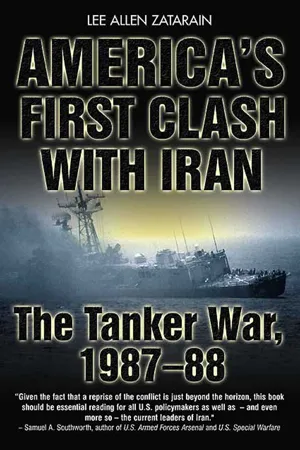
A revealing account of the US conflict with Iran over the Persian Gulf during the Reagan era—and the groundwork it set for today's tensions.
In May 1987, the US frigate
Stark was blown apart by an Iraqi jet fighter in the Persian Gulf, jumpstarting a major conflict with Iran that came to be known as the Tanker War. In
America's First Clash with Iran, author Lee Allen Zatarain employs Pentagon documents and firsthand interviews to reveal the full story of a conflict that may have presaged further battles to come.
At the climax of the Iran-Iraq War, Iran was losing on the battlefield. Ayatollah Khomeini decided to close the Persian Gulf against shipping from Iraq's oil-rich backer, the emirate of Kuwait. When the United States sent a fleet to the Gulf, raising the Stars and Stripes over Kuwait's commercial tankers, a tinderbox was set off.
The Iranians laid mines throughout the narrow passage and launched attack boats against both tankers and US warships. The US Navy fought its largest surface battle since World War II against the Ayatollah's assault boats. As Saddam Hussein looked on, Iranian gunners fired missiles against US forces—actions which, if made known at the time, would have required the US Congress to declare war against Iran.
- 448 pages
- English
- ePUB (mobile friendly)
- Available on iOS & Android
eBook - ePub
About this book
Information
CHAPTER 1
THE STARK DISASTER
Under a clear evening sky, on Sunday, May 17, 1987, the guided missile frigate USS Stark cruised slowly through the Persian Gulf. The Stark was on a routine patrol in international waters, some 80 miles northeast of Bahrain. Commanded by Captain Glen Brindel, 43, a 21-year Navy career officer, the 445-foot long ship carried a crew of 200 officers and men. Brindel’s tour as the Stark’s CO was rapidly winding down, with his replacement due on board in six days.
Iraq was hitting tankers carrying Iran’s oil exports, while Iran was attacking ships carrying oil from Kuwait and Saudi Arabia, who were extending financial aid to Iraq. There had been misdirected attacks by both sides. However, so far, no U.S. ships had been involved. Iranian attacks had usually been mounted in the southernmost part of the Gulf. Iraqi attacks were usually mounted in northern areas.
The Stark was sailing in the central Gulf, in an area in which no attacks had occurred to date. Still, there was reason to worry. Iraqi antishipping strikes had been creeping further south. Three days earlier, on May 14, an Iraqi fighter had hit a tanker with a French-made Exocet missile barely sixty miles away from the area the Stark was now sailing in. Capt. Brindel had been warned about the Iraqi attack. However, on the evening of the 17th, he seemed to be preoccupied with readying his ship for an upcoming inspection.
Shortly before 8:00 P.M., a U.S. Air Force E-3A “Sentry” Airborne Warning and Control aircraft (AWACS) flying in Saudi Arabian airspace picked up an Iraqi aircraft on its powerful surveillance radar. The AWACS was part of what was dubbed the “ELF-1” force, based in Dhahran, Saudi Arabia. The Iraqi aircraft was flying on a relatively rare, for the Iraqis, nighttime mission toward the central Gulf. The Iraqi aircraft’s course took it over water in a southeasterly direction, threading through the relatively narrow strip in international waters between an Iranian declared “exclusion zone” and Saudi Arabian territory. Iraqi fighters often took this route for their ship attacks. American officers sometimes called this strip “Mirage Alley.”
As a precaution, the AWACS called in air cover in the form of two Saudi Arabian Air Force F-15 fighters. It didn’t call on them to intercept the Iraqi aircraft, since it appeared to be flying the kind of mission the Iraqis usually flew against Iranian shipping targets. The Iraqi aircraft picked up by the AWACS was outside the detection range of the Stark’s own air search radar. However, the Stark was quickly alerted to the Iraqi’s presence by the AWACS, which began feeding data on the contact to the USS Coontz, sitting dockside in the port of Manama, Bahrain.
The Coontz whose own radars were not operating, relayed the AWACS information to the Stark over a Navy data link. The Stark could, in effect, see through the eyes of the AWACS and follow the path of the oncoming aircraft. The AWACS confirmed that it was tracking an Iraqi military aircraft, a French-made Mirage F-l fighter. Iranian-U.S. antagonism was still strong following the fall of the U.S.–supported Shah and the embassy hostage crisis. To counter expansion by Iran’s revolutionary government, the U.S. was even extending “soft” support to Iraq’s war effort. Given the circumstances, the AWACS classified the Iraqi track as a “friendly strike/support aircraft.”
Captain Brindel briefly stopped by the Stark’s Combat Information Center (CIC) and was told that an Iraqi aircraft was headed south. Brindel told his Tactical Action Officer, Lieutenant Basil Moncrief, to keep a close eye on the contact, noting that the Iraqis had been coming further south recently. The Stark was scheduled to participate in an Atlantic Fleet Mobile Training Team exercise and inspection in a few days. In preparation for the inspection, the Stark then began a “full power run” engineering test, running up to a speed of 30 knots. Capt. Brindel continued on to the bridge. He had the CIC contacted to find out why the Stark’s own radar had not yet picked up the Iraqi fighter.
His inquiry prompted the CIC to shift the Stark’s air search radar to a shorter- range (80-mile) mode, focusing on contacts lower and closer to the ship. The mode switch did the trick and the Stark’s own radar now detected the Iraqi fighter about 70 miles out. When the full power run ended, Capt. Brindel left the bridge and went to his cabin to make a head call.
The AWACS now saw the Iraqi fighter ending its run down the Gulf and swinging around to the east. The Iraqi pilot had either spotted a likely target or was searching for one. If the fighter kept to its new course, it would pass within approximately 11 nautical miles of the Stark. Shortly thereafter, the Iraqi jet turned even more toward the Stark. The frigate’s radar operator told Lieutenant Moncrief that the Iraqi’s course would now take it to a closest approach point of only 4 nautical miles from the ship. At the same time, an Electronic Warfare Technician in the Stark’s CIC began to pick up radar signals which correlated with emissions from the Cyrano IV radar carried on Iraqi Mirage fighters. A minute later, the Stark’s radar operator requested permission to transmit a standard warning on the Military Air Distress Frequency to the Iraqi fighter, which had now closed to a distance of 43 nautical miles from the ship. Lieutenant Moncrief responded, “No, wait.”
Not aware that anything special was going on, the Stark’s Executive Officer, Lieutenant Commander Ray Gajan walked into the CIC to discuss some administrative matters with Lieutenant Moncrief. Seeing the activity, he waited, watching events from a position near the chart table. About the same time that Lt. Commander Gajan entered the CIC, the Duty Officer on board the Middle East Force flagship, USS LaSalle, docked in Bahrain, radioed an inquiry to the Stark. He wanted to know if it was copying the details on the AWACS track of the Iraqi aircraft. Lieutenant Moncrief replied that it was, noting that the track had been evaluated as an Iraqi Mirage F-1EQ.
Unknown to the U.S. forces tracking it, the Mirage had been specially modified to carry two French-made Exocet anti-ship missiles rather than its normal load of one Exocet. The fighter also carried a centerline fuel tank for extended range. The overloaded Iraqi aircraft was aerodynamically unstable and was proving to be a handful for its pilot to fly. The AWACS could see that the plane’s track was erratic, indicating that the pilot was having difficulty in fully controlling it. Reportedly, the overloaded Mirage was going so slow at one point that it almost stalled out and crashed.
At a range of 32-1/2 nautical miles, the Iraqi fighter began flying directly toward the Stark, rapidly closing the distance between them. No one in the Stark’s CIC seemed to notice that the Iraqi jet was now headed straight at them. At 9:07 P.M., the pilot of the Mirage fired one of his Exocet missiles at a blip on his radar screen. The missile was launched at a range of 22 nautical miles and would take some two minutes to reach its target. The Stark was running with its navigation lights blazing, completely unaware that an Exocet was now streaking toward it at 550 miles per hour.
The frigate was operating at what the Navy called Readiness Condition III: its air and surface sensors were operating, and its weapons could be put into action on short notice. One third of the crew were at their stations. Still, the ship wasn’t quite as ready as it should have been. All of the consoles in the CIC were supposed to be manned but they were not. A crewman assigned to a .50 caliber machine gun was lying down at his post.
The Stark’s forward lookout saw a bright light flare on the horizon when the Iraqi missile was launched, but he assumed that the light was from something on the surface. Around the time that the first missile was launched, Lieutenant Moncrief noticed on the radar display the course change which had been made earlier by the Iraqi jet. The situation was apparently getting more serious and Lieutenant Moncrief had Captain Brindel summoned to the CIC. He also ordered the radio operator to issue warnings to the Iraqi pilot. About a minute after firing its first missile, the Mirage fired another Exocet at the Stark. The second missile was launched at a range of 15 nautical miles. At about the same time, the Stark finally broadcast a warning on the Military Air Distress Frequency:
“Unknown aircraft, this is a U.S. Navy warship at your 078… (pause), for 12 miles, request you identify yourself, over.”1
Also, around this time, the Electronic Warfare Technician in the CIC detected what he thought was the F-1EQ’s radar “locking-on” the Stark. The technician turned up the volume on his console and a steady, high-pitched signal of the radar “lock-on” sounded throughout the darkened CIC. Virtually all of the men in the CIC paused and turned their heads toward the console that was the source of the signal. About 10 seconds later, the signal abruptly ceased. It may actually have been the first Exocet missile’s seeker locking on the Stark. A concerned crewman got permission from Lieutenant Moncrief to go topside and arm the Super Rapid Bloom Off Board Chaff (SRBOC) launchers. That sys tem consisted of clusters of mortar-like tubes which fired packages of metallic strips, or chaff. The strips dispersed in the air and reflected back a signal to a missile’s guidance radar, mimicking a ship. Hopefully, a missile would be distracted into the cloud of chaff and away from its intended target. The Stark then issued its second warning on the Military Air Distress Frequency:
“Unknown aircraft this is US Navy warship on your 076 at 12 miles… (pause), request you identify yourself and state your intentions, over.”2
There was no reply.
Two of the deadly 15-foot long Exocet missiles, each tipped with a 300-pound warhead, were now streaking toward the Stark. Their blue rocket exhausts reflected off the waters of the Gulf as they bobbed up and down slightly, maintaining a sea-skimming altitude about 10 feet above the surface. The frigate’s low alert status had not changed and off-duty crewmen, some in the last moments of their lives, remained settled in their bunks.
Lieutenant Moncrief moved to the console controlling the Phalanx Close In Weapon System (CIWS). The Phalanx is a short-range “last ditch” anti-missile defense in the form of a self-contained, radar-directed, 20-mm multi-barrel “Gatling” gun. The weapon was capable of firing up to 3,000 rounds per minute, using very dense, depleted uranium ammunition. The rounds could penetrate a missile’s warhead, detonating it, or damage the missile’s fuselage and control surfaces, knocking it into the sea. Lieutenant Moncrief inserted his key in the console and brought the Phalanx into “stand-by” mode, which meant that it was warmed up, but its internal radar was not operating. If the Phalanx had been set on “automatic” it would have tracked and fired on any target it detected.
Lieutenant Moncrief then told the fire control technician to “lockon” the Iraqi jet with the long-range search radar of the ship’s MK92 Fire Control System. When a radar “locks-on” a target, it continuously tracks it rather than just periodically picking it up as it searches in all directions. If the aircraft detects that it has been “locked-on,” it would assume that the source of the “lock-on” has targeted him and might be preparing to fire. Accordingly, “locking-on” a plane serves as a definite attention-getter and warning, even if the ship does not intend to actually fire at that point. The radar “lock-on” would also indicate to an Iraqi pilot on an attack mission that the source of the radar signal was a warship and not a tanker, which would most likely have been his intended target.
However, the Stark’s radar was unable to lock-on to the Iraqi since its signal was blocked by the ship’s superstructure, which fell between the radar antenna and the location of the Iraqi fighter at the time. Lieutenant Moncrief then ordered another radar at a different location be used to “lock-up” the Iraqi. This had finally been accomplished at a range of about 10 nautical miles. Observing the proceedings, Lt. Commander Gajan said, “Let him know who we are.” It was way too late.
The Stark’s forward lookout had seen the flash of the first Exocet launch without realizing what it was. He then observed a small blue dot on the horizon, moving erratically up and down. The dot resolved itself into a blue fireball, which became steady as it neared the ship, coming in at an angle of 10 to 15 degrees off the port bow. Seconds before impact, the lookout realized just what the approaching fireball of missile exhaust meant and screamed, “Inbound missile! Inbound missile!” on the sound powered phone circuit. He then dived to the deck. Bernard Seely was standing watch at the helm when he saw a nearby fog bank suddenly turn an eerie blue color. A ball of light streaked out of the mist and seemed to head straight for the bridge. At the last second, the missile dove into the hull of the ship.
The Exocet slammed into the Stark with a loud thud rather than an explosion, indicating that its warhead had failed to detonate. Seely was jolted into a compass in the console behind him. Alarmed by the impact, the men around him began shouting, “What the hell is going on?”3 Most crewmen, including those in the CIC, did not even realize that a missile had just hit their ship. Men at the aft end of the ship thought that a fire pump or some other piece of operating machinery had torn itself apart. Others thought that maybe the ship’s 76mm cannon had fired or that chaff had been launched from the SRBOC tubes.
The Exocet’s warhead may not have exploded, but the...
Table of contents
- FRONT COVER
- TITLE PAGE
- COPYRIGHT PAGE
- CONTENTS
- FRONTMATTER PAGE
- INTRODUCTION
- ACKNOWLEDGMENTS
- 1 / THE STARK DISASTER
- 2 / TARGET: KUWAIT
- 3 / RAISING QUESTIONS
- 4 / OPERATION EARNEST WILL
- 5 / AMBUSH
- 6 / RETHINKING
- 7 / THE INVISIBLE HAND STRIKES AGAIN
- 8 / IN FLAG RAN TE
- 9 / FORT APACHE—THE GULF
- 10 / “TURN AND ENGAGE”
- 11 / “WE WILL COMMENCE FIRING”
- 12 / “WE ARE THE BIG WINNERS IN THE GULF NOW”
- 13 / “NO HIGHER HONOR”
- 14 / “A ONE-DAY WAR”
- 15 / “STOP, ABANDON SHIP, I INTEND TO SINK YOU”
- 16 / “NONE OF THESE LADIES HAS A SCRATCH ON HER”
- 17 / “MULTIPLE SILKWORMS INBOUND”
- 18 / POLICEMAN OF THE GULF?
- 19 / “UNKNOWN, ASSUMED HOSTILE”
- 20 / “I DEEPLY REGRET THE RESULT, IF NOT THE DECISION
- 21 / SEA OF LIES?
- 22 / “GIVE ME THE KEY. GIVE ME THE KEY.”
- 23 / “THEY DON’T FIGHT LIKE IRANIANS ANYMORE”
- END NOTES
Trusted by 375,005 students
Access to over 1.5 million titles for a fair monthly price.
Study more efficiently using our study tools.
Frequently asked questions
Yes, you can cancel anytime from the Subscription tab in your account settings on the Perlego website. Your subscription will stay active until the end of your current billing period. Learn how to cancel your subscription
No, books cannot be downloaded as external files, such as PDFs, for use outside of Perlego. However, you can download books within the Perlego app for offline reading on mobile or tablet. Learn how to download books offline
Perlego offers two plans: Essential and Complete
- Essential is ideal for learners and professionals who enjoy exploring a wide range of subjects. Access the Essential Library with 800,000+ trusted titles and best-sellers across business, personal growth, and the humanities. Includes unlimited reading time and Standard Read Aloud voice.
- Complete: Perfect for advanced learners and researchers needing full, unrestricted access. Unlock 1.5M+ books across hundreds of subjects, including academic and specialized titles. The Complete Plan also includes advanced features like Premium Read Aloud and Research Assistant.
We are an online textbook subscription service, where you can get access to an entire online library for less than the price of a single book per month. With over 1.5 million books across 990+ topics, we’ve got you covered! Learn about our mission
Look out for the read-aloud symbol on your next book to see if you can listen to it. The read-aloud tool reads text aloud for you, highlighting the text as it is being read. You can pause it, speed it up and slow it down. Learn more about Read Aloud
Yes! You can use the Perlego app on both iOS and Android devices to read anytime, anywhere — even offline. Perfect for commutes or when you’re on the go.
Please note we cannot support devices running on iOS 13 and Android 7 or earlier. Learn more about using the app
Please note we cannot support devices running on iOS 13 and Android 7 or earlier. Learn more about using the app
Yes, you can access America's First Clash with Iran by Lee Allen Zatarain in PDF and/or ePUB format, as well as other popular books in History & Middle Eastern History. We have over 1.5 million books available in our catalogue for you to explore.