This biography of one of World War II's great military leaders is a "rich tribute to a staunch American naval hero" (
WWII Quarterly).
John S. "Slew" McCain was an old-school sailor. Wiry, profane, a cusser, and a gambler, he reminded more than one observer of Popeye. He was also a pioneer in the hard-hitting naval tactics that brought Imperial Japan to its knees.
McCain graduated from Annapolis in 1906 and served aboard an armored cruiser in World War I. Perceiving the future of naval warfare, he earned his aviation wings in 1936, and by 1939, McCain was commander of the aircraft carrier
USS Ranger. He was thus well-placed to play a leading role in America's cut-and-thrust war with the Japanese across the broad expanses of the Pacific. In 1942, he was made commander of all land-based aircraft during the campaign for Guadalcanal. Though he took his share of blame for the disaster at Savo Island, he counterattacked with every means at his disposal, to the point of commandeering the planes of the crippled carriers
Enterprise and
Saratoga to reinforce US strength on Henderson Field.
By the time the US returned to the Philippines, McCain was leading a fast carrier task force under William "Bull" Halsey. When asked what he thought about his carrier commander, Halsey replied, "Not much more than my right arm." McCain's carrier group would destroy thousands of enemy planes and hundreds of ships with aggressive swarming tactics. Four days after Japan officially surrendered, McCain died in his bed. His name has lived on, however, through his son, who became commander of US naval forces in the Pacific, and his grandson, John S. McCain III, carrier pilot, Vietnam POW, and United States Senator.
Drawing upon a wealth of primary sources, including information provided by the McCain family, as well as an expert grasp of the titanic battles waged by the US armed forces in the Pacific, Alton Keith Gilbert has provided the fullest account of the Admiral John McCain's life yet written.
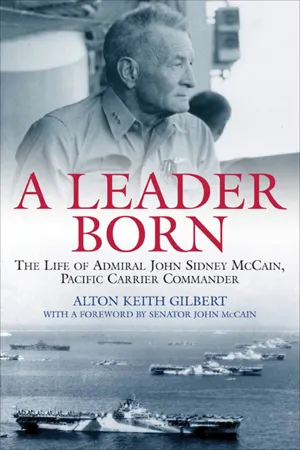
eBook - ePub
A Leader Born
The Life of Admiral John Sidney McCain, Pacific Carrier Commander
- 304 pages
- English
- ePUB (mobile friendly)
- Available on iOS & Android
eBook - ePub
About this book
Information
1
FROM TEOC TO TOOL ROOM
In 1941, John Sidney McCain wrote: “I was born on a plantation at Teoc, Mississippi, August 9th, 1884, the son of John S. and Elisabeth Young McCain. Both parents are now dead. My brother, Mr. Joseph P. McCain, still runs the plantation. Living with him is my spinster sister, Katie Lou McCain. Another married sister, Mrs. Luther Spencer, lives in the nearby metropolis of Carrollton, Mississippi. A brother, Harry Hart McCain, died in Wisconsin four years ago—no children. My remaining brother is Brigadier General William A. McCain, in command of the Quartermaster depot in Philadelphia. My only other surviving close relative is Major General Henry P. McCain, Retired, Washington, D.C. I visit the plantation every year or two, as does my Army brother, and it looks to me more peaceful and pleasant every time I see it. My father was a grand old gentleman, completely unselfconscious—that is he would talk as readily to the President as he would to a field hand. He wandered by mistake one day into the office of Admiral Charles F. Hughes, then the chief of naval operations, which was the beginning of a beautiful friendship. My father had access to the Admiral’s office at all times. When my father died the entire county and half the state attended the funeral. That, of course is an exaggeration.”
McCain’s older brother, Brigadier General William Alexander McCain, was born in 1878, attended Ole Miss, and then graduated from West Point in 1902. He received Distinguished Service medals in both world wars. By 1948 he was retired and living in Doylestown, Pennsylvania. McCain’s uncle, Henry Pinckney McCain, graduated from West Point in 1885, attained the rank of major general, and was Adjutant General of the Army in World War I.
The brother, William Alexander, was quite a character (as was John Sidney himself). As a cavalryman, Bill McCain helped “Black jack” Pershing chase Pancho Villa through the Mexican foothills. He was a poker-playing polo player who earned the nickname “Wild Bill” for his daring riding of his polo ponies. In fact, injuries from polo forced him to give up the cavalry and transfer to the quartermaster corps. He retired before World War II as a colonel, but he was recalled and promoted to brigadier general.
Camp McCain, an army post near Grenada, Mississippi, was named “In honor of a famous family of military men from neighboring Carroll County, including Carroll county native Major General Henry P. McCain.”
The McCains of Teoc
Author Elizabeth Spencer, Admiral McCain’s niece, wrote of McCain’s father. He was also named John Sidney McCain, but was not called “senior” or “1st.” She knew him in his later years, and he was the only grandparent she knew.
She described him as tall, with a white mustache and blue eyes. Year-round he wore dark suits and a black bow tie. He owned and used a variety of walking sticks, and distrusted motor cars. As a youth he tried to join the Confederate cause, but was turned away as too young—he was only fourteen. In his elder years he could often be found in an armchair by the fireplace or on the porch.
The elder McCain, called “Mister Johnny,” was devoted to Teoc and his family. He instilled in John Sidney and his siblings the traditional McCain family values of honesty, loyalty, integrity, and a thirst for education.
Elizabeth Spencer recorded of her fond memories of Teoc:
The original family home, overlooking the flat expanse of Delta land, stood on a hill and was once described to me by my uncle Bill, the eldest son, as “impressive…in the old Southern style.” By that I could imagine a mansion if I chose, but I now think it was probably a traditional two-story plantation home. It burned down the year of my mother’s birth.
My mother was born soon after the fire, in the only shelter the family had to go, one of the Negro houses on the place.
These houses, as I recall them, having been constantly in and out of so many when I visited Teoc, were simple but comfortable and roomy.
The house, expanded and embellished, became a real home place, plain at first, but tended charmingly, with verandas added. The oaks planted around it grew and flourished, forming a shady grove.1
There were churches and schools on the farm to serve the large population living there and working the land. Today, of course, the land is nearly empty, farmed from afar and by machinery.
Teoc Today
To visit Teoc today, you drive about five miles north from Greenwood, Mississippi, on Highway 7. A small green highway sign with an arrow and “Teoc” points to the east. A sharp right turn leads onto a paved road that soon traverses the McCain fields “that Uncle Sidney plowed as a boy.”2
About three and a half miles east on that road, crossing Teoc Creek, brings you to Teoc itself. Bill McCain, John Sidney’s nephew, said the family had queried the Smithsonian about the name “Teoc” and were told that it is a Choctaw word for “tall pines.” Bill’s ancestor, William Alexander McCain, bought the land from Mr. Vick (the namesake of Vicksburg of hallowed rebel memory) in 1851.
A long northwest—southeast bluff line runs through Mississippi, separating the hill country to the east from the flat delta lands to the west. Teoc sits at the foot of that bluff. A dirt road leads off to the north from the paved road to the old house. Close by the intersection, on the north side of the paved road, is the old McCain-Spencer general store. When the dirt road extended to the south (as it did in olden days) it crossed an antique iron bridge, called the “iron bridge.” That was the original entrance to Teoc.
Today the store still stands pretty solid, with a large main hall plus two small rooms at the back. On one side of the main hall is a swing-up door to a port for weighing cotton. The old scales are still in place, built right into the wall. Bill McCain relates that in the old days they had a one-cylinder cotton gin during the picking season.
Outside over the front door is a faded sign “US GOVERNMENT MOTOR GASOLINE.” Around the corner to the side of the store is where Sidney used to pitch pennies, a favorite pastime of the brothers.
As you drive north along the graveled road, on the right is an African-American cemetery. Then on the left the old house appears. To reach the building, you crawl through some brambles and cross a meadow. On the north side of the meadow is an old flower bed and a “potato house.” Further back is the old orchard site. To the west are the flat 1, 800 acres planted in soy beans and cotton. Off to the north is Sharkey’s Bayou. The bayou is locally called the “slew,” which provides one family theory about the origin of John Sidney’s nickname.
The house is truly a derelict; the porches have nearly all fallen off, but the tin roof seems okay. Trees, weeds, and vines have grown up all around the outside. Inside, the floors and walls are reasonably solid. Wallpaper is peeling from the walls, but the wooden paneling on the walls looks pretty good; it could be salvaged. There are two fireplaces, one older than the other. There are bookshelves on the wall beside the older fireplace. Nephew Bill McCain remembers that the house was always full of books.
Both John Sidney and brother Bill visited when they could. John Sidney probably was there for the last time in February 1945, while on his way back to the Pacific to relieve Marc “Pete” Mitscher as commander of the fast carrier task force. When he was home, John Sidney sometimes paced the porches, waiting for the official start of the cocktail hour. He frequented Lusco’s in Greenwood, a restaurant with a long-standing reputation for good dinners (and bootleg liquor).
The number of people on the farm has dropped from dozens to virtually none. The houses and outbuildings are gone. The store is closed. But you can still get the lay of the land and imagine what it must have been like to get up in the morning, walk out on the porch, sniff the air, and greet the day.
Carrollton
McCain’s father, in addition to running the farm, held county offices. Carrollton, the county seat of Carroll County, is a beautiful town, with lots of shade trees, lovely old homes, a small square, and a court-house in the Southern tradition. There is one family tale about John Sidney, as a youth in Carrollton, taking on the responsibility of protecting his sisters. When he saw and heard movement outside one night, he let go with shotgun blasts. The next day it was found he had thoroughly destroyed a nearby tree.
Sidney attended school in Carrollton even though there were school houses out at Teoc. William Thomas was the superintendent of schools in Carroll County, and recounted to his family that his greatest accomplishment was retaining his job for nine years as a Baptist with a school board of Methodists, and that Admiral John McCain was his star pupil.3
Elizabeth Spencer recalled in a letter that, for a time, her Uncle Sidney was the telephone operator for all of Carrollton. Once, during a severe thunderstorm, he rang his father to ask if he should close up until it was over. The advice came back “Stick to your post, son!”
On his last visit to Carrollton in 1945, when he was ready to go back to the war, John Sidney (nominally a Presbyterian) asked his sister “Jimmy” (Mary James, who married Luther Spencer) to “have all the Episcopalians pray for me.”
Ole Miss
Sidney attended the University of Mississippi for the 1901—02 academic year. His name appears as number 238 on the President’s Register of Students, and he is listed in the 1900—1903 catalogue as a Bachelor of Science freshman. It’s not clear exactly which aspects of science he studied in his year at Ole Miss, but he did attend Greek or Latin classes taught by Katherine Vaulx of Arkansas, a lady who was to figure prominently in his life. He also joined the Phi Delta Theta fraternity.
Annapolis
In his book, Senator John McCain described the McCains of Teoc as “clannish, devoted to one another and to their traditions.” One of these traditions was an Army career starting at West Point. In a switch of direction that was to set a tradition for at least three more generations, Sydney obtained a senatorial appointment to Annapolis on September 25, 1902. He took the Naval Academy exams only as practice for the future West Point tests, but he scored so well that he opted for Annapolis.4
His appointment by Senator A. J. McLauren was one of the first by a U.S. senator. Prior to that, all appointments had been made by representatives only. Also, McCain and his classmates were the first to hold the title of midshipman. Up to 1902, Academy entrants were known as naval cadets.5
This was a propitious time to enter the Naval Academy and the United States Navy. The Spanish-American war in 1898 had left the United States, like it or not, as a colonial power with global responsibilities. President Theodore Roosevelt, previously an assistant secretary of the Navy, and looked upon the fleet as the “big stick” he carried while “walking softly.” Congress (and the public) agreed and authorized a steady stream of new battleships. Six new battleships were commissioned in 1906, McCain’s graduation year, followed by four in 1907. Soon the United States Navy was second in the world only to the Royal Navy.6
In 1899 reconstruction of the entire Naval Academy began. By 1903 the new Macdonough and Dahlgren halls were opened to house academic departments. The first wing of a new dormitory, Bancroft Hall, opened in 1904. Not all of the Class of 1906 was allowed to taste its luxuries, but some enjoyed their first class (senior) year in the more spacious new surroundings.7 The class of 1906 history, published in 1954, commented that the majority of the class lived for the larger part of the academic year in two-story frame barracks called annexes. The annexes were described as having few of the comforts of home and “lacked the benefit of the modern plumbing installed in the marble halls then building.” The class history went on to say, “The isolation of the annexes was not conducive to strict discipline and the result was rough-housing at all hours and the performance of innumerable pranks conceivable only in the fertile minds of youth.”8
In 1903 the student body expanded from four companies to eight. The brigade marched in President Roosevelt’s inaugural parade in 1905, a year that also saw the remains of J...
Table of contents
- Cover Page
- Title
- Copyright Page
- Contents
- Maps
- Foreword
- Preface
- Introduction
- 1 From Teoc to Tool Room
- 2 The Great War
- 3 Shore Duty
- 4 Sea Duty
- 5 Aviation
- 6 Flag Rank
- 7 War In The South Pacific
- 8 Guadalcanal
- 9 Return To Washington
- 10 Deputy Cno
- 11 The Fast Carriers
- 12 The Philippines Campaign
- 13 Slew Takes Over
- 14 Heavy Hits
- 15 Final Blows
- 16 Command Performance
- 17 Finale
- 18 Respect And Affection
- Acknowledgments
- Glossary
- Notes
- Bibliography
Trusted by 375,005 students
Access to over 1.5 million titles for a fair monthly price.
Study more efficiently using our study tools.
Frequently asked questions
Yes, you can cancel anytime from the Subscription tab in your account settings on the Perlego website. Your subscription will stay active until the end of your current billing period. Learn how to cancel your subscription
No, books cannot be downloaded as external files, such as PDFs, for use outside of Perlego. However, you can download books within the Perlego app for offline reading on mobile or tablet. Learn how to download books offline
Perlego offers two plans: Essential and Complete
- Essential is ideal for learners and professionals who enjoy exploring a wide range of subjects. Access the Essential Library with 800,000+ trusted titles and best-sellers across business, personal growth, and the humanities. Includes unlimited reading time and Standard Read Aloud voice.
- Complete: Perfect for advanced learners and researchers needing full, unrestricted access. Unlock 1.5M+ books across hundreds of subjects, including academic and specialized titles. The Complete Plan also includes advanced features like Premium Read Aloud and Research Assistant.
We are an online textbook subscription service, where you can get access to an entire online library for less than the price of a single book per month. With over 1.5 million books across 990+ topics, we’ve got you covered! Learn about our mission
Look out for the read-aloud symbol on your next book to see if you can listen to it. The read-aloud tool reads text aloud for you, highlighting the text as it is being read. You can pause it, speed it up and slow it down. Learn more about Read Aloud
Yes! You can use the Perlego app on both iOS and Android devices to read anytime, anywhere — even offline. Perfect for commutes or when you’re on the go.
Please note we cannot support devices running on iOS 13 and Android 7 or earlier. Learn more about using the app
Please note we cannot support devices running on iOS 13 and Android 7 or earlier. Learn more about using the app
Yes, you can access A Leader Born by Alton Keith Gilbert in PDF and/or ePUB format, as well as other popular books in History & Military Biographies. We have over 1.5 million books available in our catalogue for you to explore.