A vivid memoir of the conflict's early years combined with "an insightful review of our problems in Iraq" (
Publishers Weekly).
Winner of The Army Historical Foundation's Distinguished Writing Award.
Shortly after the launch of Operation Iraqi Freedom, the war in Iraq became the most confusing in US history, the high command not knowing who to fight, who was attacking coalition troops, and who among the different Iraqi groups were fighting each other. Yet there were a few astute officers like Lt. Col. Christopher Hughes, commanding the 2nd Battalion of the 327th Infantry Regiment, 101st Airborne, who sensed the complexity of the task from the beginning.
In
War on Two Fronts, Lt. Col. Hughes writes movingly of his "no-slack" battalion at war in Iraq. The war got off to a bang for Hughes when his brigade command tent was fragged, leaving him briefly in charge of the brigade. Amid the nighttime confusion of fourteen casualties, a nearby Patriot missile blasted off, panicking nearly everyone while mistakenly bringing down a British Tornado fighter-bomber.
As Hughes' battalion forged into Iraq, they successfully liberated the city of Najaf, securing the safety of Grand Ayatollah Sistani and the Mosque of Ali while showing an acute cultural awareness that caught the world's attention. It was a feat that landed Hughes within the pages of
Time,
Newsweek, and other publications. The Screaming Eagles of the 101st Airborne then implemented creative programs in the initial postwar occupation, including harvesting the national wheat and barley crops while combating nearly invisible insurgents. Conscious that an army battalion is a community of some seven-hundred-plus households, and that when a unit goes off to war, the families are intimately connected in our internet age, Hughes makes clear the strength of those connections and how morale is best supported at both ends.
Transferred to Washington after his tour, Hughes also writes an illuminating account of the herculean efforts of many in the Pentagon to work around the corporatist elements of its bureaucracy in order to better understand counterinsurgency and national reconstruction, which Lawrence of Arabia described as "like learning to eat soup with a knife." This book helps explain the sources of mistakes made—and the process needed to chart a successful strategy. Written with candor and no shortage of humor, mixed with brutal scenes of combat and frank analysis, it is a must-read for all who seek insight into our current situation in the Mideast.
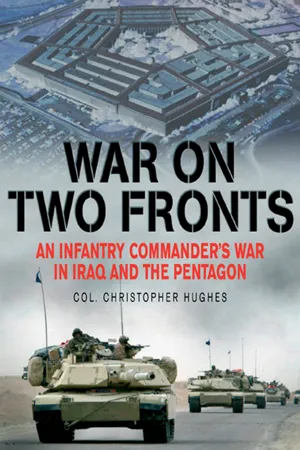
eBook - ePub
War on Two Fronts
An Infantry Commander's War in Iraq and the Pentagon
- 320 pages
- English
- ePUB (mobile friendly)
- Available on iOS & Android
eBook - ePub
About this book
Information
Topic
StoriaSubtopic
Biografie in ambito militarePart I
The 31st Invasion of Ancient Mesopotamia
1
PREPARING FOR WAR
FORT CAMPBELL, KENTUCKY
In a moment of weakness that came back and bit me square in the ass, I allowed the wives of my battalion, 2d Battalion of the 327th Infantry Regiment, access to the battalion area while their husbands prepared to deploy to war. It was akin to letting wives and girlfriends into the locker room hours before the Super Bowl, but my men were going off to something much more serious.
Under normal circumstances, Army families say their goodbyes at home, and most wives drop their husbands off at the edge of the battalion area in good order and then go about their own daily business.
However, going to war was not normal circumstances.
Therefore, when the wives of No Slack (my battalion’s nickname) asked me for access to the battalion to say their final goodbyes before they entrusted their husband’s lives to me, my resolve to keep my troops focused squarely on the job at hand weakened.
After all, they had promised to remain strong and not interfere with our out-loading. My gut told me it was the wrong thing to do, but it seemed a harmless concession at the time. Now, just hours be fore our departure, my battalion area was filled with painful, con fused and heart-wrenching scenes of emotional hugging and kids crying.
It was a bad start.
A further distraction was that my own family was taking advantage of my decision. My wife Marguerite, daughter Ashley, and sons Patrick and Michael were all milling about, diverting my attention from the job at hand. In my twenty years as an Army officer, they had never once accompanied me to my office during a deployment, and most certainly not at 3:00 a.m. My normal pre-deployment routine was to say my goodbyes to my children the night before and briefly wake them in the morning to give them my last hug goodbye.
Marguerite and I would spend quality-time days before the deployment and then remain formal and business-like in the hours before and the morning of my departure. As the wife of the battalion commander, Marguerite was expected to keep a stiff upper lip and set an example for the other 380 wives and 213 children. In the Army, this was the traditional role of a senior wife—she bore the brunt of the demands, concerns and frustrations of the wives of junior soldiers on behalf of the Army. It was her expected place though not her job. It was by far the most difficult thing I’d ever asked of her in over twenty years of marriage.
Normally, Marguerite just dropped me off at my headquarters, and I would conduct my final checks—personal gear, maps, orders and memorandums. After which I would give someone the task of ensuring my personal stuff got on the right train, plane or bus.
When my personal chores were complete, I would take about 15 or 30 minutes alone, donning my commander’s mask. The mask is one of the most valuable leadership tools an officer has. It is a facade leaders have used for centuries to deter or hide fear, check emotions, and present subordinates with an example they can count on during moments of great stress, such as war. Once the mask is donned, a commander walks alone and is held to a higher standard than his soldiers, peers or friends. It is often a lonely and difficult road of absolute responsibility, moral inconsistencies, religious quandary and the reality of dealing with death.
After twenty years of military service, I was comfortable wearing my mask, but this morning it did not fit right. Looking into the eyes of my soldiers’ wives was making me feel more alone and anxious than ever before. The welfare of my men was always in the forefront of my mind, but the idea that this duty also extended to the continued well-being of their families was suddenly being driven home. It made me a bit uneasy. My own family’s well-being was contributing to my unease.
Their presence had turned my routine upside down. I was finding it impossible to fit my commander’s mask and monitor the progress of the battalion in the detached way I was accustomed to. The unexpected flood of personal emotions slowed my preparation, clouded my judgment, and hindered my ability to command at a time when I should have been more focused than ever before.
The fear in my son Patrick’s eyes kept reminding me that I might never see him again; my daughter Ashley’s precise and intellectual questions about the deployment process distracted my packing; and Marguerite’s brave and proud looks were tearing me apart inside. Had we come this far in our lives and in my career to place myself in such a dangerous situation … was I an ignorant fool for dreaming of this moment for almost twenty years? Was I a bad father, husband—or person? Who in their right mind would dedicate their entire adult life to studying, training and planning to kill other human beings? Would God forgive me? How many of my men would die because of my faults and weaknesses as a man and as a commander? Had I done everything I could? How could I face the wife of a man killed under my command?
The flood of emotion was making me ill and weak in the knees.
I was snapped out of my reverie by my Executive Officer (XO), Major Peter Rooks, an exceptionally organized and competent officer, storming into my office with the battalion’s senior ranking enlisted soldier, Command Sergeant Major (CSM) Richard Montcalm, in his wake to announce that a number of pissed-off wives from D Company were in the headquarters waiting area demanding to see me now. Montcalm was my senior enlisted advisor and responsible for the morale, appearance and discipline of the men. As my confidant, he was my eyes and ears—responsible for preventing me from forgetting my place and the welfare of the men. A matchless presence, Richard was a tinkerer—a gadget man who loved a mechanical challenge, a skill I would eventually learn to appreciate and leverage. Nevertheless, this kind of challenge was absolutely the last thing I needed, and as I glanced at my youngest son asleep on my office couch, I cursed myself for being so weak as to allow families to enter the battalion area as we were leaving for war. This unnecessary drama was a self-inflicted wound. I had no time for this kind of drama—no time!
“I’ll be right back,” I said to Marguerite as I left to deal with the upset wives. I knew what they were pissed about. The First Sergeant from Delta Company, First Sergeant (1SG) Steven Bratton, was a gruff, crusty old fart—an old Army sergeant who felt that wives were only authorized if the Army issued them to the soldier as part of his basic kit. The wives were lined up in my hallway and, as I expected, they were upset because Bratton had sent them packing because they were getting in the way and making it difficult to get pre-deployment tasks accomplished before the company’s movement. Being the exceptional sergeant he was, Bratton had modified my rules to best support his mission. This was commendable, but I just wished he’d possessed a tiny modicum of tact. Instead, he had declared the wives camp followers, a nuisance, and had just run them off. I kept in mind that the collected spouses were tired and anguished, as I tried to explain that I had made a mistake letting them stay this long and that we now needed space to get our work done on time. After a bit, the wives settled down and reluctantly complied.
Back in my office, the drama continued as Patrick and Michael tried on my battle gear, Ashley worked at my desk, and Marguerite tried to be helpful while staying noninvasive. The dense cloud of emotions was more than I could take, and I desperately needed to get out of the office, clear my head and get my mask on. So I picked up my gear and told Marguerite I needed to go load my equipment on a truck in the battalion parking lot. Without a second thought, she told Patrick to help me with my bags. Before I could say no, Patrick swung my 120lb deployment bag over his left shoulder and was heading for the door. My heart sank as I looked at him. Tall for his age, Patrick looked like any one of the 900 young men I was taking to war. Again, I was reminded that every soldier I would command in combat was someone else’s child.
Patrick bore the heavy load well, and I noted how attentive he was to all that was going on around him. As I watched him throw my equipment bag onto the battalion bag pile, I could not help noticing how easily he blended in with the surrounding soldiers. He was almost 16, only two or three years younger than most of my young soldiers of the 101st Airborne Division. My mind drifted again and I wondered what he would do and become if I was killed. How would he react to the news, and what kind of man would he turn into? Would he step up and help his mother, or would he consider my death a foolish endeavor and curse me for placing myself in such a position?
I longed to hug him and tell him it would be fine and that I would be home soon, but that would be a lie and I could never lie to him. He had the ability to see right through me. I never sugarcoated what I did for a living. I wanted him to respect what I did, but I also made it clear that I didn’t want him to follow in my shoes. I wanted him to be the first man in our family to reap the benefits and rights won for him on battlefields that his great-grandfather, grandfather and I have fought to protect since 1917. The men in my family had loved and defended their country, only asking for the opportunity to make a difference. I wanted a different path for him. But I am sure that this was a wish shared but not realized by each previous generation. Still, it was my strongest wish that I would be the last of the Hughes men to fight on some foreign battlefield.
After a three-hour ordeal of final roll calls and loading the buses that would take us to the airfield, I was happy to be getting away. The sun was rising and the faces of the wives were more visible. They reflected their solid support for the departing soldiers, but their eyes were also reddened from tears and worn from worry. I boarded last and quickly ordered the column to move. As the driver released the brake, I looked back at my family standing in a small clump in the morning haze. They bravely waved and Marguerite mouthed, “I love you.” I waved back, swallowed hard and then forced myself to look ahead. My commander’s mask was at last firmly in place.
THE STITCH AND BITCH
It was difficult to find ways to fill the idle time preceding the invasion once we shipped our equipment and awaited the final orders to deploy. Rumors, changes, politics and CNN all play a role in soldiers’ lives before a deployment, for better or worse.
As warriors, my troops and I spent thousands of hours training, preparing, talking, drilling, learning, relearning and getting in the best physical shape of our lives. Consequently our spouses did the same, through the rituals of forming family readiness groups and attending records briefs and coffees. For the most part, all in our community did much to ease anxieties and keep everyone informed as much as possible, but mostly what the process did was drive the point home that we really knew nothing other than that we might be in combat soon.
And although we had lived this reality since 9/11 it was now becoming a reality—we were actually being issued our desert uniforms. Everyone knew that once we got our brown-mottled uniforms and boots we were going. No more guessing and rumors; it was now a fact in the eyes of all those involved, especially the wives.
I must admit in hindsight that I longed for the decision to finally issue the new desert uniforms to my battalion. My men were frustrated and needed to stop being told to stand by, get ready, or to be prepared—it was time to go! On the other hand, the gasp from the spouse when the uniforms actually came home that night was heard across Fort Campbell. They are actually going; the issue was decided. WAR!
This was a reaction I hadn’t experienced since being at Fort Drum, preparing to invade Haiti with the 10th Mountain Division in 1994. During that mission I was already away from my family and did not witness the stress at the family level like I was seeing this time as the commander. The uniforms were akin to the enemy in Iraq, they represented the pending war and potential loss of life to the spouses…they hated them and I could see it in their eyes. The men ran around with them like a new toy; the women cursed them. In a day, after months of training and preparing the wives, I lost them with the dispatch of two sets of desert camouflage uniforms.
That night I was panicking, trying to figure out how I was going to get my patches sewn on my new uniforms. Normally this was a very simple process: buy the patches—US Army, Hughes, and my 101st Airborne patch—then take them to the tailor shop and pick them up the next day. The problem: 17,000 other soldiers from the 101st were all trying to do the same thing at the same time. How could we get through this hurdle, a hurdle as small as a mouse turd, but in the eyes of my soldiers and me the size of a small mountain? It was a matter of pride and history; we needed that 101st patch on our left shoulder so the world would know that The Screaming Eagles were coming!
That evening, after thinking about this new issue, mainly because everything else was done, I considered something I hadn’t tried in seventeen years: I prepared to ask Marguerite to sew on my patches. Now this was a significant emotional event for me because I had asked Marguerite one other time to sew on a patch when I was a second lieutenant. At the time it seemed like a reasonable request because she was a hell of a fine seamstress and constantly made clothes for herself and others, a skill that continues to impress me today.
However, when she quickly complied with my request all those years ago, I discovered my paranoia with the appearance of my uniforms, and after numerous attempts and one of the first fights in our young marriage, we agreed that I would never ask her to sew or iron my uniforms ever again—they would forever be my responsibility and mine alone. So the thought of asking her to do this a second time was a bit intimidating; the last thing I needed was to start a uniform debate the week before deploying to combat.
The approach was simple. I complained about my inability to get my uniform sewn and asked for a needle and thread to do it myself. W...
Table of contents
- Front Cover
- Title Page
- Copyright
- Content
- Dedication
- ForeWord
- Preface
- Part:1
- Chapter 6
- Part:2
- Appendix:1
- Appendix:2
- Acknowledgements
- Notes
Trusted by 375,005 students
Access to over 1.5 million titles for a fair monthly price.
Study more efficiently using our study tools.
Frequently asked questions
Yes, you can cancel anytime from the Subscription tab in your account settings on the Perlego website. Your subscription will stay active until the end of your current billing period. Learn how to cancel your subscription
No, books cannot be downloaded as external files, such as PDFs, for use outside of Perlego. However, you can download books within the Perlego app for offline reading on mobile or tablet. Learn how to download books offline
Perlego offers two plans: Essential and Complete
- Essential is ideal for learners and professionals who enjoy exploring a wide range of subjects. Access the Essential Library with 800,000+ trusted titles and best-sellers across business, personal growth, and the humanities. Includes unlimited reading time and Standard Read Aloud voice.
- Complete: Perfect for advanced learners and researchers needing full, unrestricted access. Unlock 1.5M+ books across hundreds of subjects, including academic and specialized titles. The Complete Plan also includes advanced features like Premium Read Aloud and Research Assistant.
We are an online textbook subscription service, where you can get access to an entire online library for less than the price of a single book per month. With over 1.5 million books across 990+ topics, we’ve got you covered! Learn about our mission
Look out for the read-aloud symbol on your next book to see if you can listen to it. The read-aloud tool reads text aloud for you, highlighting the text as it is being read. You can pause it, speed it up and slow it down. Learn more about Read Aloud
Yes! You can use the Perlego app on both iOS and Android devices to read anytime, anywhere — even offline. Perfect for commutes or when you’re on the go.
Please note we cannot support devices running on iOS 13 and Android 7 or earlier. Learn more about using the app
Please note we cannot support devices running on iOS 13 and Android 7 or earlier. Learn more about using the app
Yes, you can access War on Two Fronts by Christopher Hughes in PDF and/or ePUB format, as well as other popular books in Storia & Biografie in ambito militare. We have over 1.5 million books available in our catalogue for you to explore.