"An excellent, balanced history of the 23rd Special Troops . . . may be one of the most important books to come out of World War II." —
Engineer Magazine
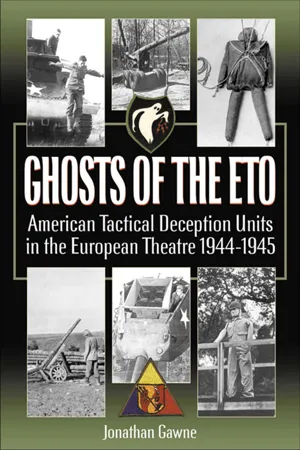
No history of the war in Europe has ever taken into account the actions of the men of the US 23rd Special Troops. These men took part in over twenty-two deception operations against the German army. Some of these operations had tremendous impact upon how the battles in Europe were fought. The men who participated in these actions were sworn to secrecy for fifty years and are only now willing to talk about their role.
The 23rd was composed of four main units. A signal deception unit to broadcast fake radio signals, an engineer camouflage unit to set up rubber dummies of tanks and trucks, a combat engineer unit to construct emplacements and provide local security, and a sonic deception company. The sonic unit was developed to fool German listening posts by playing audio recordings of various sounds, such as tanks moving up or bridges being built.
The 23rd was the only tactical deception unit of the American Army in World War II combining all aspects of deception. This book also covers the birthplace of sonic deception, the Army Experimental Station at Pine Camp, and the 23rd's smaller sister unit, the 3133rd Sonic Deception company that saw action for fourteen days in Italy.
"Highly recommended reading as being a simply fascinating military history of a hidden aspect of World War II that would have a profound and lasting influence on military strategy and tactics." —
Midwest Book Review
eBook - ePub
Ghosts of the ETO
American Tactical Deception Units in the European Theater, 1944–1945
- 352 pages
- English
- ePUB (mobile friendly)
- Available on iOS & Android
eBook - ePub
Ghosts of the ETO
American Tactical Deception Units in the European Theater, 1944–1945
About this book
Information
Chapter 1
Military Deception
Deception is possibly the second oldest maneuver in battle. As soon as man learned how to punch, he next learned how to feint and thus deceive his opponent about his intentions. It is not surprising that governments like to keep their means of deception in modern warfare secret, but it is surprising that some of the most unusual deceptions performed in World War II have not only been ignored, but also seemingly forgotten by the army that originally developed them.
Deception in warfare has been practiced throughout history. The most famous example is the Trojan Horse, but the ancient world is filled with other cases. When Hannibal had to cross some mountains he sent a column of oxen through a different pass than the one he planned to use. He tied torches to their horns so that at night they looked like a moving body of men. His enemy moved to defend that pass while Hannibal slipped through the mountains from another direction. The writings of Julius Caesar are filled with examples of deception. In his book The Gallic Wars, Caesar instructed his men to build encampments smaller than normal to deceive the enemy about their true numbers. On another occasion, he instructed his men to appear to be tired and worn out, thus purposely drawing an enemy attack.
During the American Revolution, the colonists made frequent use of deception to compensate for their weak numbers and lack of weapons. General Washington allowed phony documents to be captured, constructed decoy installations, and planted information with known enemy agents. Large quantities of supplies were purchased in specific locations to make the British think a Colonial army was massing in that area. Carefully coached deserters fed the British false information on American plans. In the campaign outside Philadelphia, Washington made the British think his 3,000-man army was 40,000 strong. At Boston, he forced the British to withdraw under threat of bombardment, from guns that were seriously short of ammunition.1
During the American Civil War, both sides realized they were able to read the other’s semaphore signals. On at least a few occasions false signals were sent, designed to be intercepted and read by the enemy. Before the Seven Days battle in 1862, the South planted false information on a deserter sent over to the North. During the Antietam campaign later that year, General McClellan captured the vital Southern documents known as Special Order 191. These described Confederate plans in great detail, but they were not acted upon because the information was thought to be another ruse. At various times, both sides attempted to deceive the enemy with wooden dummy artillery known as “Quaker cannon.”2
During the First World War, camouflage developed into a high art. Dummy trenches and positions were constructed to fool aerial reconnaissance. Dummy soldiers were created to draw the fire of enemy snipers, thus allowing the snipers to be located. On the oceans, “Q” ships resembling unarmed merchant ships took a toll on German submarines when their hidden guns suddenly opened fire. The letter “Q” thus became a code for a decoy or dummy object. Dummy airstrips would later be known as “Q-strips” and false lighting arrangements as “Q-lights.”
One of the better-known deception operations in WWI took place in the Middle East. An intelligence officer appeared to drop a dispatch case containing phony maps and orders. The Turks, upon intercepting messages indicating that the careless officer was to be court-martialed for losing the plans, decided that the documents were real, and thus were misled about the real direction of a British attack.3
The story of deception in World War II has, until now, been largely that of strategic deception. The most commonly mentioned operation is FORTITUDE, the Allied plan to deceive the Germans about the location and date of the Allied landing in Normandy. Strategic deception involves attempting to fool the enemy on a grand scale. Tricking the Germans into thinking you will invade Norway or Greece when your real target is France is a strategic deception. Tactical deception concerns events that take place in a more localized area—generally within the same country or within the boundaries of one army or army group. Tactical deceptions in WWII generally involved divisional or regimental sized units, but they could also involve units as large as an entire corps, or down to the level of an individual battalion or company.
Tactical and strategic deceptions also differ in the amount of time involved. Typically, a tactical deception operation will last from a few hours to, at the extreme, a few weeks. The key is to fool the local enemy commander into delaying a decision long enough to effect his final plans. A strategic operation can take place over a matter of months or even years, the object being to compel the enemy into a decision that will in turn take a long time to reverse (such as placing troops in Norway rather than France).
At some point the lines between tactical and strategic deception blur, and many operations contain elements of both. Many deception operations have one name for the overall plan, then many different sub-codenames for each segment. FORTITUDE was actually part of Operation BODYGUARD, the overall plan to conceal preparations for the invasion of France from German eyes. FORTITUDE itself had many components: FORTITUDE NORTH threatened a landing in Norway; FORTITUDE SOUTH pointed to a landing in France; COPPERHEAD involved sending a double of General Montgomery to Gibraltar to draw attention away from England; QUICKSILVER I concerned the imaginary units preparing for D-day; QUICKSILVER II covered the radio deception; QUICKSILVER III the decoy landing craft; QUICKSILVER IV and V the deceptive bombing campaigns; and QUICKSILVER VI the decoy port lights along the southern coast. Operations TROLLEYCAR and TWEEZER dealt with the movements of both imaginary and genuine formations in the UK.
No history of deception in WWII would be complete without mentioning the work of British magician Jasper Maskelyne. He claimed credit for advancing deception by bringing the practice of stage magic to the military. The British emphasis on deception, however, started well before him, in the North African desert when General Wavell established the deception unit “AForce.” According to other memoirs of the period, Maskelyne’s contribution to deception was in itself a deception. His principal function in the British Army was developing materials for MI9 to help Allied POWs escape German hands, as well as lecturing on escape and evasion.4 A popular and semi-fictional account of Maskelyne’s wartime effort gives the magician far greater credit for deception than he deserves.5 His main contribution to deception was that many British officers increased their faith in this unorthodox field of operations only because the well-known, semi-miraculous Maskelyne was supposedly involved in it.
The first British deception unit, “A-Force,” was organized in 1940 under the command of Brigadier Dudley Clarke.6 Outnumbered and out-gunned, the British were desperate to find a way to make their small forces appear more numerous and powerful. The desert is a perfect environment for deception. With so few obstructions, decoy vehicles and dummy installations can be seen for a great distance. A-Force created not only decoy tanks, but also constructed covers for genuine tanks that made them appear to be trucks. These covers were known as “sun shields.”
A-Force’s Operation BERTRAM was a surprisingly successful attempt to mask General Montgomery’s planned build-up before the battle of El Alamein in late 1942. It involved many different forms of deception, including not only decoy tanks, but also dummy pipelines and supply dumps. When Montgomery attacked on 23 October, the Germans were taken completely by surprise, having assumed his attack would come from a different location sometime in November.
One of the more unusual tricks performed in the desert was to disable captured German munitions, then place false notes in them claiming it was the work of anti-German resistance workers in the munitions factories. The munitions were carefully returned to German lines, in hopes that German soldiers would suffer a loss of morale after finding that their supplies had been sabotaged at home. Carefully crafted rumors were disseminated about these sabotaged munitions, and even today it is accepted as fact by many that forced laborers in Germany took the risk of not only sabotaging equipment, but of including notes indicating they had done so.7
To coordinate the various deception operations underway around the world, the British formed the London Controlling Section (LCS). The LCS was to make sure that no attempt at deception accidentally conflicted with another deception, or even worse, with a genuine operation. When America entered the war, the British pressed to have the LCS be allowed to govern operations for all the Allies, but the Americans developed their own group to oversee deception. Formed in August 1942, it was initially known as the Joint Security Committee, but the name was later changed to Joint Security Control (JSC).
The duty of the JSC was twofold:
- Preventing information of military value from falling into the hands of the enemy.
- Timing the implementation of those portions of cover and deception plans that had to be performed by military and non-military agencies in the United States.
The JSC was composed of three general officers (one each from the army, air force, and navy), each with a colonel (or navy captain) as his assistant. They were allowed to organize their own staff of enlisted men as they felt necessary. Sadly, many of the records of the JSC dealing with deception do not seem to be included in the National Archives, and rumor indicates they may be in the hands of the CIA.
The British were convinced that they should remain the supreme authority on deception, and made a few attempts to bring the JSC underneath their command. At the end of 1943 the British released a report claiming that American deception was poorly organized, whereas the British had everything running smoothly.8 The ploy did not work, yet while the American and British deception headquarters remained separate entities, they did agree to work closely together.
There were many Allied strategic deceptions during WWII, mostly run by the British, and far more than can be mentioned in this book. A number were used to divert attention from Operation TORCH, the 1942 invasion of North Africa. Operation KENNECOTT pointed to a landing in Greece; Operation SOLO indicated Norway was the target; and Operation OVERTHROW pointed to an invasion of France. The Americans ran Operation SWEATER, which claimed that their troops, actually destined for Africa, were merely being sent to train in Haiti.9 Operation COCKADE included plans to make the Germans think there were 570,000 Americans in England by August 1943, when in fact there were only 330,000. It also indicated a planned landing in 1943 of British troops in Normandy (STARKEY), in Norway (TINDALL), and of American troops in Brittany (WADHAM). To demonstrate that the Americans were interested in the Brittany region, Operation POUND had the 29th Ranger Battalion raid an island near the port of Brest, with specific instructions to leave behind American equipment for the Germans to find.10
Almost every soldier in WWII can recall a time when rumors of his unit shipping out to a cold (or warm) climate were suddenly found to be false. Specialty clothing, supposedly to be used in a cold environment, was rapidly taken back and the unit sailed instead for the tropics. Phrasebooks in Japanese were distributed to troops, who instead set off the following week for Italy. Of course, as veterans will also attest, some of these may have been true military blunders, but the majority were parts of schemes to confuse the enemy as to the final destination of the unit in question.
One of the more famous deception operations of the war has become known as “the man who never was.” As part of Operation MINCEMEAT, a dead body was dressed as a British officer, chained to a briefcase containing (bogus) top-secret documents, and dispatched from a submarine to float onto a Spanish beach. The Spanish allowed German intelligence to copy the documents, which indicated that the next Allied invasion would be aimed at Sardinia, not the genuine target of Sicily. The Germans fell for the deception and failed to reinforce Sicily prior to the 1943 invasion.11
The Italian front had its own share of deception operations, not all successful. The Germans realized Operation VENDETTA was a deception because there were far too many reports pointing to an upcoming amphibious landing, yet there were not enough landing craft in the Mediterranean to support one. Operation CHETTYFORD attempted to distract the Germans from the Anzio landing, but much of it went unnoticed due to a lack of German aerial reconnaissance. However, decoy tanks and dummy radio traffic did manage to pin down two of Kesselring’s best divisions until the Anzi...
Table of contents
- Front Cover
- Title Page
- Copyright Page
- Table of Contents
- Foreword
- Preface
- 1. Military Deception
- 2. Developments in the United States
- 3. On to England
- 4. France and Operation ELEPHANT
- 5. Sonic Deception
- 6. Operation BRITTANY
- 7. Operation BREST
- 8. Operation BETTEMBOURG
- 9. Operation WILTZ
- 10. Artillery, Operation VASELINE, and Propaganda
- 11. Operation DALLAS
- 12. Operation ELSENBORN
- 13. Operation CASANOVA
- 14. Operation KOBLENZ and the Bulge
- 15. Operation KODAK
- 16. Operation METZ-I
- 17. Operation METZ-II
- 18. Operation L’EGLISE
- 19. Operation FLAXWEILER
- 20. Operation STEINSEL
- 21. Operation LANDONVILLERS
- 22. Operation WHIPSAW
- 23. Operation MERZIG
- 24. Operation LOCHNIVAR
- 25. Operation BOUZONVILLE
- 26. Operation VIERSEN
- 27. The 3133rd and the War in Italy
- 28. War’s End and DP Camps
- 29. After the War
- Appendix 1. The Correct Name of the 23rd
- Appendix 2. Officers of the 23rd Special Troops
- Appendix 3. Medals and Decorations Awarded
- Appendix 4. Tables of Organization
- Appendix 5. Patton and Deception
- Appendix 6. Original Poop Sheets
- Glossary
- Select Bibliography
- End Notes
Trusted by 375,005 students
Access to over 1.5 million titles for a fair monthly price.
Study more efficiently using our study tools.
Frequently asked questions
Yes, you can cancel anytime from the Subscription tab in your account settings on the Perlego website. Your subscription will stay active until the end of your current billing period. Learn how to cancel your subscription
No, books cannot be downloaded as external files, such as PDFs, for use outside of Perlego. However, you can download books within the Perlego app for offline reading on mobile or tablet. Learn how to download books offline
Perlego offers two plans: Essential and Complete
- Essential is ideal for learners and professionals who enjoy exploring a wide range of subjects. Access the Essential Library with 800,000+ trusted titles and best-sellers across business, personal growth, and the humanities. Includes unlimited reading time and Standard Read Aloud voice.
- Complete: Perfect for advanced learners and researchers needing full, unrestricted access. Unlock 1.5M+ books across hundreds of subjects, including academic and specialized titles. The Complete Plan also includes advanced features like Premium Read Aloud and Research Assistant.
We are an online textbook subscription service, where you can get access to an entire online library for less than the price of a single book per month. With over 1.5 million books across 990+ topics, we’ve got you covered! Learn about our mission
Look out for the read-aloud symbol on your next book to see if you can listen to it. The read-aloud tool reads text aloud for you, highlighting the text as it is being read. You can pause it, speed it up and slow it down. Learn more about Read Aloud
Yes! You can use the Perlego app on both iOS and Android devices to read anytime, anywhere — even offline. Perfect for commutes or when you’re on the go.
Please note we cannot support devices running on iOS 13 and Android 7 or earlier. Learn more about using the app
Please note we cannot support devices running on iOS 13 and Android 7 or earlier. Learn more about using the app
Yes, you can access Ghosts of the ETO by Jonathan Gawne in PDF and/or ePUB format, as well as other popular books in History & Military & Maritime History. We have over 1.5 million books available in our catalogue for you to explore.