A member of the 101st Airborne's Glider Infantry recalls WWII, from the horror of D-Day to the despair of Nazi captivity, in this compelling memoir.
As World War II broke out, Robert Bowen was drafted into Company C, 401st Glider Infantry, 101st Airborne Division. Soon afterwards, he found himself storming Utah Beach amid the chaos of D-Day, through unfamiliar terrain littered with minefields and hidden snipers. Bowen was wounded during the Normandy campaign but went on to fight in Holland and the Ardennes, where he was captured. That's when his "trip through hell" truly began.
In each of Bowen's campaigns, the 101st "Screaming Eagles" spearheaded the Allied effort against the Nazi occupation of Europe. At Bastogne, they stood nearly alone against the onslaught of enemy panzers and grenadiers. His insights into life behind enemy lines after his capture provide as much fascination as his exploits on the battlefield. Written shortly after the war, Bowen's narrative is immediate and compelling. An introduction by the world's foremost historian of the 101st Airborne, George Koskimaki, further enhances this classic work.
eBook - ePub
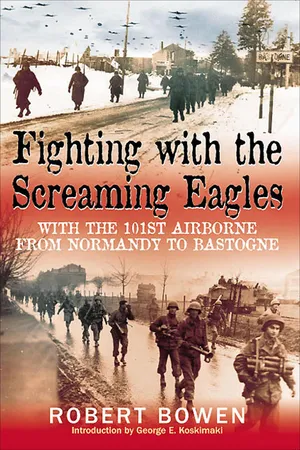
Fighting with the Screaming Eagles
With the 101st Airborne from Normandy to Bastogne
- 257 pages
- English
- ePUB (mobile friendly)
- Available on iOS & Android
eBook - ePub
About this book
Trusted by 375,005 students
Access to over 1.5 million titles for a fair monthly price.
Study more efficiently using our study tools.
Information
CHAPTER 1
You’re in the Army Now
My road to Fort George G. Meade, Maryland, my first Army post, was a path of illusions, my head filled with all sorts of propaganda and stories that I had been told by veterans of the Great War and read in books and magazines. Most of the men in my family had served in the Navy, so going into the military seemed the natural thing to do. That is why I had gone to Citizens’ Military Training Camps each summer when I was in high school, why I joined the State Guard when the National Guard was called up in 1940, and why I applied for Officer Candidate School (OCS) shortly after Pearl Harbor. It had been a big disappointment when my application for OCS was rejected in 1942. I found that the fact that I had never graduated from high school disqualified me.
Despite my experience with Citizens’ Military Training and the Guard, entering the Army, which I did on February 13th, 194.3, was like going to a different planet. Everything about it seemed beyond my comprehension—the Army way of doing things seemed so strange. To begin with, I often asked myself how we ever won the last war. How could anything have been accomplished in such mass confusion with so many contradictory orders? Shots, tests, examination by disinterested doctors who did not even comment upon the two missing fingers on my left hand, marching from building to building in ragged columns for more tests, and my first taste of Army food were just a few of the things that made me want to pack my bags and head for home.
Emerging from the bureaucratic maze of processing without going crazy, I joined an equally bewildered group of fellow recruits about to be shipped to a training center where we would be turned into soldiers. Once a sufficient number of recruits had been gathered we were sent off on a train headed for somewhere in the South. We were packed on board the train like sardines, our misery compounded by the smell emanating from the freshly issued clothing. Our heads were filled with vicious rumors and, despite all the lectures, we did not have the slightest idea what was in store for us. Most had never even been away from home for an extended period of time.
The train moved at a snail’s pace, shaking and rattling with each uneven joint in the tracks. The clatter of its passage and the odor of the coal smoke made sleep impossible. To top it off, there didn’t seem to be a siding during the entire trip that we didn’t pull into, spending long hours with the engine spouting steam and blowing ear-splitting blasts of its whistle. Nerves quickly became raw, tempers flared, fights broke out and the train soon resembled an institution for the mentally deranged. If the trip hadn’t ended when it did three days later I believe an insurrection would have followed.
The men waiting for us at our destination, Camp Blanding, Florida, were evidently used to such a state of affairs. They patiently got us off the train and formed into a ragged column and then marched us away in the darkness to the main camp. Our destination was a tent city where small groups of the column were gradually peeled off until all of the recruits had been assigned to a tent. The 20-odd men in my group were led down a company street and dispersed in large canvas tents, which were already partially occupied by sleeping men. Our arrival in the middle of the night ensured that our reception was not exactly warm. The men in my tent had just completed a 24-hour guard shift and were none too happy about being disturbed. Their curiosity, however, soon got the best of them and they rolled out of their bunks to see who they would have to put up with in the future.
It was there that I learned that we were now members of Company I, 104th Infantry Regiment, 26th Infantry Division. The 26th was a National Guard outfit originally from Massachusetts. My new regiment had been called up in 1940, participated in the Carolina maneuvers, and was then put to work guarding the East Coast against a feared Axis landing. Thousands of troops had been sent to surround vital defense installations, government buildings, vital bridges and communications centers along both coasts. Despite the fears of many, during its time along the coast the division had seen nothing more dangerous than hermit crabs and migrating sea turtles and it was now ready to absorb a bevy of recruits even though its own efficiency left much to be desired.
The next morning we were assigned to training platoons, being excused from all guard and fatigue details until our training had been completed. This arrangement proved to be a blessing for us. Unfortunately it also pissed off the veterans because it meant that the burden of these unpleasant duties would fall on them. I couldn’t blame them, but the training was being accelerated and there was little that we could do but comply.
Our world now consisted of close order drill, manual of arms, weapons familiarization, gas mask drills, compass and map reading. Gradually, through repetition and practice, the majority of us began to get a feel for our new surroundings. Although a few men in my company became sick or died because of inadequate physicals given at reception centers, before too long most of us could complete a 25-mile hike carrying a full field pack under a broiling hot sun. We could run and flop on the ground time after time without dislodging too many teeth from contact with rifle stocks and we had dug enough slit trenches and foxholes to excavate a pit the size of the Little Grand Canyon in Vermont. We spent many nights in foxholes in cold soggy uniforms and we had eaten enough tasteless corned beef hash and baked beans to ruin our stomachs forever. Perhaps most important of all we had learned how to overcome contradictory orders from officers who seemed to be as untried as we were. Finally, after three months, we no longer resembled extras in a Laurel and Hardy routine and were returned to our companies.
With the recruits back with their companies and the regiment at full strength, our illustrious leaders decided that it was time to whip the unit into fighting shape. The best way to do this, they believed, was to embark on a series of exercises known as “problems.” The problems involved us charging through brush, swamps and pine forests until we were dead on our feet. We fought make-believe enemies in good weather and bad, the violent thunderstorms we encountered being nearly as bad as artillery barrages. After the problems ended, we would rush back to our barracks to shower, dress, and clean weapons in order to fall in for inspection.
Our stay in Camp Blanding ended in late March 194.3. It was time for the different regiments of the division to assemble in one place. We packed, boarded trains and headed for Camp Gordon, Georgia. The engineer seemed to drive the train as if he had a premonition that a bridge over a river was out and he needed to feel every inch of the way. The heat in the cars was terrific, with cinders and other debris flying into the open windows. We finally got to our destination, and unloaded the train with all of the precision of a street riot. It was hot as hell and we were carrying enough baggage to last forever. Eventually we were allowed to stagger to our assigned area, a compound of equally spaced old wooden barracks.
To our great disappointment we soon discovered that the food was even more deplorable than in Camp Blanding. Even the chowhounds in the company hesitated before entering the mess hall. Our battalion commanding officer had a thing about waste, even going so far as stationing a non-commissioned officer (NCO) by the garbage pail to see that nothing was wasted. Those who couldn’t stomach the GI cuisine couldn’t forsake it and expect to fill up at the post exchange (PX). Most of the shelves were emptied of cookies, cakes and candy bars soon after our arrival. Even the beer was in short supply. To add to our misery the other amenities at the camp were not much better. The post theaters were like ovens, and passes to Augusta and neighboring cities were issued with the same reckless abandon as raises in pay.
June brought even greater discomfort with steam-bath heat day and night and an acceleration in training. We were in the field for days on end, running seemingly mindless problems that did little other than piss us off more we already were. We got a new platoon leader, a gem with a Napoleon complex who put some unfortunates on extra duty for having the gall to roll up their sleeves in the 100-degree heat during a 25-mile hike. He was a young blond giant who looked as if he had been a linebacker on a pro football team. Fresh out of OCS, he wore his gold bar as if it were five stars and made damn sure we honored it. He drove us mercilessly, bent on proving that he could put our squad on par with the Rangers. His dedication was all right with us until he began issuing silly orders. Late one afternoon we were returning from a hard day in the field, hot, tired, clothing soaked to the skin by sweat and carrying full packs. To increase the misery, as we headed for home, we ran into a thunderstorm, which quickly drenched us. We got halfway up a long hill when our junior Napoleon gave the order to don gas masks and double time. It didn’t take long before half the platoon had collapsed beside the road and the other half wasn’t far from it. Fortunately, our company commander, Captain O’Neill happened to come by in a jeep, saw what was happening and quickly put a stop to it.
The platoon officer, however, was not my only headache. Another was an NCO named Anderson in the 3d Platoon. He was as mean as a pit bull to most of the recruits who might challenge his authority, and I was no exception. I got on his “list” early during an overnight problem. Two pits had been dug to take care of waste after eating, one for garbage, the other for cans from C rations. After disposing of my trash properly I was walking away when Anderson spotted a can in the garbage pit. He called me over, convinced that I had thrown the can in the pit, and ordered me to climb down into the mess to pick it up. Having no alternative I did what he ordered, but he could see that I didn’t like it and after that he went out of his way to see that I toed the line. For the rest of my time in the company I hoped in vain that he would step into a slit trench and break his neck.
Later, however, I had some amusement at my tormentor’s expense. On another night problem I was on guard duty when I heard a yell and had the pleasure of watching Anderson’s pup tent rise in the air as if it had exploded. Then it staggered along the company street, poles, pegs, ropes and all. Finally it tripped over a rope and everything collapsed in a heap. Meanwhile, Anderson’s tent mate sat up with a startled look on his face, not knowing what was going on until his hand went down on the ground and came to rest on a long fat rattlesnake that had crawled into the tent for warmth. For weeks afterwards the rest of the NCOs in the company teased Anderson about his zoo.
Although the months of training had hardened our bodies, they had done little to improve our morale. Our leaders had done little to encourage us. In addition, most of us were dreadfully homesick, especially those of us who were married. If it hadn’t been for letters, parcels and the occasional phone call to our families, more men would have gone absent without leave (AWOL) than did. After four months in the Army most of us recruits were in the depths of despair, hating every day of our existence and desperately seeking a way out.
The realization of what lay ahead for us as infantrymen added to our fears. From what we were told, ten percent of us would be killed during our first campaign; another 40 percent would become casualties of another sort. Few, if any of us, could expect to remain with our companies until the end of the war. The figures were enough to scare even the most lion-hearted among us. Our daily existence did not help matters. Living like animals in holes in the ground, eating C and K rations for long periods of time and being treated not much better than galley slaves turned most of us off the infantry life all together. We prayed for any way out of our dilemma.
My salvation, I thought, came about the middle of June while we were on another long problem. One morning after breakfast, Howard Hill, Walter Halsey and myself were called to the company command post. Upon arrival we found Captain O’Neill in a magnanimous mood and he greeted us warmly. I sensed something was up when he took us aside and began talking to us like a concerned father. He praised our performance while in the company and said he had been instructed to submit names of men whom he thought were more advanced than others in their training. We had been selected from the list submitted and, therefore, were being transferred to another unit which needed qualified infantrymen. When he said our new home was going to be the 101st Airborne Division, however, I nearly fainted. Paratroopers! Glider troops! This was not exactly the escape I had hoped for.
We returned to our tents, trying to make light of our transfer but secretly very apprehensive about it. We said our goodbyes to everyone and left for our barracks in a waiting jeep. We spent several days preparing for our move while others from the 26th who were being transferred to the 101st were assembled. Then it was off to Fort Bragg, North Carolina, the home of the 101st.
CHAPTER 2
Marking Time
Our group reached Fort Bragg on June 23d, 1943, joining a mob of men from other outfits sent to the 101st as replacements. It was a typical June day in North Carolina with temperatures near the boiling point and the only breeze created by a flock of crows that watched us from nearby loblolly pines. Bragg was a Regular Army base with all of the support elements of such a place, a sprawling octopus covering thousands of acres.
Orientation to the division took place the following day in the post theater. Sharply dressed airborne personnel who looked at us all with jaundiced eyes conducted our introduction to the airborne, though most of the men of the division were away on maneuvers in Tennessee when we arrived. We were given a review of the airborne and our new division in particular. The 82d and 101st Airborne Divisions, we were told, had sprung from the old 82d Infantry Division in August 1942. The 101st consisted of two glider infantry regiments, the 327th and 401st, and a parachute regiment, the 502d, plus artillery, engineer and other units. Later that month a second parachute regiment, the 506th, was attached to the division. We came away from our briefing knowing that we were replacements for one of the two glider regiments, although some of our number would be assigned to parachute regiments in non-jumping roles.
It was made clear to me on that first day in the 101st that there were major differences between parachute and glider troops, the first volunteers and the latter assigned. Paratroops drew hazard pay, wore distinctive uniforms and had undergone rigorous jump training. Glidermen, on the other hand, drew no extra pay, wore ordinary uniforms and were given normal training. Glidermen, generally, were draftees who thought they had drawn a miserable line of duty, one where they were expected to risk their necks in the “flying coffins” because they were ordered to.
The divisional commander, Major-General William C. Lee, was known as the “father of the airborne” for his work in the pioneering days of this new branch of the Army. Lee’s aim was to create a division, which, though lightly armed, could land behind enemy lines and seize and hold objectives until relieved by regular infantry. His assistants were Brigadier-General Donald F. Pratt and Brigadier-General Anthony C. McAuliffe; the former was instrumental in developing the airborne concept, the latter in developing much of the early clothing and equipment used by the airborne troops.
After orientation we were sent to 100-man “casual” companies. The commander of the company I was assigned to was a paratroop captain and he seemed to detest the very ground we replacements walked on. Every morning he would rail about how the Army had taken a turn for the worse with our inclusion. Following a few days of this abuse it dawned on me that the reason for his bellicosity was that none of us were jumpers. In all the time we were with the casual company he never uttered a single word of praise for our efforts and it was then that I received my first lesson on the difference between the paratroopers and glidermen.
Our NCOs were a mixed bag of paratroopers and glidermen. Most had been on the Tennessee maneuvers, gotten sick or gone on furloughs and, like us, were waiting for the division to return. They were firm with us but amiable and none of them exhibited the animosity of our CO.
The following few weeks were great, a complete reversal of my time in the 26th Division, with a light training schedule and plenty of spare time. There were a lot of lectures, mostly about military topics, and, of course, some on venereal disease. The VD films were graphic, making one want to be celibate for the rest of one’s life. Afterward, a couple of chaplains talked to us about the moral and religious aspects of the war.
I liked everything about Bragg but the sand and the heat. The food was decent and plentiful, the PXs were well stocked and there were passes to Fayetteville, not too far distant. This delightful sojourn came to a screeching halt when the daily inspections began.
The Army has a manual for everything but the proper procedure for using the latrine and many of us believed that even that was being contemplated. A Saturday inspection of the barracks was routine. However, to have an inspection daily was not, and that is what now began. Each man in the casual company was required to have a certain amount of clothing and it all had to be accounted for. Shortages were noted and, if an item was missing, a statement of charges was filled with the cost of the item coming from the unfortunate soldier’s monthly pay.
Each morning after breakfast and police call we were greeted by our sergeant bellowing, “All I want to see are asses and elbows.” Hearing that invitation prompted us to throw everything we owned into barracks bags, which were then lugged to a sandy drill field. Ranks were opened and our gear spread in a prescribed manner. After waiting a couple of hours under the broiling sun, an officer would come around, noting shortages, then everything would be repacked and taken back to the barracks. Some time later the supply room replaced the missing articles. The routine was maddening.
About the same time as we were enduring these inspections, someone noted that many of us had not qualified in all phases of training. Captain Stoner, the casual company CO, somehow learned that I was an artist so he had me design a large chart with names and the prescribed courses. As the courses were completed, names were checked OK It meant repeating courses that most of us already had, but anything to keep us busy. For me, the firing range was the most enjoyable as I got to fire the MI Rifle, MI Carbine and Browning Automatic Rifle (BAR). Those of us who made Expert Rifleman got to instruct others. I loved it, especially when I got to train a batch of newly commissioned second lieutenants.
Halsey, Hill and I spent most of our off hours together. Howard Hill was from the Eastern Shore of Maryland. He had been married about the same time as me. Walter Halsey was younger, a year longer in the Army, and with a wild streak. We became good friends during that period but were separated when the division got back. Hill and Halsey eventually went to the 327th and I went to the 401st. We didn’t see much of each other after that.
Hill was killed in action on June 7th, 1944, leaving a wife and a son who was born while he was overseas. I met Halsey while we were...
Table of contents
- Coverpage
- FM
- DedicationPage
- Title
- Copyrightpage
- Contents
- List of Illustrations
- List of Maps
- Foreword
- Introduction
- CHAPTER 1 You’re in the Army Now
- CHAPTER 2 Marking Time
- CHAPTER 3 The Reluctant Transport
- CHAPTER 4 Atlantic Convoy
- CHAPTER 5 No Milk or Honey
- CHAPTER 6 The Calm Before the Storm
- CHAPTER 7 D-Day: Operation Overlord
- CHAPTER 8 Evacuated as a Casualty
- CHAPTER 9 Windmills and Wooden Shoes
- CHAPTER 10 The Fight for Veghel
- CHAPTER 11 The Island
- CHAPTER 12 Debilitation
- CHAPTER 13 Bitter December
- CHAPTER 14 Into the Frying Pan
- CHAPTER 15 Siegburg to Hoffenstahl
- CHAPTER 16 The Bottom of the Pit
- CHAPTER 17 Hell Train
- CHAPTER 18 Bremervorde: Stalag IOB
- AFTERWORD And Yet So Far
- Bibliography
- Roll of Honor
Frequently asked questions
Yes, you can cancel anytime from the Subscription tab in your account settings on the Perlego website. Your subscription will stay active until the end of your current billing period. Learn how to cancel your subscription
No, books cannot be downloaded as external files, such as PDFs, for use outside of Perlego. However, you can download books within the Perlego app for offline reading on mobile or tablet. Learn how to download books offline
Perlego offers two plans: Essential and Complete
- Essential is ideal for learners and professionals who enjoy exploring a wide range of subjects. Access the Essential Library with 800,000+ trusted titles and best-sellers across business, personal growth, and the humanities. Includes unlimited reading time and Standard Read Aloud voice.
- Complete: Perfect for advanced learners and researchers needing full, unrestricted access. Unlock 1.5M+ books across hundreds of subjects, including academic and specialized titles. The Complete Plan also includes advanced features like Premium Read Aloud and Research Assistant.
We are an online textbook subscription service, where you can get access to an entire online library for less than the price of a single book per month. With over 1.5 million books across 990+ topics, we’ve got you covered! Learn about our mission
Look out for the read-aloud symbol on your next book to see if you can listen to it. The read-aloud tool reads text aloud for you, highlighting the text as it is being read. You can pause it, speed it up and slow it down. Learn more about Read Aloud
Yes! You can use the Perlego app on both iOS and Android devices to read anytime, anywhere — even offline. Perfect for commutes or when you’re on the go.
Please note we cannot support devices running on iOS 13 and Android 7 or earlier. Learn more about using the app
Please note we cannot support devices running on iOS 13 and Android 7 or earlier. Learn more about using the app
Yes, you can access Fighting with the Screaming Eagles by Robert Bowen in PDF and/or ePUB format, as well as other popular books in History & Military Biographies. We have over 1.5 million books available in our catalogue for you to explore.