Profiles of unsung American battlefield commanders—from the Revolutionary War through the Civil War. "A pleasure to read" (Raymond E. Franck, Brig. Gen., USAF, retired).
History plays tricks sometimes. During the course of America's experience, it has enshrined an exceptional few military leaders in our collective consciousness as "great," while ignoring others often equally as deserving. For example, few of the thousands who pass by the traffic square between Fifth Avenue and Broadway in Manhattan realize that it houses the tomb of one of America's best military commanders—William Worth—a hero in not one but two of the nation's wars. Similarly, the Civil War general who never lost a battle and who many military historians believe fought one of the two most perfect battles in history was not Grant, Sherman, Lee, or Jackson; it was Thomas—who never extolled his own cause, but in all likelihood saved his nation's. At the same time, conflicts themselves have often disappeared from consciousness, the public forgetting the fights the country waged against the Barbary Pirates, the British in 1812, and against the Seminoles and Apaches.
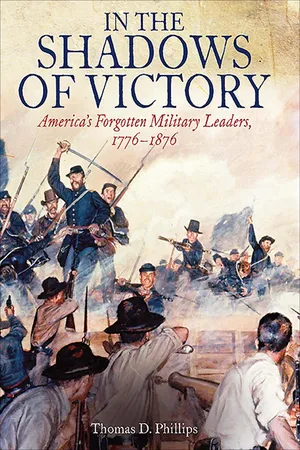
In the Shadows of Victory describes the heroics and command acumen of twenty-five superb military leaders whose sacrifice and skill have often been neglected—from the War of Independence through the Mexican War and Civil War, and during numerous Native American conflicts. As such, it provides a fascinating tour through early American military history and the various martial challenges the young nation faced during its first century of existence.
"Well written . . . reading about these officers' achievements is an enjoyable experience." —
The Journal of America's Military Past
eBook - ePub
In the Shadows of Victory
America's Forgotten Military Leaders, 1776–1876
- 288 pages
- English
- ePUB (mobile friendly)
- Available on iOS & Android
eBook - ePub
About this book
Trusted by 375,005 students
Access to over 1.5 million titles for a fair monthly price.
Study more efficiently using our study tools.
Information
CHAPTER 1
THE WAR OF INDEPENDENCE

Afflicted with a limp so pronounced that some initially thought it should disqualify him from military service, Greene’s extraordinary generalship in the Carolinas saved the South for the American cause.
America rightly identifies George Washington as the towering figure of the nation’s War of Independence. Yet, without the services of one of history’s most implausible military leaders the war might well have taken a different turn. Dimmed by the enormous shadow cast by Washington, the war-saving accomplishments of Nathanael Greene remain relatively unrecognized.
Greene was born July 27, 1742 at Forge Farm in Potowomut, Rhode Island, an isolated community on a peninsula fronting Greenwich Bay. One of the area’s oldest families, the Greenes were modestly prosperous, operating saw and grist mills and a forge where Nathanael worked as a youth. In 1770, at age 27, he moved to Coventry, a village about six miles inland, to run a foundry his father had purchased. Though operating the forge aggravated his asthma, a life-long affliction, Greene quickly established himself in the community, building a home—a 2½-story dwelling called Spell House—and leading efforts to found the hamlet’s first public school.
Little in his past marked Nathanael Greene for military leadership so exceptional that in the closing months of the war it surely bordered on genius. Greene often suffered from asthma and his appearance was characterized by a limp sufficiently pronounced that some of his colleagues at first thought it should disqualify him from military duty. Raised a Quaker, Greene was expelled from the faith before the war began, likely because of his interest and participation in military duties. His Quaker upbringing provided Greene with little opportunity for formal schooling. He was, however, intensely self-educated particularly in mathematics, law, and military history. A voracious reader, he purchased numerous texts dealing with strategy and tactics, and in essence taught himself the art of war. Even more remarkable perhaps is that in his most important role as Commander of the Southern Army, Greene never won an outright victory on any major battlefield.
Greene met Washington for the first time during the siege of Boston, where Greene had taken the Kentish Guards, a 1,600-man unit formed of men from his home region. The young Rhode Islander’s exceptional competence was obvious to all and he quickly earned Washington’s confidence, becoming one of his closest advisors. It was a trust he would retain throughout eight years of war.
Like Washington, Greene was one of the few American commanders who grasped immediately that the essential condition for American victory was to preserve an army in the field. Thus, in the South, Greene was content to draw the British away from their bases, engage them in chases, exhaust their supplies and fight at times and places of his choosing. After inflicting casualties that at times destroyed as much as a third of the British force, Greene typically chose to withdraw, leaving the ground to his opponent rather than risk losing his small army to acquire momentary possession of otherwise inconsequential real estate. So well-conceived was his strategy that by bleeding his opponents of troops, supplies, and endurance he caused British forces to withdraw from the Carolinas and Georgia, thwarting their attempt to sever the South from the rest of the American colonies. Eventually, the British commander, Lord Charles Cornwallis, moved north out of the Carolinas into Virginia—a trek that took him to Yorktown and to the final defeat that brought the war to a close.
American prospects in the South, dire from the beginning, had deteriorated steadily during the course of the war. The first American commander, Robert Howe, had lost Savannah. The second, Benjamin Lincoln, had lost Charleston and surrendered an entire American army in the process. The third, Horatio Gates, had been routed at Camden, South Carolina, nearly losing an army in a battle so horribly mismanaged that his leadership was most notable for his having been among the first to flee the field. Now, late in the fourth year of the war, the British were perilously close to effective control of Georgia and the Carolinas, and to separating the South from the middle and northern colonies.
Greene was appointed commander of the infant nation’s southern forces in October 1780. It would tum out to be a fortuitous choice for Washington, who made the appointment, and for the revolutionary cause.
Greene was 38 years old when Washington’s letter of appointment reached him. At five feet ten inches, he was taller than most of his contemporaries. Greene was solidly built with clearly defined features characterized most prominently by clear blue eyes and a high forehead.
After bidding goodbye to his wife Catharine (“Caty”) in Philadelphia—it would be two years before they saw each other again—Greene traveled south, visiting governors of the states along the way, pleading for supplies and leaving liaison officers in place. These efforts were, at best, only minimally successful. States were reluctant to furnish scarce supplies to a national army.
Greene sent a senior officer ahead to map the terrain and identify favorable lines of march, retreat, and communication. Anticipating that the many rivers of the South would influence the type of campaign he intended to wage, Greene dispatched Thaddeus Kosciouszko to locate fords, build boats, and pre-position them at crossing points. In combination, these initiatives illustrated the qualities that would become the hallmarks of Greene’s leadership: foresight, preparation, and planning. To those characteristics would soon be added innovation, a sense of anticipation on the battlefield, and skill at organizing and leading an army. All would prove essential.
When Greene arrived at Charlotte, North Carolina, to take command he found the wreckage left by Gates: a small, demoralized army, ill-disciplined and chronically short of supplies. Greene’s initial force, numbering between 1,000 and 2,100 troops, was, like much of the American Army, underfunded and under-provisioned, lacking weapons, clothes, shoes, blankets, medical supplies, lumber, nails, and wagons. Morale was low to non-existent following a string of devastating losses.
As one of his first steps, Greene met with leaders of the South’s guerrilla bands—the “Swamp Fox” Francis Marion, Thomas Sumter, Elijah Clarke, Andrew Pickens—eliciting their support. Marion, in particular, would come to render special services. In the months ahead the partisan forces along with Greene’s superb cavalry commanders, Henry ‘Light Horse Harry’ Lee and William Washington, would launch raids on British and Loyalist outposts, supplies, and lines of communication, harassing and inflicting losses in men and material before vanishing into the interior of a country with whose vastness their opponents could never quite contend.
Greene’s first move was unorthodox, but masterful in its conception and brilliant in its consequence. Although outnumbered two to one by British and Loyalist forces under Charles Cornwallis, Greene split his small army. Greene’s maneuver caused Cornwallis, nearby at Winnsborough, South Carolina, with 4,000 men, to divide his own force in order to pursue the separated American columns. Greene believed his move might allow him to recombine his army at a favorable moment and attack the British wings one at a time. What actually took place was even more fortuitous. On July 17, 1781, the segment of Greene’s army under General Daniel Morgan destroyed the force sent against it by Cornwallis. At Cowpens, South Carolina, in a brilliantly conducted battle, Morgan killed, wounded, and captured more than 900 of an 1,100-man force led by Banastre Tarleton, one of the British army’s most capable and ruthless commanders.
Following the victory at Cowpens, Morgan’s and Greene’s forces recombined as Greene began a strategic retreat closely pressed by British units under Cornwallis’ direct command. Greene’s intention in retreating was to buy time to gather additional forces—at the time his army consisted of only 1,400 regulars and 600 local militia—while stretching the British forces and exhausting their supplies.
Greene formed an elite light cavalry unit to hold off the advancing British in a series of sharply fought rear-guard actions and then used pre-positioned boats to cross rivers just ahead of his pursuers. Greene’s retreat—“the race to the Dan”—across the breadth of North Carolina is considered a masterpiece in the annals of warfare.
Finally, in mid-February, with the British army only a few miles behind, using boats hidden along the river’s banks and gathered from areas nearby, Greene crossed the Dan River into Virginia. The British arrived on the opposite bank not long after. The river was too high to cross without boats, and all the boats were on Greene’s side of the river. Cornwallis gave up the chase. Greene and his army had escaped.
After a few days to replenish his supplies and secure promises of additional help, Greene re-crossed the river and went after Cornwallis. On March 15, 1781, on a field he had personally chosen, Greene brought his army to battle near Guilford Court House, a remote county seat in north central North Carolina.
The morning of the 15th dawned bright but cold in the late days of winter. Recent rains and snow had left the ground spongy and the nearby woods heavy with moisture. Early morning frost had burned off by the time the first shots were fired at about noon. The terrain selected by Greene was slightly rising ground near an abandoned court house. Now within the city confines of Greensboro, in March 1781 the landscape was mostly fields and some cleared areas flanked by occasional woods.
Cornwallis, approaching from the south, traveled along a north-south track, the Great Salisbury Wagon Road, that split the grounds of a large plantation before bisecting a fenced, wooded area a bit farther north. Past the fenced area the road emerged from the timber into an extensive open space of mostly cleared ground that ran toward the court house in a gentle upward slope. At the point, heavy forest bordered the road on the east.
Cornwallis formed his line of battle and at midday began moving across a plowed field toward the first American line about a quarter of a mile away. Greene had placed the first of his three defensive lines on the open ground just north of the fenced, wooded area. The second line, with two six-pound cannons in the center, was 200–300 years farther north. The third and final line was 400 yards back, closest to the court house. The first line was composed mostly of North Carolina militia, the second of Virginia militia, and the third by Continental regulars from Virginia, Delaware, and Maryland.
At this point in the war it had been the general experience of American commanders that the lesser trained and disciplined militia forces seldom held when faced with close attack by British regulars. In employing the militia forces at Guilford Court House, Greene adopted the stratagem used with great success by Daniel Morgan at Cowpens: he asked his militia lines to get off two aimed shots before retreating. They did so, many of them using fence posts to steady their aim before retreating in some disorder after the center of the line collapsed. Still, the 1,500 or so American muskets along the first line wreaked havoc on the British attackers. An officer with the 71st Highland Regiment thought that half of his unit had been knocked down by the initial wall of fire.
Greene’s intention was to use his militia units to drain off the British advance before it reached his main line of resistance. The British attacked along the west side of the road, eventually forcing back Greene’s first two lines while sustaining heavy losses—although Greene lost some effectiveness by placing his lines too far apart to fully support one another. Fighting was especially sharp at the second line before the British pushed around a flank and continued their attack in the direction of the court house.
When the battle reached Greene’s third line, the struggle between the American and British regulars soon escalated into some of the most intense combat of the entire war. A painting depicting the fury of the battle at its height shows Greene mounted on a charger immediately behind the American line, directing blue-clad Continentals and militia in homespun garments against the oncoming Redcoats. In the background, William Washington’s Light Dragoons outfitted in green uniforms race to the attack. As the armies surged back and forth, at one point two of Greene’s cannons were lost and then recaptured in a violent counterattack.
As the savage fight continued, a British advance was repulsed by the 1st Maryland Regiment and Washington’s horsemen. Portions of the British force were trapped and placed under simultaneous attack from two directions. With his army in retreat and its lines threatening to break, Cornwallis ordered British artillery to fire into the midst of the melee where forces from both sides were intermixed and struggling. The ‘friendly fire’ losses from his own shells killed several British soldiers but caused the Americans to break off their attack.
At this point, having destroyed more than a quarter of Cornwallis’ army and not wishing to place his own force at further risk, Greene withdrew from the field. From a force that began the battle with about 1,900 men, British losses numbered 93 killed, 413 wounded and another 26 missing or captured. Greene lost 79 killed, 185 wounded, and 75 others wounded and captured. Additional numbers ‘missing’ are uncertain because of the propensity of some militia units to drift off after an encounter.
A torrential downpour began soon after the last shots were fired, further compounding the agony of an already horrific scene. Dead and dying soldiers from both sides lay scattered over the extensive battle area. Nearby families, many of them Quakers, helped doctors care for the wounded using farmhouses for many miles around as temporary hospitals.
After the battle, Greene withdrew his force into the more remote areas of North Carolina. Cornwallis chose not to pursue. Instead, still recovering from his severe losses and leading a force now depleted in men and materiel, he abandoned the interior of the state. Eventually, he arrived at Wilmington, a port city 100 miles distant where he could rest, recruit, and replenish his army. His decision later in the year to leave Wilmington and move north into Virginia would have major consequences for the outcome of the war.
Guilford Court House was a decisive battle. While Greene kept an army in the field and the revolutionary cause alive in the South, Cornwallis took his forces out of the area and put them on the path that led to Yorktown. The battle is remembered in other ways as well. Cornwallis described it thus: “I never saw such fighting since God made me. The Americans fought like demons.” Greene’s later words were more prosaic but also more telling: “We fight, get beat, rise, and fight again.”
It was a pattern that would repeat itself.
In the days ahead, Greene and his army would fight, get beat, and rise again across North and South Carolina. After Guilford Court House they would wage three more substantial battles. In the conventional sense, they lost them all; but by those ‘losses’ the Americans wrested control of the South.
When Cornwallis moved north from Wilmington, Greene turned south. It was in some ways a surprising decision, but one that was of considerable strategic importance. Rather than trailing Cornwallis, Greene began a series of operations that would clear the interiors of Georgia and the Carolinas.
In April 1781 Greene’s army fought at Hobkirk’s Hill near Camden, South Carolina. They were beaten in a fight that cost the British a greater number of wounded and double the number killed. American losses were 19 killed, 115 wounded, 48 more wounded-captured, and an additional uncertain number captured or missing. British losses were 38 killed, 220 wounded and an additional, fairly small, number missing. Soon after the battle, Lord Francis Rawdon, the British commander, retired to Camden. There, flanked by Greene’s forces on one side and militia units under Thomas Sumter on the other, and subjected to devastating raids on his supplies and lines of communication with the coast led by Francis Marion and “Light Horse Harry” Lee, Rawdon abandoned Camden and began a retreat that eventually took him to Charleston.
Greene used Continental regulars, local militias, and guerrilla forces in a concerted fashion in the campaign that led to Hobkirk’s Hill. The British had possessed the town of Camden for a year and during their long occupation had constructed a chain of formidable breastworks around the city. When Greene approached Camden he saw that his fo...
Table of contents
- Front Cover
- Title Page
- Copyright Page
- Contents
- Preface
- Explanatory Notes
- Maps
- 1 The War of Independence
- 2 The Barbary Wars
- 3 The War of 1812
- 4 The Seminole Wars
- 5 The Mexican War
- 6 The Civil War
- 7 The Indian Wars of the West
- Closing thoughts
- References
- Selected Bibliography
Frequently asked questions
Yes, you can cancel anytime from the Subscription tab in your account settings on the Perlego website. Your subscription will stay active until the end of your current billing period. Learn how to cancel your subscription
No, books cannot be downloaded as external files, such as PDFs, for use outside of Perlego. However, you can download books within the Perlego app for offline reading on mobile or tablet. Learn how to download books offline
Perlego offers two plans: Essential and Complete
- Essential is ideal for learners and professionals who enjoy exploring a wide range of subjects. Access the Essential Library with 800,000+ trusted titles and best-sellers across business, personal growth, and the humanities. Includes unlimited reading time and Standard Read Aloud voice.
- Complete: Perfect for advanced learners and researchers needing full, unrestricted access. Unlock 1.5M+ books across hundreds of subjects, including academic and specialized titles. The Complete Plan also includes advanced features like Premium Read Aloud and Research Assistant.
We are an online textbook subscription service, where you can get access to an entire online library for less than the price of a single book per month. With over 1.5 million books across 990+ topics, we’ve got you covered! Learn about our mission
Look out for the read-aloud symbol on your next book to see if you can listen to it. The read-aloud tool reads text aloud for you, highlighting the text as it is being read. You can pause it, speed it up and slow it down. Learn more about Read Aloud
Yes! You can use the Perlego app on both iOS and Android devices to read anytime, anywhere — even offline. Perfect for commutes or when you’re on the go.
Please note we cannot support devices running on iOS 13 and Android 7 or earlier. Learn more about using the app
Please note we cannot support devices running on iOS 13 and Android 7 or earlier. Learn more about using the app
Yes, you can access In the Shadows of Victory by Thomas D. Phillips in PDF and/or ePUB format, as well as other popular books in History & Military Biographies. We have over 1.5 million books available in our catalogue for you to explore.