The thrilling memoir of the legendary army colonel and paratrooper—the only airborne officer to lead three different battalions into combat during WWII.
In his distinguished service during World War II, Col. Mark James Alexander took command of three separate battalions of parachute infantrymen within the 82nd Airborne Division. A legend in his own time, he fought in North Africa, Sicily, Italy, and France. Even after sustaining serious wounds in Normandy, he insisted on playing a role in the Battle of the Bulge.
Alexander's exploits in Italy, from capturing hundreds of prisoners in Sicily to holding ground against German counterattacks in Salerno, won him a reputation known from the lowest private to Airborne generals Gavin and Ridgway. At Normandy, Lt. John "Red Dog" Dolan called him "the finest battalion commander I ever served under," after witnessing his leadership through the bloody battle for La Fière Bridge and Causeway.
This memoir is based on the transcription of hundreds of hours of recorded interviews made by Alexander's grandson, John Sparry, over a period of years late in his life. Providing valuable insight into the beloved commander who led three of the most storied battalions in the US Army,
Jump Commander also contains a wealth of new detail on 82nd Airborne operations and unique insight into some of the most crucial battles in the European Theater.
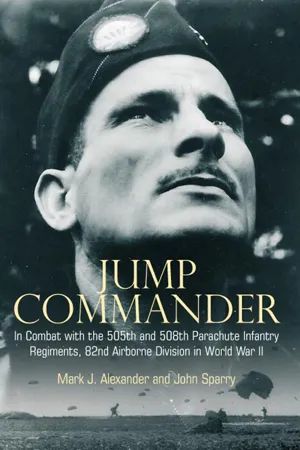
eBook - ePub
Jump Commander
In Combat with the 505th and 508th Parachute Infantry Regiments, 82nd Airborne Division in World War II
- 288 pages
- English
- ePUB (mobile friendly)
- Available on iOS & Android
eBook - ePub
Jump Commander
In Combat with the 505th and 508th Parachute Infantry Regiments, 82nd Airborne Division in World War II
About this book
Information
CHAPTER TWENTY-ONE
YOU CAN TAKE THE
PARATROOPER OUT OF THE
FIGHT, BUT…
SAN JOSE TURNED OUT TO be a wonderful place to raise a family. The Alexanders put down roots and never left. Mary was especially pleased to establish a home after so many years of packing and moving here and there while her husband had been in the military. Mary Jo and Mark Junior soon were joined by little brother Don, born in 1951.
For Alexander, the initial years in San Jose were dominated by the desire to establish a business of his own. A natural leader with an entrepreneurial spirit, he was continually frustrated by a lack of funds. Several opportunities presented themselves, but like many others of his generation who had struggled through the Great Depression, Alexander was loath to put his family at risk by going into debt to finance an uncertain future. As he succinctly phrased the question always on his mind, “What could I get into where I worked on the other man’s money?”
Moving to San Jose before he’d found employment, Alexander worked a series of short-term jobs, followed by a stake in a taxi company, before he moved on to become a sales supervisor at Royal Crown (R.C.) Cola. Here, his paratrooper training and fighting instincts, notoriously difficult to quantify in civilian life, stood him in very good stead. “I had six drivers in San Jose, five in Redwood City, and three in Salinas. I had to go around to the various areas, and discovered that a big guy up at Redwood City was bullying the other guys all the time.
“I warned him, ‘You’re going to have to lay off of these guys. You’re getting them upset and they’re all going to quit.’ And he poo-poo’d me for it.
“I talked to the manager up there and said, ‘Why don’t you let him go?’
“He said, ‘I’m scared to.’
“So I said, ‘Ooookay,’ and knew I would have to take care of it.”
To pay employees, Alexander stood behind a counter with a swinging door. “When it came time to pay off on Friday evening, I had his check ready for him. I told him it was the last he would be getting from me.
“He said, ‘You can’t do that.’
“I said, ‘I told you before, you had to quit picking on these guys. I’m going to have to let you go.’
“He said, ‘You can’t do that!’
“I said, ‘Well, there’s your last check and you’re through as of tonight.’
“I guess he couldn’t think of anything else to say. Again he repeated, ‘You can’t do that!’ and charged me. But I didn’t wait on him. I hit him coming through the swinging door, and got in two shots on him. The first one cut him up on his mouth, and he later said I knocked two teeth loose. I got in a second punch and hit him in the gut as he came in that swinging door.
“Then all the guys grabbed us. I was tickled to death they broke it up. He wanted me to go out in the yard and fight with him. I said, ‘They don’t pay me enough to go out in the yard and fight with you and roll around in the cinders, but if you find me someplace, sometime, and you want a bite of me, go ahead and try to take it.’ And he finally left. The next day I had a knot on the back of my neck where I got inside of a punch, and I had a bump on my tailbone where he pushed me back against a desk.
“I worked at R.C. Cola for about a year, found no future there and quit. The franchise holder for the 15 western states offered me the Hawaiian franchise and said they would finance me, but I would have been in hock for many years, and we really did not want to leave the mainland.”
Less than five years after the end of World War II, the Korean War began. By this time, Alexander had joined the reserves, and had been promoted to full colonel. When the commander of the United States Eighth Army died, Ridgway headed to Korea to take command, passing en route through San Francisco. Alexander recalls: Ridgway left “a note in red pencil with the Chief of Staff to call me back to active duty. The Chief of Staff called and gave me the word, ‘Be prepared.’
“I asked how long I had, and he said ‘30 days.’ So I started getting ready for it.
“In about two or three weeks, he called me again. He said, ‘Colonel Alexander, the war department has decided not to call any more full colonels. Would you take a shake down to lieutenant colonel?’
“I said, ‘Let me think about it.’”
Alexander was now confronted with one of the toughest decisions of his life. The Eighth Army had been on its heels for months. Ridgway had replaced many of the commanders with fresh, aggressive men. Alexander certainly fit that bill, and almost certainly would be given command of a regiment.
As hard as it was, he sat this one out. “Mary didn’t want me to go. I had three kids by that time. I had to give it a lot of serious thought, but I called Ridgway’s Chief of Staff back and said, ‘No, if you can’t take me as a full colonel, leave me alone.’ So they did.”
Not long afterward, Alexander had his first contact since World War II with his old friend Jack Norton. Norton had stayed in the military, and served as aid to the Secretary of the Army in the 1950s.
“They came to town one morning to tour the Food and Machinery (FMC) plant where they built a lot of tanks. Norton said, ‘Come on, go through with us.’
“I said, ‘I’d like to, but I haven’t got a clearance.’
“He said, ‘You won’t need it.’
“When we got there, one of the guys tried to stop me at the door. Norton told him, ‘He’s with us. He’s going through.’ That cleared me. There was enough brass to get me anywhere. The security agent at the gate was kind of upset that they had taken me in.”
Alexander also renewed ties with another old friend from the army, his right-hand man Chick Eitelman. Wounded twice in the war, Eitelman lived in Portland, Oregon. His work as a truck driver often allowed him to spend the night at the Alexanders’ when he was in their area. Mary and the kids thought the world of him. “He was still doing barbells and working out a lot, but he died of a heart attack in 1956,” Alexander reports. “Sometimes these big, powerful guys who have built up so much muscle don’t do so well in old age. I don’t know. I got a letter from him about two weeks before he died, and he was still lifting weights.” This time, Alexander had lost Chick for good.
During the Korean War, Alexander worked at the U.S. Tire Company. After five years, he walked away from the offer of franchises in Fresno and Chico, which both involved him going into debt, to pursue a career in real estate. “I had only $15,000 in cash and a home I had purchased with a loan from Bank of America. I studied real estate law for three weeks, took the real estate examination, and passed as a salesman. One year later, as allowed by law, I took and passed the broker’s examination.” At last, Alexander had found his civilian career.
Many of the houses he sold were newly built. He bought one himself and moved the family to Campbell, a suburb of San Jose, where he sold a few more houses on the same street. “I sold one near mine to a Japanese man who had fought for Japan in World War II. In 1957, many Americans still had hard feelings about the Japanese. The woman across the street and the woman next door to the house for sale came over and said, ‘You can’t sell that house to a Japanese.’
“I said, ‘Why can’t I? The builder wants to sell it to him. He’s offered the full price.’ The old gal across the fence from him came over to see me another time to complain. Boy, she was adamant as hell about it. I said, ‘I can’t do anything about it, and I wouldn’t even if I could. The war is over. Let’s try to forget about it.’ And that man still lives there today.”
Just at the point his business was gong well, Alexander had one more invitation to get back into military matters. “My old 2nd Battalion master sergeant, Tommy Gore, stayed in the military and worked for a while as a courier out of Washington. I never figured out what department he worked for, but he brought me an application one time. I swear, it must have been about 15 feet long there were so many pages. This took place when we were having trouble with China, and the application was for a CIA assignment. They wanted me to train some of our local Chinese to jump. They would then drop them in China so they could work their way into the population and send out reports. I turned it down. Mary wasn’t interested in my going and I wasn’t either.”
In October 1959, Alexander developed serious health issues, resulting in an operation for cancer and financial setbacks. “The illness came at a bad time. I had had three small subdivisions going and had to dump them all. Gradually, over a 17-month period, I went back to work. I decided I would work alone and set my own pace.”
During this period of recuperation, Alexander unexpectedly had to call on his paratrooper fistfight skills when he and Mary attended a major real estate dinner at a local county club. All the agents from the area were there, including Harold Sparry, the father of the young man whom Mary Jo, now 19, was seriously dating. Although Mark and Harold had met, the mothers of the dating couple had not, and they now introduced themselves to each other since their children were dating. During the dinner, a cantankerous agent claimed that Alexander had cheated him out of a real estate deal. “He also thought that a fellow named Baroski, who worked at the title company, was partly responsible. But he wasn’t. It was my deal.”
The angered agent was physically a very big guy. “He caught Baroski going back to the men’s room and threw him down on the floor. Then he knocked and rolled him around, tore his shirt, pulled his jacket off and stuffed it in the trash can.” When word of the fight got to Alexander, he confronted the other agent. “What really made me mad was that Baroski wouldn’t swat a fly, he was that nice. I said, ‘You shouldn’t be picking on Baroski. He’s a mild-mannered guy. He didn’t have a damn thing to do with that problem you and I had.’
“Well, he took a swing at me. I got under it and hit him with a left. It straightened him up and then I hit him again, knocking him down and breaking his nose. I always figured when you fight a bigger guy, you’ve got to get the first shot in. And get it in the right place. If I figured a guy was going to take me on and there was no chance to talk my way out of it, I didn’t wait.
“The fight took place right beside the bar. I stepped over into the open space where I had room to move around, because he was a 200– pounder. A guy of 150 pounds doesn’t want to be in close quarters with him. He got up and came at me again. I got in one shot and hit him in the ear ...
Table of contents
- ACKNOWLEDGMENTS
- INTRODUCTION
- THE FIRST JUMP
- LEARNING TO FIGHT
- PREPARING FOR WAR
- EARLY DAYS IN THE 505 PARACHUTE INFANTRY REGIMENT
- NORTH AFRICA
- SICILY: FROM THE JUMP TO BIAZZO RIDGE
- ON TO TRAPANI
- RETURN TO NORTH AFRICA AND PREPARATIONS FOR ITALY
- FROM SALERNO TO NAPLES
- TO THE VOLTURNO: THE BATTLE OF ARNONE
- DUTY IN NAPLES
- NORTHERN IRELAND
- ENGLAND
- D-DAY: JUNE 6, 1944
- LA FIÈRE BRIDGE AND CAUSEWAY
- MONTEBOURG STATION
- WESTWARD TO THE DOUVE: THE BATTLE OF ST. SAUVEUR-LE-VICOMTE
- THE 508 PARACHUTE INFANTRY REGIMENT
- HILL 95
- RECOVERY, HOLLAND AND THE BULGE
- RETURN AND TRANSITION
- YOU CAN TAKE THE PARATROOPER OUT OF THE FIGHT, BUT…
Trusted by 375,005 students
Access to over 1.5 million titles for a fair monthly price.
Study more efficiently using our study tools.
Frequently asked questions
Yes, you can cancel anytime from the Subscription tab in your account settings on the Perlego website. Your subscription will stay active until the end of your current billing period. Learn how to cancel your subscription
No, books cannot be downloaded as external files, such as PDFs, for use outside of Perlego. However, you can download books within the Perlego app for offline reading on mobile or tablet. Learn how to download books offline
Perlego offers two plans: Essential and Complete
- Essential is ideal for learners and professionals who enjoy exploring a wide range of subjects. Access the Essential Library with 800,000+ trusted titles and best-sellers across business, personal growth, and the humanities. Includes unlimited reading time and Standard Read Aloud voice.
- Complete: Perfect for advanced learners and researchers needing full, unrestricted access. Unlock 1.5M+ books across hundreds of subjects, including academic and specialized titles. The Complete Plan also includes advanced features like Premium Read Aloud and Research Assistant.
We are an online textbook subscription service, where you can get access to an entire online library for less than the price of a single book per month. With over 1.5 million books across 990+ topics, we’ve got you covered! Learn about our mission
Look out for the read-aloud symbol on your next book to see if you can listen to it. The read-aloud tool reads text aloud for you, highlighting the text as it is being read. You can pause it, speed it up and slow it down. Learn more about Read Aloud
Yes! You can use the Perlego app on both iOS and Android devices to read anytime, anywhere — even offline. Perfect for commutes or when you’re on the go.
Please note we cannot support devices running on iOS 13 and Android 7 or earlier. Learn more about using the app
Please note we cannot support devices running on iOS 13 and Android 7 or earlier. Learn more about using the app
Yes, you can access Jump Commander by Mark J. Alexander,John Sparry in PDF and/or ePUB format, as well as other popular books in History & Military Biographies. We have over 1.5 million books available in our catalogue for you to explore.