The dramatic experiences of an ambulance driver in the Great War, told through personal correspondence and photographs.
Though the United States was late to enter the Great War, a number of idealistic young Americans wished to take part from the beginning. One of these was Avery Royce Wolf, a highly educated scion of a family in America's burgeoning industrial heartland.
Volunteering as an ambulance driver with the French Army in the Verdun sector, Royce sent back a constant stream of highly detailed letters describing the experience of frontline combat, as well as comments on strategy, the country he encountered, and the Allies' prospects for success.
This treasure trove of brilliant letters, only recently discovered, is accompanied by several albums worth of rare, high-quality photos depicting aspects of the Great War in France never previously published. Full of action, including the suspense and terror of the Ludendorff Offensive, and interesting firsthand analyses, such as comparing French and German trench works,
Letters from Verdun brings the reader amazingly close to the frontlines of the Great War.
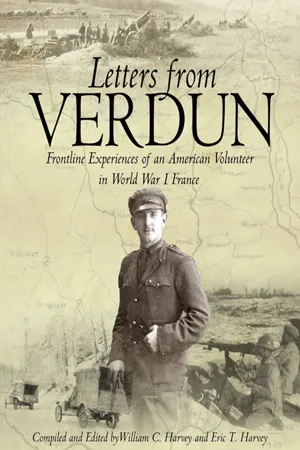
eBook - ePub
Letters from Verdun
Frontline Experiences of an American Volunteer in World War I France
- 226 pages
- English
- ePUB (mobile friendly)
- Available on iOS & Android
eBook - ePub
Letters from Verdun
Frontline Experiences of an American Volunteer in World War I France
About this book
Information
Part I
Summer of 1917
Introduction
By 1917, only propagandists on either side believed a victory was possible through one final and decisive battle. The worst fears of the earlier visionaries had become manifest. Even commanding generals divulged privately a vision of war that involved all a nation’s citizens—men, women, and children—civilian as well as military. This war would destroy entire economies and would not end until the combatants were utterly exhausted.
The grand strategy of a decisive breach of the enemy trench lines, subscribed to by both sides, fell victim on any number of occasions to an inability to exploit significant breakthroughs once they occurred. While the commanders could move men on an unprecedented scale, they lacked the technology to move the requisite food and ammunition to support the offensive. Here we see another instance of theorizing that it would be possible “to punch through the lines, roll up both sides, and end the war.” The first part was accomplished on many occasions; the second, never. Having belatedly grasped the tactical advantage of the machine gun and massed artillery, the generals never met the attendant logistical demands.
In the summer of 1917, the line of battle on the Western Front arced north from Switzerland to the English Channel, having changed little from September 1914, the second month of the war. The “war of attrition” went on. Royce Wolfe’s ambulance unit was assigned to the French Second Infantry Division (2 DI), which occupied a segment of the front just northwest of the Verdun Salient.
At the beginning of the First World War, the American Ambulance Service operated one hospital in Paris.3. To house future operations, an expansion was begun on the Lycée Pasteur, a French High School under construction at the time. By 1915, an Inspector General had been appointed to the hospital and the American Field Service was created. In the spring of that year, volunteer American ambulance personnel units were formed in cooperation with the French. By 1916, many such units were operating along the Western Front. By the time of the federalization of the ambulance services in 1917, 30 ambulance units were in existence, and over 2,500 ambulances and other vehicles were turned over to the French and American armies. The men of these units had also redesigned the structure and features of the ambulances to be used in future service. The Ford truck was the preferred vehicle, as it was reliable and maintenance was straightforward.
Wednesday, June 27th, 1917 – Very hot
After arriving from Crystal Beach on the 8:15, I was met at the Buffalo dock by Father, Mother, and Spencer. Milton was not on hand because he understood I was to leave on Thurs day night. Upon arriving home, I completed what little packing I had not finished. While packing John B. called, and after making a few calls to the family, John and I left in his car for the NYC station with the hope of seeing the other boys off. We arrived just too late, so John took me to the Lehigh Valley station. I took leave of the folks, said farewell to John, and boarded the train which left on time.
Thursday, June 28th – Very hot
I had a very good night on the train, which arrived in Easton one and a half hours late. I walked up the hill and saw Mr. Smith, Mrs. Hatch, and a number of the boys and professors who were just finishing up summer school. Later I visited Mrs. Hatch and arranged to have my things sent home. I boarded the 11:30 train and arrived at 23rd St. at 1:30, then went immediately to the Waldorf Hotel and secured Room 43, between Mort Wilkinson and Irv Williams. After arranging my things, I boarded the “L” and went to the office of A.A.F.S. at No. 14. Wall St., received my passport and necessary papers without any difficulty, then went to the French Consul’s office and had my passport “visa-d.” I then took a surface car up Broadway to 33rd St. and walked to the hotel. No charge is required of men in uniform for riding on cars or subways. While I was taking a bath, Mort and Ed Lowery came in. I had a fine dinner at the Waldorf with Mort, and later walked up 5th to Central Park and back. After writing numerous letters and taking an other bath, I retired very much exhausted.
Waldorf Astoria Hotel – June 28th
I arrived in New York this afternoon after stopping in Easton to see Mr. Hatch and getting a few of my things. I received my passport and necessary documents and have been informed that we sail this Saturday afternoon on the Touraine of the French Line. I have a room next door to Mort Wilkinson, and Irving Williams shares the adjoining room with Reginald Leper. The hotel has given me a very cheap rate: four dollars a day, which includes three meals and a very comfortable room with a bath.
Tell Milton I am sorry he misunderstood the date of my leaving, and if it wouldn’t be too much trouble, please get him some kind of gift for his birthday. Tonight I walked up Fifth Ave. to Central Park with Mort. It is terribly hot here and my uniform is awfully heavy. Promising to write you full particulars of my voyage as soon as possible. I am,
Your loving son
Mort will cable our safe arrival to his mother and she will telephone you. Yes, I have written those letters.
Friday, June 29th – Rain and cooler
Arose at 9:30 very much refreshed, bathed, and had a very good breakfast with Irv and Reg Leper. I took the boys to the passport office to secure their papers, and then returned to the Waldorf for lunch. After lunch I sent to the French Line and obtained my ticket ($87.50), and found out that we were to sail Saturday at 3:00 on the liner Touraine.
After visiting Battery Park and the Aquarium, we went to visit Irv’s cousin (Mr. Bird 3rd) and obtained from him the use of his house in Paris. We returned to the hotel in time for dinner, later securing tickets for “Oh Boy” at $3 dollars apiece, but it was well worth the price. We returned to the hotel, and after a game of Five Hundred, we retired at about midnight. During the day I had obtained shoes and other required things at Abercrombie, Fitch and Co.
Saturday, June 30th – Cool and fair
I was awakened by a telephone call from Mort who was having trouble obtaining his papers. I got dressed immediately and took a telegram of Mort’s down to 14 Wall St. He finally received his papers, and then I took him to the other offices where he received his ticket and had his passport “visa-d.” I returned to the hotel and had a hurried lunch, finished packing, and had my baggage taken down. Upon applying for the bill, I found that the Buffalo office had taken all charges over to themselves. Mort and I had our baggage put on a taxi and accompanied it to the dock. I stayed with the baggage and saw that it was inspected and put aboard. Then I had my passport stamped and signed by U.S. authorities on the dock and went aboard. I found my bunk very comfortable. It was a lower in a room with four other bunks. It was also very hot and close, being in an inside stateroom. I immediately began looking around for a more favorable berth and found a very comfortable one for two, which I took possession of after seeing the head purser. Later a chap named Arthpach from Boston moved into the room. I left the cabin after getting settled and went on the deck. It was crowded with mothers and fathers and friends of the boys who were going to sail. After a while, I went on board again and took a deck chair on the starboard side. Three o’clock came and we did not sail. It was very noisy on account of the winches loading the ship. Four and five o’clock passed, and still we had failed to move. At 6:00 the whistle blew, dogs on the nearby wharfs barked, and answering whistles from the tugs made the air quite dizzy with confusion. Hurried goodbyes were said at the command “all aboard,” and a general rush for the gangplank ensued.
The hawsers were thrown off, and the boat quietly slipped out of the berth and proceeded down the river. The boys who had been supplied with American flags gathered along the rails and waved a last farewell to the crowds of people on the balcony of the dock. We passed Governor’s Island and the Statue of Liberty and entered the Narrows. Upon coming abreast of two U.S. destroyers and a cruiser, we maneuvered into position beside them with our bow pointing up the bay. Our curiosity as to this move was interrupted by a bell announcing dinner. I had previously been assigned to sit at table 51 in the upper dining room, first class. I was very fortunate, as we have the best service in this cabin. The meal was very good. I went on deck again after dinner to find that we were still lying beside the destroyers. It was a wonderful night, cool and clear.
In front of us the mass of lights from New York illuminated the horizon. Quite prominently the Statue of Liberty, illuminated by numerous search lights, stood out against the lights of the city. Newark Bay was studded with the lights of numerous ships lying at anchor, while from the mast-heads of the destroyers, signals were being continuously flashed. Under the spell of this beautiful scene of quiet and restfulness, I gradually fell asleep.
I was awakened shortly by a short blast of a whistle, very close and loud. Jumping up I saw that people were congregating on the port side of the boat, so following the crowd, I made my way to the rails and saw a large tug fastened to the side of the steamer. A gangplank had been lowered, and I noticed at the same time that the deck of the tug was piled with baggage. After the party came aboard, a group of American sailors formed a chain up the plank and moved the baggage aboard. I got into conversation with one of the Jackies and learned that the tug, the Patrol, belonged to the Mayor of New York, and thaft it had been detailed to carry the Italian Mission from Newark to our boat. There was quite a good deal of confusion when this became known on board. As soon as their baggage was aboard, the ship came about and started out to sea. We noticed that the two destroyers were convoying us, so we were very glad that the Italian Mission had come aboard. I retired about 12:30.
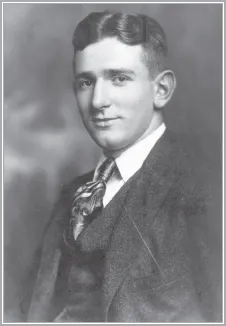
Avery Royce Wolfe, from picture taken in Spring 1917.
Sunday, July 1st – Superb weather
This is Milton’s birthday. I sent some money home for a little remembrance which I hope he appreciated. I arose about 9:00 after a comfortable rest. I found a bath, but was very much disappointed in it. The water is salty and it is use less to try to use soap, as it does not lather. The best you can do is just immerse yourself long enough to allow the dirt to dissolve off. You feel quite refreshed while in the water, but after drying off you feel sticky and uncomfortable. I found that I was late for breakfast, so I only obtained a few buns and some jam. The bell for dinner rang at 11:00 while I was taking exercise on the deck. The food is very good and tastefully cooked, but I find a good deal of difficulty in ascertaining what the menu is. This afternoon I spent in reading. It appears that no church services are held on French steamers on Sunday, although I have been told that such is not the case on other lines.
The Italian Mission appeared on deck this afternoon. It contains several princes, dukes, etc. If these are a fair ex ample of European nobility, I can understand why the world is gradually turning into one large democracy. The Prince of Undine and his aide are dressed in blue uniforms. They seem to be built like question marks, if not more like shadows. They are always very much in evidence. Supper was at 6:00 again. I must comment on the excellent quality of the food. The evening was wonderful—a large moon illuminated the ship and made the blue surging sea visible for miles around. I was told that the moon was a disadvantage to us, as it makes us more visible to the submarines. I retired about 12:00.
Monday, July 2nd – Fine weather
I forgot to say that the U.S. destroyers left us Sunday night while we were at supper. I missed breakfast again, but dinner is so early that I have decided it best to sleep as late as possible and get up just in time for dinner. The day passed as usual, varying the monotony with a game of bridge and walks around the deck. I have met a number of very nice men and boys. They are congenial, and come from almost every part of the States. As it was very hot last night, I attempted to sleep on deck in my steamer chair, but about 1:00 it commenced to rain. On account of this and the fact that I was not very comfortable, I returned to my bunk and slept very well. I have been talking to a little French marine and he is very interesting. I have been teaching him English, and he has been helping my French. I regret now that I failed to spend more time on my French at school because I find it very useful, if not necessary. A little French woman aboard has volunteered her services to teach the fellows her language. She holds classes every day at 3:00 in the saloon. There are quite a few notables aboard. Mrs. Johnson, wife of Owen Johnson, is the center of activity aboard. She is Italian by birth and has a very wonderful voice. The Italian princes make much of her, as does everyone else. Mr. Sayre, son-in-law of President Wilson, is also aboard. He is going to do Y.M.C.A. work in France. He resembles the President very much. With him is an attractive young girl of about 20 who is going to do hospital work. She is very popular with the young men, as she is the only girl of her type aboard. She seems very sensible and carries her self well. I would like to meet her. Mayor McCormick and wife are also among those on board. The mayor, a very tall and attractive man who in private life is president of the Chicago World, is going to join General Pershing’s staff.
Tuesday, July 3rd – Good weather
Missed breakfast again. Arose in time for dinner. The afternoon I devoted to reading. Just before supper there were games on deck in which I participated. They amused the people immensely and were a lot of fun. After supper I played bridge until 11:00, and then went on deck to enjoy the evening. I talked a great while with a young fellow named Connosit, who knew Buffalo and people that lived there.
Wednesday, July 4th – Good weather
The Glorious Fourth. What a novelty it is to be thousands of miles away, surrounded by the solitude and quiet of a great expanse of water, when usually the air is full of the noises of bursting firecrackers and the shrill cries of excited children. It is undoubtedly the most quiet 4th I have ever witnessed, but I can truthfully say that never before have I so appreciated the solemnity of the day.
The simple exercises we held on board were terribly impressive. I awoke in time for lunch which was excellent as usual. At 3:00 all the men in uniform congregated at the bow of the boat and sang the national anthem. After witnessing the raising of the American flag, Mayor McCormick then delivered a brief address in which he impressed upon the boys the greatness and solemnity of the work in which they were about to enter, and also reminded them of the standard which they, as American soldiers, mus...
Table of contents
- Front Cover
- Title Page
- Front Page
- Copyright Page
- Table of Contents
- Dedication
- Preface
- Part I: Summer of 1917
- Part II: Autumn of 1917
- Part III: Winter of 1917–1918
- Part IV: Spring of 1918
- Part V: Late Spring and Summer of 1918—The Ludendorff Offensive
- Epilogue: Final Letters
- Afterword
- Glossary of Terms
- Bibliography and Reference Materials
- Footnotes
Trusted by 375,005 students
Access to over 1.5 million titles for a fair monthly price.
Study more efficiently using our study tools.
Frequently asked questions
Yes, you can cancel anytime from the Subscription tab in your account settings on the Perlego website. Your subscription will stay active until the end of your current billing period. Learn how to cancel your subscription
No, books cannot be downloaded as external files, such as PDFs, for use outside of Perlego. However, you can download books within the Perlego app for offline reading on mobile or tablet. Learn how to download books offline
Perlego offers two plans: Essential and Complete
- Essential is ideal for learners and professionals who enjoy exploring a wide range of subjects. Access the Essential Library with 800,000+ trusted titles and best-sellers across business, personal growth, and the humanities. Includes unlimited reading time and Standard Read Aloud voice.
- Complete: Perfect for advanced learners and researchers needing full, unrestricted access. Unlock 1.5M+ books across hundreds of subjects, including academic and specialized titles. The Complete Plan also includes advanced features like Premium Read Aloud and Research Assistant.
We are an online textbook subscription service, where you can get access to an entire online library for less than the price of a single book per month. With over 1.5 million books across 990+ topics, we’ve got you covered! Learn about our mission
Look out for the read-aloud symbol on your next book to see if you can listen to it. The read-aloud tool reads text aloud for you, highlighting the text as it is being read. You can pause it, speed it up and slow it down. Learn more about Read Aloud
Yes! You can use the Perlego app on both iOS and Android devices to read anytime, anywhere — even offline. Perfect for commutes or when you’re on the go.
Please note we cannot support devices running on iOS 13 and Android 7 or earlier. Learn more about using the app
Please note we cannot support devices running on iOS 13 and Android 7 or earlier. Learn more about using the app
Yes, you can access Letters from Verdun by William C. Harvey, Eric T. Harvey, William C. Harvey,Eric T. Harvey in PDF and/or ePUB format, as well as other popular books in Social Sciences & Military Biographies. We have over 1.5 million books available in our catalogue for you to explore.