"An authoritative look at an event that has taken on a legendary status . . . [an] essential history for those wanting the truth behind the legend" (
Publishers Weekly).
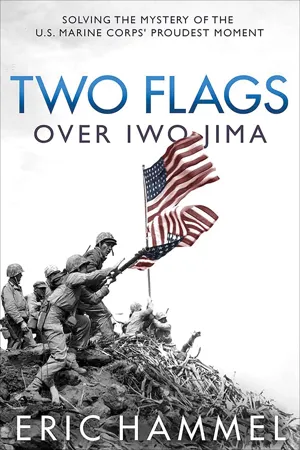
Joe Rosenthal's "Raising the Flag on Iwo Jima" photo is one of the best-known images of US war history—and a powerful symbol of patriotism. But the story of how the flag got there, and even the identity of the soldiers in the photo, has been muddied by history. Here, military historian Eric Hammel sets the record straight—viewing complex events through the lens of the story of the infantry company in which all the flag raisers served.
The photo captures the moment that the first American flag flew over the core of Imperial Japanese territory on the top of Mount Suribachi. The focus of this book lies on the 28th Marine Regiment's self-contained battle in February 1945 for Mount Suribachi, the 556-foot-high volcano on Iwo Jima. It was here that this one regiment defeated more than 1500 heavily armed Japanese combatants who were determined to hold the highest vantage point on the island.
Two Flags over Iwo Jima reveals the all-but-forgotten first flag raising and the aftermath of the popularization campaign undertaken by the post-WWII Marine Corps and national press. Hammel attempts to untangle the various battles that led up to the first and second flag raisings, as well as follow the men of the 28th Marine Regiment in the events that took place after. The full story behind one of the most iconic photographs ever taken is revealed—along with the real heroism and stories of the men behind a dramatic moment captured in time.
"A richly illustrated account . . . A must for World War II buffs." —
Kirkus Reviews (starred review)
eBook - ePub
Two Flags over Iwo Jima
Solving the Mystery of the U.S. Marine Corps' Proudest Moment
- 222 pages
- English
- ePUB (mobile friendly)
- Available on iOS & Android
eBook - ePub
About this book
Information
Topic
HistoireSubtopic
Seconde Guerre mondialeCHAPTER 1
Before
Why Iwo Jima?
Iwo Jima is one of the most isolated places on Earth. Waterless and barren, it is unsubtly hostile to human settlement. Today, fewer than 400 people inhabit the island—all members of the Japan Self-Defense Force. The island is open to international travelers just one day a year—around the February 19 anniversary of the invasion—and only American and Japanese pilgrims, historians, and history buffs make the journey.
Today, as in days predating the opening of Japan to the world in the mid-19th century, Iwo Jima rests at the very outer limit of the empire. Her only economic function has been the export of sulfur, a byproduct of the volcanic action that seethes barely beneath the island’s mantle.
During the first four years of the Pacific War, Iwo Jima had only two functions: as a watch post against invasion of the inner empire, and as the seat of an air base complex built to enhance her garrison’s watch mission. But her importance to Japan in late 1944 and early 1945 was also emotional; Iwo Jima, nearly useless though it was, was nonetheless an integral component of the empire. Also, because she could support several large airfields—which nearby islands could not—she would naturally come under the eye of the American naval, air, and amphibious forces sweeping across the vast Pacific toward the Japanese home islands. The reasons for stoutly defending the otherwise useless and barren volcanic speck was first one of honor—for Iwo Jima was intrinsically Japanese; second, to deny the Americans the airfield sites for as long as possible; and third, to lay down the gauntlet, to communicate to the onrushing Americans that all of Japan would be as stoutly, as heroically, as unremittingly defended as was tiny, useless—but oh so Japanese—Iwo.
The bloodbath at Iwo Jima in late February and most of March 1945 owes itself entirely to the exigencies of the air war in the Pacific as a whole and specifically to the needs of the culminating phase of the strategic air off ensive against the Japanese home islands.
Until mid-1944, when U.S. Marine and Army divisions seized Japanese-held Saipan, Tinian, and Guam in the Mariana Islands, the Allied Pacific War strategy had been hobbled by the operational range (i.e. the effective combat radius) of land-based fighters. Simply put, to run an effective land-based bombing campaign against Japanese-held Pacific island bases, the U.S. Army Air Forces, Navy, and Marine air commands in the Pacific had to provide numerous and effective fighter escorts. So, though bombers outranged fighters by a considerable margin, the advance up the Solomons chain in 1942 and 1943, along the northern coast of New Guinea from late 1942 to mid-1944, across the central Pacific in late 1943 through mid-1944, and through the Philippines from September 1944 had to take place at a pace of up to 300 miles per hop if the objective was to seize airfield sites from which Japanese bases farther out could be effectively interdicted by fighter-escorted, land-based bombers.
This linkage between the Allied Pacific offensive and the operational range of fighters (which was less than half their actual range) held up as a military law of nature until the unveiling of the U.S. Navy’s fast carrier task force in late 1943. At that point, as new fleet carriers and light carriers began to arrive in the Pacific war zone at an average rate in excess of one per month, the 300-mile law could be bent somewhat if enough carriers could be shackled to a new objective long enough for ground troops to either seize an existing airfield that could be quickly rehabilitated or clear room for the rapid installation of a new airfield. As land-based fighters, fighter-bombers, and single-engine light bombers moved up to the new airfield, land-based, multi-engine medium and heavy bombers also could be brought forward, to support invasion troops ashore as well as to strike nearby bases that had been kept under the gun to that point by carrier air strikes. At that juncture, the full weight of the fast carrier task force could be used to soften up new targets beyond the operational range of land-based fighters and, as the central Pacific campaign progressed, even beyond the effective range of land-based bombers. The addition of numerous escort carriers to the invasion fleets from late 1943 substantially enhanced the reach of the fast carriers, because escort-based air squadrons were trained and equipped to guard the invasion fleet and provide air support for forces ashore. Thus more fast carriers could move on to more distant assignments sooner than had been the case prior to the organization of flotillas of escort carriers.
The technological leap that nearly severed the link between the length of a new step forward and the operational range of land-based fighters was the appearance of U.S. Army Air Forces Boeing B-29 Superfortress very heavy bombers. These aerial leviathans, which were first employed out of forward bases in China, were built to fly at 32,000 feet—higher than most Japanese defensive fighters could reach—as well as to carry four tons of bombs out to ranges of 1,600 miles, and return. This was about 5,000 feet higher and 600 miles farther in each direction than the tried-and-true Consolidated B-24 Liberator heavy bomber.
The seizure of Saipan, Tinian, and Guam would place nearly all of Japan within range of a B-29-based bombing offensive as soon as highly reinforced, extra-long runways could be built on the three islands.
The first B-29s reached Saipan on October 12, 1944; several groups ran a training mission against Japanese-held-but-bypassed Truk on October 28; and six of 17 B-29s dispatched from Guam attacked Iwo Jima on November 8 (at a range of nearly 650 miles), the first of several winter “training” missions to Iwo. Finally, on the night of February 4, 1945, 69 Marianas-based XXI Bomber Command B-29s flew all the way to Kobe, while 30 other B-29s that failed to find the city bombed targets of opportunity and of last resort. Two B-29s failed to return.1
Other than as a practice target in the run-up to the February 4 attack, Iwo Jima as yet had no direct role in the B-29 strategy, but the island stood at the apex of a shallow equilateral triangle, roughly half the distance between the Marianas and central Japan.
By early 1945, all three of the Army Air Forces’ long-range, high-altitude fighter types of the day—Lockheed P-38 Lightnings, Consolidated P-47 Thunderbolts, and North American P-51 Mustangs—had been refined to the point at which their operational range was more than the distance between Iwo Jima and Tokyo. In other words, Iwo Jima, as an air base, stood at an optimum point for emergency landings by damaged or malfunctioning B-29s on their way to or from Japan and the Marianas—and as the extreme launch point for long-range fighters that could provide daylight escort for B-29s over Japanese cities and industrial zones.2
In a nutshell, Iwo Jima or a neighboring island in the Volcano or Bonin island groups were the most suitable sites for an emergency airfield and advance escort-fighter base in support of the upcoming strategic bombing offensive against the Japanese homeland. All of the calculus by which invasion targets were selected that late in the Pacific War ground out inexorable results to all of the mathematical inputs bound up in distances and even in the tradeoffs in lives laid on the line to seize the bases as opposed to lives saved by having airfields available for emergency landings, not to mention fighter escorts that could reach central Japan. Indeed, twin-engine North American B-25 medium bombers (designated PBJ by the Marine Corps) would be able to attack Japanese shipping and shore targets in southern Japan from Iwo Jima, a minor but nonetheless interesting bonus.3
There were other islands in the vicinity of Iwo Jima that would have been fine as advance support bases that late in the war, but Iwo Jima was the only one whose topography could support the very long runways required by the B-29s. The Japanese did not realize this, because they knew very little about the B-29 program. Nevertheless, they very well comprehended the offensive value Iwo Jima would have if the largest, longest-ranged American heavy bomber of the last phase of the Pacific War would have remained the B-24, because B-24s based at or staging through Iwo Jima from the Marianas would nonetheless have complete access to all of Japan. Moreover, they knew that Iwo-based, state-of-the-art fighter escorts would be able to range over all of the southern two-thirds of Japan.
Even without factoring in the B-29 program, the Japanese knew that Iwo Jima was a highly likely target for American strategic planners, so they decided to defend it as heavily as their reeling war industry and burgeoning manpower needs (and declining manpower) could support. The fact that Iwo Jima stood at the extremity of the pre-war Japanese Empire added honor—and thus intractable stubbornness, or even fanaticism—to the mix of defensive priorities in a way American invasion forces had not yet experienced in the Pacific.4
Fortress Iwo
The Japanese architect of the Iwo Jima battle plan was Lieutenant General Tadamichi Kuribayashi, who was handed his assignment to defend the volcanic island directly by the prime minister, General Hideki Tojo, in late May 1944—a month ahead of the first American carrier strikes. Even then the Japanese strategists knew that their defense of Iwo would be a rearguard battle fought to gain time for the bitter defense of the home islands to take shape.
Kuribayashi was a well-traveled 54-year-old who had served two of his 30 years in uniform in the United States. He knew what he was up against in terms of industrial might and described Americans thusly: “[T]he people are energetic and versatile. One must never underestimate the American’s fighting ability.”5
The new island commander, who reached Iwo during the second week of June 1944, experienced American energy once again through all of the summer’s air attacks, during which the island’s air-defense contingent was virtually annihilated. Certain the attacks presaged an imminent direct invasion, Kuribayashi and the rest of the island’s too-few defenders awaited a similar annihilation. They were flabbergasted when it failed to materialize.
As Kuribayashi settled in to his apparently final service to his emperor, his thinking departed radically from—but built upon—that of colleagues all across the wide Pacific. Rather than bank everything on an all-out beachside defense that offered little to no defensive depth, Kuribayashi ordered his troops to construct interlocking defenses throughout the island’s rough interior. And rather than hold troops back to participate in a desperate, all-out mass counterattack—a so-called banzai—in the open, he decreed that nearly every defender must remain in place, under good cover, until blown up or pried out on the point of a bayonet. And the entire island would be covered beneath interlocking fans of artillery, mortars, and rockets. The Japanese defensive tactics American planners had come to rely upon for quick victory on Pacific islands would not be used; Kuribayashi’s brief to gain time for the homeland defense dictated a long, bloody battle of attrition.
As the troops already on Iwo dug in, Kuribayashi’s nominal and newly activated 109th Infantry Division began to be filled out with reinforcements. The 5,000-man 2d Independent Mixed Brigade was transferred from Chichi Jima, and the 2,700-man 15th Infantry Regiment, which had been earmarked for Saipan before that island was invaded in June 1944, also was sent to Iwo. Next to arrive was a 1,200-man naval construction battalion, followed by 2,200 elite naval infantry troops and sufficient aviation ground personnel. A mixed bag of artillery units and five antitank battalions came next, but thereafter U.S. Navy submarines clung to the sea lanes to Iwo, sinking many supply ships through the late summer and autumn. One spread of torpedoes took to the bottom most of the barbed wire to be allotted to Iwo, and all 28 of the vehicles of the tank regiment assigned to Iwo also were lost with their transport. Nevertheless, 22 tanks were replaced in due course (every one of them was dug in to a static emplacement) and the artillery strength rose to 361 artillery pieces rated at 75mm or over, 94 dual-purpose antiaircraft guns rated 75mm or over, 33 dual-purpose naval guns rated 80mm or over, 12 320mm spigot mortars, 65 150mm and 81mm mortars, more than 200 20mm and 25mm antiaircraft guns, 69 47mm and 37mm antitank guns, and an array of 70 rocket weapons with warheads rated between 200 pounds and 550 pounds. Lighter weapons included every type offered to ground-combat units of the Imperial Army and Imperial Navy, from infantry rifles and light, medium, and heavy machine guns to the small 70mm field guns assigned to infantry battalions. There were gaps in weapons rations caused by American action against the sea lanes, but, one way or another, every defensive unit achieved more or less its assigned fighting capability.6
Fully 25 percent of the troops who reached Iwo were assigned to tunneling operations. The tunnels were designed for two purposes: deep protection against air attack and interior lines of communication that would be maximally difficult for invaders to sever. Every type of defensive emplacement or bunker imaginable was built, from one-man spider holes to huge underground living and command bunkers. Many individual and crewed light-weapon emplacements were lined with stone or even constructed from precast concrete.7
In the end, even though General Kuribayashi’s defensive arrangements were not completed, Iwo Jima was in a class by itself, the ultimate expression of death and mayhem for the sake of death and mayhem to be found in the annals of the Pacific War. Improving exponentially on a “defend and die” concept first encountered by U.S. Army troops on Biak, an island off New Guinea, and then by Marines at Peleliu, the island commander insisted upon the construction of hundreds of bunkers, pillboxes, blockhouses, and other fighting positions as well as multistory underground command centers and underground barracks—some as deep at 75 feet, and all interconnected by D-day by eleven miles of underground passageways.
Reinforcements continued to arrive until early February 1945. Thus an estimated 23,000 Imperial troops, many of them veterans, were on hand to defend Iwo. The hundreds of mortars, artillery pieces, and rockets emplaced throughout the internal defensive sectors were painstakingly preregistered to cover virtually every square yard of the island. Nearly all the defenders had been bonded into a brotherhood born of rugged training (70 percent of their waking time) and the extreme difficulties encountered during the building of bunkers and passageways underground in extreme heat laced with sulfurous fumes. Beyond that, all the defenders took a solemn oath to fight to the death, to give no ground for any reason short of death. All questions of counterattacking the invaders were quelled when Kuribayashi sacked 18 senior officers who openly disagreed with his static-defense strategy; except for designated roving assault detachments, the defenders would man their positions unto death. Indeed, each and every Japanese on the island took a solemn oath to the Emperor to fight to the death, and to kill ten Americans before he died.8
CHAPTER 2
Invasion
Company E
This is Company E—about 250 Marines and hospital corpsmen strong. Forty percent of the Marines in the company are former Marine Raiders or paramarines; the other 60 percent are well schooled in the art of war but not yet personally familiar with it.1 Together with Company D and Company F, Company E forms the infantry component of the 2nd Battalion, 28th Marine Regiment. Company E, as were all U.S. Marine companies since mid-1944, is composed of three 45-man rifle platoons (numbered 1st, 2nd, and 3rd), plus a small headquarters component, a machine-gun section, and a 60mm mortar section. Each rifle platoon is composed of three rifle squads of about ten men each plus a ten- or eleven-man assault squad manned by flamethrower operators, bazooka teams, and demolitions assault men.2 Each rifle squad is composed of three three-man fire teams (team leader, rifleman, automatic rifleman) plus the squad leader. The infantry squads are usually employed to engage and pin down enemy soldiers manning fixed defensive positions while the flameth...
Table of contents
- Cover
- Title
- Copyright
- Dedication
- Contents
- Author’s Note
- Acknowledgements
- Prologue
- Maps
- 1 Before
- 2 Invasion
- 3 Operation Hot Rocks
- 4 The First Flag
- 5 The Second Flag
- 6 Cropping History
- 7 Grinding Forward
- 8 After
- 9 The Mighty 7th
- 10 Block
- 11 What Became of Them
- 12 The Irishman and the Omahan
- 13 The Marines
- Afterword
- Appendix A: Report of the Huly Board Review of Information Regarding the Identity of the First Flag Raisers Atop Mount Suribachi, Iwo Jima
- Appendix B: Report of the Huly Board Review of New Information Regarding the Identity of the Second Flag Raisers Atop Mount Suribachi, Iwo Jima
- Appendix C: Identification of Personnel in Flag Raising Photograph
- Notes
- Bibliography
- Plate section
Trusted by 375,005 students
Access to over 1.5 million titles for a fair monthly price.
Study more efficiently using our study tools.
Frequently asked questions
Yes, you can cancel anytime from the Subscription tab in your account settings on the Perlego website. Your subscription will stay active until the end of your current billing period. Learn how to cancel your subscription
No, books cannot be downloaded as external files, such as PDFs, for use outside of Perlego. However, you can download books within the Perlego app for offline reading on mobile or tablet. Learn how to download books offline
Perlego offers two plans: Essential and Complete
- Essential is ideal for learners and professionals who enjoy exploring a wide range of subjects. Access the Essential Library with 800,000+ trusted titles and best-sellers across business, personal growth, and the humanities. Includes unlimited reading time and Standard Read Aloud voice.
- Complete: Perfect for advanced learners and researchers needing full, unrestricted access. Unlock 1.5M+ books across hundreds of subjects, including academic and specialized titles. The Complete Plan also includes advanced features like Premium Read Aloud and Research Assistant.
We are an online textbook subscription service, where you can get access to an entire online library for less than the price of a single book per month. With over 1.5 million books across 990+ topics, we’ve got you covered! Learn about our mission
Look out for the read-aloud symbol on your next book to see if you can listen to it. The read-aloud tool reads text aloud for you, highlighting the text as it is being read. You can pause it, speed it up and slow it down. Learn more about Read Aloud
Yes! You can use the Perlego app on both iOS and Android devices to read anytime, anywhere — even offline. Perfect for commutes or when you’re on the go.
Please note we cannot support devices running on iOS 13 and Android 7 or earlier. Learn more about using the app
Please note we cannot support devices running on iOS 13 and Android 7 or earlier. Learn more about using the app
Yes, you can access Two Flags over Iwo Jima by Eric Hammel in PDF and/or ePUB format, as well as other popular books in Histoire & Seconde Guerre mondiale. We have over 1.5 million books available in our catalogue for you to explore.