"An intriguing account of two of Nazi Germany's top architects" and how their work prolonged the war for months—includes hundreds of photos (
WWII History).
A Selection of the Military Book Club.
While Nazi Germany's temporary ascendancy owed much to military skill, the talent of its engineers not only buoyed the regime but allowed it to survive longer than would normally be expected. This unique work focusing on Fritz Todt and Albert Speer is based on many previously unpublished photographs and artwork from captured Nazi records.
Todt was the brilliant builder of the world's first superhighway system, the Autobahn, and the architect of the German West Wall, the Siegfried Line, that predated the later Atlantic and East Walls. The builder of each of the wartime "Führer Headquarters," as well as the submarine pens, Todt was killed in a still-mysterious airplane crash that may well have been a Nazi death plot, though he was given a state funeral by Hitler.
Todt was succeeded as German Minister of Armaments and War Production by the Führer's longtime personal architect, Albert Speer, who was described by the Allies after the war as having prolonged the conflict by at least a year. Called a genius by Hitler, Speer designed and built the prewar Nuremberg Nazi Party Congress rally stands and buildings. More importantly, amid the constant rain of Allied bombs and the Soviet advances from the East, Speer managed to keep the German industrial machine running until the spring of 1945, though it was driven ever further underground. He also allocated resources to fortifications and counterattacks, like the V-missile installations, against both West and East, in attempts to stave off defeat. Convicted as a war criminal at Nuremberg, Speer served twenty years at Spandau Prison and remained a Nazi apologist who died in London in 1981 on the anniversary of the German invasion of Poland.
Together, Todt and Speer were the pillars that propped up the Third Reich through the vicissitudes of battlefield fortune. With over three hundred photographs, this is the first work that examines their role in history's most terrible war.

eBook - ePub
Hitler's Engineers
Fritz Todt and Albert Speer: Master Builders of the Third Reich
- 272 pages
- English
- ePUB (mobile friendly)
- Available on iOS & Android
eBook - ePub
About this book
Information


DR. FRITZ TODT: NAZISM’S MASTER ENGINEER-BUILDER
“The master builder who builds in the stone-ocean of a great city must envision his creation amidst the forms and modes of human expression of earlier times. He must express the greatness of our time in relationship to the accomplishments of earlier periods, but the attitude of the master builder who is called upon to create in the wide open space of the German landscape must be altogether different.
“His building site is the wide room of nature. The attempt to be even more monumental, even greater than nature, will seem arrogant and presumptuous.”
“His building site is the wide room of nature. The attempt to be even more monumental, even greater than nature, will seem arrogant and presumptuous.”
Fritz Todt in Eduard Schönleben, Fritz Todt: The Man, the Engineer, the National Socialist, 1943
Shortly after being named German Reich Chancellor on January 30, 1933, Adolf Hitler announced his intention to build the world’s best system of highways—the Autobahnen (autobahns)—as well as Europe’s first inexpensive common person’s car to drive on them.
Hitler’s domestic roads were partially completed by the time that his mechanized armies invaded Poland in September 1939, and proved of military value by enabling the armies of Nazi Germany to move both east and west in record time, although the bulk was still handled by the more traditional railway system. In 1945, the Allies would use these same autobahns to overrun Nazi Germany.
“Hitler’s highways,” as they were called, helped the Nazi Party eliminate unemployment in Germany in a bare six years according to many period scholars, although that long-held conclusion has been disputed in the 2007 book The Wages of Destruction. The fact remains, however, that Hitler and his Nazi regime did away with unemployment within six years; a feat unheard of up to that time, and unequaled since in any modern, industrial state anywhere in the world under any political ideology.
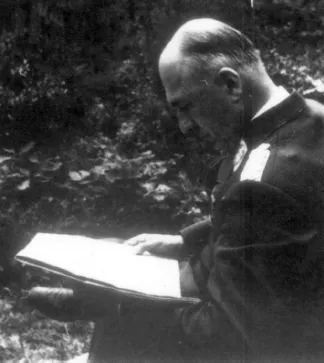
Dr. Todt seen reading during the war in a previously unpublished photograph. (HHA)
Even today, over seven decades later, the autobahns remain engineering marvels of the modern world, and the Nazi-inspired Volkswagen Beetle became the best-selling car in the world just as Hitler predicted. Today, they traverse Central Europe on the Führer’s most enduring legacy: the concrete ribbons that encompass the modern German democratic state.
Both Hitler and the Czech-born car genius Dr. Ferdinand Porsche the Elder—designer of the prototype VW—are names well-known in the West, and, indeed, around the world, but not so that of the father of the Autobahnen, Hitler’s premier engineer, Dr. Fritz Todt, who also built the German West Wall (known to the Allies as the Siegfried Line), and who started construction of the Atlantic Wall. Who was Fritz Todt, and why was his loss in an airplane crash on February 8, 1942 so lamented by his brother Nazis?
Fritz Todt was born in Pforzheim, Baden, Germany on September 4, 1891, the only child of Emil and Elise Todt. His father was the owner of a jewelry factory. Albert Speer wrote of the similarities between Todt and himself: “We had much in common… Both of us came from prosperous, upper middle class circumstances; both of us were Badeners and had technological backgrounds. We loved nature, life in alpine shelters, ski tours…”1 He attended public primary and secondary schools in Pforzheim, graduating in 1910 with a “very good” certificate. Following a year’s enlistment in the Baden Field Artillery Regiment 14 in Karlsrühe, he studied at a Technische Hochschule (college of technology) in Munich and in Karlsrühe from 1911 to 1914.2 His studies were interrupted by World War I. At Todt’s funeral in 1942, Hitler summarized his service in World War I:
At the outbreak of war, he joined the fourth regiment of field artillery and first saw action on the Western Front. In October 1914, he was named a lieutenant of the reserves, and assigned to the 110th Regiment. With this outfit, he fought up to January 1916. Then he joined the Air Force, became an aerial observer, and was finally leader of an independent flight squadron up to war’s end on the Western Front. He was also wounded in an air battle.3
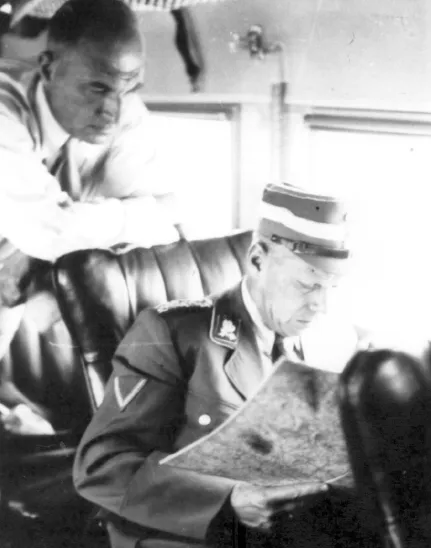
Dr. Todt (left) looking over the shoulder of Nazi Motor Korpsführer (Corps Leader) Adolf Hühnlein during a joint inspection tour of autobahn construction sites in 1935. The two top Nazis worked closely together, just as, later, Dr. Speer would also cooperate with the German Inspector General of Automotives, Jakob Werlin. (HHA)
From August to October 1914 he served on the Western Front with the Baden Field Artillery. Afterwards he became a lieutenant in the reserves in Baden Infantry Regiment 110. Having joined the Air Force in January 1916, in June he became “leader of the Reihenbildtruup (Reihen Picture Troop) of Army Group C, Mars-la-Tour/Briey, France. In August 1918, he was wounded in an air battle.”4 In all, Todt was wounded twice, and was decorated with the Iron Cross 1st and 2nd Class, the Hohenzollern Order, the Bavarian Military Service Order, and the Baden-Zahringer Lion Order.
After World War I, Todt returned to his studies. He completed his professional studies in 1920. He worked first as a laborer, before settling at the Munich civil engineering firm of Sager & Wörner in 1921. He was soon promoted to construction foreman at a water power plant project at Ulm on the Middle Isar River. Beginning in 1925, Todt studied the latest construction methods of the day, leading to his next promotion, when he became Sager & Wörner’s technical leader and manager. He then specialized in modern road surfacing, working all over Weimar Republican Germany, from Bavaria to Pommern, from East Prussia to Hanover, from Saxony to Württemberg, from the Saar to Pfalz. As the later Nazi-made film Dr. Todt: Man, Mission and Achievement asserted in 1943, “Times were hard. Prospects were poor for engineers.”
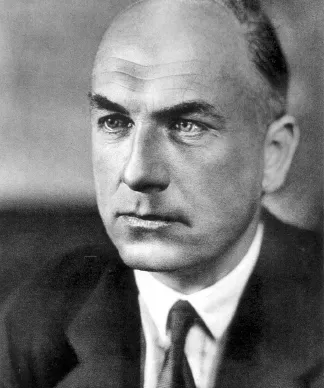
General Inspector Doctor of Engineering Fritz Todt, builder of the Reich Autobahnen, an official portrait that appeared as the frontispiece of his 1943 biography. (HHA)

On January 12, 1941, Dr. Fritz Todt (left) presented Reich Marshal Hermann Göring (right) with a book on fortress building on Göring’s 48th birthday, to his evident pleasure. Dr. Todt was Göring’s commander in two separate capacities, both as a Major General in the Luftwaffe, and also as his Four Year Plan appointee for construction projects—an unusual position to be in with one’s rival! (HGA)
Todt joined the Nationalsozialistische Deutsche Arbeiterpartei (German National Socialist Workers’ Party or NSDAP) on January 5, 1922. In 1931, he was made an Schutzstaffel (Protection Squad, or SS) Standardtenführer (Colonel) on the staff of Heinrich Himmler. Hitler’s eulogy summarizes his progression within the Party:
In 1931, he joined the SA [Sturmabteilung (Storm Detachment)] … starting as an ordinary Storm Trooper. He then became a squad leader, in the same year was advanced to standard bearer, and by 1938, had risen to Chief Leader, Brigade Leader, and—finally—Chief Brigade Leader, and was active as well in the Party … an associate of the progressive League of German Architects and Engineers in Munich … and Technical Consultant of Highway Construction in the Office for Economic Coordination and Work Procurement of the Party.5
In 1931, Todt completed his doctorate. His doctoral dissertation was a paper based on his personal experiences at construction sites and his specialization in modern road surfacing, entitled The Causes of Defects of Asphalt (Blacktop) on Roads (also known as Reasons for Paving Mistakes of Roads Paved with Tar and Asphalt). Hitler’s eulogy continued:
In 1932, [his activities] resulted in the NS German Technical Union coming under his leadership… In connection with the opening of the Automobile Exposition in 1933, I tried to realize … improvement of the German road network already in existence, but also in the field of construction of new, special auto roads.
This was a general plan which essentially only embraced the general principles. In Dr. Todt … I believed I had found a man who was suited to transform a theoretical intention into a practical reality. A brochure published by him about new ways of road construction was submitted to me, and especially strengthened me in this hope.
After long discussions, I entrusted him on June 30, 1933 with the task of building the new Reich’s auto roads, and … the general reform of the whole German highway construction system, as General Director for the German Highway Construction System…
During the next decade, the modest, unassuming technologist gathered into his hands responsibility for the entire German construction industry … in charge of all navigational waterways and power plants.6
DR. ROBERT LEY AND THE DEUTSCHE ARBEITSFRONT (DAF)
Doctor Robert Ley’s early, and enduring, support of Adolf Hitler meant that he achieved great power despite the negative opinions held of him by most of the rest of the Nazi leadership. In World War I his aircraft was shot down, and he became a prisoner of war. He almost lost a leg, and sustained frontal-lobe damage which affected his mental condition, leaving him with a stammer, and increasingly, an alcohol addiction. (A car accident in 1930 may have exacerbated the damage.) However, once released from captivity, he renewed his studies, and obtained his doctorate in chemistry within six months.
He gave up his job to devote all his time to Party affairs in the mid-1920s, a risky move that showed his complete conviction, which Hitler never forgot. He rose within the Party, becoming Reich Organizational Director in 1933....
Table of contents
- Cover
- Title Page
- Copyright
- Contents
- Dedication
- Acknowledgments
- Author’s Preface
- Chapter One: Dr. Fritz Todt: Nazism’s Master Engineer-Builder
- Chapter Two: “The Führer’s Roads”: Nazi Autobahnen Ribbons of Concrete, 1933–45
- Chapter Three: The West Wall: Hanging out the Washing on the Siegfried Line
- Chapter Four: Minister of Armaments and Munitions, 1940–42
- Chapter Five: 1942: A Funeral in Berlin, 1942
- Chapter Six: Enter Dr. Albert Speer
- Chapter Seven: Nazi Rocketry, 1933–45
- Chapter Eight: Speer and the German Atomic Bomb, 1942–45
- Chapter Nine: Reich Minister of Armaments and War Production, 1942–45
- Chapter Ten: From Capture to Nuremberg, 1945–47
- Chapter Eleven: Prisoner #5: from “Spandauer” to Bestselling Author, 1947–81
- Bibliography
- Endnotes
Trusted by 375,005 students
Access to over 1.5 million titles for a fair monthly price.
Study more efficiently using our study tools.
Frequently asked questions
Yes, you can cancel anytime from the Subscription tab in your account settings on the Perlego website. Your subscription will stay active until the end of your current billing period. Learn how to cancel your subscription
No, books cannot be downloaded as external files, such as PDFs, for use outside of Perlego. However, you can download books within the Perlego app for offline reading on mobile or tablet. Learn how to download books offline
Perlego offers two plans: Essential and Complete
- Essential is ideal for learners and professionals who enjoy exploring a wide range of subjects. Access the Essential Library with 800,000+ trusted titles and best-sellers across business, personal growth, and the humanities. Includes unlimited reading time and Standard Read Aloud voice.
- Complete: Perfect for advanced learners and researchers needing full, unrestricted access. Unlock 1.5M+ books across hundreds of subjects, including academic and specialized titles. The Complete Plan also includes advanced features like Premium Read Aloud and Research Assistant.
We are an online textbook subscription service, where you can get access to an entire online library for less than the price of a single book per month. With over 1.5 million books across 990+ topics, we’ve got you covered! Learn about our mission
Look out for the read-aloud symbol on your next book to see if you can listen to it. The read-aloud tool reads text aloud for you, highlighting the text as it is being read. You can pause it, speed it up and slow it down. Learn more about Read Aloud
Yes! You can use the Perlego app on both iOS and Android devices to read anytime, anywhere — even offline. Perfect for commutes or when you’re on the go.
Please note we cannot support devices running on iOS 13 and Android 7 or earlier. Learn more about using the app
Please note we cannot support devices running on iOS 13 and Android 7 or earlier. Learn more about using the app
Yes, you can access Hitler's Engineers by Blaine Taylor in PDF and/or ePUB format, as well as other popular books in History & Political Biographies. We have over 1.5 million books available in our catalogue for you to explore.