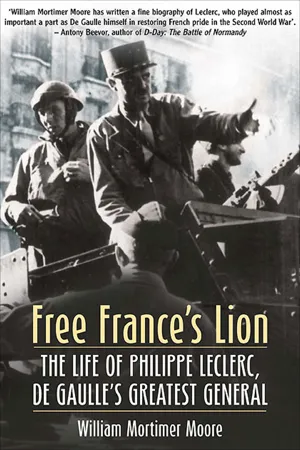
"A fine biography of Leclerc, who played almost as important a part as de Gaulle himself in restoring French pride in the Second World War" (Antony Beevor, international bestselling author of
D-Day).
From the fall of France until 1943, Philippe Leclerc dovetailed his operations with the British effort in North Africa, establishing himself as a dynamic combat leader in the battles against Rommel. But once the conflict shifted to European soil, he became even more prominent as the commander of the 2nd French Armored Division—the famous 2e DB). For the next two years, he was under the operational control of either Patton's Third Army, as in the Normandy breakout, Hodges' First Army, at the Westwall, or Patch's Seventh Army in the south.
His career not only includes the liberation of Paris, for which he is most famous, but the retaking of Strasbourg and the reduction of the Colmar Pocket. Helping to spearhead the advance into Germany itself, Leclerc's armor comprised a rock upon which American units could rely, and its waving the tricolor during the Allied counter-invasion went far toward retrieving French prestige in the war. Leclerc is one of very few Frenchmen of whom it can be said that he never stopped fighting to regain France's freedom, from the debacle of 1940 right through to the end.
The "first full-scale biography in English of the 'liberator of Paris,'"
Free France's Lion will make fascinating reading for any serious student of the full scope of World War II (
Publishers Weekly).
For a man whose death united all classes in grief, Leclerc had begun life in the privileged upper stratum that typified “Old France.” He officially adopted the name Leclerc in 1945 from the nom de guerre he had used since 1940, but he always stayed true to the traditional values of his upbringing.
Born on 22 November 1902, he was christened Philippe Francois Marie de Hauteclocque, and was the fifth child and second son of Count and Countess Adrien de Hauteclocque of Chateau Belloy Saint Leonard in Picardy. His father, an aristocratic patriarch, ruled the locality, setting a traditional tone both for his family and the village he dominated. For Count Adrien the Third Republic, which followed Prussia’s defeat of Napoleon III, was not good enough for la belle France. Yet, even in the days of monarchy, the Hauteclocque family usually preferred its own patch to hanging around court at Versailles or cavorting in Paris—a stance which attracted the nickname “gentilhomme fesses-lièvres” (“gentleman harebuttocks”) from flashier branches of the French aristocracy.
Even with industrial Amiens nearby, life at Belloy Saint Leonard was self-contained, time-warped and exclusive. The estate pack of hounds, the “Rallye Scarbon,” attracted glamorous and influential guests including “Bendor,’ the Duke of Westminster who courted Coco Chanel,1 while Count Adrien’s love of deer and boar stalking often made him drive his Bugatti or Lancia to distant forests in eastern Europe.
More serious and reflective than his older brother, Philippe was educated at home until the age of thirteen. Count Adrien himself gave his younger son competent Latin lessons and, supported by a solid grounding in Catholic morals from the Countess and German from his Alsatian governess, Philippe rose to the top of his first year when he was sent to the Jesuit-run École de la Providence in Amiens. This Catholic education, so similar to de Gaulle’s, was to be one of the most formative influences on Philippe’s character.
The Hauteclocques were Papal counts, ennobled by Pius IX in 1857 for their longstanding support of Catholic interests. The title carried social prestige but no political rights, and eclipsed the rank of chevalier (the French equivalent of a baronet or hereditary knight), which had been bestowed on earlier branches of the family. When the Revolution of 1789 erupted, the Hauteclocques, having been seigneurs in Picardy for eight centuries, were undoubtedly at risk. Fortunately, Robespierre’s Committee of Public Safety were after larger fish, and the family’s only brush with “the Terror” was borne by Chevalier Francois Louis de Hauteclocque, who was imprisoned but not guillotined.
Of Chevalier de Hauteclocque’s five sons, three served Napoleon: Stanislas, the eldest, fought at Essling and Saragossa; César, the second son, also fought in Prussia and Spain before serving the restored Bourbons until 1830; and Constantin, the third son, suffered such severe frostbite in his toes during the infamous retreat from Moscow that he was forced to resign his commission. Constantin, raised to chevalier by Louis XVIII and made Papal Count in 1857,2 had two sons: Alfred Francois Marie (1822–1902) who died childless, and Gustave Francois Marie Joseph (1829–1914). In 1859 Gustave married Marie-Henriette de Morgan-Frondeville, producing three sons: Henry (1862–1914), Adrien (1864–1945) and Wallerand (1866–1914). Marie-Henriette, a strong and lively character, was also an heiress who brought a considerable fortune to the Hauteclocques, including the chateau of Belloy Saint Leonard.3 Count Adrien’s wife, Marie-Therese Van der Cruisse de Waziers (1870–1956), was also descended from a family of Papal counts, and sufficiently beautiful for her portrait to be exhibited at the Paris Salon of 1908.
Steeped in the traditions of France’s Catholic aristocracy, it was naturally impossible for Philippe de Hauteclocque to conceive of a France where Catholic belief was not central to daily life. Religious practice was carried out with an intensity few outside holy orders would now recognise. Count Adrien’s chateau was a place of pries-dieux, mantillas, crucifixes, and frequent prayer, where the encyclicals of nineteenth-century Catholicism were followed to the letter. When the new Third Republic attempted to sever the historic ties between church and state, families like the Hauteclocques felt compelled to express their quasi-medieval patriotism through Christian democracy. Bow as he must to political changes, the staunchly monarchist Count Adrien never allowed Bastille Day celebrations at Belloy, and increasingly adhered to the right wing views of Charles Maurras.
Maurras first made his name as an anti-Dreyfusard when a Jewish officer was falsely accused of spying for Germany. Like Maurras, the Hauteclocques were horrified that the predominantly Catholic and aristocratic officer corps should be attacked over the fate of a single officer, even if he was innocent! Following the success of his pamphlet Enquete sur la monarchie, Maurras launched the right-wing journal Action Française in 1908. Action Française quickly evolved into a highly influential movement, especially in the countryside. For the next thirty years, sons of the landed and business classes (Camelots du Roi, or “Peddlers of the King”), brandishing hawkers’ licences issued by the Gendarmerie, sold the journal after Sunday Mass. Regarding itself as the standard bearer of “Old France” and taking the royal fleur de lys as its emblem, Action Française advocated restoration of the monachy, mystical devotion to la Patrie, and Christianity (preferably Catholicism), the recovery of the lost provinces of Alsace and Lorraine, and it also included a hefty dose of social—as distinct from murderous— anti-Semitism.4 The Hauteclocques were early subscribers to the journal, as was Henri de Gaulle, the future leader’s father. But Action Française also had an inherent flaw: Maurras himself was not a Christian but saw “Frenchness” in almost racial terms. This factor made little difference unless, or until, French patriotism required a moral—and necessarily Christian—core in order to reinvent itself.
The Hauteclocques in all other respects saw themselves as any other European aristocratic family—well armed with common sense and more than a little “gung-ho.” Anecdotes of Count Adrien’s nonchalance towards hunting injuries were inevitably absorbed by Philippe. One story relates how Count Adrien, after being decked and gored in the thigh by a wild boar, got to his feet expecting to continue the hunt, and only allowed a doctor to examine him when he was almost fainting from blood loss. Another anecdote concerns uncle Wallerand, who broke both legs when his horse bucked during a parade at Belfort. Wallerand insisted on handing the parade to another officer before being taken to hospital. Yet typically, when fighting Samory in the Soudan, Wallerand’s letters home were more concerned with la chasse: “The first day I didn’t feel too well, but since then I have regularly been king of the hunt…. The day before yesterday I shot a bustard which I offered straight away to Lieutenant Cambaceres…. A little while ago I managed to put a bullet into a large cayman by the river bank. This pleased me a lot as we hadn’t managed to bag anything for four days. We have also discharged our guns at a lot of monkeys!”5
So far, however, the family’s military tradition was neither unbroken nor especially distinguished. France’s defeat by Prussia in 1870 reinvigorated the Hauteclocque family’s martial instincts that had lain dormant since Napoleon. But while the French Army commissioned his brothers, Adrien was declared unfit because his chest was too small. But then the Great War changed everything.6 On 5th August 1914, Adrien pretended he was going into Amiens to run a few errands but went instead to the recruitment office. That evening he told his wife that he could not live with himself while others fought, saying God had given him a chance to prove himself. A few days later he jumped on a tram in Amiens and went off to war, making a good-bye gesture with his helmet, while his wife, who thought the war purifying, waved him au revoir with a newspaper.7 Though pushing fifty years of age, he enlisted in the 11e Cuirassiers where his eldest son Guy was already a cornet. Relishing life as an ordinary cavalryman, Adrien astonished everyone with his toughness. However, during the very first month of the war, both his brothers Henri and Wallerand and his nephew Bernard were killed. Trooper Adrien thus became Count de Hauteclocque.
After a spell in the ranks, Count Adrien was commissioned. He won his first Croix de Guerre in May 1917 during the disastrous Nivelle offensive: “Showing great endurance and selflessness, he showed a remarkable disregard for danger in leading his troop into the attack under heavy fire.” Later that same summer Count Adrien carried the ensign at the Bastille Day parade in Paris, despite his monarchist views and the tradition that colours are usually entrusted to younger officers. His second Croix de Guerre came the following year: “Finding himself at his colonel’s command post at a time when it was severely menaced by an outflanking movement by the enemy, he took command of a hastily formed detachment made up of whoever was available, and advanced resolutely to contact with the enemy over open ground … he fought all day at the head of his detachment with great courage and coolness, succeeding in halting the German advance.”8
When the 11e Cuirassiers were ordered to fight as infantry Count Adrien was offered a transfer to a mounted regiment but chose to stay with the men. Trench life did not curtail his indulgence in la chasse, and he even managed to keep his dog with him. “The game seemed impervious to the dangers,” he wrote joyfully in his diary.9
On leave, Count Adrien gave his younger son as much time as possible. If leave dates did not coincide with Philippe’s exeats, the Jesuits were flexible in allowing Philippe to make his own way back to Amiens even if it meant walking through snow.10 The École de la Providence provided a comprehensive classical and religious education combined with physical fitness. Philippe’s older brother Guy, Count Adrien and his uncles had also attended, though his grandfather, Gustave, was educated in Belgium since the Jesuits were then still banned from running schools in France.
Amiens’ proximity to the trenches meant classes were often conducted amid the sound of not so very distant cannon fire. Following the failure of Nivelle’s 1917 offensive, the school moved temporarily to Abbeville. The German spring offensive of 1918 then forced the school to evacuate to Poitiers until the war’s end.11 Any joy the Armistice held for Philippe was eclipsed by the death of his eldest sister, Françoise, who was also his godmother, a usual practice in such families.
Despite the continuous stress that all pupils shared with their fathers and brothers in the front line, Philippe did well academically and was popular enough for his class to vote him a prize for good behaviour. They also called him the “aristo” due to his cool shyness. Unless obliged to tell someone exactly what he thought of them, Philippe always had perfect manners. His strong Christian faith was also always remarked upon, both by those who had known him as a young man and by officers who later built their careers with him. École de la Providence’s Father Villaret would write:
You must understand that it is difficult for me to give you concrete details and circumstances of his spiritual life; his actions speak for themselves. But I can note, as a particular character trait, his intense devotion for the Holy Eucharist and for the Sacred Virgin. He consecrated himself to her in the Marist congregation at Amiens, Poitiers, and at Versailles, in the fullest possible meaning of the term, that is to say by a total and absolute gift of himself. This exquisite devotion is the source of the marvellous purity which struck everybody; even the most indifferent and distracted, without being able to explain it even to themselves, submitted to his charm.12
It is hard to imagine anyone writing such things in our more secularised age. Yet Philippe studied Catholicism extensively while at Amiens. Surviving library entries show that he withdrew titles such as La communion fréquente et quotidienne (“Frequent and Daily Communion”) and De la chasteté (“On Chastity”), both written for young Christians.13 Even so Philippe was no paragon; Father Villaret spotted his talent for teasing and noted that being “very sharp, he seized quickly on the essential aspect that was comic in things, people, even masters, guying them openly … ”14 Philippe, even then, was quick to recognise another’s weaknesses.
In 1920, shortly before his eighteenth birthday, Philippe de Hauteclocque arrived at École Sainte-Geneviève at Versailles. Recognised by France’s Society of Preparatory Schools, this college was also run on strict Jesuit lines, and taught officer candidates their science baccalaureat. Called “Ginette” by former pupils to this day, the school’s present website suggests a relaxed, easy and informal atmosphere, with religious staff dressed in mufti, belying its militaristic past and the strong patriotic sense of duty which it instilled into the war generations.15 It had only been seven years at its Versailles venue where it had taken over the Grand Montreuil. This fine building retained its grand chapel and cloistered courtyard, though was augmented with laboratories and had its park laid out to sports fields. The walls of Philippe’s spartan room were soon decorated with pictures of Belloy, family and dogs. Yet trips into 1920s Paris often included punchups with students from similar academies, which would be unthinkable today.16
Each year the top student was awarded a sabre blessed in front of the statue of Joan of Arc. General de Maud’huy17 presented this in Philippe’s year, with the words:
“Never draw this sabre without reason, never return it to its scabbard until you have accomplished the task for which it was drawn. When I look back on the last forty-five years, I remember around me the same faces, the same names and the same families who seem to have the monopoly on furnishing the officers of France. As Napoleon said, it’s always the same ones who get killed.
“You receive scruffy peasants without cohesion and you turn them into handsome soldiers; guys without discipline, working class revolutionaries, and you turn them into soldiers, patriots, men who will obey your slightest sign, ready to die for their country. Isn’t that wonderful? An officer must be a reservoir of energy and conscience…. It’...
Table of contents
Front Cover
Title Page
Copyright Page
Contents
Dedication
Foreword
Maps
Preface - Death in The Desert
Chapter 1: A True Son of France
Chapter 2: La Chute - The Fall of France
Chapter 3: De Gaulle's Man in Africa
Chapter 4: Annoying The Italians
Chapter 5: Consolidating, Raiding, and Planning
Chapter 6: A Very English Frenchman
Chapter 7: "A Gigantic Effort is Required of Us"
Chapter 8: The 2E DB in England
Chapter 9: First Blood - Alencon
Chapter 10: "Mouvement Immediat Sur Paris"
Chapter 11: Dompaire and Baccarat
Chapter 12: The Last Winter of The War
Chapter 13: A Good End to a Good War
Chapter 14: Indochine
Chapter 15: Back to French North Africa
Acknowledgments
Notes
Bibliography
Index
Trusted by 375,005 students
Access to over 1.5 million titles for a fair monthly price.
Study more efficiently using our study tools.
Frequently asked questions
Yes, you can cancel anytime from the Subscription tab in your account settings on the Perlego website. Your subscription will stay active until the end of your current billing period. Learn how to cancel your subscription
No, books cannot be downloaded as external files, such as PDFs, for use outside of Perlego. However, you can download books within the Perlego app for offline reading on mobile or tablet. Learn how to download books offline
Perlego offers two plans: Essential and Complete
Essential is ideal for learners and professionals who enjoy exploring a wide range of subjects. Access the Essential Library with 800,000+ trusted titles and best-sellers across business, personal growth, and the humanities. Includes unlimited reading time and Standard Read Aloud voice.
Complete: Perfect for advanced learners and researchers needing full, unrestricted access. Unlock 1.5M+ books across hundreds of subjects, including academic and specialized titles. The Complete Plan also includes advanced features like Premium Read Aloud and Research Assistant.
Both plans are available with monthly, semester, or annual billing cycles.
We are an online textbook subscription service, where you can get access to an entire online library for less than the price of a single book per month. With over 1.5 million books across 990+ topics, we’ve got you covered! Learn about our mission
Look out for the read-aloud symbol on your next book to see if you can listen to it. The read-aloud tool reads text aloud for you, highlighting the text as it is being read. You can pause it, speed it up and slow it down. Learn more about Read Aloud
Yes! You can use the Perlego app on both iOS and Android devices to read anytime, anywhere — even offline. Perfect for commutes or when you’re on the go. Please note we cannot support devices running on iOS 13 and Android 7 or earlier. Learn more about using the app
Yes, you can access Free France's Lion by William Mortimer Moore in PDF and/or ePUB format, as well as other popular books in History & Military Biographies. We have over 1.5 million books available in our catalogue for you to explore.