"Uses modern methods of operational analysis to determine exactly how the Japanese planned and executed the great raid . . . a worthy, useful analysis" (
Naval History).
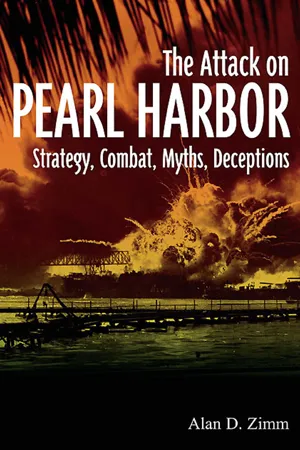
The December 7, 1941 attack on Pearl Harbor has been portrayed by historians as a dazzling success. With most American historians concentrating on command errors and the story of participants' experiences, the Japanese attack has never been subjected to a comprehensive critical analysis of the military side of the operation.
This book presents a detailed evaluation of the attack on the operational and tactical level. It examines such questions as: Was the strategy underlying the attack sound? Were there flaws in planning or execution? How did Japanese military culture influence the planning? How risky was the attack? What did the Japanese expect to achieve, compared to what they did achieve? Were there Japanese blunders? What were their consequences? What might have been the results if the attack had not benefited from the mistakes of the American commanders?
The book also addresses the body of folklore about the attack, assessing contentious issues such as the skill level of the Japanese aircrew; whether mini submarines torpedoed
Oklahoma and
Arizona, as has been recently claimed; whether the Japanese ever really considered launching a third-wave attack—and the consequences for the Naval Shipyard and the fuel storage tanks if it had been executed. In addition, the analysis has detected for the first time deceptions that a prominent Japanese participant in the attack placed into the historical record, most likely to conceal his blunders and enhance his reputation.
The centerpiece of the book is an analysis using modern Operations Research methods and computer simulations, as well as combat models developed between 1922 and 1946 at the US Naval War College. The analysis sheds new light on the strategy and tactics employed by Yamamoto to open the Pacific War, and offers a dramatically different appraisal of the effectiveness of the attack on Pearl Harbor.
- 465 pages
- English
- ePUB (mobile friendly)
- Available on iOS & Android
eBook - ePub
About this book
Information
CHAPTER ONE
STRATEGIC AND OPERATIONAL SETTING
Early Rumblings
An attack on Pearl Harbor as an opening move in a war between Japan and the United States was not a new or unusual concept in Japanese military circles.
The Japanese Navy had a tradition of opening wars with surprise attacks without a formal declaration of war. This was exemplified by their attack on the Russian fleet at Port Arthur, delivered two days after breaking off relations with Russia and two days before their formal declaration of war in the Russo-Japanese War.1
In 1927 Kaigun Daigakko, Japan’s naval staff college, wargamed an attack on Pearl Harbor by two carriers, one of which was lost. That same year, Lieutenant Commander Kusaka Ryunosuke, later as a Rear Admiral to serve as the Chief of Staff of the Pearl Harbor attack force, presented lectures on an aerial attack on Pearl Harbor.2 The following year, Yamamoto Isoroku, a captain who was to rise to command the Combined Fleet, in a lecture at the Navy Torpedo School, said “In operations against America, we must take positive actions such as an invasion of Hawaii,”3 and discussed striking Pearl Harbor. The subject was examined anew in “A Study of Strategy and Tactics in Operations against the United States,” a 1936 Naval Staff College analysis which suggested that Japan should open the war with a surprise attack on Pearl Harbor.4
On the civilian side, between 1910 and 1922, books about imaginary wars were in vogue. After a lull in the late 1920’s, there was an unprecedented outpouring of these books after the London Naval Conference and the Manchurian Incident of 1931, when Japan replaced Russia as the dominant power in South Manchuria. In 1934 alone at least 18 such books were promoted in magazines and newspapers, describing a future war with Russia, the United States, or both.5 Japanese authors such as Hirata Shinsakyu used a pre-emptive attack against Pearl Harbor to begin fictional depictions of war between Japan and the United States.6
Similar attacks were postulated by American and British authors as early as 1909.7 Novelists Ernest Fitzpatrick in The Conflict of Nations and Homer Lea in The Valor of Ignorance depicted Imperial Army soldiers arriving in the Hawaiian Islands as immigrant workers, wiping out the American garrison in a surprise attack, and proceeding to invade the American mainland.8 Bywater’s The Great Pacific War, written in 1925, had the US Asiatic Fleet hit by a surprise attack at Pearl Harbor to open the war.9
One curious aspect was that in many of the Japanese novels the Japanese were defeated, while many American novels had the Americans ignominiously booted out of the Pacific. “Rouse the populace by describing the horrors of defeat” was the message of this genre, predicting disaster if actions were not taken to forestall the threat.
The critical nature of Hawaii was well understood. Pearl Harbor was America’s central position in the Pacific, situated 2,074 nautical miles (nm) from San Francisco, 2,200nm from San Diego, 5,000nm to the Philippines and 3,350nm from Tokyo. First established as a U.S. naval base in 1908, it had been the headquarters of the Pacific Fleet since 1940, a crucial repair and logistics facility, and a vital link in the sea and air lines of communication between the United States and the Philippines. It was the ideal springboard for an American counterattack against Japan and the last line of defense before America’s mainland. Hawaii was considered by the Japanese as part of their Greater East Asia Co-Prosperity Sphere, and portrayed as a legitimate object of Japanese expansion—160,000 of its 400,000 population were doho, or ethnic Japanese, presumed to be yearning for reunification with their Japanese roots.10
Pearl Harbor and Oahu were developed as major bases, with the US Navy taking advantage of Hawaii’s good weather for training. The Pacific Fleet used raids on Pearl Harbor as a component of several Fleet Exercises from 1928 on.11
Japanese Naval Strategy in the 1920s and 1930s
Under the terms of the Washington Naval Treaty, Japan’s fleet of battleships was limited to 60% of the tonnage allocated to America and Great Britain. A disparity of forces was something the Japanese had overcome before. At the beginning of Japan’s war with China in 1894, the Japanese had fewer and smaller ships, on aggregate less than two-thirds of the Chinese tonnage, but they prevailed on the strengths of better gunnery and better tactics. In the Russo-Japanese War the Japanese again began as the weaker side, with half the number of capital ships and one-third the tonnage, and again they emerged victorious.12
With this heritage the Japanese were confident they could develop a strategy to defeat the United States. Two assumptions were central in their strategic planning. First, they believed that an attacking fleet required twice the combat capability of the defending fleet in order to prevail. This was to them confirmed by the travails of the Russian Baltic Fleet, which traveled halfway around the world only to be destroyed in the famous battle of Tsushima, the first defeat of a major Western naval force by an Asian navy.
Second, they believed that combat power was the square of the size of the force. This concept was similar to Frederick Lanchester’s modeling of air-to-air battles from the First World War, although the Japanese likely paid more attention to the writings of Rear Admiral Bradley Fiske, who worked out similar mathematical relationships. Fiske also advocated wargaming as a means of working out tactical and strategic problems in advance, a practice the Japanese embraced with enthusiasm. Thus, by squaring the proportions of force, the 10:6 ratio required by the terms of the treaties became 100:36 in terms of combat power, almost 3 to 1, which the Japanese viewed as sufficient for an attacking force to defeat them.13
To win, the Japanese had to change these odds. These assumptions would come into play later in their justification for the Pearl Harbor attack.
The Japanese strategy called for luring the American Pacific Fleet from San Diego out to the Western Pacific, where it would be defeated in a decisive battle. According to Agawa:
…the orthodox plan of operations called for the navy to throw its strength first into an attack on the Philippines. Then, when the US fleet came to the rescue and launched the inevitable counterattack, the Marshalls, Marianas, Carolines, Palaus, and other Japanese mandates in the South Pacific would be used as bases for whittling down the strength of the attacking American forces with submarines and aircraft so that finally, when they had been reduced to parity with the Japanese forces or even less, they could be engaged in a decisive battle in the seas near Japan and destroyed. This was much the same concept as underlay the Battle of the Japan Sea in which, in 1905, Japan had taken on and annihilated the Russian Baltic Fleet off Tsushima.14
The Japanese would invade the Philippines to secure their sea line of communications to the southern resource areas, and as a means to lure out the American fleet into an immediate movement to relieve the islands.15 The Americans would concentrate their warships to protect the large numbers of oilers, supply ships and auxiliaries needed to support the move. As this huge fleet steamed west a battle would develop, in several phases over perhaps several weeks.
In the first phase Japanese submarines, some uniquely equipped with search planes, would locate and track the American Fleet. The submarines, faster on the surface than the American battleline, would converge and deliver repeated attacks. Japanese long-range medium bombers based out of the Mandates would further bleed the American fleet. This was called “The Strategy of Interceptive Operations.”16
Contact between the surface ships of the two fleets would initiate the second phase. Japanese cruisers and destroyers would launch a series of night attacks, firing massive volleys of 120 or more long-range torpedoes, 25% of which were expected to hit. The Americans were expected to suffer heavy losses that would shatter their morale.
In the final phase, the Japanese battleline, now equal or superior in strength to the Americans, would complete the destruction in a long-range gun battle, using their superior speed to isolate portions of the American fleet. The Japanese expected this final battle to be decisive, leading to a negotiated peace. The Americans would be forced to acknowledge Japan’s dominant position in the western Pacific and Asia. This was Zengen Sakusen, or “The Great All-Out Battle Strategy.”17
This basic strategy became fixed in the minds of the Japanese Navy General Staff, changing little between 1925 and 1941. In 1936 Great Britain was added as an enemy. However, up through 1940, while American territories in the western Pacific were to be invaded and taken, and in spite of the popular exhortations of the novelists, the Naval General Staff’s Concept of Operations never considered Hawaii as a target.18
The Japanese expected to win through better tactics, better weapons, and higher-quality ships and personnel. Their training was intensive and realistic, often eschewing safety precautions: for example, destroyers practiced torpedo attacks at night and in poor weather at high speed, and had some dreadful collisions. During 1938 to 1940 training was particularly intensive, “as though a major war were in progress.” The stakes were high. For example, a new exercise was introduced where the fleet would enter harbor at night without illuminating the ships’ running lights, a risky undertaking. Should an error cause damage to one of the ships it was possible that the officer in charge would be “obliged to commit ritual suicide.”19 Night bombing attacks were practiced with an emphasis on realism. Searchlights from air defense sites would dazzle the pilots, which caused mid-air collisions and the loss of aircraft and lives. After several such incidents the program was questioned, but ultimately training continued as before. The losses were accepted.
Japanese ships were customized for the specific conditions and location of the expected encounter. The final decisive battle was to occur near home waters, so Japanese ships characteristically had only moderate endurance and low habitability and were expected to be able to operate largely out of their home ports. Hull strength, damage control fittings, stability, and other attributes were sacrificed to attain very high top speeds and very heavy armament. Ships were loaded with weapons far out of proportion to the ship’s displacement.
Sometimes the designs pushed armament loads too much. In 1934 the torpedo boat Tomozuru capsized in heavy seas. The design had to be revised, and the stability margins in other classes re-examined. Many ships were required to take aboard hundreds of tons of ballast to lower their center of gravity.
An attack on Pearl Harbor was not included in Zengen Sakusen. Japanese ships generally did not have the fuel to sail from Japan to Pearl Harbor and back. Since the decisive battle was to be fought near Japanese home bases, there was no imperative to develop underway replenishment methods or to build the specialized auxiliaries needed for remote operations.
The advent of the Southern Operation—the plan to capture the petroleum and resource producing regions of Malaya, Borneo and Java—delivered a shock to the Japanese Navy. Now the fleet was expected to take the offensive thousands of miles away from Japanese home waters, capture enemy territory, and hold it. Outlying areas that were expected to be lost in the course of the Interceptive Operations now were to be held.
The Naval General Staff adapted. The Decisive Battle was moved thousands of miles from Japan, before the Southern Resource Areas could be recaptured. Zengen Sakusen, the darling of the Naval General Staff, still applied.
However, with a change in command of the Japanese Combined Fleet came a change in the Fleet’s concept of how to open the war. The new commander was Admiral Yamamoto—the same Yamamoto Isoruko who had lectured on attacking Pearl Harbor in 1928. His thoughts returned to Pearl Harbor, considering the idea of a pre-emptive attack against the American Pacific Fleet employing Kido Butai, the concentrated carrier striking force. “It took someone in the Japanese naval high command of his position, stature, and heretical outlook to make the argument at the highest levels, and then push it through to activation.”20
To Attack Pearl Harbor: Yamamoto’s Objectives
Yamamoto believed that Japan should “fiercely attack and destroy the US main fleet at the outset of the war, so that the morale of the U. S. Navy and her people” would “sink to the extent that it could not be recovered.” He went on to say, “We should do our very best at the outset of the war with the United States… to decide the fate of the war on the very first day.” More ominously, he predicted that “If we fail, we’d better give up the war.”21
With the spectacular success of the Pearl Harbor attack, such fatalism has been discounted. Yet, Yamamoto himself...
Table of contents
- FRONT COVER
- TITLE PAGE
- COPYRIGHT PAGE
- CONTENTS
- CHARTS AND DIAGRAMS
- INTRODUCTION
- CHAPTER 1 Strategic and Operational Setting
- CHAPTER 2 Targets, Weapons and Weapon-Target Pairings
- CHAPTER 3 Wargames
- CHAPTER 4 Planning the Attack
- CHAPTER 5 Pre-Attack: Training, Rehearsals, Briefings and Contingency Planning
- CHAPTER 6 Execution of the Attack
- CHAPTER 7 Assessment of the Attack
- CHAPTER 8 Battle Damage Assessment
- CHAPTER 9 What Might Have Been: Alerted Pearl Harbor Defenses
- CHAPTER 10 Assessing the Folklore
- CHAPTER 11 The Fifth Midget Submarine: A Cautionary Tale
- CHAPTER 12 Reassessing the Participants
- CHAPTER 13 Summary and Conclusions
- APPENDIX A: Tabulation of Second-Wave Dive-Bomber Attacks
- APPENDIX B Abbreviations, Acronyms, and Japanese Terms
- APPENDIX C: Ships in Pearl Harbor and Vicinity
- APPENDIX D: The Perfect Attack
- APPENDIX E: Acknowledgments
- BIBLIOGRAPHY
- END NOTES
Trusted by 375,005 students
Access to over 1.5 million titles for a fair monthly price.
Study more efficiently using our study tools.
Frequently asked questions
Yes, you can cancel anytime from the Subscription tab in your account settings on the Perlego website. Your subscription will stay active until the end of your current billing period. Learn how to cancel your subscription
No, books cannot be downloaded as external files, such as PDFs, for use outside of Perlego. However, you can download books within the Perlego app for offline reading on mobile or tablet. Learn how to download books offline
Perlego offers two plans: Essential and Complete
- Essential is ideal for learners and professionals who enjoy exploring a wide range of subjects. Access the Essential Library with 800,000+ trusted titles and best-sellers across business, personal growth, and the humanities. Includes unlimited reading time and Standard Read Aloud voice.
- Complete: Perfect for advanced learners and researchers needing full, unrestricted access. Unlock 1.5M+ books across hundreds of subjects, including academic and specialized titles. The Complete Plan also includes advanced features like Premium Read Aloud and Research Assistant.
We are an online textbook subscription service, where you can get access to an entire online library for less than the price of a single book per month. With over 1.5 million books across 990+ topics, we’ve got you covered! Learn about our mission
Look out for the read-aloud symbol on your next book to see if you can listen to it. The read-aloud tool reads text aloud for you, highlighting the text as it is being read. You can pause it, speed it up and slow it down. Learn more about Read Aloud
Yes! You can use the Perlego app on both iOS and Android devices to read anytime, anywhere — even offline. Perfect for commutes or when you’re on the go.
Please note we cannot support devices running on iOS 13 and Android 7 or earlier. Learn more about using the app
Please note we cannot support devices running on iOS 13 and Android 7 or earlier. Learn more about using the app
Yes, you can access The Attack on Pearl Harbor by Alan D. Zimm in PDF and/or ePUB format, as well as other popular books in History & Military & Maritime History. We have over 1.5 million books available in our catalogue for you to explore.