From flying with the Screaming Eagles in Vietnam to serving with the Marines and the Royal Navy, this memoir recounts the life of a career military pilot.
Sometimes it just isn't your day. Whether your helicopter comes apart in flight due to equipment failure, or another aircraft runs into you in midair, or an enemy gunner lands his rounds in exactly the right spot to take you out of the sky. That's why, after twenty-four years and more than five thousand flight hours with four armed services, Maj. Robert Curtis was surprised to still be alive when he passed his retirement physical.
His flying career began in the thick of the war, flying Chinooks over Vietnam with the 101st Airborne. From there, Curtis continued to serve with the National Guard while attending college. By then, flying had become an addiction for Curtis, so he continued on with the Marine Corps and Royal Navy. Over the next seventeen years, he would fly off US and British ships from Egypt to Norway and all points in between.
Curtis flew eight different helicopters—the wooden-bladed OH-13E, through the Chinook, SeaKnight, and SeaKing—in war and peace around the world. During that time, many of his friends died in crashes, both in combat and in accidents. But some combination of skill, luck, and superstition saw him through.
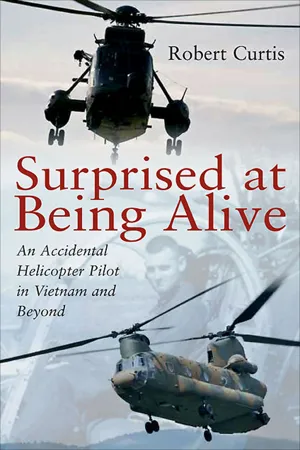
eBook - ePub
Surprised at Being Alive
An Accidental Helicopter Pilot in Vietnam and Beyond
- 312 pages
- English
- ePUB (mobile friendly)
- Available on iOS & Android
eBook - ePub
About this book
Information
FLYING LIFE ONE
THE ARMY
1968–1972
1
THE ACCIDENTAL AVIATOR
COVINGTON, KENTUCKY ■ FEBRUARY 1968
The posters showed a young man of the classical All-American type, clean cut, moderate length dark hair, brown V-neck sweater, sitting on the steps of what appeared to be a high school. His hand was resting on his chin and he looked upward, off upward toward a clear blue sky. Below him, printed in large letters were the words, “1, days between you and the sky.” In smaller type below that, the poster announced the US Army would take a young man with a high school diploma or a general educational development (GED) certificate, 20–20 vision (or correctable to 20–20), and who would be at least-1 years old upon completing the program and make him into a helicopter pilot. If you could meet these minimal requirements, pass a flight physical, and complete the training, you could become an Army Aviator and find the freedom of the sky. And, although the ad did not say it, in -1/0 you would also find the Vietnam War.
I received the notice from my local draft board to take the draft physical in early March, 1968. I would turn 19 in May and had been relatively certain that this letter would be forthcoming. In March, 1968 there were no draft numbers, only the near certainty of being drafted if you did not have a ready deferment, like college. The physical itself was a long boring day of lines and forms and being herded from one room to another for tests of one sort or another in the big downtown Cincinnati Federal Building. As I walked into the building that morning, an anti-war protester about my age standing just outside the door handed me a flyer. I glanced at the words just long enough to see what it was, and then I wadded it up and bounced it off his forehead as I continued inside. At the end of the day, I was certified mentally and physically qualified for military service. After passing the physical, I knew the “Greetings” letter would soon come to the two-room apartment I shared with my wife of six months. We rented it from one of her cousins and, both of us being 18, kept their kids entertained through the walls, or must have since they always giggled for some reason whenever they saw us.
In ‘68, being a high school dropout with a GED certificate, 18, married with no children, not a student or an objector or a sole-surviving son, completely settled the issue. A week after I got the letter confirming I had passed the physical, I called the draft board. “Yes, you will be drafted, probably in July; unless, of course, you want to volunteer to be drafted, in which case you could leave next month.”
There were other choices: objector, Canada, immediate entry into school (if I could find one that would take me and that I could afford, both doubtful) but I really did not see any other choices except one. Instead of waiting for the draft I could enlist and gain some small measure of control over my fate. The other alternatives, if I thought of them at all, which I didn’t, were unacceptable, not because I was a burning anti-Communist, or believed “my country, right or wrong,” or because I pretended to understand the war one way or another. My people were from the mountains of Kentucky and there were some things the men always did. Going into the military was one of them.
All my life I played among the dusty uniforms hanging in the closets and looked at the fading photographs of my dad and my uncles from their military times, war and peace. I played in their old “Ike” jackets from the 40’s and 50’s and treasured the spent cartridge cases and old unit patches they had given me. I had my “science cabinet” (an old china cabinet) full of these things and others, patches from various Army units, a Nazi party pin one of my uncles brought back from the war, a WWI Victory medal given to me by an old veteran neighbor, an empty ammo clip from an m-1 rifle, all displayed next to the buffalo skull I brought back from a visit to relatives in Oklahoma, plus the dead tarantula sent me in a match box by my Uncle Bill, a veteran of the war in the Pacific who lived in Texas.
All my life, too, I saw the well-oiled and cleaned rifles and shotguns hanging on the walls of the houses in the Kentucky hollers (mountain valleys) of my childhood. No matter how poor the family, the weapons were always there along with pictures of the men in uniform. Few men were drafted out of the hollers because most enlisted when their war came. In fact, in Breathitt County during one of our wars, no one was drafted because all the men enlisted. Again, not from burning patriotism, although patriotic they were and still are—it was just what the men in their families had always done. The hardships of military service were often a rest from the reality of the true hardships of mountain life, coal mines and small farms. After all, in the military you always had clothes and food and a paycheck, small perhaps, but more than welfare.
My then wife’s people were of the same mountain stock as mine; in fact, we were distant cousins. But for her, it was not so simple. At 18 her life as a woman had just begun. She was only now becoming adjusted to our life together and she saw clearly that it could end all too soon. One of our high school teachers even told us, as we sat in the cafeteria before I quit high school for the second and final time, that we would get married; I would then get drafted and would be killed in Vietnam. But running away never occurred to her either.
The next day I drove our first new car, a blue ‘68 Mustang that my factory laborer’s job allowed us to buy, across the bridge from Newport over the Licking River to Covington, to the nearest recruiter’s office. The street the recruiting office was on had been the center of town—you could still see the streetcar tracks in between the cobbles laid down by the German immigrants—but in ‘68, Covington was fading fast. Empty storefronts displayed “for lease or sale” signs in the windows and the streets were not swept as often as they once had been. The litter of city trash sat in the curb and on the sidewalks and made everything feel even more rundown than it was.
The recruiting office had once been a restaurant, but as the businesses that provided the customers for the lunch trade folded, the restaurant joined them. Where the tables and chairs of the diner had been, were the desks of the three service’s recruiters, Navy, Marines, and Army, all in a row. The tiles on the floor still spelled out the restaurant’s name. During the race riots of the year before, I had worked at a very similar restaurant, just down the street from the recruiter’s office. The restaurant’s owner hid guns throughout the place—a rifle and a shotgun in the kitchen and a pistol under the counter, and told me, “If they start breaking in, just grab the first gun you are close to and open up.” my plan was simpler—“they” break in the front, I am out the back and gone. It’s all “theirs.”
When I walked in, the Army recruiter was talking to two other young men, which was fine—I didn’t want to talk to him anyway. One of my uncles was a marine gunnery sergeant, a “Gunny.” Because of him, I had wanted to be a marine since I was a little boy. The marine recruiter was sitting alone reading a western novel when I walked to the front of his desk and stood there, waiting for him to look up. When he did, the marine smiled.
Motioning me into a chair by the desk, the marine introduced himself as the Gunny, non-commissioned officer in charge, NCOIC, of the Marine Corps portion of the recruiting station. What could he tell me that was not already common knowledge? “The greatest fighting outfit the world had ever seen and after boot camp, you become one of us, you become a Marine. A two-year enlistment in the infantry would be the perfect start on life and an experience that you could tell your grandchildren about.” Still with a smile the Gunny said, “Boy, we’ll put you in the rice paddies and you can kill all the Cong you can find.”
As the Marine talked about his own infantry experiences in “the Nam” I looked at the three rows of ribbons on his chest and the hardness of his smile. My Marine uncle’s experiences from boot camp, Korea, and Vietnam came back to me, and the Gunny lost his recruit. Rifles and rice paddies would be only a last resort. I would not voluntarily sign on for what the draft promised anyway. After listening politely for a decent interval, I thanked the marine and told him I would think about what he said. As I turned to go I saw the Army recruiter was now free.
As I walked toward the Army recruiter he turned his head slightly and gave the marine a little grin. After a few questions about my background the recruiter asked, “How would you like to be a helicopter pilot?” Leafing through the pamphlets on his desk, he selected one, and laid it in front of me. The leaflet began, “90 Days Between You And The Sky.” As I read, the thought came to me that if I were to die, it would be better to fly to the spot rather than walk to it. Six months later I reported to Fort Polk, Louisiana. Nearly all warrant officer candidates (WOCs) went through Fort Polk and it was exactly what you would think it would be with the Vietnam War in full swing. Everyone smart enough to get out of military service had, leaving mostly National Guard and reserve enlistees, draftees and those of us who enlisted to “beat the draft.”
Twelve weeks later, a couple hundred candidates-to-be boarded Greyhound buses immediately after graduation from basic training and traveled to Fort Wolters, Texas, for a month of pre-flight training and then primary flight training. The demand for pilots was so strong that the Army had ten companies of WOCs under training at once for many years. I joined 9th WOC, the Tan Hats.
2
CHASING BUZZARDS
FORT WOLTERS, TEXAS ■ FEBRUARY 1969
The OH-23 Raven was a three-man bubble helicopter designed by one of the pioneers of vertical flight, Stanley Hiller. The first ones came out in the early 1950’s and the final versions lasted long enough to see service as scouts in Vietnam. Even in 2013, a few OH-23’s soldier on as crop dusters or toys for people with the money to keep an old helicopter operational. The 23 was a typical bubble helicopter, i.e., slow, with a manual throttle that works opposite of a motorcycle (the grip was black rubber and read “Harley-Davidson”), and was a very rugged machine, as I discovered when I bounced one about 20 feet into the air after screwing up a simulated engine failure, with no damage to the machine.
Seventeen flight hours into my aviation career, I couldn’t say I really had much of an understanding of the process of flying in general, and the process of flying helicopters in particular. All us warrant officer candidates (WOCs) struggling to get through Primary Flight training at Fort Wolters were in about the same position; that is, scared and confused, but never admitting anything, even to each other. To admit any fear meant running the risk of having the staff wash you out of flight school, or maybe having one of your classmates write you up in a peer review that would accomplish the same thing, whereupon the Army would hand you a rifle and send you wading into the Vietnamese rice paddies. This, of course, is exactly what they did do in 1968 when you washed out of flight school. You still owed Uncle Sam a year and a half—plenty of time for a Vietnam tour.
I had soloed in the OH-23D helicopter the week before. After six-and-a-half hours of dual flight, my instructor looked over at me, smiled, and said, “Take it around the pattern three times, then come back and pick me up.” As he opened the door to climb out of the little helicopter, he started laughing, laughing so loud that I could hear him over the engine noise. I watched him walk to the ready shack where we waited between flights without even looking back, still laughing.
My first solo flight was uneventful, despite the pounding of my heart. After the three wobbly landings and takeoffs, with shaky hovering in between, my instructor came back to the aircraft, no longer laughing but smiling broadly.
“Congratulations! Looks like you won’t get washed out after all, well, not yet anyway. Let’s take it home now, while we’re on a roll,” he said.
He let me hover back out to the runway and make the takeoff. I remembered where our home field was, more or less, and after more or less leveling off (plus or minus 100 feet or so, i.e., the height of a ten-story building) I turned the aircraft toward it. Feeling very pleased with myself, I actually felt like I was in control of the aircraft, for once. Five miles from the outlying field we had just left, the instructor said, “I’ve got it” and as we had been taught, I immediately let go of the controls.
Looking over at the instructor, I wondered what I had done wrong, since they did not normally take the flight controls without a reason. He was still smiling as he took the controls. With his left hand he pointed out to the front of the bubble.
“See that buzzard at one o’clock, just a little high,” he asked? “
“Yes, sir. I saw it and was going to avoid it,” I replied, thinking he thought I was going to get too close to the bird and have it hit the bubble of our aircraft.
“Watch this,” he said and turned directly for the bird.
The vulture saw us, or had been watching us already, and turned to escape from the larger “bird” attacking him. As the vulture turned, we turned with him. As he dove, we dove, always staying far enough away to ensure we did not hit him. For what seemed to be three or four minutes, we followed him through the sky, turning, twisting, climbing, diving, and then, laughing, my instructor turned the H-23 back toward the base, resumed level flight, and gave me back the controls.
It was the first time I had ever been in a maneuvering helicopter. We were not just taking off, climbing out and flying level around the traffic pattern—we were actually twisting and turning through the sky! With the assurance of a god-like flight instructor sitting next to me, I knew there was no danger to us and it was fun! After the grind of basic training, the terror of preflight training and the pressure to solo, it was the first time that “90 days between you and the sky” seemed real, the first feeling of freedom, of real flying, like the old war movies.
Now, another week and another five hours of flight time later, I was being entrusted with flying an aircraft the fifteen miles from the stage field back to Fort Wolters, all by myself. I was sure it would be no problem. I felt good, having had a good flight earlier in the day. So I pulled up on the collective, and not wobbling too much, took off to head for home. I leveled off at 500 feet, plus or minus only 50, instead of the 100 feet of last week; this time it was a five-story building instead of a ten-story. At about the same place as the week before, a vulture was circling.
“That was fun, chasing the buzzard last week,” I thought as I turned toward the bird. The only problem was that this buzzard was either the same one or one that had been chased once too often. Instead of turning way, the buzzard, or maybe it was a hawk, turned toward the helicopter, intending to fight.
For a moment I panicked. A good-sized bird, or even a small one for that matter, will do a lot of damage to an aircraft, if it hits the right parts, like the bubble and/or the pilot. To avoid the buzzard, I turned hard right, pulled a lot of power while rolling on as much throttle as I could. The bird passed beneath the H-23, clear and gone. My heart pounding, I rolled the aircraft level and started to lower the collective to descend to the mandated 500 feet. I was already passing through 800 feet, climbing rapidly, and knew I would get in trouble (thoughts of rice paddies passed through my mind) if I went higher. But as I tried to lower the collective pitch lever, I found it would not go down. The collective was stuck up and I was climbing faster than I ever had.
Climbing into the Texas sky, I was passing through 1,200 feet when the thought occurred to me that I had no idea how high this aircraft could go or what happened if you tried to go higher than that. Unable to think of anything else except getting the helicopter started on its way back down, I loosened my seat belt and half stood in the cockpit, all the while keeping my feet on the rudders. Holding the cyclic stick with my right hand, I put all my weight on the collective stick with my left and it came down. All the way down, leaving me almost floating in the air as the aircraft entered mild negative “G,” like when you almost leave the ground in your car taking a rise in the road too fast. I was now mostly a passenger, instead of the pilot. The aircraft wobbled around the sky, upright as it fell but not really under control.
As the slight negative G faded, I managed to regain control, more or less, and after stopping the descent, did the first thing all men do when they have done something stupid or clumsy or something they know they shouldn’t have done. I looked around to see if anyone had seen me. There were no other helicopters in sight, so no one had.
It took a few minutes for me to get my heart under control, get to more or less the right altitude, and to figure out exactly where I was, a...
Table of contents
- Front Cover
- Title Page
- Copyright Page
- Contents
- PROLOGUE
- INTRODUCTION: Helicopters
- FLYING LIFE ONE: The Army 1968–1971
- FLYING LIFE TWO: The National Guard 1972–1975
- FLYING LIFE THREE: The Marine Corps 1975–1973
- FLYING LIFE FOUR: The British Royal Navy 1983–1985
- EPILOGUE: The Wall, 20 Years After
- GLOSSARY
- ACKNOWLEDGMENTS
Trusted by 375,005 students
Access to over 1.5 million titles for a fair monthly price.
Study more efficiently using our study tools.
Frequently asked questions
Yes, you can cancel anytime from the Subscription tab in your account settings on the Perlego website. Your subscription will stay active until the end of your current billing period. Learn how to cancel your subscription
No, books cannot be downloaded as external files, such as PDFs, for use outside of Perlego. However, you can download books within the Perlego app for offline reading on mobile or tablet. Learn how to download books offline
Perlego offers two plans: Essential and Complete
- Essential is ideal for learners and professionals who enjoy exploring a wide range of subjects. Access the Essential Library with 800,000+ trusted titles and best-sellers across business, personal growth, and the humanities. Includes unlimited reading time and Standard Read Aloud voice.
- Complete: Perfect for advanced learners and researchers needing full, unrestricted access. Unlock 1.5M+ books across hundreds of subjects, including academic and specialized titles. The Complete Plan also includes advanced features like Premium Read Aloud and Research Assistant.
We are an online textbook subscription service, where you can get access to an entire online library for less than the price of a single book per month. With over 1.5 million books across 990+ topics, we’ve got you covered! Learn about our mission
Look out for the read-aloud symbol on your next book to see if you can listen to it. The read-aloud tool reads text aloud for you, highlighting the text as it is being read. You can pause it, speed it up and slow it down. Learn more about Read Aloud
Yes! You can use the Perlego app on both iOS and Android devices to read anytime, anywhere — even offline. Perfect for commutes or when you’re on the go.
Please note we cannot support devices running on iOS 13 and Android 7 or earlier. Learn more about using the app
Please note we cannot support devices running on iOS 13 and Android 7 or earlier. Learn more about using the app
Yes, you can access Surprised at Being Alive by Robert F. Curtis in PDF and/or ePUB format, as well as other popular books in History & Military Biographies. We have over 1.5 million books available in our catalogue for you to explore.