"Drawing universal truths from urgent battlefield crises, the author provides a terrific guide and training tool for leaders at all levels" (Ralph Peters,
New York Times–bestselling author).
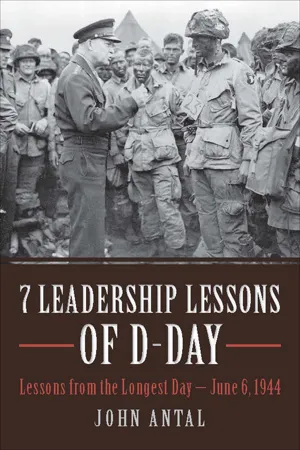
The odds were against the Allies on June 6, 1944. The task ahead of the paratroopers who jumped over Normandy and the soldiers who waded ashore onto the beaches, all under fire, was colossal. In such circumstances, good leadership can be the deciding factor of victory or defeat. This book is about the extraordinary leadership of seven men who led American soldiers on D-Day and the days that followed. Some of them, like Eisenhower, Theodore Roosevelt Jr., and Lt. Dick Winters, are well known, while others are barely a footnote in the history books.
This book is not a full history of D-Day, nor does it cover the heroic leadership shown by men in the armies of the Allies or members of the French Resistance, who also participated in the Normandy assault and battles for the lodgment areas. It is, however, a primer on how you can lead today, no matter what your occupation or role in life, by learning from the leadership of these seven figures.
A critical task for every leader is to understand what leadership is. Socrates once said that you cannot understand something unless you can first define it in your own words. This book provides the reader with the means to define leadership by telling seven dramatic, immersive, and memorable stories that the reader will never forget.
"Nobody tells a story better than John Antal and nobody knows better how to root out the lessons of history." —James Jay Carafano, author of
Wiki at War
- 224 pages
- English
- ePUB (mobile friendly)
- Available on iOS & Android
eBook - ePub
About this book
Information
Topic
Negocios y empresaSubtopic
Biografías militaresCHAPTER 1

Making the Decision
Leadership
“The one quality that can be developed by studious reflection and practice is leadership.” General Dwight D. Eisenhower
“Never take counsel of fear.” General Thomas J. “Stonewall” Jackson
The weather was foul. Everyone was in a dark mood. The man seated at the head of the table took a deep drag from a cigarette. He was smoking too much these days and getting too little sleep. Maybe that’s why he looked older than his 53 years. He did not worry much about himself. Mostly, he opined about the weather.
The weather in May had been beautiful, with clear skies over the French coast. His forces were ready, but last minute changes to the plan involving Utah Beach required more landing craft and the decision to launch the invasion was postponed to June. The weather in June had turned miserable. It had rained every day. He had postponed the invasion once already. Initially planned for June 5, the weather forecast he was issued on June 4 was so terrible that he was forced to postpone the invasion in the hope of better conditions. The weather prediction for June 5 turned out to be true. The seas were so rough that day that many of the Allied ships had to seek safe harbors for fear of being swamped. Timing in war is everything, and everything was coming down to this moment and his decision.
People doubted that he could do what he had been asked to do. Some of those people were sitting at the table with him and some were waiting in the wings. The previous day, June 4, he had briefed the leader of the Free French Forces in exile, General Charles de Gaulle. The dour Frenchman lectured him for an hour about the miscalculations of the invasion plans. He listened patiently but put these doubts aside. His mission was clear: “You will enter the continent of Europe and, in conjunction with the other united nations, undertake operations aimed at the heart of Germany and the destruction of her armed forces.”1
He mulled over in his mind the words he would use if his plan failed. “Our landings in the Cherbourg-Havre area have failed to gain a satisfactory foothold and I have withdrawn the troops. My decision to attack at this time and place was based on the best information available. The troops, the air and the Navy did all that bravery and devotion to duty could do. If any blame or fault attaches to the attempt, it is mine alone.”2
The air was damp with moisture. Outside the building, a hard, driving rain assailed the glass windows of Southwick House, an elegant three-story English manor located north of Portsmouth in Hampshire, England. Southwick House served as the advanced command post of the Supreme Headquarters Allied Expeditionary Forces (SHAEF), providing space for the operations staff and for meetings of the senior commanders and staff. Spartan living quarters were located nearby. The Supreme Commander lived in a specially designed trailer and his staff slept in prefabricated metal Quonset huts or tents. As the principal Allied headquarters, SHAEF coordinated the immense duties of inter-service and inter-Allied policy, plans, and operations to prosecute the war against Nazi Germany.
The time was 4 a.m., Monday, June 5, 1944. The leaders were assembled in the library of Southwick House. A fierce storm, with near hurricane winds and drenching rain, beat against manor’s roof and walls. If the invasion were to take place on June 6, Eisenhower had to make the decision in the next few minutes.
Eisenhower sat at the head of a long rectangular table in the library, flanked by his subordinate commanders. Behind him was a hearth with a glowing fire; on the mantel, a clock continued to tick the seconds by, accentuating the intensity of the moment and adding to the pressure.
Two US soldiers stood guard outside the room, each armed with a .45-caliber Thompson submachine gun. The tension was as thick as the armor of a German Tiger tank.
At the table, to Eisenhower’s right, was Lieutenant General Omar Bradley, Commander in Chief, First US Army Group; Admiral Sir Bertram H. Ramsay, Allied Naval Commander in Chief, Expeditionary Force; and Air Chief Marshal Sir Arthur W. Tedder, Deputy Supreme Commander, Expeditionary Force. At his left was General Sir Bernard L. Montgomery, Commander in Chief, 21st Army Group; Air Chief Marshal Sir Trafford Leigh-Mallory, Allied Air Commander, Expeditionary Force; and Lieutenant General Walter Bedell Smith, Eisenhower’s chief of staff. According to Smith, “All the commanders were there when General Eisenhower arrived, trim in his tailored battle jacket, his face tense with the gravity of the decision which lay before him. Field Marshal Montgomery wore his inevitable baggy corduroy trousers and sweatshirt. Admiral Ramsay and his chief of staff were immaculate in navy blue and gold.” The chief meteorologist was standing, facing Eisenhower and ready to brief. A slight smile crossed his lips. “I think we have found a gleam of hope for you, sir.”
The weather briefing lasted for 15 minutes.
“So, what you are telling me, Stagg, is that we may have a brief period of barely tolerable weather?” Eisenhower responded.
Group Captain James M. Stagg, Operation Overlord‘s senior weather adviser, nodded. Stagg had served in the Royal Air Force in the 1930s but was a civilian weatherman recruited to help plan for Operation Overload. Due to a disagreement between the US and British over Dr. Stagg’s non-military status, Stagg was converted to the rank of group captain, Royal Air Force Volunteer Reserve. In a previous briefing, Stagg had explained to Eisenhower that the decision to “go” would be made on the meteorological advice given three days before D-Day (D-3). Stagg knew that the necessary operational orders would have to be issued on D-2, and that once the movement was begun, no postponement would be possible after D-l. “Yes sir,” Captain Stagg replied in a heavy Scottish accent, looking down at the latest weather report in his hand. “Atmospheric surface pressure is rising steadily. This indicates a forecast of a window of marginal weather for the Normandy coast for at least 18 hours, possibly as long as 24 hours, on June 6. Wind swells in the Channel at 5–6 feet, decreasing to 3–4 feet with 3–4-foot wind waves near the invasion beaches. The weather on June 7 remains uncertain.”
“How firm is your forecast?” General Montgomery asked.
“Very firm, sir,” Stagg replied, “but not all the SHAEF meteorologists agree with me.”
“And the waves will permit us to get the landing craft to shore?” General Bradley added.
“The morning will be fair,” Stagg said. “Good weather may last through the afternoon.”
“Only 18 hours?” Eisenhower inquired.
“Yes, sir. I can predict 18 hours of marginal weather from midnight on the 5th of June to the evening of the 6th of June with accuracy,” Stagg answered, standing firm. “Twenty-four hours if we are lucky, but no more than 18 hours.”
“Marginal weather?” Air Chief Marshal Tedder interjected. “Eighteen hours?”
“It’s the best forecast I can offer,” Stagg replied nervously. “There is a brief improvement in the conditions. The storm front is moving faster than we originally expected. The tide and wave swells are within margin, but cloud coverage could impede bombers from seeing their targets.”
“If you decide to go on Tuesday, June 6, we will have to give the order to the Omaha and Utah beach forces in the next half hour,” Admiral Ramsay added. Ramsay was in command of over 5,000 vessels involved in the invasion, ranging from naval combatants, landing craft and ships, naval auxiliaries, to merchant vessels. He clearly understood the time-and-space factors involved in maneuvering such a large and diverse naval force. “As you know, the Americans have the farthest to go.”
Eisenhower knew that Ramsay was right. The specific planning requirements for the invasion at Normandy offered only 10 days a month for a successful amphibious landing. The Germans knew the invasion was imminent, although they did not know the exact time and location. General Erwin Rommel, one of Germany’s finest generals and the man in charge of the German defenses in Normandy, had been improving the defenses of the Atlantic Wall all along the coast of continental Europe and Scandinavia. Rommel had increased the construction of German fortifications and ordered thousands of cleverly designed anti-invasion obstacles sown on every available landing beach. Rommel had guessed that the Allies would land in high tide and had rigged thousands of beach obstacles with deadly Teller mines. These devices were antitank mines, but they also served as excellent anti-landing craft mines. Each 20-pound Teller mine was loaded with 11 pounds of explosives. At high tide, the boats would not see the submerged obstacles and, if they hit a mine, the landing craft would be blown out of the water. Many of these Teller mines also had anti-handling devices that would explode the device if Allied engineers tried to disarm them. Eisenhower’s planners learned about the beach obstacles and determined that they had to be mitigated. They planned for the landings at low tide, to permit Allied landing craft commanders the ability to identify and circumvent these deadly beach obstacles.
The low tide for the Normandy beaches occurred in the spring and then only for a few days each month. If these small windows were not used for the invasion, then the casualties from the beach obstacles alone could spell doom for the Allied landing forces.
“We have nearly a quarter of a million men on ships, landing craft, airfields, and naval embarkation points,” Lieutenant General Walter Bedell Smith, Eisenhower’s chief of staff, offered. “We can’t keep them waiting indefinitely. And the longer we wait, the more likely the Germans will discover our plan. The next time the moon and tide will be right will be on the 19th of June.”
Eisenhower nodded. These initial invasion troops were just the tip of the spear to penetrate Hitler’s Atlantic Wall. Nearly three million men were under arms in southern England. With so many troops quartered on the island awaiting word of the invasion, security was a major concern. German spies and reconnaissance flights were active. So far, Eisenhower believed that the Germans did not know the time or location of the invasion. Another postponement might negate that surprise.
Long ago, Eisenhower had earned the nickname “Ike.” He preferred being called Ike; it set people at ease. He had a knack for getting along with people of dissimilar temperaments. This was certainly the case among the Allied leaders. Ike realized that he had to play a role to bring people together, not tear them apart. Disarming people with his genial manner was part of his style. Patience was his most powerful virtue. There was enough happening in a world at war that was upsetting. He never wanted an impetuous attitude to inhibit his leadership and his ability to influence the team to work together to accomplish the assigned mission.
Ike knew that if the weather in the Channel was too rough, then many of his landing craft might sink. Should he postpone the invasion in hope of better weather? It was a very difficult decision and his decision alone. As the Supreme Allied Commander, he would take sole responsibility for the outcome of the attack, but he also demanded that his senior officers speak their minds. These were the best military, naval, and air force leaders of their respective services and nations. He understood that he was leading a coalition of nations and the points of view of their key leaders had to be considered. This was not the Soviet Union or Nazi Germany, where one leader would make the decision, seldom ask for advice, and expect to be blindly obeyed. The opinions of these men mattered to him. The code name of the invasion may have been Overlord, but Ike was keen not to “Lord Over” anyone.
Ike knew the fate of the invasion was in his hands. He knew that he would have to roll the dice, make his play, and, if he chose wrongly, thousands would die. A bloody failure of the invasion of France could set back the war for years. By then, who knows what evil new weapons the Nazis might create. There was already intelligence evidence of a new, long-range missile program, dubbed Vergeltungswaffen or “vengeance weapons” by the Germans. There were also credible reports that Nazi scientists were developing a new kind of bomb, more powerful that anything the world had ever seen. If the invasion failed and the Germans could marry their missile program with a new powerful means of destruction, then the war might be prolonged for decades—or worse, be lost. General George C. Marshall, the US Chief of Staff of the Armed Forces in Washington, D.C. and the right-hand military man for President Franklin Roosevelt, had sent an officer to brief Ike about a secret project called “Manhattan” and fears that the Nazis might use “radioactive toxins” against Ike’s invasion force. He was worried about the possibility of the Nazis using chemical agents, such as chlorine or mustard gas, as had been employed on the battlefields of World War I. If the Germans gassed his men on the beachheads, then casualties would be horrendous. To add to these concerns, the top-secret Ultra intelligence intercepts that allowed the Allied leaders to read the Germans’ strategic command messages had detected movement of the German 91st Division into the 82nd Airborne’s drop zone. Was this coincidence, or did the Germans know the invasion was coming to Normandy?
In short, Ike had a significant list of troubling information to consider.
Every general at the table looked at Ike, waiting for a decision. The clock ticked. Ike put on his best poker face. Normally, he worked hard to appear optimistic in the presence of his generals and the troops. Their load was heavy enough and he knew that he did not need to add to it by brooding, being depressed, or showing hesitation. Ike understood that both optimism and pessimism are infectious. He believed that they spread more rapidly from the higher echelons of command downward than in any other direction. If he leaned either way, too optimistic or too pessimistic, then he might influence his generals. Right now, he wanted their personal and clear assessments.
“Sir, I can speak for the airborne forces,” Air Commander Trafford Leigh-Mallory, the commander responsible for transporting the British and American paratroopers for Operation Overlord, announced. “In this weather, we can expect heavy casualties.”
“How heavy?” Ike asked.
“I estimate our losses could be as high as 75 percent in the 101st and 82nd Airborne Divisions,” Mallory said without flinching.
Several of the officers sitting at the table sat back in their chairs. Air Marshal Tedder shook his head and looked down at the table as if seeing the dead bodies of the young men laid out in front of him. If the decision was made to go, then the plan called for the landing of over 13,100 paratroopers, most of them behind Utah Beach. Seventy percent casualties meant the deaths, incapacitation or capture of at least 9,750 of the Allies’ best soldiers.
“Maybe you should cancel the para-drops,” Tedder offered.
“Sir, with all due respect to the Air Marshal, I need those troops dropped behind Utah Beach,” Lieutenant General Omar Bradley, Commander in Chief, First US Army Group, in command of all US forces landing on Omaha and Utah, announced. The paratroopers from the 101st and 82nd Airborne Divisions were ...
Table of contents
- Front Cover
- Title Page
- Copyright Page
- Table of Contents
- Preface Why Leadership Matters
- Introduction The Road to the Longest Day
- Chapter 1 Making the Decision—Influence1
- Chapter 2 Taking and Holding the Bridge at La Fiére—Selflessness
- Chapter 3 Storming the Pointe du Hoc—Courage
- Chapter 4 Tanks on Omaha Beach—Adaptability
- Chapter 5 Decision at Utah Beach—Point of Decision
- Chapter 6 Before the Sun Rises—Example
- Chapter 7 The Alamo of Normandy—Intent
- Chapter 8 Earn This and Learn—You Will Rise to the Level of Your Leadership
- Appendices
Trusted by 375,005 students
Access to over 1.5 million titles for a fair monthly price.
Study more efficiently using our study tools.
Frequently asked questions
Yes, you can cancel anytime from the Subscription tab in your account settings on the Perlego website. Your subscription will stay active until the end of your current billing period. Learn how to cancel your subscription
No, books cannot be downloaded as external files, such as PDFs, for use outside of Perlego. However, you can download books within the Perlego app for offline reading on mobile or tablet. Learn how to download books offline
Perlego offers two plans: Essential and Complete
- Essential is ideal for learners and professionals who enjoy exploring a wide range of subjects. Access the Essential Library with 800,000+ trusted titles and best-sellers across business, personal growth, and the humanities. Includes unlimited reading time and Standard Read Aloud voice.
- Complete: Perfect for advanced learners and researchers needing full, unrestricted access. Unlock 1.5M+ books across hundreds of subjects, including academic and specialized titles. The Complete Plan also includes advanced features like Premium Read Aloud and Research Assistant.
We are an online textbook subscription service, where you can get access to an entire online library for less than the price of a single book per month. With over 1.5 million books across 990+ topics, we’ve got you covered! Learn about our mission
Look out for the read-aloud symbol on your next book to see if you can listen to it. The read-aloud tool reads text aloud for you, highlighting the text as it is being read. You can pause it, speed it up and slow it down. Learn more about Read Aloud
Yes! You can use the Perlego app on both iOS and Android devices to read anytime, anywhere — even offline. Perfect for commutes or when you’re on the go.
Please note we cannot support devices running on iOS 13 and Android 7 or earlier. Learn more about using the app
Please note we cannot support devices running on iOS 13 and Android 7 or earlier. Learn more about using the app
Yes, you can access 7 Leadership Lessons of D-Day by John Antal in PDF and/or ePUB format, as well as other popular books in Negocios y empresa & Biografías militares. We have over 1.5 million books available in our catalogue for you to explore.