"Moves quickly; it entertains and provides a decent overview of the life of an American Doughboy" on the Western Front during the Great War (
San Francisco Book Review).
The American Doughboys of World War I are often referred to as the "Lost Generation"; however, in this book, we are able to gain an intimate look at their experiences after being thrust into the center of Europe's "Great War" and enduring some of the most grueling battles in US history.
Len Fairfield, the author's grandfather, was an Artillery Scout, or Forward Observer, for the US Army and was a firsthand witness to the war's carnage as he endured its countless hardships, all of which are revealed here in vivid detail. His story takes the reader from a hard life in Chicago, through conscription, rigorous training in America and France, and finally to the battles which have become synonymous with the US effort in France—St. Mihiel and the Argonne Forest, the latter claiming 26,000 American lives, more than any other US battle.
The American Expeditionary Forces endured a rare close-quarters visit to hell until it was sensed that the Germans were finally giving way, though fighting tooth-and-nail up to the very minute of the Armistice. This action-filled work brings the reader straight to the center of America's costly battles in World War I, reminding us once again how great-power status often has to be earned with blood on battlefields.
"All in all, this book is a bit of a gem. It is a well paced easy read and you will find yourself rooting for our hero." —
War in History
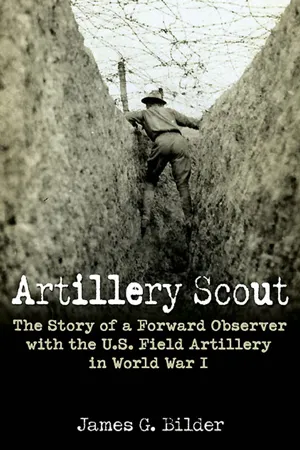
eBook - ePub
Artillery Scout
The Story of a Forward Observer with the U.S. Field Artillery in World War I
- 208 pages
- English
- ePUB (mobile friendly)
- Available on iOS & Android
eBook - ePub
Artillery Scout
The Story of a Forward Observer with the U.S. Field Artillery in World War I
About this book
Information
CHAPTER 1
Neutral Land, a Common Man, the Makings of Love and War
WHEN THE “GREAT WAR” first erupted in August of 1914, virtually every American was happy that the United States had no part in it. Since the height of the Roman Empire, nearly two thousand years earlier, the European continent seemed to be continually awash in conflict. Europe seemed to Americans to be a place of never ending wars and conquests. Provinces and peoples bounced back and forth between nations like tennis balls in hotly contested matches.
Americans felt that Europeans experienced peace in only brief spurts, lasting long enough to draw up fresh maps designating the spoils of war in the form of changes in national boundaries and territories. This was then followed by new wars that would erupt before the ink on the peace treaties and maps had time enough to dry. This cycle seemed to repeat itself with almost as much regularity and certainty as the change of seasons.
Now, in the twentieth century, a perceived time of heightened reason and enlightenment, the Europeans were at war with each other yet again. This time, no less, over the assassination of an Archduke and his wife by a crazed nationalist! The Europeans appeared to Americans to look for excuses to fight one another.
This current conflict did not seem to bear any more relevance to Americans than the countless ones that preceded it. Europeans would be killing each other infinitum, and if that was their wish then America could best serve its own interests by staying far removed and uninvolved. After all, this was the very thing that America’s first President, George Washington, had envisioned and warned against when making his farewell address as he urged his fellow countrymen to avoid “entangling alliances.”
War in Europe may have erupted in 1914, but Americans in 1914 were limiting their struggles to domestic politics. Progressives, socialists, and conservatives were battling, not over social change, but to what degree it would occur. Among the economic lower classes (which was most of the country) things were always hard but always continuing to improve. Americans were concerned with things far more provincial, entertaining, progressive, and certainly safer than world war.
Scott Joplin’s release of “Maple Leaf Rag” in 1899 had brought ragtime music into the mainstream of American popular culture. Ragtime was no longer music limited to the country’s black communities and in 1914 it was still as popular as ever. You could even listen to it in the comfort of your home; playing a recording on your own Victrola. The musical transitions moved onto the dance floor as well, with the waltz and the two-step replacing the cotillion as the country’s most popular dances.
If music and dance weren’t enough, one could always go to the local nickelodeon, plunk down five cents, and watch the “flickers,” so named for the poor quality of film with its moving pictures constantly flickering and often causing headaches. Movies and serial shorts, while silent and requiring the frequent changing of reels, were incredibly popular. So much so, that local “movie houses” started popping up on almost every street corner.
Many were nothing more than vacant storefronts that had wooden chairs, benches, or even pews for seating. The lighting (if any) was atrocious; there was rarely any circulating air, and the “projection screen” was usually nothing more than a sheet of cloth or muslin. But despite these shortcomings, they were affordable to the public, valued entertainment, and exceptionally lucrative to their owners. Chicago, led by Essanay Studios, was the filming location and production capital for the world’s movies at the time.
Vaudeville and the “legitimate” theatre allowed patrons to see and hear in person everything from the magic of the Great Houdini to opera’s great Enrico Caruso, right down to tawdry comedy acts and exotic oriental dancers. Even the fire at Chicago’s famed Iroquois Theatre in 1903, which claimed over 600 lives and had long since been relegated to ancient history, didn’t discourage people from filling theatres to capacity.
Americans were enjoying every modern convenience. Horses were being replaced by automobiles and streetcars. For Americans fortunate enough to work at Ford Motor Company in 1914, the booming that year began not in August but in January. What’s more, it was not with guns but with dollars.
Henry Ford revolutionized the thinking of America’s business community when he announced that he would pay his workers the lavish sum of $5.00 per day (roughly doubling his average worker’s pay)! And while the workweek was still six days long, the number of work hours on Ford’s assembly line was reduced from nine per day to eight. It was done with the belief that a happier worker would be a more productive worker and would use part of his increased wages to buy the high quality product he produced. As a result of Ford’s mass production and shared wealth, the sale of his “Tin Lizzies” reached new heights, and automobiles moved from being play things for the wealthy to a near common necessity.
Communication had long since progressed from the telegraph to the telephone, and by 1914 many urban homes in America, and virtually every business, had a telephone. Cross country travels, as well as suburb to city commutes, were now done in the comfort of modern rail cars, and electric lighting displaced nighttime darkness in homes, factories, and along streets.
The nation’s political direction and fortunes had changed recently and manifested themselves at the ballot box. The Progressive movement was again in full swing in the United States. During the presidential election of 1912, Democrat Woodrow Wilson was elected to the White House. His most popular opponent in that three-way race was not the incumbent president, Republican William Howard Taft, but former President Theodore Roosevelt who ran as the nominee of the new Progressive Party.
Taft had been Roosevelt’s handpicked successor in 1908, but Roosevelt disagreed with Taft’s policies and style of governance and challenged his re-election bid in the Republican primaries of 1912. Roosevelt won nearly all of those primary contests, but Taft was able to use federal patronage to secure the convention delegates necessary for his re-nomination. Roosevelt stormed out of the Republican convention, accepted the nomination of the Progressives (Bull Moose Party), and promptly split the Republican vote ensuring Wilson’s election.
Roosevelt could take some satisfaction in the fact that he received more votes than Taft (the only time in an American presidential election in which a third party candidate garnered more votes than a major party nominee). Wilson espoused progressive ideals in a pragmatic way but was too shrewd to reveal publicly that he was far more an ideologue than a pragmatist.
Pure Progressive ideology contained a healthy dose of populism and class warfare. It espoused a much bigger role for centralized (federal) government that included higher tax rates, especially for corporations, and using that authority in support of labor unions. They also took a liberal stance on social issues: racial equality, woman’s suffrage, and support for Darwin’s theory of evolution.
Ironically, though Wilson had been Governor of New Jersey, he was a native of Virginia, lived for a few years in South Carolina, and then in Georgia. He was a racial bigot and chauvinistic toward women. He paid only lip service to the civil rights and suffrage movements of the day, but this served his political purposes well. As Joseph PI Kennedy, father of President John Kennedy once said, “In politics, perception is reality.” In sum, Wilson had far more interest in domestic issues than foreign affairs.
Most Americans supported a progressive agenda, in varying degrees, but tempered with a healthy dose of social morality (seemingly odd by modern political standards). This was evidenced by growing support for things like the prohibition of alcohol, along with widespread opposition (even among Protestants) to Margaret Sanger and her advocacy of birth control.
Wilson’s Secretary of State was William Jennings Bryan. A pacifist, populist, and class warrior extraordinaire, Bryan had been the unsuccessful presidential nominee of the Democratic Party in 1896 (he was simultaneously the nominee of the Populist Party that year), 1900, and 1908. Now, at a time of war in Europe, he was the nation’s most influential man in determining America’s foreign policy.
Wilson and his policies received an endorsement of sorts when the Democrats kept their congressional majorities in the mid-term elections of 1914, due in no small measure to the presence of Progressive Party candidates on the ballot who again split the Republican vote.
But even with certain domestic political divisions, much of America in 1914 was relatively peaceful and nearly everyone was in favor of neutrality. In May of that year, Wilson signed a resolution passed by congress declaring the second Sunday in May as “Mother’s Day.” The country was urged to show support for their mothers by displaying the nation’s flag from the front of their homes.
There was some unrest as Jacob Coxey tried, but failed, to form a second “Coxey’s Army” (of the poor and unemployed) to march on Washington and demand financial relief for their plight. This had been done before, during the depression of 1894, but the industrial boom that America had been experiencing since before the Civil War had increased wages by roughly 75% over the previous sixty years, and so Coxey’s effort fizzled out.
Child labor was still a problem, with children under the age of 10 working in factories and mines and experiencing the horror of industrial accidents, but this was accepted as a norm of the times, with many believing that the need for formal education ended once a child had learned the three R’s; “reading, ‘riting, and ‘rithmatic.”
Americans, while desiring neutrality for reasons already stated, had also shown throughout their history that they were not afraid to fight Europeans. They had fought two wars with Britain in their national infancy. The first when the thirteen colonies had won their independence (with essential French help) after a protracted eight-year struggle (1775–1783) in which the British decided that their cost for victory could not be justified by the necessary expenditure of blood and treasure.
During the start of the Napoleonic Wars, America fought a quasi, or undeclared naval war, with France for two years (1798–1800). The semi-hostilities between the two countries originated when the United States concluded a trading agreement with Great Britain, France’s mortal enemy. Insult was added to injury when the U.S. refused to repay its war debts to Republican France, saying the money was owed instead to the now defunct French monarchy.
The French responded by seizing cargo from American ships on the high seas, and before long it was common practice for French and American ships to fire at one another on sight. A diplomatic solution was reached before the matter escalated into a full-blown war.
America fought its “second war for independence” and became an un-intentional ally of Napoleonic France when it declared war against Britain in June of 1812. Britain’s great military might rested primarily in its navy and, since it had a manpower shortage and did not recognize the right of its own people to become naturalized American citizens, it began the process of simply impressing any American on the high seas it suspected of being from the commonwealth into the British Navy. This outrage, along with the less noble desire of American war hawks to acquire Canada, led the united States to declare war against Britain.
This second conflict between America and Britain ended without a victor after Russian urgings for negotiation eventually resulted in the Treaty of Ghent. The warring parties signed the peace treaty in December of 1814, but it took considerable time for news to cross the Atlantic.
In the meantime, the war continued unabated in the united States. When the British sent a large force to seize the port city of New Orleans in January of 1815, it was repulsed by American General (and future president) Andrew Jackson in one of the most lopsided military victories in history. In America, the news of the victory at New orleans was followed immediately by the news of peace, which left almost every American mistakenly believing—even to this day—that the united States had “won” the war.
The united States won a decisive victory against the decaying Spanish Empire during a brief five-month conflict in 1898. The Spanish-American War, often referred to as, “that splendid little war,” resulted in the U.S. acquiring the Philippine Islands and Puerto Rico from Spain, while obtaining independence for Cuba. From the most powerful Empire in Europe, and probably the world, to one whose glory was now only a memory, Americans had taken on and defeated Europeans.
Closer to home, President Wilson militarily assisted the efforts to overthrow the government of Mexican President, and dictator, Victoriano Huerta in 1914. This meant America was choosing sides amidst the continuous revolutions, counter-revolutions and civil war occurring in Mexico.
Using the opportunity of an insult to U.S. honor, (nine U.S. sailors were taken into custody at Tampico while collecting fuel supplies but released almost immediately), Wilson ordered American sailors and marines to seize the city of Vera Cruz when the Mexicans did not apologize in the manner prescribed by the U.S. This effectively denied Huerta a prized port city and its many revenues. The city remained occupied for seven months by U.S. forces, until November of 1914, with war between Mexico and the U.S. narrowly averted.
Unfortunately, the American intervention did considerable damage to diplomatic relations between the two countries and would come back to haunt the U.S. in the near future. In September of 1914, two months before the American occupation of Vera Cruz ended, revolutionary leaders Emiliano Zapata of the south, and Pancho Villa of the north, broke with their Revolutionary Premier, Venustiano Carranza, over his refusal to support their radical “social reforms.” Zapata and Villa now harbored a growing resentment over American intervention in general and for the de facto support it lent Carranza in particular. The following year U.S. Marines would occupy Haiti to maintain order and protect American financial interests, after the assassination of Haitian President Vilbrun Guillaume Sam.
The current war in Europe brought reports of German atrocities in occupied Belgium, which angered Americans, but the blockade of Germany by the Brits seemed to even out public opinion. Irish-Americans were large in number and most were faithful Catholics, detesters of England, and Democrats. This undoubtedly made easier the desire of Wilson, a Democrat, to keep the United States officially neutral.
When Germany’s U-20 shot a torpedo into the side of the British passenger liner Lusitania on May 7, 1915, sending 1,198 civilians, including 128 Americans, to the sea bottom off the Irish coast, U.S. opinion began shifting noticeably toward the Allies. But the shift was only an academic matter, insofar as it helped determine who to cheer for from the sidelines. President Wilson, and one Leonard (“Len”) Fairfield, certainly were not convinced that American entry into the war was now a necessary thing.
While Len was no German sympathizer (he was of English-Irish ancestry), he couldn’t help but smell a rat when it came to the Lusitanias sinking. He wondered if the British hadn’t intentionally baited a hook and dangled it right in front of the Germans. With the Germans foolish enough to take that bait, the Americans might well be ready enough to enter the war on the Allied side.
The Germans had placed ads in over 50 newspapers warning those traveling abroad that the ship was in danger of submarine attack. The ship, while civilian, was always rumored to be carrying Allied war materials, and despite the fact that German subs were known to be operating off the Irish coast, the British specifically denied any destroyer escort to the Lusitania as it approached the war zone.
Wilson protested the attack but stated that in regards to America, there was such a thing as a nation being, “too proud to fight.” Len described things less nobly and felt the issue was more cut and dry. The Germans may have taken the bait but he and the American public had not. For the moment at least, all remained right, or at least stable, in Len’s world. Wilson did not take the country to war over the sinking of the Lusitania and that was fine with him. His life up to this point had been a very hard one and he certainly didn’t think war would make it any easier.
________
LEN WAS BORN IN Chicago on November 7, 1892 to Frank and Agnes Fairfield. His father Frank was not, and would never become, an American citizen. Born in Lambeth, Surrey (London) in 1859, he came to America in his teens and took up residence in Chicago where he worked as what the census taker listed as a “can maker.” He was not a licensed chemist, but earned a few extra coins mixing his own cold creams and salves that he sold himself.
Baptized in the Anglican Church, he accepted a conversion to Catholicism as necessary in order to marry Agnes O’Brien in August of 1884. He received a conditional baptism into the Catholic faith a month before his wedding. The couple had five children; two girls, followed by Len, and then two more boys. The Fairfield clan, which included Catherine O’Brien, Agnes’ widowed mother, lived at 913 South 59th Street on Chicago’s Southside. While he became a devout Catholic, Frank never gave up singing his beloved Protestant hymns, which he did frequently while sitting and rocking in the privacy of the home’s attic. He refused American citizenship because he could never bring himself to renounce the crown.
Unfortunately, Frank had a serious drinking problem, was known to wander from home for periods, and was not an adequate provider. Len had to help support the family and was unable to continue his education beyond elementary school. He refused to attend his graduation ceremony because he had no proper shoes to wear. He spent a fair portion of what should have been his time for youthful folly walking along the railroad tracks picking up coal, often thrown intentionally from trains by kind-hearted rail workers for the poor and destitute, to bring home for heat.
While anti-Catholic feelings ran strong amongst many Protestants of the era, Len remained grateful all his life to the Salvation Army for the charity and assistance they extended to the Fairfield household. They never questioned the faith of those in need. They simply helped.
Len had a handsome face with ...
Table of contents
- Coverpage
- Titlepage
- Copyright
- Contents
- Dedication
- Cadence of the U.S. Army Field Artillery
- Foreword
- Introduction
- 1. Neutral Land, a Common Man, the Makings of Love and War
- 2. Arriving, Training, and Departing Camps Grant and Logan
- 3. The Yanks Are Coming to Be Buried Over Here
- 4. Camp Le Valdahon: Getting a French Education in Survival
- 5. Baptism By Fire
- 6. St. Mihiel: The Americans Enter the War in Earnest
- 7. The Lull Before the Storm
- 8. The Argonne: Let the Slaughter Commence
- 9. Bearding the Lion in His Den
- 10. In the Death Throes of the Great War
- 11. Occupation, Recuperation, and Demobilization
- Epilogue
- Acknowledgments
Trusted by 375,005 students
Access to over 1.5 million titles for a fair monthly price.
Study more efficiently using our study tools.
Frequently asked questions
Yes, you can cancel anytime from the Subscription tab in your account settings on the Perlego website. Your subscription will stay active until the end of your current billing period. Learn how to cancel your subscription
No, books cannot be downloaded as external files, such as PDFs, for use outside of Perlego. However, you can download books within the Perlego app for offline reading on mobile or tablet. Learn how to download books offline
Perlego offers two plans: Essential and Complete
- Essential is ideal for learners and professionals who enjoy exploring a wide range of subjects. Access the Essential Library with 800,000+ trusted titles and best-sellers across business, personal growth, and the humanities. Includes unlimited reading time and Standard Read Aloud voice.
- Complete: Perfect for advanced learners and researchers needing full, unrestricted access. Unlock 1.5M+ books across hundreds of subjects, including academic and specialized titles. The Complete Plan also includes advanced features like Premium Read Aloud and Research Assistant.
We are an online textbook subscription service, where you can get access to an entire online library for less than the price of a single book per month. With over 1.5 million books across 990+ topics, we’ve got you covered! Learn about our mission
Look out for the read-aloud symbol on your next book to see if you can listen to it. The read-aloud tool reads text aloud for you, highlighting the text as it is being read. You can pause it, speed it up and slow it down. Learn more about Read Aloud
Yes! You can use the Perlego app on both iOS and Android devices to read anytime, anywhere — even offline. Perfect for commutes or when you’re on the go.
Please note we cannot support devices running on iOS 13 and Android 7 or earlier. Learn more about using the app
Please note we cannot support devices running on iOS 13 and Android 7 or earlier. Learn more about using the app
Yes, you can access Artillery Scout by James G. Bilder in PDF and/or ePUB format, as well as other popular books in History & Military Biographies. We have over 1.5 million books available in our catalogue for you to explore.