A strategic analysis of the Nazi high command's decisions in the north, from "an established scholar of the Scandinavian theater" (
Publishers Weekly).
One of the prominent controversies of World War II remains the debate over Germany's strategy in the north of the Soviet Union as the tide of war turned and gigantic Russian armies began to close in on Berlin. Here, Henrik Lunde—former US Special Forces officer and author of renowned works on the campaigns in Norway and Finland—turns his sights to the withdrawal of Army Group North.
Applying cool-headed analysis to the problem, the author first acknowledges that Hitler—often accused of holding on to ground for the sake of it—had valid reasons in this instance to maintain control of the Baltic coast. Without it, his supply of iron ore from Sweden would have been cut off, German naval U-boat bases would have been compromised, and an entire simpatico area of Europe—including East Prussia—would have been forsaken. On the other hand, Germany's maintaining control of the Baltic would have meant convenient supply for forces on the coast—or evacuation if necessary—and, perhaps most important, remaining German defensive pockets behind the Soviets' main drive to Europe would tie down disproportionate offensive forces. Stalwart German forces remaining on the coast and on their flank could break the Soviet tidal wave.
However, unlike during today's military planning, the German high command, in a situation that changed by the month, had to make quick decisions and gamble, the fate of hundreds of thousands of troops and the entire nation at stake on quickly decided throws of the dice. In this book, both combat and strategy are described in the final stages of the fighting in the Northern Theater with Lunde's even-handed, thought-provoking analysis of the campaign a reward to every student of World War II.
Includes maps.
eBook - ePub
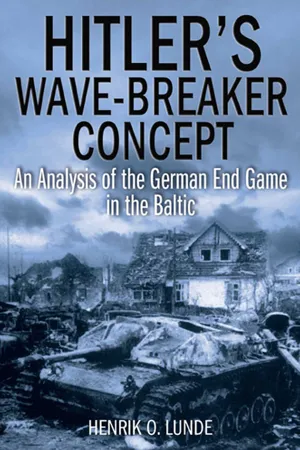
Hitler's Wave-Breaker Concept
An Analysis of the German End Game in the Baltic
- 289 pages
- English
- ePUB (mobile friendly)
- Available on iOS & Android
eBook - ePub
About this book
Information
1
HITLER’S STRATEGIC THINKING
Early Life and World War I Experiences
Hitler, as is true for most of us, was a product of his life experiences. His military and strategic thinking was based on multiple factors: his personal service as a soldier in World War I; his sometimes warped view of history; the turbulent social, economic, and political scene in Germany in the 1920s; the years of struggle as a party leader; his own personality as it had developed over the years; and the intoxicating years of triumphs from 1933 to 1941. He claims to have read and studied some of the military theorists mentioned in the introduction, and there is no reason to doubt this claim. For the most part, however, rather than use these theories as a framework for arriving at a strategy, he selectively used what he read to support actions already chosen.
It would be surprising if Hitler was not, like some of the Soviet leaders—particularly Vladimir Lenin—influenced by Clausewitz’ writings, as was the German General Staff. Walter Görlitz’ book on the history of the German General Staff has a whole chapter titled The Philosopher of War.1 A reading of Hitler’s Mein Kampfreveals a number of similarities to Clausewitz’ thoughts. Karl von Clausewitz was not always the ultimate rationalist that we associate with his main work—On War. After Prussia’s defeat by Na poleon he wrote a much lesser-known essay titled I Believe and Profess. It is worthwhile quoting a passage from this essay as it may throw some light on Hitler’s behavior in the closing period of World War II:
I believe and profess that a people never must value anything higher than the dignity and freedom of its existence; that it must defend these with the last drop of its blood; that it has no duty more sacred and can obey no law that is higher; that the shame of a cowardly submission can never be wiped out; that the poison of submission in the bloodstream of a people will be transmitted to its children, and paralyze and undermine the strength of later generations; that honor can be lost only once; that, under most circumstances, a people is unconquerable if it fights a spirited struggle for its liberty; that a bloody and honorable fight assures the rebirth of the people even if freedom were lost; and that such a struggle is the seed of life from which a new tree inevitably will blossom…. Danger must be countered with virile courage joined with calm and firm resolve and clear conscience. Should we be denied the opportunity of defending ourselves in this manner, I hold reckless despair to be a wise course of action.2
Hitler was apparently an avid reader and there are reasons—direct and indirect—to indicate that he had read a number of military theorists and practitioners, including Clausewitz, Frederick the Great, and Napoleon. Hitler’s biographer Ian Kershaw writes that the shelves in his sparsely furnished room in Munich were loaded with books on history, geography, mythology, and especially war.3 Ernst Hanfstaengl, who befriended Hitler in the early days after World War I, makes a similar observation.4
Books by or about the German existentialist philosopher Friedrich Wil helm Nietzsche (1844–1900) are often mentioned. Nietzsche challenged the foundations of Christianity and traditional morality, but he was not an anti-Semite. Nietzsche believed that a person should be guided by the world we live in and not by the world beyond. Although Hitler never met Nietzsche, his thoughts were compiled and espoused by the Nazis, such as justification for war, aggression, and domination based on national and racial grounds. Nietzsche’s influence on Hitler is partly due to Hitler’s friendship with Elisabeth Förster Nietzsche (1846–1935), Friedrich Nietzsche’s sister. She established the Nietzsche Archive in 1894. She had been married to a strident anti-Semite named Bernhard Förster (1843–89) and she was obviously influenced by both her brother and husband.
What Hitler learned from his readings and how he used what he read are different matters entirely. He seems to have applied ideas selectively and when it suited his purposes, disregarding them when it was inconvenient. John Keegan relates one such incident from August 1941, when Hitler lectured his generals during the pause on the Eastern Front.5 Referring to Clausewitz’ writings, he observed that one must first destroy the enemy in the field and then occupy their capital. While I don’t know the date of this statement, it was made after the partial failure of several encirclements and was probably a defensive argument for stripping Army Group Center of its armored strength and sending it to the flanks, particularly the southern flank, against the wishes of most of his generals. Hitler was arguing what his generals had maintained during the Barbarossa planning period and during the pause, but for different reasons. They had argued for a drive to Moscow—not because it was the capital—but because it was the political and economic epicenter of the Soviet Union. They assumed that the Soviets would commit their full armed strength to defend this geographic locality and give the Germans the opportunity to inflict a decisive military defeat that could, for all practical purposes, end the war.
After the two very successful encirclements at Kiev and Vyazma, Hitler decided to go for Moscow, despite what he had said earlier and the lessons from Napoleon’s campaign. Again, most generals argued against it because of the lateness of the season and the requirements to regroup. The arguments between Hitler and his generals during the pause is a perfect example of Hitler’s selective use of what he had absorbed from his earlier readings.
Hitler’s interest in Nordic mythology is testified to by other books on his shelves. He often referred to a verse from the Norwegian Eddas that reads: “All things will pass away, nothing remains but death and the glory of deeds.”6 Hitler was deeply influenced by another 18th-century German, the famous composer Wilhelm Richard Wagner (1813–83).7 Wagner was also an ardent nationalist and a leading polemicist. The difference between a debater and a polemicist is that unlike debaters, who try to seek a common ground, a polemicist intends to establish the truth of a controversial point of view while refuting the opposing point of view—there is no room for compromise. We find this a main trait throughout Hitler’s adult life. His dogmatic attitude and stubborn refusal to compromise or make concessions can be traced directly to this trait and probably to the influence of Wagner. It would be surprising if Hitler’s behavior, military strategy, and operational concepts, particularly in the last years of World War II, were not heavily affected by his earlier learning experiences.
There were few things in Hitler’s early life that would make one think he would become a leader of a great nation and one of the most influential men of the 20th century. He came from a family of very modest means, had a meager education, was a drifter and unemployed neurotic who lived from hand to mouth in the slums of Vienna. He failed at his ambitions of becoming an artist or architect. However, Hitler had some qualities that fitted well into the tumultuous times of Germany in the 1920s—just as Napoleon fell into his opportunity at the end of the French Revolution. Sometimes fate brings men and events together either for good or evil.
It is beyond the scope of this work to examine Hitler’s personal traits, education, and abilities in detail.8 However, a few comments are in order. Hit ler excelled in the political arena. He was a strong and mesmerizing orator who spoke to the masses in terms they understood. As a populist he was adept at combining nationalistic and down-to-earth social and economic sentiments. He found the necessary scapegoats for Germany’s dilemma in Communists, socialists, Jews, and the Versailles Treaty. He promised that Germany could regain its greatness and the people their prosperity, and that he was the man to bring those achievements to fruition. Hitler ex emplified the potential danger of falling victim to a spellbinding orator who exploits social and economic problems by promising to cure their ills through radical approaches.
When Hitler came to power he set out to keep his promises. In the 1930s he gave the Germans a string of bloodless achievements on the international scene (the occupation of the Rhineland, the annexation of the Sudetenland and take-over of Czechoslovakia, and the Anschluss with Austria). Those successes addressed the “nationalist” part of the party name. He also undertook massive public works projects—roads, canals, dams, airports, and harbors—that not only helped solve the unemployment problem but brought about a sense of prosperity and well-being to the working classes. This action addressed the “socialist” part of the party name. His rearmament program served the same purpose, while also achieving the support of industrialists and the military.
Many of Hitler’s views on both strategy and relations with the military were influenced by his service in World War I. Ian Kershaw writes that World War I was a godsend for Hitler.9 His quest to become an artist came to an end with his 1907 failure at the Art Academy. Also, he soon realized that he would not become a great architect. Hitler had no credible prospects for a career and did not have the personality to make lasting and close friendships. He sunk into the doldrums, drifted without any realistic hopes for the future, and grew increasingly angry at a society that had rejected him.
Although he failed to register for military service in Austria in 1909 he was nevertheless liable for service when he turned 21 in a state (Austria) that he detested. He managed to avoid the call-up until 1913 and it appears that the danger that he would be caught was one of the motivations for him to leave for Germany that year.10 Despite his earlier reluctance to serve in the Austrian military, Hitler, like so many of his generation, reported to the colors in August 1914. In the 1920s the question was raised of how it was that a person of Austrian nationality was allowed to join the Bavarian military rather than being sent bac...
Table of contents
- Cover
- Title Page
- Copyright
- Contents
- Maps
- Preface and Acknowledgments
- Introduction
- Chapter 1: Hitler’s Strategic Thinking
- Chapter 2: Barbarossa’s Planning and Execution—Signs of Trouble
- Chapter 3: Army Group North’s Years of Hope and Frustration
- Chapter 4: The Retreat Begins and Finland Opts for Peace
- Chapter 5: Summer of Disasters
- Chapter 6: Army Group North Trapped
- Chapter 7: Sweden and Germany
- Chapter 8: New German Submarines and Their Training Areas
- Chapter 9: Overview of the Soviet Winter Offensive
- Chapter 10: The Fate of the Enclaves
- Conclusion
- Appendix
- Bibliography
- Index
Trusted by 375,005 students
Access to over 1.5 million titles for a fair monthly price.
Study more efficiently using our study tools.
Frequently asked questions
Yes, you can cancel anytime from the Subscription tab in your account settings on the Perlego website. Your subscription will stay active until the end of your current billing period. Learn how to cancel your subscription
No, books cannot be downloaded as external files, such as PDFs, for use outside of Perlego. However, you can download books within the Perlego app for offline reading on mobile or tablet. Learn how to download books offline
Perlego offers two plans: Essential and Complete
- Essential is ideal for learners and professionals who enjoy exploring a wide range of subjects. Access the Essential Library with 800,000+ trusted titles and best-sellers across business, personal growth, and the humanities. Includes unlimited reading time and Standard Read Aloud voice.
- Complete: Perfect for advanced learners and researchers needing full, unrestricted access. Unlock 1.5M+ books across hundreds of subjects, including academic and specialized titles. The Complete Plan also includes advanced features like Premium Read Aloud and Research Assistant.
We are an online textbook subscription service, where you can get access to an entire online library for less than the price of a single book per month. With over 1.5 million books across 990+ topics, we’ve got you covered! Learn about our mission
Look out for the read-aloud symbol on your next book to see if you can listen to it. The read-aloud tool reads text aloud for you, highlighting the text as it is being read. You can pause it, speed it up and slow it down. Learn more about Read Aloud
Yes! You can use the Perlego app on both iOS and Android devices to read anytime, anywhere — even offline. Perfect for commutes or when you’re on the go.
Please note we cannot support devices running on iOS 13 and Android 7 or earlier. Learn more about using the app
Please note we cannot support devices running on iOS 13 and Android 7 or earlier. Learn more about using the app
Yes, you can access Hitler's Wave-Breaker Concept by Henrik O. Lunde in PDF and/or ePUB format, as well as other popular books in History & European History. We have over 1.5 million books available in our catalogue for you to explore.