"An excellent read for anyone interested in men at war, as well as for students of the airborne operations, the Italian Campaign, and the war in Europe" (
The NYMAS Review).
Upon the completion of the Sicily and Salerno Campaigns in 1943, the paratroopers of Col. Reuben Tucker's 504th Parachute Infantry Regiment were among the first Allied troops to enter Naples—a ghost town at first sight. The residents soon expressed their joy at being liberated. Four weeks later, the 504th—upon the special request of Gen. Mark Clark—spearheaded Fifth Army's drive through the notorious Volturno Valley—the Germans' next stand.
January 1944 seemed to promise a period of rest, but the landing at Anzio meant deployment for the paratroopers again, this time by ship. A bombing raid during their beach landing was a forecast of eight weeks of bitter fighting. Holding the right flank of the beachhead along the Mussolini Canal, the paratroopers earned their nickname "Devils in Baggy Pants" for their frontline incursions into enemy lines, as well as their stubborn defense of the Allied salient.
In this work, H Company's attachment to the British 5th Grenadier Guards—and the Victoria Cross action of Maj. William Sidney—are painted in comprehensive light for the first time. The story of honorary member of the 504th PIR, Italian veteran Antonio Taurelli, is also included. Using war diaries, personal journals, letters, and interviews with nearly eighty veterans, an up-close view of the 504th PIR in the Fifth Army's Italy Campaign is here in unsurpassed detail.
From the author of two previous works on the 504th PIR,
The Battle of the Bridges and
Blocking Kampfgruppe Peiper, this book shows that the Italian theater was second to none in terms of grueling combat, courage against formidable odds, and an extremely expert enemy.
eBook - ePub
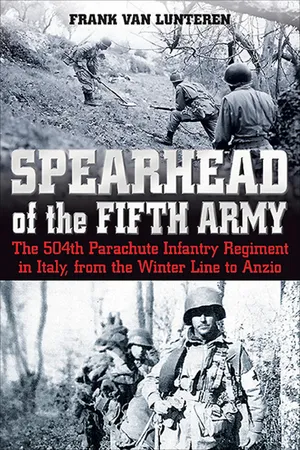
Spearhead of the Fifth Army
The 504th Parachute Infantry Regiment in Italy, from the Winter Line to Anzio
- 324 pages
- English
- ePUB (mobile friendly)
- Available on iOS & Android
eBook - ePub
Spearhead of the Fifth Army
The 504th Parachute Infantry Regiment in Italy, from the Winter Line to Anzio
About this book
Trusted by 375,005 students
Access to over 1.5 million titles for a fair monthly price.
Study more efficiently using our study tools.
Information
CHAPTER 1
ENTERING A GHOST TOWN
Naples, September 28–October 25, 1943
When the U.S. Fifth Army of Lt. Gen. Mark W. Clark landed at Salerno on September 9, 1943, the German resistance was fierce. Counterattacks nearly drove the U.S. VI Corps into the sea, so the 504th PIR of Col. Reuben H. Tucker III jumped in the evening of September 13 to save the beachhead. At Altavilla the paratroopers successfully counterattacked and Col. Tucker’s exclamation over the radio when surrounded—“Retreat? Hell! Send me my other battalion!”—became legendary. Tucker’s troopers helped to turn the tide and were transferred on September 20 by boat across the Gulf of Salerno to the Sorrento Peninsula. Their regimental motto “Strike Hold” was born.
By late September the 504th Regimental Headquarters was set up in the town of Roccadaspide and received orders from Maj. Gen. Geoffrey Keyes, commander of U.S. II Corps, to send out patrols in the area while the majority rested and refitted.
On September 28 a new regimental executive officer was assigned by Maj. Gen. Matthew B. Ridgway, 82nd Airborne Division commander, to Col. Tucker to replace the earlier wounded Lt. Col. Leslie Freeman. His replacement, Lt. Col. Charles Billingslea, was a familiar face to all. A graduate of the West Point Class of 1936, Billingslea was the senior airborne adviser at Fifth Army Headquarters and had previously been employed at the Parachute School at Fort Benning.
That same day the 504th Regimental Combat Team [RCT] moved out in the early afternoon into the coastal plain south of Naples under the command of British X Corps. Second Lieutenant Chester A. Garrison, the 2nd Battalion Adjutant, wrote: “Went ahead by jeep with Major Cook to pick 2nd Battalion bivouac area. Road crowded with British (mostly) and American transportation. Bridge at Sala over deep chasm had been blown but made passable by a GI span erected by British engineers. Sala well shot up. The bivouac area established at Piazza, close to the foot of the mountain and completely under the cover of a thick orchard of lemon, orange and lime trees.
“The road down the mountain was long and winding and mined. The column was caught in the open by a heavy rain and hail storm at 1500, the first real rain we have seen since we have been overseas. Closed in bivouac by 1630 (hike of eight miles). The medics established themselves in the only liveable rooms (second floor) in a local building. Heavy thunder and lightning storms throughout the night, making everybody wet and miserable as there was no shelter except for blankets. Occasional long range enemy artillery bursts in the vicinity during the afternoon and night, but no casualties. Heard what seemed to be a particularly heavy barrage laid down by the Allied artillery at 2130. Lieutenant Colonel Billingslea now acting regimental executive officer.”1
Staff Sergeant Robert J. Lowe and sergeants Albert B. Clark and Robert A. Lininger of A Company were sent out to the left flank to contact the Rangers. “We went out a mile or so and were unable to find anyone,” recalled Clark. “It was a terribly stormy night and the wind, rain and lightening distorted everything. On our return we had to cross a ditch that had been dry when we went out and on our return we had to wade through water waist deep. We also passed within three feet of a foxhole that two of my men were in, as outposts, and they didn’t even know it. It was a really stormy night and we heard that at Salerno the hospital tent had almost blown over and a lot of damage had been done there.”2
Headquarters and Headquarters Company was following the 2nd and 1st Battalion columns, as recalled by Pvt. David K. Finney who lost his rifle in the same rain storm: “We walked most of the day and were happy not having to hide and sweat out incoming shells and pot shots from snipers. About two hours before dark, we took up positions at Chiunzi Pass. This is a mountainous area with good underbrush and trees for concealment. We dug trenches and made do with any sort of head covering available. Rain clouds were forming overhead and a change of weather was on the way. We feasted on C-rations as it began raining.

“It was raining very hard when darkness came. We had put up our pup tents on the side of a hill. Some tents were flooded quickly and left no place to keep out of the rain. Forget about sleeping, there was little to none on this night. The rain became very heavy with high winds, thunder and lightning. Some of the bank washed away—my tent and rifle went with this slide. I did save my back pack. I could hear men yelling and cursing at anything and everything as they tried finding their belongings. The rain stopped falling before dawn.
“We moved out at daybreak after having breakfast (K-rations) and hot coffee (out of the C-ration package). The sun came out very bright. The warmth soothing to all of us. As the sun got higher in the sky, it became warmer and the clothes we were wearing became dry. What a wonderful feeling.”3
One evening the paratroopers could see a glow in the sky and wondered what it might be. A huge bonfire? A star? The following day they noticed smoke billowing up from a high hill in the east and realized it was the volcano Vesuvius. For several nights in a row the glowing could be seen at night. The sight impressed 19-year-old Pvt. Francis X. Keefe of I Company: “Looking out from Chiunzi Pass everything was blacked out and the only light we could see was Mount Vesuvius glowing in the dark. It was a beautiful sight—you could imagine yourself a couple of hundred years back. I can still see the sight now: a light in a surrounding dark for miles. The only other fire we could see was the coal factory that the Germans had put on fire near Castellammare to the west.”4
War correspondent Reynolds Packard, writing for the United Press, visited a number of G Company troopers on September 29: “American troops on this front have become cliff-dwellers, setting themselves up in a neat hillside cave colony known as ‘Shrapnel Row.’ The caves, dug into the sides of the cliff-like hills on the road from Salerno, are in three layers, one above the other, and the whole setup suggests a tenement district back home.
“‘If you get off my face I’ll be glad to show you the place,’ shouted Private Daniel Quinn, Brooklyn, New York, today as I scrambled into his cave when a German shell crashed nearby. We untangled and then Quinn showed me around his ‘apartment’. The hole through which I crashed was both a window and door and from there the dugout turned at right angles deep enough for the two of us to sit up and share some C-rations while the shells continued to crunch, crash and spatter outside. ‘We call this place “Shrapnel Row” because the enemy never lets up shelling and mortaring us,’ Quinn said. ‘Not that we care, now that we made these dugouts which are something new in the way of foxholes.’ He had fixed up his earthen cubicle so that the interior looked almost like an attic bedroom. The dirt walls were covered with pictures taken from old Italian calendars, a mirror and a wooden shelf. He had a bed in a corner, made of hay covered with blankets. An ammunition box served as a table in another corner. The name ‘Huron’ was printed with stones above the combination door-window.
“When the shelling quieted down, Quinn introduced me to neighbors who stuck their heads out of their dugouts. They were from all parts of the United States, including: Sergeant William Rozas, Bethlehem, Pennsylvania; Private Stanley Majestic, 27 Clifton Park Place, Pittsburgh; Private Clarence Heatwole of Akron, Ohio; Private Willmer Gale, Washington and Private Charles Green, Benning Station, Washington D.C. The neighbors and my host were covered with dust from constant diving into the caves as they received signals telling them that shells were coming. The burst of the smoke and flame from the enemy guns could be seen through powerful observation glasses focused on enemy batteries aiming at this point.
“The signal ‘Here they come again!’ would be yelled by Lieutenant Frank Payne, Charleston, West Virginia.”5 Payne told Packard: “After we see a puff of flame and smoke through the telescope it takes five or six seconds for the shell to arrive. We aren’t always sure it is coming our way but as a rule we guess correctly.”6
Although the veteran paratroopers were able to calculate the speed of the German shelling, it was vital that any spotted enemy guns were quickly reported. This required a presence of telephone wires, also during the advance toward Naples. Private Louis C. Marino of the 2nd Platoon in A Company received the order to lay a field telephone wire over the last mountain before moving into Naples: “They gave me a roll of communications wire and told me to carry it over the mountain and bring it with us. And boy, that was really a job. Trying to carry all the rest of my equipment and pushing that damn row of wire over the top. We got over the top of the mountain and the next day I said, ‘What do you want me to do with that roll of wire?’ The guy said, ‘Well, just leave it there.’ I could have shot him.”7
Below the mountain 1st Lt. Roy M. Hanna with his 3rd Battalion Machine Gun Platoon “met a column of our armored tanks headed toward Naples. We jumped on top of the tanks and rode into [the suburbs of] Naples. The streets were lined with waving and shouting Italian civilians. We jumped off the tanks and allowed the women to hug us.”8
Private First Class Earl S. Oldfather of G Company recalled that at 1800 hours on September 30 his platoon leader, 1st Lt. Francis W. Deignan, called the platoon together: “We are moving to Naples and [will] live inside—we’ll have the north section of the city—see that it is policed up. The 505th and 325th will be in other parts of Naples. There will be certain regulations—proper uniform—military courtesy—stay out of civilian homes. There will be a price regulation list—pay no more. It all sounds swell.”9
To 21-year-old Pvt. Marino, Naples looked like a ghost town when the 504th RCT entered the city on October 1. Marino did not see any civilians on the streets. Doors and window shutters were closed and there was any eerie silence. Then they spotted great billows of black smoke: “The Germans had set the coal on fire. I was one of the guys that were put on guard duty to guard the coal. It was right at the harbor in Naples. As soon as the people saw that we weren’t going to shoot them they started coming and started to salvage what they could from that coal fire. I could speak some Italian and I could understand them and they could understand me. That made it very nice for me. My folks were both born over there, but I was born in Elkhart, Indiana.
“I acted as an interpreter one night when the sergeant came with a civilian and said, ‘This guy says there is a patrol out here.’ I talked to the guy and he said he was a patrone which meant he owned the house where the sergeant was staying. The sergeant thought he had said patrol, a German patrol. It was just that he was the owner of the house.”10
Another A Company soldier, Pfc. Ervin E. Shaffer, recalled that they bivouacked in the newer part of Pompeii before “we were put in a school building to stay while we were in Naples. After we got in we were assigned to a place to put our gear. I was one of the men that were then ordered out on a patrol and we patrolled the streets in Naples.
“The next morning we were on one of the squares there in the city when daylight came. In the center of the square, they had a fountain. As I walked over towards that fountain someone yelled, ‘Americano!’ And then I heard three or four other people yelling ‘Americano!’ and they came out of the houses.”11
Private First Class Darrell G. Harris of the Regimental Demolition Platoon remembered the entry was made shortly after “we were caught in a drenching downpour. I remember sitting in an olive grove most of the night with the rain pouring off my helmet and poncho. The next morning the skies had cleared, and we began moving into Naples. The Italian people treated us not as their conquerors, but as heroes. They lined the roadway cheering, throwing flowers, and even handing us bottles of wine. We spent a couple of days chasing down snipers in Naples, and then we settled down as occupation troops for a while.”12
The snipers proved to be less dangerous for the 82nd Airborne Division than the various time bombs that had been planted by the Germans before they fled the city. On October 10, at 0830 hours, a German time bomb exploded in the former Italian artillery barracks where B Company of the 307th Airborne Engineer Battalion [AEB] was billeted. Twenty-two non-coms and enlisted men were killed and many more were wounded. Staff Sergeant Ernest W. Parks of D Company recalled of this incident: “Many of our soldiers were in these buildings which were located near the great university in the heart of Naples. The building down the street from our refuge was devastated by one of the two great bombs that exploded at the completion of their set time. Colonel [James M.] Gavin, later to be promoted to major general, arrived in what seemed to be a very short time … He was dressed in a spotless and exquisitely pressed uniform. He entered one of the mostly demolished buildings wherein some of our fellow 82nd Airborne troops were victimized in the terrible wreckage.
“When the sun went down, Colonel Gavin looked like a refugee from an underworld. He proceeded to examine the entire wreckage and inspected every load that was hauled away for bodies of dead soldiers. From that day on, we had greater respect for him, which up to that point seemed impossible.
“Except for the time bombs, our activities in Naples covered the space of approximately two weeks in comparative safety. During this time we occupied ourselves with keeping order among the returning civilians and finding food for them. Our first concern was the starving babies, children and mothers.”13
The airborne engineers of C Company received the unpleasant task of removing the debris and retrieving the (fatal) casualties. Corporal William E. Kero wrote in his diary: “One of the Battalion’s biggest disasters took place this morning at 9 a.m. Just walking around posting the guard when the building B Company was in blew up. The building had TNT stored up in it. About knocked me down, another minute and I would have been under it. Some boys from 36th Engineers got killed, too. Had a job keeping the civilians away. One woman got hysterical and fainted, worked digging up the bodies. Never saw such horrible sights in my life, boys blown to bits. Some of them were saved. Knew a lot of them.”14
It took several days before all the bodies had been removed and were buried. Kero wrote on October 12: “Still digging up bodies. They smell so you can hardly stand it. Wear gas mask when you carry them away. Found TNT in the building where we were.”15
Headquarters and Headquarters Company acquired a large building. “Each squad was assigned to different rooms in the same building, which made it convenient,” recalled Pvt. Finney. “As we normally did, we had roll call, calisthenics and best of all, a hot meal. For now, no more C-rations. It was almost like a wonderful and restful dream. Naples was still considered a combat zone as we continued finding hold-up German snipers. There were occasional air raids, usually at night, plus having to be aware of the many booby-traps left behind as the Germans fled the city. The day after our arrival the Naples Post Office was rocked by a very large explosion. Ov...
Table of contents
- Cover
- Title Page
- Copyright
- Dedication
- Contents
- List of Maps
- Foreword
- Introduction
- Acknowledgments
- Chapter 1: Entering a Ghost Town: Naples, September 28–October 25, 1943
- Chapter 2: Across the Matese Mountains: Valle Agricola, Letino, and Gallo, October 26–November 3, 1943
- Chapter 3: Conquering the Volturno Valley: Macchia, Fornelli, Isernia, November 4–8, 1943
- Chapter 4: Breaching the Barbara Line: Colli, Hill 1017, and Rocchetta, November 9–30, 1943
- Chapter 5: Battle for the Bernhard Line: Hills 610, 687, 877, 950, and 954, December 1–31, 1943
- Chapter 6: Reaching the Breaking Point: Hills 710 and 1205, December 9–31, 1943
- Chapter 7: Planning Operation Shingle: Naples, January 1–21, 1944
- Chapter 8: Landing on Red Beach: Anzio Beachhead, January 22, 1944
- Chapter 9: Battle at Bridge No. 2: Anzio Beachhead, January 23–24, 1944
- Chapter 10: Disaster at Borgo Piave: Anzio Beachhead, January 25–27, 1944
- Chapter 11: Last Attempt to Break Out: Anzio Beachhead, January 28–31, 1944
- Chapter 12: The Factory: Anzio Beachhead, February 1–6, 1944
- Chapter 13: The Grenadier Guards Gully: Anzio Beachhead, February 7–8, 1944
- Chapter 14: Battle for Carroceto: Anzio Beachhead, February 8–10, 1944
- Chapter 15: The Mussolini Canal: Anzio Beachhead, February 1–15, 1944
- Chapter 16: Operation Fischfang and Deadly Patrols: Anzio Beachhead, February 16–29, 1944
- Chapter 17: Journey to the Line: Anzio Beachhead, March 1–9, 1944
- Chapter 18: Battle Experience: Anzio Beachhead, March 10–21, 1944
- Chapter 19: Relief at Anzio: Anzio Beachhead and Naples, March 22–April 9, 1944
- Chapter 20: Postscript: Postwar Careers
- Appendix A: Distinguished Service Cross Recipients
- Appendix B: List of Battlefield Commissions
- Appendix C: Order of Battle for the Apennine Mountains Campaign, October 25, 1943
- Appendix D: Order of Battle for Operation Shingle, January 22, 1944
- Appendix E: Order of Battle for Operation Shingle, March 22, 1944
- Appendix F: Order of Battle for the 24th Guards Brigade, February 7–8, 1944
- Appendix G: Field Orders of the 3rd Infantry Division to Col. Tucker, January 1944
- Acronyms and Abbreviations
- Notes
- Contributing Veterans
- Selected Bibliography
Frequently asked questions
Yes, you can cancel anytime from the Subscription tab in your account settings on the Perlego website. Your subscription will stay active until the end of your current billing period. Learn how to cancel your subscription
No, books cannot be downloaded as external files, such as PDFs, for use outside of Perlego. However, you can download books within the Perlego app for offline reading on mobile or tablet. Learn how to download books offline
Perlego offers two plans: Essential and Complete
- Essential is ideal for learners and professionals who enjoy exploring a wide range of subjects. Access the Essential Library with 800,000+ trusted titles and best-sellers across business, personal growth, and the humanities. Includes unlimited reading time and Standard Read Aloud voice.
- Complete: Perfect for advanced learners and researchers needing full, unrestricted access. Unlock 1.5M+ books across hundreds of subjects, including academic and specialized titles. The Complete Plan also includes advanced features like Premium Read Aloud and Research Assistant.
We are an online textbook subscription service, where you can get access to an entire online library for less than the price of a single book per month. With over 1.5 million books across 990+ topics, we’ve got you covered! Learn about our mission
Look out for the read-aloud symbol on your next book to see if you can listen to it. The read-aloud tool reads text aloud for you, highlighting the text as it is being read. You can pause it, speed it up and slow it down. Learn more about Read Aloud
Yes! You can use the Perlego app on both iOS and Android devices to read anytime, anywhere — even offline. Perfect for commutes or when you’re on the go.
Please note we cannot support devices running on iOS 13 and Android 7 or earlier. Learn more about using the app
Please note we cannot support devices running on iOS 13 and Android 7 or earlier. Learn more about using the app
Yes, you can access Spearhead of the Fifth Army by Frank van Lunteren in PDF and/or ePUB format, as well as other popular books in History & Italian History. We have over 1.5 million books available in our catalogue for you to explore.