"A condensed 'Band of Brothers' with profiles of Richard Winters and Easy company as well as the German and American Generals . . . 5 stars" (Army Rumour Service).
101st Airborne Division was activated in August 1942 in Louisiana, and its first combat mission was Operation Overlord. On D-Day—June 6, 1944—101st and 82nd Airborne dropped onto the Cotentin Peninsula hours before the landings, tasked with capturing bridges and positions, taking out German strongpoints and batteries, and securing the exits from Utah and Omaha Beaches. Things did not initially go smoothly for 101st Airborne, with cloud and antiaircraft fire disrupting the drops. Casualties were high in some areas due to heavy pre-registered German fire. Nevertheless, the paratroopers fought on, and they did manage to secure the crucial beach exits, even if they only achieved a tenuous hold on some other positions.
A few days later, 101st Airborne was tasked with attacking the German-held city of Carentan as part of the consolidation of the US beachheads and establishment of a defensive line against the anticipated German counteroffensive. The 101st forced its way into Carentan on June 10 and 11. The Germans withdrew the following day, and a counteroffensive was put down by elements of the 2nd Armored Division.
This fully illustrated book details the planning of the airborne element of D-Day and the execution of the plans until the troops were withdrawn to prepare for the next big airborne operation, Market Garden.
"Always good to read a detailed account of one division's contribution to Operation Overlord. The detail is exceptional and fascinating." —
Books Monthly
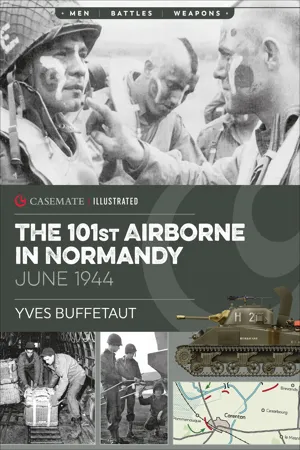
- 128 pages
- English
- ePUB (mobile friendly)
- Available on iOS & Android
eBook - ePub
The 101st Airborne in Normandy, June 1944
About this book
Information
Topic
HistoriaSubtopic
Historia militar y marítimaThe 101st in Carentan
On June 7, Eisenhower landed at Omaha Beach and ordered Lt. General Omar Bradley, commander of US First Army, to concentrate his efforts on joining the two American beachheads: V Corps would attack from Omaha west in the direction of Isigny and VII Corps from Utah would take Carentan. The latter mission was quite naturally assigned to the 101st Airborne Division which held the southern front in the Utah sector. In case it was unable to take Carentan alone, Bradley asked Major General J. Lawton Collins to make use of other available divisions. This implied changing the axis of the main effort, as the Allied strategy was to isolate the Cotentin peninsula, then seize Cherbourg—that is to say an advance toward the west then to the north, while Carentan lay to the south.
Stage 1: Take Saint-Côme-du-Mont
As already described, elements of the 101st Airborne advanced toward Saint-Côme-du-Mont early on June 8, with a three-battalion front supported by an artillery barrage. On the German side, the front was held by the reserve battalion of 7. Armee and elements of Fallschirmjäger Regiment 6 commanded by Oberstleutnant von der Heydte. These troops suffered the brunt of the American artillery, as described by von der Heydte himself:
In the early hours of the morning of June 8, the positions of the 8th Company and the regimental command post were submitted to a violent barrage of enemy artillery that lasted around 30 minutes and caused losses.
At the end of the bombardment, the American paratroopers launched their assault. The 3rd Battalion, 501st PIR, seized Les Droueries and advanced rapidly toward the south. The 1st and 2nd Battalions, 506th PIR took up defensive positions to the east of Saint-Côme-du-Mont. Meanwhile, 3rd Battalion, 501st PIR swung around the village, supported by men of the glider regiment. The 3rd Battalion reached the highway just north of the crossroads at Beaumont in mid-morning, which provoked much anxiety on the German side. Colonel Ewell, commanding the battalion, noticed signs of withdrawal by the Germans, who appeared to be abandoning Saint-Côme-du-Mont. Von der Heydte also talked about the fighting that morning:
At daybreak, the American assault detachments penetrated the sector held by the reserve battalion of the 7. Armee and advanced as far as Saint-Côme-du-Mont. Again, its defensive line began to disintegrate. From the command post of the regiment, I could first see individual soldiers, then whole groups fleeing Saint-Côme-du-Mont toward the west. The battalion’s command post had changed location and we could not locate it. The noise of the battle showed that the 3rd battalion [of German paratroopers], east of Saint-Côme-du-Mont, were engaged in a violent fight.

An American soldier smokes a cigarette during the battle for Carentan. Success at Carentan was crucial to the objectives of consolidating the American beachheads of Utah and Omaha, and creating a defensive line in preparation for the expected German counterattack. (NARA)
Fallschirmjäger Regiment 6 on the verge of annihilation
It was an extremely difficult situation for the German paratroopers. They could not remain north of the Douve because they ran the risk of being surrounded, so they retreated south of the river before it was too late. Von der Heydte:
Because of the situation, the commander of the regiment [by this he means himself] had no other choice than to retreat behind the canal of the Douve and to pursue the defense of Carentan from that point. There were not enough reserves to plug the breaches opened by the collapse of the reserve battalion of the 7. Armee, push back the enemy troops who were trying to get in, or stop the adverse penetration. He gave the necessary orders to the units of the regiment who fought in the neighborhood, and the two companies of the 3rd Battalion. The orders to retreat were sent to the 1st and 2nd battalions, but without having the least certainty that they were received, while the radio liaison with the 2nd Battalion was itself interrupted. Neither of the two battalions ever received the order.
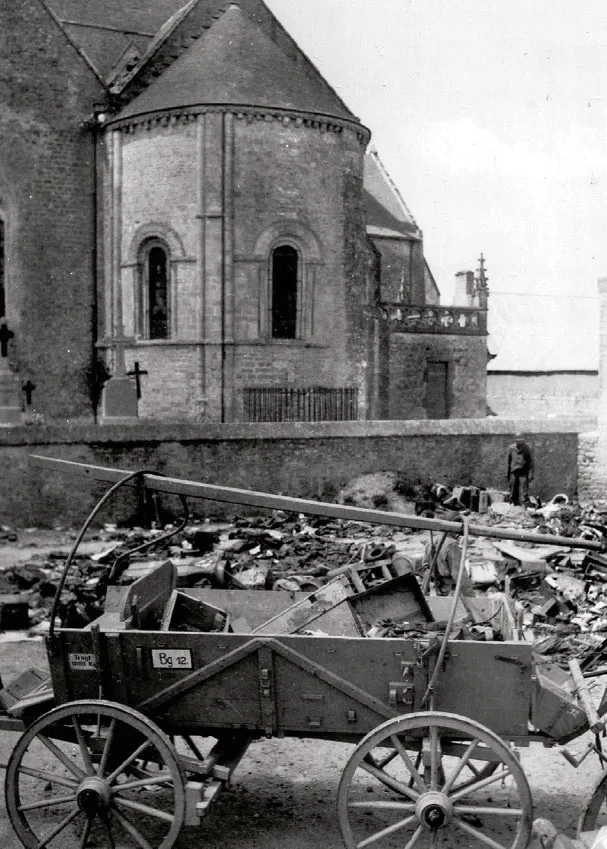
A German horse-drawn cart abandoned behind the chevet of the Saint-Côme-du-Mont church. Until the 17th SS Panzergrenadier Division arrived at the front, the Germans fighting on the Cotentin were struggling due to a lack of motorized vehicles. (NARA)
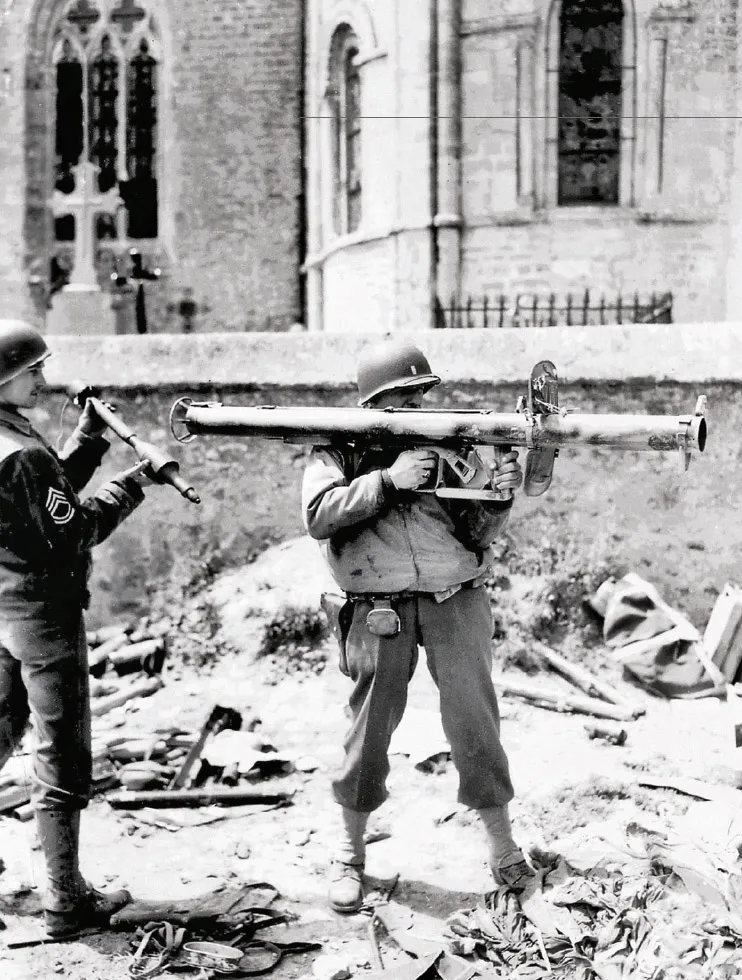
Beside the Saint-Côme-du-Mont church an American officer examines a Panzerschreck. (NARA)
The 1st Battalion, as the commander of the regiment would later learn, had been annihilated on June 7 and the head of the battalion captured; only 25 men rallied on June 9 after having broken the American lines on the marshy land along the banks of the Douve. The commander of the 2nd Battalion could no longer be reached to re-establish contact. On his own initiative, he took the decision to retreat through the American lines as far as Carentan.
It was not easy for our elements in position at Saint-Côme-du-Mont to retreat across the Douve. The majority of men had to cross by swimming to the elevated ground of the Carentan–Cherbourg railroad. Apparently, the Americans had not realized that a retreat had taken place; in any case, they only fired upon the German paratroopers crossing the Douve a little, and in a wide sweep. The railroad, which offered shelter, was not a target.
In Profile:
M4 Shermans from Utah Beach
With around 50,000 built, the Sherman was the main Allied battle tank of the war, and it appeared in a number of variations. On D-Day the Duplex-Drive variant was designed to swim ashore, surrounded by a large flotation device. But that effort largely ended in tragedy when tanks were dropped into choppy water too far from the beach.
Other tanks were improvised with steel prongs to cut through hedgerows, and some were equipped with vertical intake pipes to allow fording of rivers. The Germans had succeeded in modernizing many of their tanks by giving them more powerful guns; however, the attempt to upgun the Sherman from a 75mm to a 76mm accomplished little. Or as Eisenhower groused, “Ordnance told me this 76 would take care of anything the Germans had. Now I find you can’t knock out a damn thing with it.”
Still, while not a match for a Panther or Tiger in a shootout, the Sherman was more mechanically reliable, and Allied crews eventually learned how to compensate for its failings. During the 101st’s desperate toehold at Carentan, it was 2nd Armored Shermans coming to the rescue that helped save the integrity of the beachhead.

A Sherman M4A1 Duplex Drive, 70th Tank Battalion, as it would have appeared landing at Utah Beach on June 6, 1944.
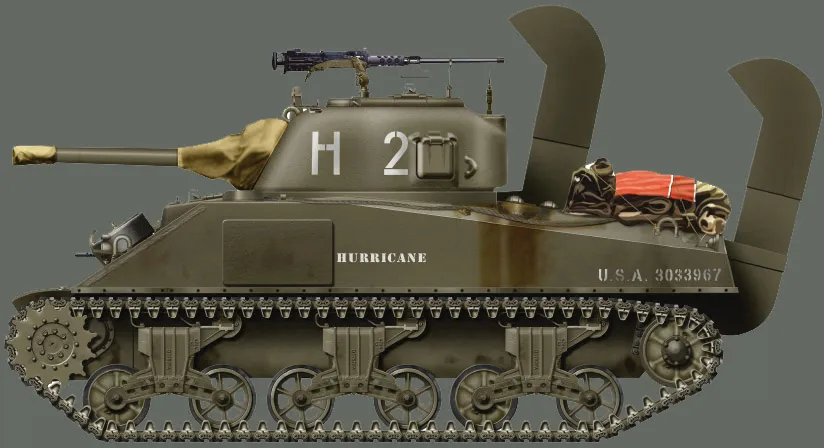
Hurricane, an M4 of the 66th Armored Battalion, which landed at Utah Beach at the same time as the 4th US Infantry Division. It is equipped with fording equipment.
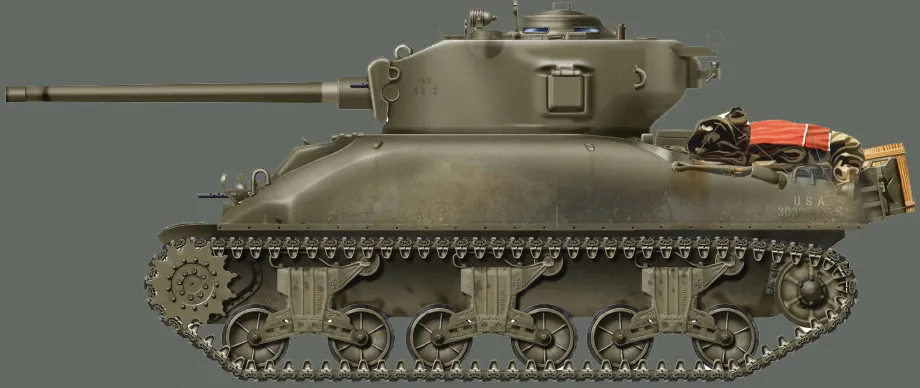
A Sherman M4A1 tank of the 67th Armored Regiment, 2nd Armored Division, a unit that supported the 101st Airborne during the battle of Carentan.
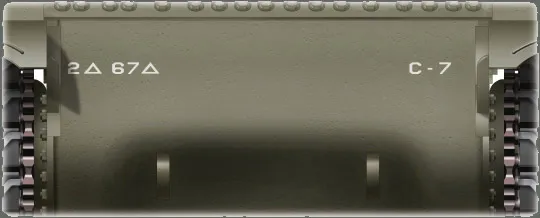
The markings on the front of the tank can be seen close-up.
The Battle from the American Side
Colonel Ewell, who commanded the 3rd Battalion, 501st PIR, soon realized that the Germans were retreating. He took advantage of it and tried to intercept the Germans by seizing the highway to Carentan, but his men were met with heavy fire from small arms, machine guns and antitank guns, situated in the buildings close to the first bridge. A number of 88mm shells, coming from Carentan, also began to fall among the Americans. The incoming fire meant that they could not stay on the road, so they retreated to the east. That’s when, according to Ewell, a German counterattack from the north was triggered, though German testimonies describe it as being more like a breakthrough attempt than a counterattack. Ewell indicated that he repelled five German assaults; these were no doubt the paratroopers of the reserve battalion of the 7. Armee trying to reach the German lines.
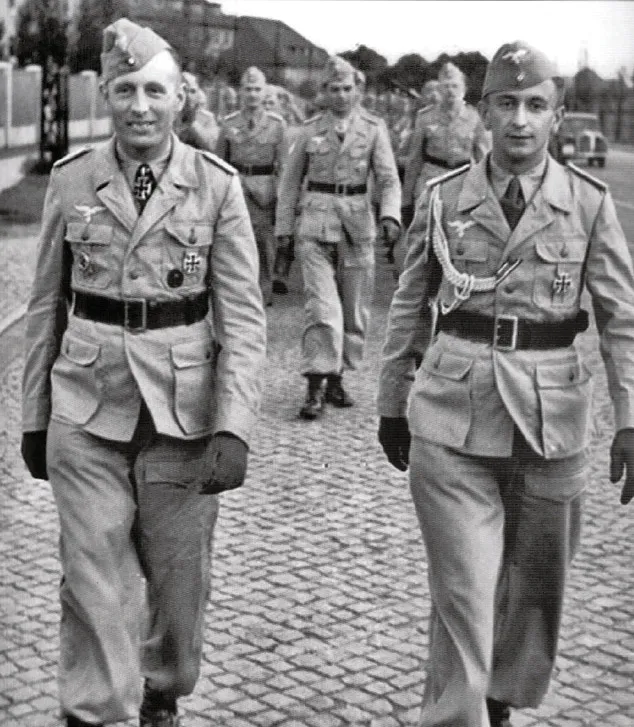
Colonel von der Heydte (left) while only a Commander. (Rights reserved)
In the middle of the afternoon, 1st Battalion, 401st GIR, arrived to reinforce Ewe...
Table of contents
- Cover
- Title
- Copyright
- Contents
- Timeline of Events: June 1944
- Background and Formation of the 101st Airborne Division
- Planning and Preparation
- Airborne Invasion
- “E” is for Easy
- The 101st in Carentan
- Afterword
- Further Reading
Trusted by 375,005 students
Access to over 1.5 million titles for a fair monthly price.
Study more efficiently using our study tools.
Frequently asked questions
Yes, you can cancel anytime from the Subscription tab in your account settings on the Perlego website. Your subscription will stay active until the end of your current billing period. Learn how to cancel your subscription
No, books cannot be downloaded as external files, such as PDFs, for use outside of Perlego. However, you can download books within the Perlego app for offline reading on mobile or tablet. Learn how to download books offline
We are an online textbook subscription service, where you can get access to an entire online library for less than the price of a single book per month. With over 1.5 million books across 990+ topics, we’ve got you covered! Learn about our mission
Look out for the read-aloud symbol on your next book to see if you can listen to it. The read-aloud tool reads text aloud for you, highlighting the text as it is being read. You can pause it, speed it up and slow it down. Learn more about Read Aloud
Yes! You can use the Perlego app on both iOS and Android devices to read anytime, anywhere — even offline. Perfect for commutes or when you’re on the go.
Please note we cannot support devices running on iOS 13 and Android 7 or earlier. Learn more about using the app
Please note we cannot support devices running on iOS 13 and Android 7 or earlier. Learn more about using the app
Yes, you can access The 101st Airborne in Normandy, June 1944 by Yves Buffetaut in PDF and/or ePUB format, as well as other popular books in Historia & Historia militar y marítima. We have over 1.5 million books available in our catalogue for you to explore.