A tale of a lifelong passion for a WWII aircraft that changed the author's life: "It is almost like an adventure novel except it is true" (
Air Classics).
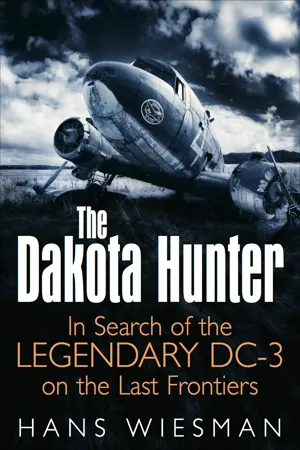
This book tells the story of a Dutch boy who grew up during the 1950s in postwar Borneo, where he had frequent encounters with an airplane, the Douglas DC-3, a.k.a. the C-47 Skytrain or Dakota, of World War II fame. For a young boy living in a remote jungle community, the aircraft reached the proportions of a romantic icon as the essential lifeline to a bigger world for him, the beginning of a special bond.
In 1957, his family left the island and all its residual wreckage of World War II, and he attended college in The Hague. After graduation, he started a career as a corporate executive—and met the aircraft again during business trips to the Americas. His childhood passion for the Dakota flared up anew, and the fascination pulled like a magnet. As if predestined, or maybe just looking for an excuse to come closer, he began a business to salvage and convert Dakota parts, which meant first of all finding them.
As the demand for these war relic parts and cockpits soared, he began to travel the world to track down surplus, crashed, or derelict Dakotas. He ventured deeper and deeper into remote mountains, jungles, savannas, and the seas where the planes are found, usually as ghostly wrecks but sometimes still in full commercial operation. In hunting the mythical Dakota, he often encountered intimidating or dicey situations in countries plagued by wars or revolts, others by arms and narcotics trafficking, warlords, and conmen.
The stories of these expeditions take the reader to some of the remotest spots in the world, but once there, one is often greeted by the comfort of what was once the West's apex in transportation—however now haunted by the courageous airmen of the past.
- 320 pages
- English
- ePUB (mobile friendly)
- Available on iOS & Android
eBook - ePub
About this book
Information
CHAPTER 1
Borneo
Born to Be Wild
The Netherlands, May 1947.
The world was just beginning to rise again from the ashes of the great fire that had raged across the globe in the shape of the Second World War. The reconstruction work required after that long and devastating war had commenced and, in order to see that through, the western world craved one thing above all others: oil.
The fuel for the New Global Order had to be found, drilled, and transported at an ever-increasing rate. Rigs, pipelines, and refineries were being built or repaired around the clock in order to cope with the exploding demand.
It was during this unprecedented global search for black gold that my father found a job for life as a mechanical engineer with the Shell Oil Company. It took him all over the world, and we followed him wherever he went.
His first posting was to the islands of Curacao and Trinidad in the West Indies in 1947 for a contract period of three years.
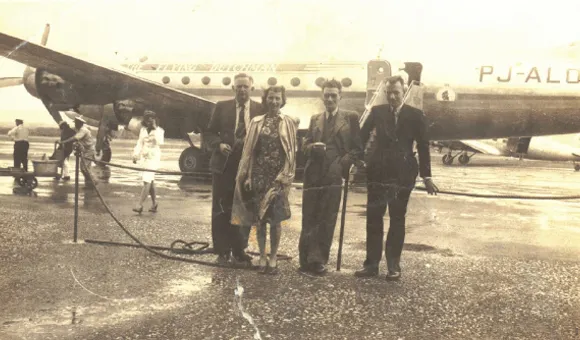
My first ever flight: only a baby, I flew from Holland to Curacao via Iceland and New York. This was in 1947 with my mom, dad and two sisters on board the KLM DC-4 PJ-ALD.
I was only six months old when I made my first intercontinental flight, with my mom and two elder sisters, to the Caribbean via Iceland and New York on board a KLM 4-engine Douglas DC-4 PJ-ALD. Though I was of course completely unaware of the fact at the time, this was my first and very early introduction to the wonderful world of flight, travel, and adventure.
My first encounter with a Douglas Dakota DC-3 also dates back to that time in the shape of the flight that brought my family from Trinidad to Curacao two years later in 1949. The photo of that wonderful occasion, taken just after my brother Fons was born, remains a precious souvenir of what turned out to be the start of a lifelong passion for that particular aircraft.
In late 1949 we returned to Holland onboard the KNSM ship the SS Peter Stuyvesant. After docking at the Azores Islands in the Atlantic for a couple of days, we arrived in Holland, where we lived until the summer, before continuing our voyage onboard the MS Oranje through the Suez Canal and on to the island of Borneo in Indonesia, my father’s place of work for the next six years.
This marked the beginning of a new and exciting chapter in my young life. It was also to be our last major trip by ship, as the newly emerging, large four-engine aircraft such as the DC-4 were now capable of making such trips in a matter of days as opposed to weeks. The era of the famous large passenger ships was drawing to a close but would continue for at least another decade, transporting emigrants to Australia and Canada.
After arriving in Indonesia we flew in a Dakota from Djakarta to the Borneo jungle near Banjarmasin in the southeast. From there it was a long haul by car through the wilderness to the small remote village of Tanjung, where we settled down to live in a postcolonial Indonesia that had just emerged from four hundred years of Dutch Rule and three and a half years of Japanese occupation during the Pacific war.
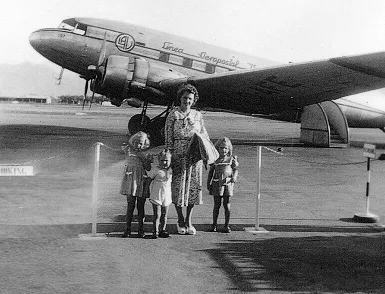
Two years later, in 1949, I made my first flight in a Douglas DC-3 from Trinidad to Curacao. Here I am posing proudly before the aircraft with my mom and my sisters Corine and Rita. It marked the start of a long lasting and passionate relationship with the plane.
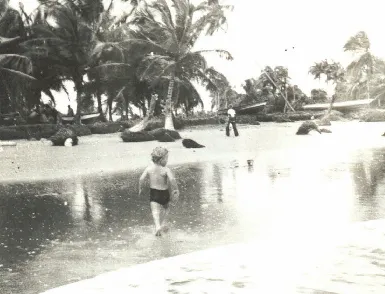
Paradise for toddlers in Trinidad, where we lived for one year. My brother Fons was born here in 1949. Beach, sea and palm trees were to become our playground for the next 10 years and we soon excelled as swimmers and climbers, like little monkeys.
Immediately after the Japanese surrender on August 17, 1945, the Indonesian Freedom Movement issued a declaration of independence on behalf of the Republic of Indonesia, and thus began the Merdeka (freedom) guerrilla struggle against the Dutch that would last until December 1949. We arrived just after that five-year period of postwar turmoil had ended. Indonesia had been declared a free state by its first president, Sukarno, and was now formally recognized as such by the whole world, including the reluctant Dutch government. The dramatic events in this fledgling postwar nation in which thousands of people were killed had been well publicized, so my parents had mixed feelings about bringing their four children to such a primitive, hot, and humid part of the world. This formed the imposing backdrop to the start of what would prove a very adventurous and eventful sojourn in Borneo.
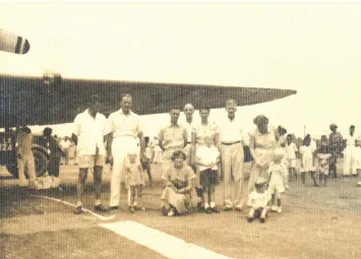
Our arrival by Dakota in Banjermasin, SE Borneo in 1950. The scars of Japanese occupation and the ensuing war for independence meant, in many people’s eyes, that it was not a suitable environment for raising young kids, but we loved it.
A year later, we moved again to a second jungle settlement called Sanga Sanga, which was surrounded by very rich oil fields full of derricks and drilling towers. Finally, three years after first setting foot on the island, we made our home in the city of Balikpapan, on the east coast, where the largest oil refinery in Indonesia was situated.
Covered largely by dense and impassable tropical rainforest, as it was at that time, there was hardly any infrastructure on the island. So most transport was by boat, plane, or seaplane. Not surprisingly, we flew most frequently with the Douglas DC-3/C-47 (aka the Dakota) and sometimes with an extraordinary-looking amphibian aircraft, the Consolidated PBY-5A Catalina, a parasol wing plane that flew us to places where there was no airstrip for landing, such as in Sanga Sanga. The Catalina frequently landed right in front of our house near Samarinda on the Mahakam River, a mighty stretch of water almost 1,000 kilometers in length that originates deep in the heart of Borneo.
Both types of aircraft had arrived there straight after the war from the US surplus depots. They were demilitarized, converted to passenger transports, and taken over by Shell and KLM/Garuda. These planes were the fastest means of transport from our village to other places in the country, including for our annual vacation to Bandung or Surabaya and the cooler mountain resorts on the island of Java, where Shell owned holiday houses for its employees.
For as far back as I can recall, flying, to me, was the most wonderful of adventures. I always claimed the window seat and would sit with my nose pressed against the glass for the duration of the flight, looking out in awe at the colorful scene below. I felt like a bird of paradise and was incredibly lucky to be able to experience all of this in my dreamlike youth.
AFTERMATH OF THE WARTIME
The Japanese Army invaded Borneo in early 1942, as they considered it a primary strategic objective due to its rich oil fields. The port and refinery facilities built by Shell in Balikpapan and Tarakan were undoubtedly attractive targets. The Americans estimated that half of all Japanese oil supplies for their war effort in Southeast Asia originated from the eastern Borneo region. Not surprisingly, when the tables were turned against the Japanese in 1944 and 1945, the refineries were subjected to frequent air raids. The Japs constructed defenses in the form of heavy artillery bunkers, especially in Balikpapan, in anticipation of the imminent arrival of the Allied naval invasion fleet. By the end of the occupation enormous damage had been inflicted on the oil refineries by the Americans’ bombing raids and also by the Japanese themselves as they withdrew in the face of the advancing armies. Starting in September 1944, the USAAF bombed the refineries and storage tanks in five major air attacks, each time with an armada of seventy B-24 Liberators and B-25 Mitchells that took off from the recently liberated western region of Dutch New Guinea (the Biak Islands). That was an immense distance for fully loaded bombers to cover, almost 2,500 nautical miles over enemy territory and open seas. These attacks were extremely effective and resulted in the total shutdown of vital fuel production facilities in eastern Borneo. They cost the Japanese much of their fuel supply, right at a time when it was sorely needed for the defense of the Philippine archipelago, which had come under US attack not long before.
My dad was working in Borneo as a mechanical engineer for the Shell subsidiary BPM (Batavian Petroleum Company). His job was to inspect the wells, pumps, derricks, pipelines, and installations that were being repaired and expanded in order to meet the increasing demand for oil. Far from the comforts of Europe, and just five years after the end of the war, there were few cars and no real roads or railway infrastructure to speak of. However, the war had left behind other means of transport: Willys Jeeps and GMC military trucks, which were now used by BPM and by the Indonesian army.
In addition to these vehicles, there were other souvenirs of the war effort to be found all around us, including heavy artillery bunkers and aluminum landing craft. There were also semicircular corrugated Nissen huts for the housing of troops, a small Australian war memorial on the beach road and—the pièce de résistance—the wreck of a Japanese U-boat in shallow waters out in the middle of the bay, its rusty conning tower jutting out from the water. It was the favorite hangout for huge man-eating crocodiles that could grow up to six meters in length and were much feared by the locals. And with good reason, too, as they frequently lost children and women to those monsters who would lie in wait on the shore and riverbanks.
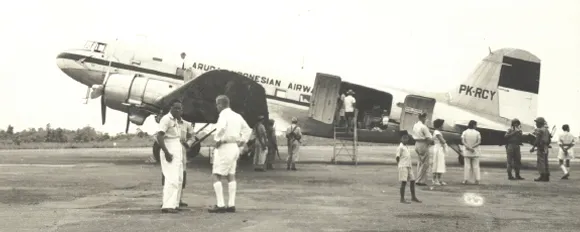
Garuda DC-3 in Borneo. It was this aircraft that played the role of flying ambulance when it took me from Tandjung to Balikpapan Hospital in 1951 after I had suffered a near fatal accident. My love for the Dakota was sparked here and resurfaced again 35 years later.
From the early 1950s on, battered-looking rusty Japanese ships came to the port to collect the twisted metal leftovers of the destroyed plants and storage tanks. Japan was actually buying up its self-inflicted iron scrap in Indonesia, which they then recycled for the industrial reconstruction process already in full swing back in their own country. The large tank storage park located just behind the harbor in the hills lay in ruins, and they returned again and again to take away every piece of metal that was worth salvaging.
One morning we heard the sound of a terrible explosion coming from the port. A Norwegian tanker had gone up in flames while refueling. We scrambled from our beds and out into the garden to watch the inferno raging below on the dockside. The tanker had been torn in two by the explosion and was burning like a huge torch, not far from the steelworks and repair facilities managed by my father.
With the sound of sirens filling the air, my dad, only half-dressed, jumped into his jeep and sped off down to the port. It was all hands on deck down there, and it took almost the whole day before the fire was brought under control and the refinery saved from destruction. The school was closed down for the day because even the teachers had to help fight the fire, as a result of the training that all the men in this oil-dependent community had to follow so that they could help in cases of emergency. We watched in awe from our mountaintop vantage point as the battle unfolded below us, the fire eventually being beaten down and the stricken tanker towed by tugs to the other side of the bay. It was like a real-time news show. And we had never even seen a TV screen in our lives.
I was at an age when the “Gates of Wonder” had begun to open up for me in a most intense manner. Life here was certainly a lot more exciting and adventurous than what kids were used to back in the Nethe...
Table of contents
- Front Cover
- Title Page
- Copyright Page
- Contents
- Introduction to the Douglas DC-3/C-47/Dakota
- Prologue
- Chapter 1 Borneo: Born to Be Wild
- Chapter 2 Holland: In the Beginning
- Chapter 3 The US Gulf States: Jackpot and Quicksand
- Chapter 4 Venezuela and Honduras: Angel Falling from the Sky
- Chapter 5 Bolivia: El Condor Pasa …
- Chapter 6 Colombia I: Never a Dull Day
- Chapter 7 Madagascar: Dancing with Colonels
- Chapter 8 Thailand: Sinking the Dakotas
- Chapter 9 Alaska and the Yukon: L’aventure se prolonge
- Chapter 10 Colombia II: Bats Out of Hell
- Chapter 11 Museums and Projects: The Icons of Victory
- Acknowledgements
Trusted by 375,005 students
Access to over 1.5 million titles for a fair monthly price.
Study more efficiently using our study tools.
Frequently asked questions
Yes, you can cancel anytime from the Subscription tab in your account settings on the Perlego website. Your subscription will stay active until the end of your current billing period. Learn how to cancel your subscription
No, books cannot be downloaded as external files, such as PDFs, for use outside of Perlego. However, you can download books within the Perlego app for offline reading on mobile or tablet. Learn how to download books offline
Perlego offers two plans: Essential and Complete
- Essential is ideal for learners and professionals who enjoy exploring a wide range of subjects. Access the Essential Library with 800,000+ trusted titles and best-sellers across business, personal growth, and the humanities. Includes unlimited reading time and Standard Read Aloud voice.
- Complete: Perfect for advanced learners and researchers needing full, unrestricted access. Unlock 1.5M+ books across hundreds of subjects, including academic and specialized titles. The Complete Plan also includes advanced features like Premium Read Aloud and Research Assistant.
We are an online textbook subscription service, where you can get access to an entire online library for less than the price of a single book per month. With over 1.5 million books across 990+ topics, we’ve got you covered! Learn about our mission
Look out for the read-aloud symbol on your next book to see if you can listen to it. The read-aloud tool reads text aloud for you, highlighting the text as it is being read. You can pause it, speed it up and slow it down. Learn more about Read Aloud
Yes! You can use the Perlego app on both iOS and Android devices to read anytime, anywhere — even offline. Perfect for commutes or when you’re on the go.
Please note we cannot support devices running on iOS 13 and Android 7 or earlier. Learn more about using the app
Please note we cannot support devices running on iOS 13 and Android 7 or earlier. Learn more about using the app
Yes, you can access The Dakota Hunter by Hans Wiesman in PDF and/or ePUB format, as well as other popular books in Social Sciences & Social Science Biographies. We have over 1.5 million books available in our catalogue for you to explore.