The decisive battle in Gen. MacArthur's reclaiming of the Philippines in WWII is told in vivid, on-the-ground detail in this "definitive account" (
WWII History Magazine).
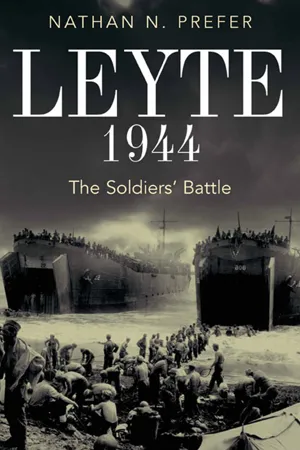
When Gen. Douglas MacArthur left the Philippines in 1942 to organize a new American army, he vowed, "I shall return!" More than two years later, he did return, retaking the Philippines from the Japanese. The site of his reinvasion was the central Philippine island of Leyte.
The Japanese high command decided to make Leyte the "decisive battle" for the western Pacific and rushed crack Imperial Army units from Manchuria, Korea, and Japan to overwhelm the Americans. The Americans in turn rushed in reinforcements. This unique battle also saw a counteroffensive designed to push the Americans off the island and capture the elusive Gen. MacArthur.
Both American and Japanese battalions spent days surrounded by the enemy, often until relieved or overwhelmed. Leyte was a three-dimensional battle, fought with the best both sides had to offer, and did indeed decide the fate of the Philippines in World War II.
- 425 pages
- English
- ePUB (mobile friendly)
- Available on iOS & Android
eBook - ePub
About this book
Information
CHAPTER 1
DECISION FOR THE PHILIPPINES

There would have been no battle for the Philippine Island of Leyte had not the United States Joint Chiefs of Staff (J.C.S.) made the determination that the Philippine Islands would be a major objective of the southern advance against Japan.
For some, such as General Douglas MacArthur, there had never been any question that the objective of his Southwest Pacific Theater of Operations was the liberation of the Philippines. He thought of the islands as his personal responsibility, a responsibility made more personal by his defeat in its defense at the hands of the Japanese Army in 1942. Besides his personal commitment to the liberation of the islands, he had a professional one as well, since any other objective would divert forces and resources from his command, making it less important in the overall strategy against Japan.
Although General MacArthur had his reasons for directing his forces on the Philippines, it was not something that had come solely from him. Even before the First World War, plans had been drawn up by the United States War Department for many eventualities. One of these envisioned a war with Japan over the Pacific Ocean. Drawn up in 1906, one such concept, known as the Blue-Orange Plans, expected an early victory by Japan against the holdings of the United States in the Pacific, followed by a steady advance from Hawaii by the American Fleet. The destinations of the fleet were Guam and then the Philippines. From the latter base, once secured, the Fleet would launch a final attack upon Japan itself.1
Variations on this plan appeared at irregular intervals for decades afterwards. In one 1926 plan the Philippines had only to sustain themselves against a Japanese attack for sixty days, after which a fleet and invasion force from Hawaii would appear fully prepared to defeat the aggressors. Indeed, for most of the pre-war years the planning was based primarily on either holding or retaking the Philippines and using its magnificent harbor at Manila for the final counterattack on Japan.
Things change. The original plans had been drawn up under certain assumptions and with certain technology. Pre-war fleets needed a base from which to launch attacks, deploy reserves, and store supplies. Air power was in its infancy. There was no such thing as replenishment at sea from specially designed ships bringing supplies to the fighting fleet at the front. Nor was the concept of air power projected by aircraft carriers fully developed. Dependence upon secure land bases within striking range of the next objective was the controlling factor in most pre-war plans for a war in the Pacific.
The situation as it stood in 1944 was far different from that predicted by the earlier planners. The Philippines had fallen, as had Guam. These had been expected, more or less. But the massive conquest of the Pacific by the Japanese and the two-front war in which the United States found itself in 1944 had not been predicted. The early destruction of the main battle fleet at Pearl Harbor was another unpredicted alteration in the scenario. The rise of air power, the improved uses for the submarine, and the developing technology would all change the circumstances under which the pre-war planners had promulgated their predictions.
By the middle of 1943, the United States Joint Chiefs of Staff had developed plans which had only some resemblance to those of the pre-war planners. Further, the plan was self-developing. Changes were being made constantly in direct response to the changing world situation. In the Pacific, for example, planned invasions were cancelled when it became apparent that the need for those bases had diminished or ceased entirely to exist. Such flexible plans did not yet designate a final base for the attack on Japan itself, something which most if not all the planners agreed would be necessary to finalize the Pacific War.
A group of planners favored China as the final base of operations. Aircraft flying from secured bases in China could devastate Japan at will. Since the Chinese coast was largely occupied by Japanese forces, the island of Formosa was selected as a likely base, once seized from Japan. From here a heavy bombardment could be launched by air, naval and undersea forces. If this didn't starve Japan into submission, then the grand final assault would be made from Formosa. Some planners preferred to use mainland China, with more room and greater local populations to assist in the support of the main forces. However, repeated efforts to clear the Chinese coast, and to fly American aircraft from Chinese bases, failed to accomplish the goals set for these operations. It would have to be Formosa or someplace else.
Formosa had much to recommend it. It was located in a strategically important position that impressed most planners and convinced them it would have to be seized, sooner or later. It blocked the water route from the United States directly to China. Its seizure would sever Japanese communications and supplies to the south, from which it got much of its war resources. From bases on Formosa, the U.S. Army Air Forces new Long-Range Bomber, the B-29, could bomb all of Japan with much heavier loads than if they flew from the Philippines or any other projected bases.
Throughout 1942 and 1943, discussions were held which lasted into 1944. Usually the War and Navy Departments disagreed. The Navy Department, under Fleet Admiral Ernest King, adamantly wanted to bypass the Philippines in favor of seizing Formosa. Others, including Admiral Chester Nimitz, King's Pacific commander, favored at least seizing some of the Philippine Islands in order to secure the Allied communications to Formosa. Their biggest concern was that Japanese air power based on Luzon would be able to interdict the Fleet's lines of supply and communication during and after the attack on Formosa.
The War Department and the Army's Chief of Staff, General George C. Marshall, were also ambivalent. Some wanted to bypass both the Philippines and Formosa and simply launch a direct invasion of the main island of Kyushu in southern Japan. Some agreed with Admiral King and wanted to bypass the Philippines but seize Formosa before launching any attack against Japan proper. The Chief of the Army Air Forces, General Henry H. Arnold, also favored bypassing the Philippines and launching his heavy bombers from Formosa. On the other side was Lieutenant General Brehon B. Somervell, commanding the Army Service Forces, who thought that the entire Philippine Archipelago would need to be seized before any assault could be launched against Japan. And of course the senior army commander in the field, General MacArthur, remained adamant that the Archipelago had to be seized before any further major advance was made against Japan. The majority of the senior army leadership of the Pacific agreed with MacArthur.
As a result, in March 1944, the Joint Chiefs of Staff directed General MacArthur to plan to attack the southern Philippines by the end of that year, and Luzon early in 1945. At the same time, they ordered Admiral Nimitz to plan for an assault to seize Formosa at about the same time. These directives were tentative, however. Barely three months after issuing these orders, the J.C.S. again discussed the question of bypassing the Philippines.
This renewed discussion was prompted by developments in the Pacific. Intelligence had reported that the Japanese were increasing the strength of their forces on Formosa. This concerned the planners in that the longer it took to prepare for the Formosa invasion the more opposition it would face. By bypassing the Philippines and moving directly on Formosa before the end of 1944 they hoped to limit as much as possible the cost of seizing a reinforced Formosa. Political intelligence feared an imminent collapse of the allied Chinese government, which would free up even more Japanese strength for other defenses. One suggested solution was to seize Formosa as a way of preventing a Chinese collapse. The success of the invasion of France in the European Theater increased the American level of confidence, so much so that the J.C.S. requested that the field commanders determine if it were sensible to cancel both the Philippine and Formosa operations entirely, pending an assault on Japan itself.
The evaluation was held in June 1944 and both General MacArthur and Admiral Nimitz were unsupportive of eliminating the Philippine-Formosa objectives just yet. The seizure of air bases in the southern or central Philippines was essential, they argued, for any future advance westward in the Pacific. Their replies were studied by the J.C.S. staff and it was agreed that some bases in the Philippines would have to be seized to provide air cover for future operations. Given the Pacific situation as it stood in June 1944, the J.C.S. planners saw no reasonable possibility of an advance directly on Japan from the bases they held at the time.
The following month President Franklin D. Roosevelt, then embroiled in a re-election campaign, called a conference between his Pacific field commanders and himself in Hawaii. During this famous July 1944 Hawaii meeting, both General MacArthur and Admiral Nimitz recommended that, as earlier proposed, air bases in the southern and central Philippines be seized to support future operations in the western Pacific, whatever those operations were finally determined to be. There was disagreement, however, when General MacArthur argued for a following invasion of Luzon while Admiral Nimitz argued that once bases had been established in the Philippines there was no need to take Luzon, and that the forces could better be used in the Formosa operation.
These various discussions, reviews and conferences did not resolve the dichotomy between Luzon and Formosa but they did come to the one conclusion, that the Philippines would not be bypassed. The need for air support, which had become a mainstay of the American attack program, dictated that air bases in the southern or central Philippines were essential. Although the Americans had developed an enormous armada of aircraft carriers, there were not enough to support simultaneously the Central Pacific and Southwest Pacific drives. And so the decision was made that the Philippines would be attacked to provide land air bases from which the Southwest Pacific campaign could launch its future campaigns.
* * *
Having decided to establish air bases in the Philippines, the question then became where these were to be established. The southern-most major Philippine island was Mindanao, and plans had been drawn up with that island in mind at least as the initial target within the archipelago. The plan, known as Reno, scheduled an advance to the Vogelkop Peninsula at the western tip of New Guinea and then the seizure of Morotai, before landing in southern Mindanao on October 25, 1944. Once forces had been established on Mindanao, the island of Leyte would be the next target, tentatively scheduled for November 15, 1944. Another plan, submitted to the J.C.S. by General MacArthur, called for the capture of the Talaud Islands as a base for air support prior to the Mindanao and Leyte landings. This new plan called for invasions of Morotai on September 15, the Talauds on October 15, Sarangani on November 15, Bonifacio-Mindanao on December 7 and Leyte on December 20, 1944. The plan went on to schedule invasions on Luzon,2 as well. This plan was later discarded due to new developments.
Debate revolving around the ongoing Luzon-Formosa controversy continued and caused planning changes and adjustments several times over the next few months. Formosa became less likely when it was found that the shortage of Service of Supply troops necessary for that operation was significant. Yet no decision had been firmly established. While the planners debated, the U.S. Navy and the Fifth U.S. Army Air Force were still preparing the way for the eventual invasion of the Philippines, wherever and whenever that would occur. Over the summer they pounded the Japanese air resources within the Philippines. A particularly heavy air strike by the U.S. Third Fleet under the command of Fleet Admiral William F. Halsey in September prompted that officer to report that air opposition over the Philippines had dwindled to the point where he could recommend that planned operations be accelerated before reinforcements could arrive. Admiral Halsey recommended the cancellation of the impending invasion of the Palau Islands and that its forces be assigned to General MacArthur for an earlier than planned invasion within the Philippines. He also recommended that the preliminary operations at Morotai and Mindanao be cancelled and that a direct strike on Leyte be instituted in their place.
Messages soon flashed across the Pacific and to Washington, D.C. General MacArthur, Admirals Nimitz and Halsey offered their thoughts to the J.C.S., who happened to be meeting in an Allied conference at Quebec. The resulting outcome was that the Palaus operation would go forward, as it was viewed as essential to protecting the flank of the advancing Southwest Pacific Theater of Operations. The invasion of Yap Island in the Carolines was cancelled, and the army units scheduled for its seizure were released to General MacArthur.3 Finally, the date for the invasion of Leyte was pushed forward two full months to October 20, 1944. The invasion of Leyte was on.
* * *
The Philippine Archipelago consists of more than 7,000 islands covering an area of more than half a million square miles. There are three major island groups: in the north the Luzon group, in the center the Visayas Islands which include Cebu, Leyte, Negros, Panay and Samar, and finally Mindanao Island with the Sulu Archipelago, a series of small islands that leads off to Borneo. Individual islands often have differing populations with separate languages and cultures. Relations were often difficult between groups and conflict was common between them.
The island of Leyte is one of two major islands in the Visayan Group, the other of which is Samar. Leyte is a natural gateway to the rest of the Philippine Islands and by seizing it the Americans would have an interior position from which to capture or neutralize the remaining islands. It is the eighth largest island of the Philippines with an area of 2,785 square miles. It is oriented generally from north to south with a length of 115 miles and a width of no more than 45 miles at its widest point. Volcanic in origin, the island has a line of mountains running down its spine from the Biliran Strait in the north to the Cabalian Bay in the south. That mountain range separates the island into the Ormoc and the Leyte Valleys. Southern Leyte, because of its mountainous area, has little military importance, and in the northwest only the port of Palompon would figure militarily in the coming campaign. The mountain ranges are composed of numerous sharp ridges and spurs with deep ravines and are an effective barrier between the island's eastern and western coastal areas.
Leyte Valley is a wide and fertile plain which runs from Leyte Gulf to Carigara Bay. The mountain range gradually narrows the valley as it moves northwest. The majority of the population in 1944 lived in Leyte Valley. Here, too, were most of the military targets including the principal towns and the Japanese airfields. The valley also contains the island's main road system, along with several streams that irrigate the soil. Using the water from these streams, the islanders cultivated many rice paddies and the water level is rarely more than a few inches below the surface. The existing road network in 1944 was primitive and inadequate, and could not handle heavy traffic, or military traffic.
Across the mountains lay Ormoc Valley, about five miles wide at its widest. This valley extends from Ormoc Bay until a narrow ridge separates it from Carigara Bay. Only one main road existed within the valley in 1944 and like those in Leyte Valley, it was totally inadequate for military purposes. Although partly cultivated, much of Ormoc Valley was covered by large patches of forest, scrub growth and cogon grass, particularly in the north.
The island's largest city, Tacloban, is located at the head of San Pedro Bay. It is the only sizeable port on the island and handled most of the prewar shipping to and from the island. Near the town of about 31,000 lies Tacloban Airstrip, which is actually on the Cataison Peninsula. The Japanese had built another airfield near the town of Dulag, while three others at respectively, Buri, Bayug and San Pablo, had also been established by them. A final military field lay at Valencia, in the Ormoc Valley north of Ormoc.
There were about 915,000 people on Leyte during the war years, nearly all of them native Visayans. There were a few thousand Chinese, mostly in the retail industry, and small groups of others including Spaniards, Germans, Americans and Japanese. The population was primarily engaged in agriculture and fishing. Rice, sugar cane, corn and copra were the main products on the island. Homes were constructed mostly of bamboo and sheathed with palm leaves on the roof and sides, and rarely numbered more than two rooms. Often livestock were kept underneath the raised homes.
After the surrender of the Philippines in 1942, a number of unsurrendered Americans and many civilians fled into the hills of Leyte, unsure of what to do. Some wanted to continue the fight while oth...
Table of contents
- Cover Page
- Title Page
- Copyright
- CONTENTS
- MAPS
- DEDICATION
- INTRODUCTION
- CHAPTER 1: DECISION FOR THE PHILIPPINES
- CHAPTER 2: “I HAVE RETURNED”
- CHAPTER 3: INTO THE VALLEYS
- CHAPTER 4: INTO THE MOUNTAINS— BREAKNECK RIDGE
- CHAPTER 5: INTO THE MOUNTAINS—KILAY RIDGE
- CHAPTER 6: INTO THE MOUNTAINS—SHOESTRING RIDGE
- CHAPTER 7: THE “OLD BASTARDS” LAND
- CHAPTER 8: THE LAST VALLEY
- CHAPTER 9: THE JAPANESE RETREAT
- CHAPTER 10: THE BITTER END
- APPENDIX 1
- APPENDIX 2
- APPENDIX 3
- NOTES
- BIBLIOGRAPHICAL NOTE
- INDEX
- PLATES
Trusted by 375,005 students
Access to over 1.5 million titles for a fair monthly price.
Study more efficiently using our study tools.
Frequently asked questions
Yes, you can cancel anytime from the Subscription tab in your account settings on the Perlego website. Your subscription will stay active until the end of your current billing period. Learn how to cancel your subscription
No, books cannot be downloaded as external files, such as PDFs, for use outside of Perlego. However, you can download books within the Perlego app for offline reading on mobile or tablet. Learn how to download books offline
Perlego offers two plans: Essential and Complete
- Essential is ideal for learners and professionals who enjoy exploring a wide range of subjects. Access the Essential Library with 800,000+ trusted titles and best-sellers across business, personal growth, and the humanities. Includes unlimited reading time and Standard Read Aloud voice.
- Complete: Perfect for advanced learners and researchers needing full, unrestricted access. Unlock 1.5M+ books across hundreds of subjects, including academic and specialized titles. The Complete Plan also includes advanced features like Premium Read Aloud and Research Assistant.
We are an online textbook subscription service, where you can get access to an entire online library for less than the price of a single book per month. With over 1.5 million books across 990+ topics, we’ve got you covered! Learn about our mission
Look out for the read-aloud symbol on your next book to see if you can listen to it. The read-aloud tool reads text aloud for you, highlighting the text as it is being read. You can pause it, speed it up and slow it down. Learn more about Read Aloud
Yes! You can use the Perlego app on both iOS and Android devices to read anytime, anywhere — even offline. Perfect for commutes or when you’re on the go.
Please note we cannot support devices running on iOS 13 and Android 7 or earlier. Learn more about using the app
Please note we cannot support devices running on iOS 13 and Android 7 or earlier. Learn more about using the app
Yes, you can access Leyte, 1944 by Nathan N. Prefer in PDF and/or ePUB format, as well as other popular books in History & Military & Maritime History. We have over 1.5 million books available in our catalogue for you to explore.