"A unique insight into the war experience . . . a realistic picture of what it is like to serve in Afghanistan as a Marine combat logistician" (Small Wars Journal).
When he joined the Marines, Jeff Clement was not a high-speed, top-secret recon guy. A logistician instead, he led combat convoys across treacherous terrain in southern Afghanistan through frequent enemy attacks in order to resupply US and British positions. As such, he and his vehicles were a constant target for the resistance, and each movement was a travail, often accompanied by thundering blasts as the insurgents paved their way with IEDs. Every step forward was fraught with danger, even as each objective had to be met. As a Marine Corps lieutenant, he deployed to Afghanistan twice and always found a learning curve, as men previously on the ground were more savvy, and the insurgents, there for the duration, were savvier still.
The Lieutenant Don't Know provides a refreshing look at the nitty-gritty of what our troops have been dealing with in Afghanistan—from the perspective of a young officer who was perfectly willing to learn and take responsibility for his units in a confusing war where combat was not merely on the "front," but all around and looking over all their roads.
"Finally, a readable, honest and gritty account of the dangerous, exhausting labor that keeps 'The Green Machine' going." —Bing West, New York Times–bestselling author of One Million Steps
"One of the best war memoirs I've ever read . . . a moving, inspiring work, that's enjoyable as hell, as well." —Stan R. Mitchell, author of Gravel Road
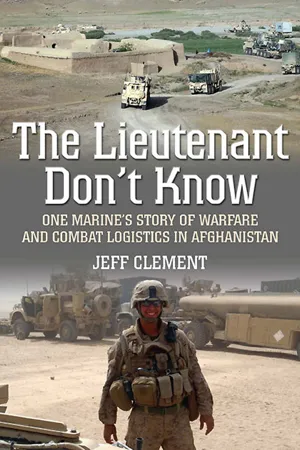
eBook - ePub
The Lieutenant Don't Know
One Marine's Story of Warfare and Combat Logistics in Afghanistan
- 264 pages
- English
- ePUB (mobile friendly)
- Available on iOS & Android
eBook - ePub
The Lieutenant Don't Know
One Marine's Story of Warfare and Combat Logistics in Afghanistan
About this book
Information
CHAPTER ONE
NO REGRETS
If I die in a combat zone
Box me up and ship me home
Box me up and ship me home
Pin my medals upon my chest
Tell my Momma I did my best
Tell my Momma I did my best
Now Momma, Momma, don’t you cry
The Marine Corps motto is “Do or Die.”
The Marine Corps motto is “Do or Die.”
—Traditional Marine Corps Running Cadence
APRIL 2010
SOMEWHERE SOUTH OF MUSA QAL’EH
HELMAND PROVINCE, AFGHANISTAN
The Afghan insurgents were aiming at me specifically, I was certain. The closer the bullets were to hitting my head, the slower time seemed to go, and the slower I seemed to be moving.
“Goddammit, where is that wrecker?” I yelled to my platoon sergeant.
“I don’t know, sir, but it’s gotta be coming up soon. Godfather went to go get it like ten minutes ago,” Staff Sergeant Joseph Caravalho, my Hawaiian-borne platoon sergeant yelled back. Godfather was the callsign of one of our sergeants.
A hundred-plus pound IED had nailed one of our trucks. It was one of the biggest IEDs we had seen. The engine compartment was shredded, and tires had been thrown over a hundred feet in the air with a mushroom-shaped dust-filled shockwave. We couldn’t recover this truck without our giant armored tow truck that we called a “wrecker.” As soon as we were stopped by the IED, Afghan insurgents began firing at us from several directions and dropping mortar rounds on our position. Bullets ricocheted off the truck I was working on, inches from my head.
“What the hell am I doing here?” I asked quietly. I chuckled to myself and answered with a canned refrain, often heard among the Marine Corps’ junior officers to describe their own obliviousness. “The lieutenant don’t know.”
DECEMBER 2012: CHRISTMAS COCKTAIL PARTY, SYRACUSE, NY
Every year, my in-laws throw an old-fashioned cocktail party, with drinks and hors d’oeuvres. I was talking with one of the guests at the party, I suppose one of the neighbors, when I was asked a question that I hadn’t ever gotten.
“Do you regret becoming a Marine?” he asked.
I was taken aback, insulted even—but it was an honest question. I’m pretty sure that he could tell I was surprised (or maybe not—the libations flowed freely and he had drunk quite a bit), but I tried not to let it show on my face.
“No, you know, not at all,” I responded. “I joined the Marine Corps to serve my country as cliche as that sounds and to learn, and to do stuff that I could never do anywhere else. I’ve gotten to do things that none of my college peers have gotten to do. So no, I don’t regret joining the Marines.”
I meant it, too. Even though I certainly had some difficult experiences, which, to be fair I expected—I also wanted them. I don’t regret it. There are different variations to the question “Are you glad that you joined the Marines?” I think the best way that I have found to answer the question is that it was the right decision for me, at that time, with what I knew then.
People would almost always follow that up with a question about Afghanistan. It might be “What do you think about Afghanistan?” or “What’s it like over there?” or the most irritating of all “Did you kill anyone?” As for Afghanistan, I’m proud of what I accomplished over there, and more so of what my Marines did, day in and day out. We answered the call of our country after 9/11, and did what we were asked to do.
SEPTEMBER 11, 2001: MR. JOHNSON’S HISTORY CLASS, GREEN HOPE HIGH SCHOOL, CARY, NC
I don’t think any American will forget where they were when they first heard about the September 11th attacks on the World Trade Center and the Pentagon. I was a sophomore in high school. One of the students had gotten word of the first plane hitting the tower, but nobody believed him. In 2001, most kids didn’t yet have cell phones, and smartphones were a thing of the future, so we had to ask permission from the teacher to use one of the computers in the classroom to check the news. Though he hadn’t heard anything, Mr. Johnson consented, hoping that the report wouldn’t be confirmed.
We couldn’t quite believe it or understand the magnitude of the attack, but Mr. Johnson turned on the TV and we learned of the plane hitting the Pentagon and the second World Trade Center tower.
All students at the school, as most students did nationwide, spent the rest of the school day watching the news. The bells would ring, and we would all race to the next classroom, trying not to be away from a TV for too long. My English teacher got a phone call and through her tears she laughed sarcastically as she told us what was said. The administration had directed all teachers to turn off the TVs, to resume teaching according to their lesson plans, and that “today was a normal day.”
“Today is a pivotal day in world history. You watch,” she said to the class. “Today is not a normal day, and to pretend otherwise is ridiculous. You all have a right to be informed.You’re not legal adults yet, but this will affect most of your adulthood.”
Pretty much every news station played the same few clips of the planes striking the towers and of the smoking buildings. I don’t think anybody really believed the World Trade Center Towers would hold, but it was still shocking watching them crumble an hour after the planes hit. Certainly after the first tower collapsed, everyone held their breath, hoping against hope that the second tower wouldn’t follow suit.
The final list of casualties totaled 2,996, but during the day the estimates from the various “experts” ran as high as 30,000.The commentators speculated wildly, and nobody yet knew what had happened with United Airlines Flight 93 (which was deliberately crashed near Stoneycreek, PA by the hijackers as the passengers were about to regain control of the plane).
SEPTEMBER 11, 2001: PRAYER SERVICE, ST. MICHAEL’S CATHOLIC CHURCH, CARY, NC
I don’t think I’m alone in saying that by about noon on September 11th, I was in a state of “emotional overload;” my capacity for further shock or devastation was exhausted. Like many others, my family went to church that night, where a special prayer service was held for the victims of the attack. Again, we didn’t really know anything yet, but I agreed with Senator John McCain who said that this was an “act of war.”
I had long planned on joining the Navy. Both of my parents and both grandfathers had been in the Navy. The September 11th attacks strengthened my resolve. As much as the prayers for the victims might be worthwhile, if I could help prevent another attack, I felt that I must. It’s one thing to attack combatants—another entirely to attack people who are just going about their daily routine.
Sitting in that church in 2001, there were still seven years before I would commission in the military. I was sure that any counterattacks or wars would be resolved long before I would be old enough to play a part. After all, any military interventions would have to be twice as long as World War II for me to get a piece of the action, right? Still, I wanted to go to the Naval Academy, join the Navy, and help prevent another attack like 9/11.
FEBRUARY 2004: CARY, NC
I had been waiting for months for the admission decision letter from the Naval Academy to arrive. I knew the chances of being admitted to the Naval Academy were slim, but it is what I had always wanted to do. When I was at St. Bernadette’s Catholic Elementary School growing up, I used to pretend that our blue and white uniforms were the uniforms of midshipmen, and when we walked in two neat lines as a class, I would pretend that we were marching. I was the only one in the class who would square the corners in the hallway. I thought I was pretty cool. Everyone else just thought I was weird. I was wrong; they were right.
But it had finally arrived. I still have that letter, actually. I pulled it out to make sure I got the words that I read that day just right:
Dear Jeffrey:Congratulations! We are pleased to announce that the Admissions Board has found you scholastically qualified for admission to the U.S. Naval Academy with the Class of 2008. You are guaranteed an offer of appointment. . . and so on . . . look forward to welcoming you as a member of the Brigade of Midshipmen.Sincerely,S.B. LATTACaptain, U.S. NavyDirector of Admissions
I was ready to sign the paperwork and send it back that day, but my mom was insistent that I wait.
“You don’t have to send it in yet, so don’t.You have a little more time to make the decision. Take the time.You might change your mind.”
I was sure that she was wrong. But as usual, she was right. My parents had insisted that I look at a few other schools, just in case. I had gone to the prospective student orientation weekends at Georgia Tech,Virginia Tech, and NC State. I don’t think I seriously looked at any other schools. I was so dead set on engineering, I didn’t even look at any other majors.
The NROTC recruiter called me every week, asking me why I hadn’t sent in my application yet. He didn’t listen when I told him that it was because I didn’t want to do NROTC. “Well, you’ll submit your application eventually.” He was right.
I don’t remember when it hit me, but at some point I realized that it wasn’t so much a conscious decision as a realization, that I didn’t want to go to the Naval Academy. I think the academic challenge and the engineering student life at Georgia Tech was attractive, as was the idea of living in Atlanta.
I was still 100% committed to joining the Navy and I still wanted to be a surface warfare officer, but I was presented another road to get there. So I signed the NROTC papers and accepted admission to Georgia Tech. I was going to be a Ramblin’ Wreck from Georgia Tech and a helluva engineer.
AUGUST 2004: GEORGIA TECH NAVAL RESERVE OFFICER TRAINING CORPS INDOCTRINATION, NAVAL SUBMARINE BASE KINGS BAY, GA
Freshman year at Georgia Tech began with INFORM, the Navy ROTC Indoctrination for Midshipmen. It was a weeklong orientation session run by a staff composed of senior midshipmen, the staff officers, and most memorably, the Marines assigned to the unit. Several Marines are assigned to each NROTC unit to assist in the training of young midshipmen. Instead of separate Marine ROTC units, midshipmen are all lumped together in the same unit and are designated as either “Navy Option” or “Marine Option” with slightly different program requirements for each group.
Although I was a Navy Option midshipman, I received “instruction” from the Marines at INFORM. One of the most fear-inspiring among them was Sergeant Joshua Roberts, who had just graduated from Marine Officer Candidate School. A Marine Enlisted Commissioning Education Program (MECEP) candidate, he was a sophomore at Georgia State University and a fearsome sight to behold for new midshipmen. INFORM left us with an introduction to the Navy and Marine Corps, and a definite impression that only a few were qualified to be Marines.
“Most of you Navy pukes couldn’t hack it,” Sergeant Roberts said, “but you’re welcome to come out to Marine PT to see how much you suck.”
Throughout my freshman year, I continued attending Marine PT, but I thought I still wanted to be in the Navy. I didn’t begin to realize that I might want to be a Marine until the summer after my freshman year at CORTRAMID, a summer training program for midshipmen.
MAY 2005: CAREER ORIENTATION TRAINING FOR MIDSHIPMEN, NAVAL STATION NORFOLK, VA
CORTRAMID stands for “Career Orientation Training For Midshipmen.” The program is organized into four, one-week segments, each designed to expose young midshipmen to one of the major career paths that they might choose, both to help them make their career decisions and to give them some perspective on other types of naval operations. We would spend one week each with the Surface Navy, the Submarine Navy, Naval Aviation, and the Marines.
Getting to CORTRAMID was not as simple as I expected it to be. I had a set of paper military orders, as well as a paper itinerary and printout of my plane ticket from Raleigh to Norfolk. I tried to check in online, but got an error message. I chalked it up to the fact that the plane ticket had been booked through the military, and headed to the airport with my seabag. I got to the counter where the agent informed me that though my ticket had been reserved, it had never been paid for.
It looked like I would be late. Here I was, ten minutes into my career, literally on my first day of active duty, tasked with a simple assignment— move myself from Raleigh to Norfolk with a prepaid plane ticket—and I couldn’t even get that done. After a while on hold with a few different customer service reps at the Defense Travel Service (DTS), the agent called me over to the counter.
“Alright, honey, there’s good news and there’s bad news. Your ticket has now been paid for. The bad news is that we just cancelled your flight.”
“That’s not good.”
“But it looks like we can get you there just a few hours late.You’ll have to go through Charlotte, but I think we can get you on a first class seat.” I was rebooked on the later flight and managed to get to Norfolk. This was to be the first of many experiences with the military bureaucracy and administration that was less than stellar—although the pinnacle of administrative failures was not to come until a few years later, which resulted in every official document for the duration of my Marine Corps career having my first name spelled incorrectly.
The CORTRAMID staff met us at the airport and brought us to our home for the next few weeks at the Bachelor Enlisted Quarters at Naval Base Norfolk. After a few days of getting settled in, taking the Navy’s Physical Readiness Test and other administrative tasks, we began our rotation.
Aviation Week was spent at Naval Air Station Oceana, nearVirginia Beach. After completing swim quals to make sure we could float if the plane crashed, and the parachute simulator to learn how to bail out, every midshipman went up in a T-34. A two-seater, single engine propeller plane, the T-34 was the Navy and...
Table of contents
- Coverpage
- Titlepage
- Copyright
- Contents
- Dedication
- Foreword
- Preface
- 1: No Regrets
- 2: Ductus Exemplo—Lead by Example
- 3: The Lieutenant Don’t Know
- 4: Checking In
- 5: What We Were Getting Into
- 6: Convoy Briefing
- 7: Routine Operations
- 8: The Queen’s Own Gurkha Logistics Regiment
- 9: Operation Lava 31
- 10: Into the Swing of Things
- 11: Route Red Recon
- 12: IED Strike
- 13: Back in the Saddle
- 14: Sangin
- 15: The Last Mission
- 16: Return Home
- 17: Reload and Do it Again
- 18: The Lieutenant Don’t Know (Redux)
- Afterword
- Appendix: Combat Logistics Vehicles
Trusted by 375,005 students
Access to over 1.5 million titles for a fair monthly price.
Study more efficiently using our study tools.
Frequently asked questions
Yes, you can cancel anytime from the Subscription tab in your account settings on the Perlego website. Your subscription will stay active until the end of your current billing period. Learn how to cancel your subscription
No, books cannot be downloaded as external files, such as PDFs, for use outside of Perlego. However, you can download books within the Perlego app for offline reading on mobile or tablet. Learn how to download books offline
Perlego offers two plans: Essential and Complete
- Essential is ideal for learners and professionals who enjoy exploring a wide range of subjects. Access the Essential Library with 800,000+ trusted titles and best-sellers across business, personal growth, and the humanities. Includes unlimited reading time and Standard Read Aloud voice.
- Complete: Perfect for advanced learners and researchers needing full, unrestricted access. Unlock 1.5M+ books across hundreds of subjects, including academic and specialized titles. The Complete Plan also includes advanced features like Premium Read Aloud and Research Assistant.
We are an online textbook subscription service, where you can get access to an entire online library for less than the price of a single book per month. With over 1.5 million books across 990+ topics, we’ve got you covered! Learn about our mission
Look out for the read-aloud symbol on your next book to see if you can listen to it. The read-aloud tool reads text aloud for you, highlighting the text as it is being read. You can pause it, speed it up and slow it down. Learn more about Read Aloud
Yes! You can use the Perlego app on both iOS and Android devices to read anytime, anywhere — even offline. Perfect for commutes or when you’re on the go.
Please note we cannot support devices running on iOS 13 and Android 7 or earlier. Learn more about using the app
Please note we cannot support devices running on iOS 13 and Android 7 or earlier. Learn more about using the app
Yes, you can access The Lieutenant Don't Know by Jeff Clement in PDF and/or ePUB format, as well as other popular books in History & Social Science Biographies. We have over 1.5 million books available in our catalogue for you to explore.