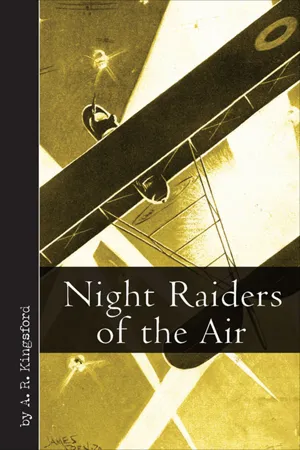
A WWI pilot's memoir of flying with the unit that dropped the first bomb at night on Germany—and, on November 11, 1918, the last one.
One of the many who came to Europe from all over the British Commonwealth to fight in the First World War, A. R. Kingsford had sailed from New Zealand in 1914. He joined the Royal Flying Corps in 1917 and learned to fly at Northolt before being posted to 33 Squadron at Lincoln, where he flew against Zeppelins sent from across the North Sea on night bombing raids. Kingsford joined 100 Squadron in France early in 1918 and had an active career with this famous squadron up until the end of the war.
Full of adventure,
Night Raiders of the Air is a first-person account of this young volunteer's experiences during the Great War—a fascinating read for anyone interested in the early days of military aviation.
- 211 pages
- English
- ePUB (mobile friendly)
- Available on iOS & Android
eBook - ePub
Night Raiders of the Air
About this book
Information
CHAPTER V
NIGHT FLYING
OUR new aerodrome was a good one and a decided change after Hounslow. It was about three-quarters of a mile long, with a good width. In addition to the Home Defence Flight, there were two training squadrons flying Avros, B.E.’s and an odd Spad or two. There was plenty of activity.
Our machines were F.E.2.B.’s, equipped with one hundred and sixty Beardmore engine. A machine gun was fixed to the front seat, to be used by the observer. There were three machines, with the same number of pilots and observers for operation. Emergency landing flares, which could be ignited by pressing a button in the cockpit, were fixed under each of the lower planes. A parachute flare could also be dropped from the back seat. This would hang in the air and light up the ground for about three minutes. There were also three other machines, used for training purposes.
Ours was A Flight, while B and C were thirty miles north and west. Our patrol was north to the Humber and ten miles south of Lincoln.
After a few flights, we realised that these buses were totally unfit for the job. They were not capable of climbing higher than about twelve thousand feet, while the Zepps. seldom came over at less than eighteen to twenty thousand. We ex-pressed our views and were granted permission to do anything with the machines to enable them to get higher. This caused tremendous competition between the three of us. Ceiling tests were frequent, without producing anything startling until the engine was taken out of my bus and a three hundred Rolls Royce put in. With this extra power, we expected something great, but even then, old 1884 would not go higher than sixteen thousand, and it took nearly an hour to get there. I did away with the observer, put the machine gun on to a mounting to enable the pilot to use it, placed a cowling over the front seat and streamlined it, and then re-rigged her. But I only got another hun-dred feet, so we took the cowling off again. It seemed pretty hopeless trying to get Zepps in these antiquated machines.
England’s aerial defence at this time was pretty rotten, and the Hun could have done what he liked with us had he known. That’s what makes me think that his secret service couldn’t have been what it was cracked up to be, or he would have known just how weak our defence was. However, we did our best in the circumstances. I think Robinson, Brandon, Tempest and those chaps must have got their Zepps at lower altitudes, probably when they came down to do their bombing. They were in B.E.’s and perhaps got a bit more out of them than we did out of our old Fees.
The Huns’ Zepp Base was at Heligoland, due east of Spurn Head. His course was due west until he struck Spurn Head, where he would pick up the lights of Hull, invariably turning south and passing right over our aerodrome, then picking up Lincoln and apparently following the Northern Railway down to London. He always came in what we called the dark period, when there was no moon, and during this time we were not allowed to leave the aerodrome after dark, operation pilots standing by the whole time, with machines ready and ears pricked up every time the telephone bell rang. We always hoped it would be orders to take the air, our first intimation usually being from the Navy. “Zepps sighted forty miles east Spurn Head, proceeding west,” later, “Zepps still proceeding west, now twenty miles from coast.” At this stage, the first operation pilot would be ordered up with certain instructions, the remaining two at ten-minute intervals. Our patrol was for three hours, and we took our turn in being first.
Owing chiefly to the fog, England was not the best of countries for flying, particularly at night. The fog was our worst foe, and being near the coast, we had to be extra careful not to go wandering out over the sea, a matter very easily accomplished at night in a fog. Two or three of our chaps went west that way, and we never heard of them again. We could only conclude that the North Sea claimed them as victims.
On the twenty-first of August, 1917, I took the air in quest of Zepps for the first time. We received our first news of them at ten-thirty p.m., and at eleven o’clock, Robiers and I taxied out, having been given a great send-off. All the pupils from the training squadrons used to turn out to see our show and would hang about all night for our return.
We circled the aerodrome for some time to gain height and then turned north, registering five thousand. The night was beautifully clear and starlit, but cold, and we tootled along past the blast furnaces at Scunthorpe, where the reflection could be seen for miles. No doubt the Hun knew the position of this furnace and it would help him to get his bearings. Why they didn’t try to lessen the flare we could never understand, and it was some considerable time before they thought to do so.
By the time we reached the Humber, our height was ten thousand, and again we circled round and round to get higher, both piercing the darkness with bulging eyes in the endeavour to glimpse a target. Seeing a searchlight pop up over Hull, we set our nose in that direction, and soon there were about half a dozen, lighting up the sky. This show promised well. We were now over the Humber, just about where the ZR2 broke her back some time later. We were hoping to break the back of a Zepp before long.
I don’t know what Robie’s eyes were like, but mine seemed to be nearly out of my head by this time. Shells were bursting all over the place, although there was no sign of the Zepp as far as I could see. Our altimeter showed twelve thousand. Gee! this old bus was slow, but I had a feeling that our luck was going to be in. We were now off our patrol, but what did that matter so long as there was something doing. The gun-fire stopped and the searchlights were scanning to and fro, an almost certain sign that they’d lost him. Our hopes went down correspondingly, as one by one the searchlights lowered, until all was darkness again, and the Zepp went gaily on her errand of destruction.
We groped around for another two hours, realising that we’d been pretty near, and still not wishing to give up all hope, saw the remaining hour out and then, benzine being low, were obliged to land. We longed for the next raid and began to feel that after all there was a certain amount of fun in Zepp hunting, never knowing when you might spot one, even if he was five thousand feet above you.
Brooky and Watson were both down when we arrived. Like us, they had seen the gun-fire and sat with bulging eyes. No one got a Zepp that night, but poor old Joe, one of B Flight’s pilots, crashed on landing and was killed.
The next dark period was a disappointing one; the Huns left us alone and we were very peeved. All kinds of new gadgets had been invented and adorned the cockpits. Reid, my new observer, was itching to hunt the skies, and we did a good deal of night flying without incident or crashes, save for one fatality, for which I was responsible.
We were carrying out forced landings one night and I pushed the parachute flare through the tube, but it failed to ignite. A few days later, a bill for twenty-five pounds was presented to me by a farmer, who called at the aerodrome with the complaint that the flare had hit his pet horse on the head. The following morning, Tony did not answer the roll call.
About this time, the Americans sent over two hundred of their picked men for the Flying Corps. The heads didn’t know what to do with them, as the training squadrons were all going hard with our own pupils. Eventually they sent a few to each Home Defence Flight and in our spare time we were told we could teach them something.
Eight of them turned up at our Flight, good chaps too, and we enjoyed their company. Big Jeff was full of good humour, stood six feet odd and weighed about fifteen stone. I pictured him trying to get into the cockpit of a Spad or Sopwith Pup, but anyway, our Jeff turned out a good flyer and flew in the Dole Race.
Ned was a great boy, too, full of Yankee stories, and he used to have competitions with Sid to see who could yarn the most. They introduced all sorts of new drinks into the mess, port flips, egg flips, all sorts of flips. One of their number would get up and act as shaker, mixing the concoction, then shaking at considerable length in a metal tumbler arrangement with a lid. After it was shaken into what appeared to be all froth, he would triumphantly hand you the mixture, and if you blew the froth off, you blew the drink away. Nevertheless, the port flip was quite a decent thirst quencher.
These chaps were the keenest mob for flying I ever struck. They were willing to go up any time, in any weather, and with anyone, irrespective of their ability as a pilot. Jeff loved speed and I used to take him up in the F.E.2.D. which I used for operations. The machine did about ninety full out, which in those days wasn’t bad.
On one occasion we were up about five hundred feet, when he yelled over from the front seat.
“Won’t she go any faster?”
“Yes,” I called back, “you watch her.” I accordingly stuck her nose down, with the engine full on, and lowered to about fifty feet off the ground and one hundred and forty miles per hour holding her there until I thought the wings might buckle, and watching Jeff all the time. He never grabbed hold of the sides until he thought I’d gone mad and was going to fly straight into the earth, then I pulled her up in a great zoom, finishing up in a climbing turn. He turned round as I flattened out again and at first his face was a blank, then it suddenly lit up and he yelled:
“Gee! boy, that was great.” He’d had his first real thrill in the air, he said. The next time I took him up, we reached twelve thousand and his nose started to bleed all over the show. He was in some pickle by the time we got down and I told him it was due to too many port flips. Jeff was annoyed and asked me not to let any of the boys know. He was afraid it might be looked upon as a physical defect and be the result of his getting chucked out. I believe that would have sent him potty, he was so keen.
We did lots of bombing practice and machine gunning for these chaps, and now and then a little visiting to the other Flights. C Flight over at Kelstern was a favourite flip for Jeff and myself.
Our next Zepp raid did not take place until October eighteen. Something must have gone wrong that night. We had a warning and were up at the Hangars, machines ready and flares alight, with the usual crowd to see the fun. We were standing by our machines and I was booked to take the air first, when, without any warning, there was a terrific explosion on the far side of the landing ground, followed by another at not half a minute’s interval.
Even then we did not realise what it was until Reid, my observer, who was standing by, grabbed my arm and said:
“Listen, can’t you hear it?” There was no doubt about it now, a Zepp was right overhead and there were we, still on the ground, waiting for orders to go up. The Zepp had seen our landing lights. We waited no longer for ord...
Table of contents
- Cover
- Aviation
- Title
- Copyright
- Dedication
- Contents
- Illustration
- PROLOGUE
- I TORPEDOED
- II AFTER
- III WE MOVE AND MOVE
- IV PER ARDUA AD ASTRA
- V NIGHT FLYING
- VI 100 SQUADRON
- VII REPRISALS
- VIII EXIT F.E.2 C. 450
- IX LEAVE
- X AERODROME STRAFING
- XI 'ARCHIE' GETS US
- XII THE LAST BOMB
- EPILOGUE
Trusted by 375,005 students
Access to over 1.5 million titles for a fair monthly price.
Study more efficiently using our study tools.
Frequently asked questions
Yes, you can cancel anytime from the Subscription tab in your account settings on the Perlego website. Your subscription will stay active until the end of your current billing period. Learn how to cancel your subscription
No, books cannot be downloaded as external files, such as PDFs, for use outside of Perlego. However, you can download books within the Perlego app for offline reading on mobile or tablet. Learn how to download books offline
Perlego offers two plans: Essential and Complete
- Essential is ideal for learners and professionals who enjoy exploring a wide range of subjects. Access the Essential Library with 800,000+ trusted titles and best-sellers across business, personal growth, and the humanities. Includes unlimited reading time and Standard Read Aloud voice.
- Complete: Perfect for advanced learners and researchers needing full, unrestricted access. Unlock 1.5M+ books across hundreds of subjects, including academic and specialized titles. The Complete Plan also includes advanced features like Premium Read Aloud and Research Assistant.
We are an online textbook subscription service, where you can get access to an entire online library for less than the price of a single book per month. With over 1.5 million books across 990+ topics, we’ve got you covered! Learn about our mission
Look out for the read-aloud symbol on your next book to see if you can listen to it. The read-aloud tool reads text aloud for you, highlighting the text as it is being read. You can pause it, speed it up and slow it down. Learn more about Read Aloud
Yes! You can use the Perlego app on both iOS and Android devices to read anytime, anywhere — even offline. Perfect for commutes or when you’re on the go.
Please note we cannot support devices running on iOS 13 and Android 7 or earlier. Learn more about using the app
Please note we cannot support devices running on iOS 13 and Android 7 or earlier. Learn more about using the app
Yes, you can access Night Raiders of the Air by A.R. Kingsford in PDF and/or ePUB format, as well as other popular books in History & Military & Maritime History. We have over 1.5 million books available in our catalogue for you to explore.