A historian reveals the surprising role that seventeenth-century Sweden played in shaping Western history.
There has been a recent trend in history to interpret the rise and fall of great powers in terms of economics, demographics, or geography. But sometimes, pure military skill can propel a nation to prominence if it is simply able to crush all its opponents on a battlefield. No better example arises than that of Sweden beginning in the seventeenth century, holding supremacy over northern Europe for a century without any technological, geographic, or demographic advantages at all.
This fascinating book describes how the Swedes first arrived in continental Europe during the Thirty Years' War, under their king Gustavus Adolfus. Just in time to roll back the reactionary Catholic tide and buttress the Lutherans, the Swedes proved more innovative in battle than their opponents, using the new arm of artillery, plus tactical formations, to establish supremacy on the battlefield. This horrific war still exists in collective memory as the worst travail in German history, even worse than the world wars; however, along with the salvation of Protestantism, the emergence of the Swedes as a power to be reckoned with meant new geopolitical complications for the existing powers of Europe.
Adolfus was eventually killed in battle, but a successor, Charles XII, renewed Swedish aggression—this time for the object of conquest—as he found that no army on the continent could stand against his legions from the north. As later military leaders would find, however, the conquest of Russia comprised a considerable overreach, and Charles was eventually trapped and defeated deep in Ukraine, at Poltava.
In this work, renowned military historian Henrik O. Lunde unveils a fascinating chapter in the foundation of Western history that is often overlooked by English-speaking readers.
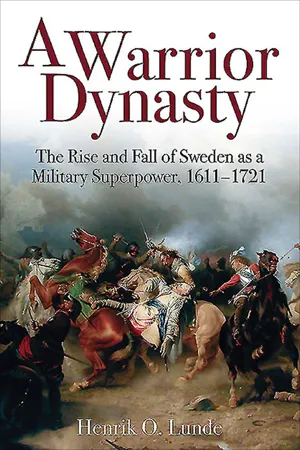
eBook - ePub
A Warrior Dynasty
The Rise and Decline of Sweden as a Military Superpower
- 320 pages
- English
- ePUB (mobile friendly)
- Available on iOS & Android
eBook - ePub
About this book
Information
| 1 Gustav Adolf’s Danish and Baltic Campaigns It is my nature not to believe well done except what I do myself: it is also necessary that I see everything by my own eyes. GUSTAV ADOLF’S REPLY TO AN ADMONITION THAT HE NOT RISK HIS LIFE NEEDLESSLY. |
THE FORMATIVE YEARS
Gustav II Adolf was born in Stockholm on 9 December 1594. He was the oldest son of King Karl IX and Kristina of Holstein-Gottorp, though Karl was not yet king when Gustav was born. king was Sigismund (crowned in 1593), King Karl’s nephew. Being the son of a royal duke and duchess, Gustav II Adolf had an opulent and sheltered upbringing. There were no indications that he would be a future king, as the Swedish crown was in a different branch of the family when he was born—his father, Karl IX, was not crowned king until 1604. Gustav Adolf had private tutors for every aspect of his education, and he was no idle child, being gifted with a considerable intellect combined with a great eagerness to learn.
It is reported that by the time Gustav was twelve he spoke perfect German—not surprising since his mother was a German princess—and was fluent in Latin, Italian, and Dutch. He also showed early signs of becoming an inspiring orator.
But it was in the study of diplomacy and military affairs that he really excelled. Young Gustav apparently read everything he could lay his hands on dealing with military art and science, and Maurice of Nassau became his hero. He was a strong athlete and became adept at horse riding and the use of various weapons. He displayed an early contempt for physical danger, a trait we find repeated in his later life and which eventually led to his death.
There was a truce in the Dutch War of Independence in 1609 and, according to Colonel Dupuy, many veterans from that war came to Sweden seeking employment in the Baltic wars. Gustav paid great attention to their description of the new method of warfare introduced by Maurice.1 These conversations and his own readings profoundly affected his life.
Sigismund was deposed by the Riksdag in 1599 and his uncle Karl became de facto king. Sigismund, the rightful heir, refused to accept the parliamentary decision engineered by his uncle, declared war in early 1600, and hostilities soon commenced in Livonia. This war, interrupted occasionally by truces, was to last until 1629.
Karl IX’s formal period as king was relatively short (1604-1611), but he began to have Gustav Adolf participate in the affairs of state at an early date. Gustav often attended meetings of the Council of State and met many foreign diplomats. In 1609, at the age of fifteen, Gustav took over the administration of the duchy of Vestmanland. The following year, he pleaded with his father to be allowed to participate in an expedition to Russia. His father refused.
The Polish-Swedish conflict was suspended after 1605 due to the implosion of the Russian government beginning with the death of Tsar Boris Godunov and ending with the reign of Michael Romanov in 1613—referred to as the Times of Trouble. A succession of pretenders claimed to be Dimitrii, the last Riúrik prince, who had actually died in 1591.2 Both Poland and Sweden took advantage of the Russian turmoil to grab Russian territory. Sigismund intervened in the Russian power struggle in 1609 by supporting a group of rebellious nobles who had besieged Tsar Vasilii Shuiskii in Moscow. Sigismund’s intent was to make his son Wladyslaw the new tsar.3
The besieged tzar requested help from Sweden. In return for the help he promised to cede control of the disputed region on the Gulf of Finland to Sweden. Karl IX agreed and dispatched a corps under Field Marshal Jacob de la Gardie.
De la Gardie’s troops, in cooperation with troops loyal to Tsar Shuiskii, relieved the Russian capital and forced the rebels to retreat.4 After the success at Moscow, de la Gardie marched with his Russian allies to the rescue of the fortress of Smolensk, which was besieged by a Polish army. However, halfway between Moscow and Smolensk, the Russo-Swedish army was badly defeated at the battle of Klushino on 4 July 1610 by a much smaller Polish force under one of Poland’s greatest commanders, Field Marshal (hetman) Stanis-law Zolkiewski.
Zolkiewski thereupon marched on Moscow, captured the city and deposed Tsar Vasilii (Basil). Having sustained a serious defeat at Klushino and with Russia now under virtual Polish control, King Karl IX decided that the wisest course of action was to withdraw northward. He also decided that with the turmoil going on in Russia, this was the right time to seize some of the properties promised by Vasilii for Swedish help. De la Gardie captured the region around Kexholm as well as the city of Novgorod.
There may also have been a dynastic motive by Karl IX, similar to that of his nephew Sigismund. The Swedish historian Nils Ahnlund (1889–1957) writes that in the early summer of 1611, the Russian national militia assembled in Moscow, despairing of the chances of its native rulers, had chosen Gustav Adolf of Sweden as their tsar and grand duke.5 When Jacob de la Gardie concluded a treaty with the authorities in the captured city of Novgorod, Karl IX is referred to as the protector of the city and it was indicated that one of his sons would become tsar. It appears that Karl IX, who was trying to cope with the progress of the Poles, was surprised by the Russian offers.
Anhlund maintains there is evidence to show that in the summer of 1612 Gustav Adolf was still considering the Russian offers, possibly for tactical reasons in dealing with his Polish enemy.6 In the end he decided that it was not a good idea because of Sweden’s and Russia’s conflicting interests.
However, Karl IX had a younger son Karl Filip who might rise to the challenge. Gustav Adolf was not too enamored of this idea either. He realized that the conflicting future interests of Russia and Sweden had the potential to create animosity between himself and his younger brother. He undoubtedly had the Polish situation in mind where he was fighting his cousin.
Nevertheless, the project was apparently favored by Queen Kristina. Considerable time passed, however, before Karl Filip headed to Russia. An event which took place before he reached the Russian frontier, however, destroyed any hope of establishing a junior Vasa line in Moscow. This event was the election of Michael Romanov as tsar in 1613—and he was to rule Russia until 1645. Sweden continued her struggle against Russia until the Peace of Stolbova in 1617.
THE KALMAR WAR (1611–1613)
Kristian IV of Denmark decided to take advantage of Sweden’s deep involvement in Russia and Livonia to settle old scores. It was a crafty move on the part of Kristian since all of Karl IX’s best troops were in the Baltic region and these could not be brought back to Sweden if the powerful Danish fleet could blockade the ports in the eastern Baltic from where it was logical they would embark. Kristian also appears to have known that Karl IX had come down with apoplexy. What we do know is that Gustav Adolf considered the attack treacherous and that he and Kristian IV remained bitter rivals until Gustav died in 1632.
Let us take a quick look at the reasons for this war, which began just forty-one years after the bloody Northern Seven Years War had been settled by the Treaty of Stettin. This treaty was a defeat for Sweden’s King Erik in virtually every area. The Treaty of Stettin only led to bitterness for the losing side and increased ambition on the part of the winning side.
As a result, the leading power in the Baltic at the beginning of the seventeenth century was the kingdom of Denmark-Norway. Even if the distant territories of Iceland and Greenland are left out, the kingdom covered an immense area from northern Germany to the extremity of the European continent. The total length of the coastline was huge, providing easy access to both the Atlantic and the Baltic. To the south, the duchies in Jutland added a considerable German-speaking population. The nearby secularized bishop -rics of northern Germany were attainable objectives for the ambitious Oldenburg dynasty. The entrance to the Baltic was completely in Danish hands, and this not only brought great wealth into the royal coffers but gave the Danes great leverage with the western maritime powers. The islands of Gotland and Ösel, off the southeast coast of Sweden, were controlled by Denmark and posed a threat to Sweden, since they were stepping stones to the eastern Baltic, and locations facilitating naval control of the Baltic.
Norway’s contribution to the union was first and foremost the Norwegian genius for seamanship—their seamen provided the backbone for the navy as well as the merchant marine. The deep-sea fishery and the large export of timber benefited from high demands in an extensive market. Norway’s northern coast made it possible to control trade coming from the White Sea. Meantime, there was only one power that Denmark-Norway needed to reckon with and that was Sweden, including Finland.
Sweden, on the other hand felt surrounded. The area to the west and north was controlled by Norway as well as two provinces east of the Scandinavian watershed. Conflict from there could reach the Baltic and separate the northern part of Sweden from the southern. Norway’s geography also posed problems for Sweden’s hoped-for outlet to the Arctic Ocean. To the east Sweden faced two great powers: Orthodox Russia and Catholic Poland. To the south she had to contend with Denmark, which occupied a large portion of the Swedish mainland, and the German Hansa League across the southern Baltic.
The mining industry had for centuries been one of Sweden’s most important resources, but its full potential was far from being realized. Agriculture was undependable; in some years surpluses were produced while in others the country had to rely on imports. Sweden and Finland were extensively forested but their exploitation was mainly for domestic use and little was left for export. Swedish shipping was in no way comparable with that of Denmark-Norway. Sweden had no outlet to the west except for a sliver of land around the fortress and harbor of Älvsborg.
King Karl IX’s policy of extending Swedish and Finnish territories to the Arctic Ocean as a way to interrupt Russian trade from the White Sea and provide the Swedes with an outlet to the Atlantic raised alarm bells in Den mark. This was at least one reason for Kristian IV’s surprise attack on Sweden in 1611 that led to the two-year conflict known as the Kalmar War. There were many other animosities between the Scandinavian countries that the leaders could use to stir up the masses. The rivalries between the two kingdoms were the single greatest force determining their relations in the seventeenth century.7
The surprise Danish invasion from Skåne and Norway found Karl IX in sickbed. He had to gather whatever forces he could locally since most of the Swedish army was fighting in Russia and Livonia. While the king prepared to move to relieve the besieged Kalmar Castle he put his son Gustav Adolf—not yet 17 years old—in command of the forces in East Gotland.
Kristian IV had made good preparations before the attack, even concluding an alliance with Poland and Russia. The heavily fortified city of Kalmar was key to the defense of southeastern Sweden, and in August Kristian sailed into Kalmar. The Danes stormed and captured the town but were not able to take Kalmar Castle.
Gustav Adolf was not content to sit in East Gotland, and on his own initiative he assembled a small militia force and crossed to the island of Öland where the Danes had left only a small force. As a consequence, the Danish garrison, unprepared when the Swedes under Gustav Adolf appeared, withdrew to Borgholm Castle but was soon compelled to surrender.
The Swedish commander of Kalmar Castle surrendered despite the approach of a relieving force under Karl IX. Kristian I V, seeing that the Swedes had been able to assemble a militia army, realized that his earlier hopes of an unopposed march through southeastern Sweden had been frustrated. With winter approaching, Kristian left a garrison to hold Kalmar and withdrew the rest of his army to prepare for the 1612 campaign.
Gustav Adolf had returned from Öland and planned additional offensive action. He led his small force into the Danish province of Skåne—apparently only intending a quick raid. However, the Danish commander of the border fortress of Christianopol became nervous and sent an urgent message to Kristian requesting reinforcement by about 500 cavalry. The message never reached its destination because it was intercepted by the Swedes. Gustav Adolf saw an opportunity and grabbed it. He dressed a force of his militia to look like Danish cavalry and approached the fort after dark. The Danes, believing it was the force they had requested, opened the gates and after a short fight the fortress was captured, ending the war’s first season with a success for the Swedes.
King Karl IX died a few weeks after the 1611 campaign came to a close. Swedish law required that a king had to be 24 years old before taking full control of the government. Gustav Adolf was not yet 17 so that a Regency Council, composed of his mother, Gustav’s first cousin Duke John of East Gotland, and six nobles from the Council of Ministers, was therefore appointed. However, within two months the Riksdag amended the succession law, allowing Gustav to become king at the age of 17. Eight days after his birthday he became king of Sweden.
Gustav’s first act in January 1612 was to appoint Axel Oxenstierna, age 28, as chancellor. It was a wise choice and Oxenstierna remained at Gustav’s side until the king’s death in battle. Thereafter, Axel took over the direction of affairs in Germany while also serving as guardian for Gustav’s underage daughter Kristina. Oxenstierna’s calm demeanor was a perfec...
Table of contents
- Coverpage
- Titlepage
- Copyright
- Content
- Map and Battle Sketch Index
- Dedication
- Preface and Acknowledgments
- Introduction
- Chapter 1 Gustav Adolf's Danish and Baltic Campaigns
- Chapter 2 The Military Revolution—Dutch and Swedish Reforms
- Chapter 3 Sweden Intervenes in the Thirty Years War
- Chapter 4 The Breitenfeld and Rhine Campaigns
- Chapter 5 The Tortured Road to Lützen
- Chapter 6 Swedish Military Operations in Germany 1633-1648
- Chapter 7 Defending an Empire—Karl X and Karl XI
- Chapter 8 Karl Xll's Danish and Baltic Campaigns
- Chapter 9 The Russian Campaign—Karl XII's Exile and Death
- Summary and Conclusions
- Appendix I Biographic Sketches of Selected Source Authors
- Appendix II Selected European Rulers 1500–1700
- Appendix III List of Field Marshals Mentioned
- Bibliography
- Index
Trusted by 375,005 students
Access to over 1.5 million titles for a fair monthly price.
Study more efficiently using our study tools.
Frequently asked questions
Yes, you can cancel anytime from the Subscription tab in your account settings on the Perlego website. Your subscription will stay active until the end of your current billing period. Learn how to cancel your subscription
No, books cannot be downloaded as external files, such as PDFs, for use outside of Perlego. However, you can download books within the Perlego app for offline reading on mobile or tablet. Learn how to download books offline
Perlego offers two plans: Essential and Complete
- Essential is ideal for learners and professionals who enjoy exploring a wide range of subjects. Access the Essential Library with 800,000+ trusted titles and best-sellers across business, personal growth, and the humanities. Includes unlimited reading time and Standard Read Aloud voice.
- Complete: Perfect for advanced learners and researchers needing full, unrestricted access. Unlock 1.5M+ books across hundreds of subjects, including academic and specialized titles. The Complete Plan also includes advanced features like Premium Read Aloud and Research Assistant.
We are an online textbook subscription service, where you can get access to an entire online library for less than the price of a single book per month. With over 1.5 million books across 990+ topics, we’ve got you covered! Learn about our mission
Look out for the read-aloud symbol on your next book to see if you can listen to it. The read-aloud tool reads text aloud for you, highlighting the text as it is being read. You can pause it, speed it up and slow it down. Learn more about Read Aloud
Yes! You can use the Perlego app on both iOS and Android devices to read anytime, anywhere — even offline. Perfect for commutes or when you’re on the go.
Please note we cannot support devices running on iOS 13 and Android 7 or earlier. Learn more about using the app
Please note we cannot support devices running on iOS 13 and Android 7 or earlier. Learn more about using the app
Yes, you can access A Warrior Dynasty by Henrik O. Lunde in PDF and/or ePUB format, as well as other popular books in History & Early Modern History. We have over 1.5 million books available in our catalogue for you to explore.