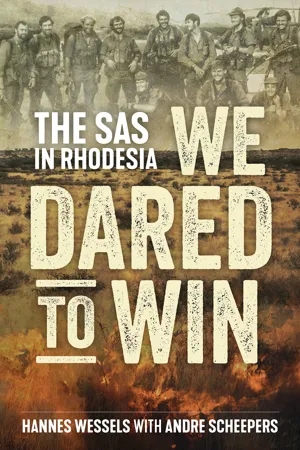
A memoir from a Special Forces fighter about his experiences in the Rhodesian War and how combat has shaped his life.
Andre Scheepers grew up on a farm in Rhodesia, learning about the bush from his African childhood friends, before joining the army. A quiet, introspective thinker, Andre started out as a trooper in the SAS before being commissioned into the Rhodesian Light Infantry Commandos, where he was engaged in fireforce combat operations. He then rejoined the SAS. Wounded thirteen times, his operational record is exceptional, even by the tough standards that existed at the time.
He emerged as the SAS officer par excellence—beloved by his men, displaying extraordinary calm, courage, and audacious cunning during a host of extremely dangerous operations. Here, Andre writes vividly about his experiences, his emotions, and his state of mind during the war, and reflects candidly on what he learned and how war has shaped his life since.
In addition to Andre's personal story, this book reveals more about some of the other men who were distinguished operators in SAS operations during the Rhodesian War.
"Andre was the best of the best and the bravest of the brave." —Capt. Darrell Watt, ex-SAS and subject of
A Handful of Hard Men
- 320 pages
- English
- ePUB (mobile friendly)
- Available on iOS & Android
eBook - ePub
About this book
Information
CHAPTER 1
Schoolboy to Soldier
Andre Scheepers: “I was born in Que Que in 1954 and went to Redcliff Primary School so grew up in what was then known as the Rhodesian Midlands. I was quite gifted at athletics and won five Victor Ludorums while often competing at national level in track and field events.
“I had a very secure and stable upbringing, and my family life was exceptionally blessed with plenty of love and kindness. Never once did I hear swearing or shouting in my family. I loved and still do love my family. We always sat together at meal times, said Grace and talked about family matters around the table. This practice certainly served to strengthen the bond between us.
“My parents were Christian and belonged to the Dutch Reformed Church. The Dominee (Minister) would always stay at our house on his circuit from South Africa, my dad being an Elder in the church. A real softie, he hated to hurt or kill anything. When a chicken had to be slaughtered he would have nothing to do with it; that was left to ‘Magets’ our cook to do.
“On the funny side, when the war worsened my Dad was called up to be part of ‘Dad’s Army’ and had to do eight weeks of call up service each year. This put strain on my mother as the cows had to be milked, and she had to become the farmer which she struggled with. She hated being alone out there. A big sacrifice for the family but Dad thought he was quite the soldier. He used to patrol with a white vest on and would always go to great trouble to prepare a whole black trunk full of rusks to go with his morning coffee so he would have enough for the deployment. He used to think of everything he needed and on one occasion he took everything but his rifle! A very big and strong man but with a heart of gold.
“My father worked for RISCO (Rhodesian Iron and Steel Company) for 32 years and had an incredible knowledge of molten metals. He was able to look at the molten iron and tell you about the sulphur, silicon, carbon and manganese content.
“While we were not rich, we lived a very comfortable life in Rhodesia with few luxuries but all the basic necessities. Our house in Redcliff was well situated and was close to the shops, school and my dad’s work. We also had a farm about 25 kilometres outside Que Que towards Gokwe. My parents had an orchard of Citrus and Litchi trees and bred Sussex cattle.
“The area where we farmed was incredibly rich in minerals. There was an abundance of wildlife and it was common to see hyena, jackals, kudu, impala and eland. I remember being told that the last black rhino in the area was shot on our farm. I spent many of my childhood days hunting and prospecting for minerals. On occasion, I would spend three days in the bush looking for rocks as I had an interest in geology. On my prospecting exploits I would find rocks and because of the weight factor, would put them into little piles and then on my return journey pick them up and put them into my pack. Often the weight caused a logistical problem for me and I had to make several return journeys because they were too heavy to carry all at once. Sometimes I would get upset because I would get lost and couldn’t retrace my steps to where I had placed my precious rocks, but this was a learning curve that would help me later as a soldier.
“My close friends were the local Africans. They always seemed to have money names like Ticky, Penny, Sixpence and Shilling. I learned from my parents to be fair and treat them with respect. I also spent a lot of time searching for bird nests and used to have many as pets; Wahlberg’s eagle, tawny eagle, kestrel, black shoulder kites, ravens, barn owls and crows. Our house servant, Magets, didn’t want to clean my room because I had a number of live snakes in my bedroom; Herald, Brown House, Skaapsteeker, Mole snake, to mention just a few.
“My father was a very hard-working and just man, being very diligent about what was owing to his labourers. Every week we would travel through to the farm and would pay them and give them their quota of meat, mealie meal and milk. What influenced me most about my dad was the way he spoke. Whenever he spoke about his plans for the future or decided to do anything, he would always say to me, ‘Son, if the Lord wills then,’ or ‘Son, if the Lord grants me the health then.’ This kind of language made a deep impression on me without my father ever knowing it.
“My mother told me that at my birth she had delivery problems because my head was too big. She made a vow to God that if He let me live then she would raise me up in the ways of God. My mother certainly kept her vows and I do not remember missing one Sunday School class until I went to high school. Even when I was sick I still had to go to Sunday School! At a very early stage I was able to recite large portions of the Bible and the visiting Dominee kept on trying to recruit me to become a minister in the Dutch Reformed Church.
“My parents sent me to Thornhill High School in Gwelo to complete my GCE ‘A Levels’ and I was in boarding school there for six years. Darrell Watt was also there but my senior by several years. Our next-door neighbour was Bill Franklin. He would often, almost on a fortnightly basis, come and visit me and tell me about what his son ‘Stretch’ and Andre Rabie were up to in the SAS. This got me interested in the military.
“After school I went to Natal University (Pietermaritzburg) and I had my first encounter with apartheid. I saw some policemen hitting a black man with a baton and kicking him. I felt my blood boil at this injustice and when I told the police to stop their evil they swore at me and told me in no uncertain terms to mind my own business. I have always felt sorry for the poor and disadvantaged people and I do not like it when we defraud the poor or commit an injustice against them. I came from a segregated society in Rhodesia but our approach to the Africans was relatively benign. Throughout the war the police (British South Africa Police) performed their duties unarmed in the urban areas and I never saw any brutality visited upon the Africans. At university I studied philosophy, sociology, theology and pedagogy. After university I went to the army.”
Into the Army
Andre Scheepers: “In early 1974, as a member of Intake 137, I got off the train outside Bulawayo to be taken by truck to Llewellin Barracks. Here they ran a short selection course to pick volunteers who wanted to join the Rhodesian Light Infantry (RLI) and the Special Air Service (SAS). I made it into the group and we were then taken by train to Salisbury and on to Cranborne Barracks, the home of the RLI.
“The first six weeks were tough and demanding. Our training officer was Captain Robin Tarr, a former RSM of the RLI. He was hard on us but fair. We were kept on the run constantly and with daily morning inspections we got very little sleep. Every day after a run, we were on the Drill Square for two torrid hours and then it was weapons training. It was an intense and demanding time but we were blessed with very thorough instructors who set high standards and came down hard on any sloppy behaviour. The RLI recruits course was an excellent one and at the end of it we were very pleased and proud to have passed. Everyone was itching to join their designated commandos, get into the fight and have a go at the enemy but I wanted to go straight to the SAS and do the selection course which I did.
“There was much emphasis placed on shooting and the SAS training staff, based on combat experience, had correctly concluded that traditional range-shooting was too conventional and therefore of limited value so we were trained to shoot straight under more realistic, operational conditions using what was known as ‘Jungle Lane’ training. The emphasis was on fast, accurate, instinctive shooting because in the field we would seldom have the luxury of time for precise well-aimed shots. We practiced night ambushes with little or no artificial light to hone our night-fighting skills. Constant emphasis was placed on shooting low as the enemy was often in the prone position taking cover. Fortunately, the enemy was not taught the same lesson and in the years ahead many of us would survive because our adversaries were too quick to fire on automatic and invariably shoot high over our heads. These were days long before GPS and we spent much time on map-reading, navigation and getting into the habit of taking note of surrounding features so as to retain a constant sense of one’s whereabouts. Rangers from the Department of National Parks instructed us in bushcraft, survival and tracking. Weapon training involved acquiring a very thorough knowledge of all the weapons in use by us and the enemy and this included mortars.
“Once the training was done the selection began in earnest with the ‘Pre-Rev’ which was 24 hours of non-stop physical punishment designed to exhaust us up to the point we would ask to be excluded from further demands and dropped from the course. On my course, those that prevailed were then taken to the Matopos Mountains for the four-day endurance. Dropped at night with a map, poles, ammo boxes full of rocks and little food and water we had to find our way to designated points every day within an allotted period of time. Only on completion of the leg did we receive our instructions to commence the next hike. The more we were worn down the tougher the legs became until the last day was a 15-mile speed-march which had to be completed within five hours. This was designed to take us to our absolute limit. On this stretch many would collapse through injury or total exhaustion. I’m happy to say I made it through.”
A Farmer’s Son
Andrew Standish-White, a farmer’s son from the Sinoia area, describes his journey to the SAS:
“My entry to the squadron was different to Andre’s in that Andre did his initial training with the RLI before going on selection so he arrived as a trained soldier. I arrived raw.
“I, like all young, able-bodied, white male Rhodesians, had to report for National Service. This was not at all an onerous duty. There is a substantial military background on both sides of my family and I had been fascinated by things military since a boy.
“We had to be an atypical bunch of conscripts for quite a few reasons. Many of the local guys were from farming stock and therefore already familiar with the bush; could do a bit of tracking, drive vehicles in rough conditions, and were capable with firearms.
“Because the ‘Bush War’ had been on the go since the mid-sixties, Rhodesian conscripts had already had to adapt to landmines, farm attacks, ambushes and the deaths of friends and family. The war was right in our faces. Brutal invaders were murdering, raping and mutilating in the very districts some of us came from. Little propaganda or motivation was needed to get them to report for duty.
“Many recruits also came from backgrounds where most, or even all, of their adult family members were uniformed or involved in the war effort in some way. Those men of fighting age not in the regular forces, were nearly all Territorials1 or Police Reservists. Their ‘moms’ ran the ‘troopies’2 canteens that were dotted around the country and, when manpower became really stretched near the end, they even got the old madalas (the elderly) out to patrol suburbia at night – known affectionately as ‘Dad’s Army’.
“Although we had all been conscripted in the first instance, being involved with the SAS was voluntary from the outset. A week or so after our arrival at Llewellin Barracks, an SAS team came down from Cranborne Barracks and had hundreds of us hopefuls running around and around until they had a manageable number to entrain back up to Salisbury for their own recruit course.
“To my knowledge, ‘C Squadron’ was the only member of the worldwide SAS family, at that time, to run their own recruit courses. This was a brilliant idea in our circumstances because keen young men, free of entrenched bad (military) habits picked up elsewhere, could be moulded any which way the squadron wanted.
“Our lot were virtually all from schools with strict discipline, including corporal punishment and compulsory sport, and many had been boarders. These lads were easily trainable, had previously been exposed to the ‘team ethic’ and were already relatively fit and tough unlike many school-leavers in the UK and Europe.
“Steroids had not yet reached Rhodesia, so we did not have any of those, common in the modern security industry, with such over-developed latissimus dorsi (back muscles) that they had to walk around like birds trying to take off.
“Also worth mentioning is that our 70-man recruit course had the two school-leavers with the best A-level results in the country. One of them, Grahame Light became a Rhodes Scholar. They both passed selection.
“The volunteer situation meant that a high level of competitive enthusiasm always existed amongst the recruits. It also provided instructors with a powerful tool with which to keep men under pressure – the dreaded RTU (return to unit), more commonly known as ‘the school bus’ because, since most had never served before, there was no unit to return to, just the impersonal, ‘organized chaos’ of hundreds of recruits at Llewellin.”
First Phase: Recruits Course
Andrew Standish-White: “We arrived at Cranborne full of naïve confidence and self-importance, after having been ‘selected’ from over 200 men. Unfortunately for us (but fortunately for the squadron and the army!) we had no concept of how much, much further we had to go, just to become decent soldiers, let alone squadron material.
“Our First Phase was eight weeks basic at C Squadron barracks in Cranborne, then followed an eight-week ‘2nd Phase’ of Classical and COIN (Counter-insurgency warfare) at Gwaai River mine, about a week of selection at Llewellin and Matopos National Park, and finally three weeks of parachute course, after which we joined the unit for operational duty.
“The standard of instruction was remarkable for a few reasons. Nearly all instructors were badged SAS. They had extensive operational experience to weave into ‘textbook instruction’, and they also obviously had a vested interest in the finished products who passed selection, because they would be working with them on operations.
“The volume of material to be taught and the essential training to be completed in such a short time precluded bullshit. Although we were certainly ‘beasted’ whenever an individual or group had stuffed up, we were never forced to waste time on ridiculous punishments like the one I heard about at Llewellin – cutting the lawn with nail scissors! The first time I ever made a bed-pack was on drill and weapons course at the School of Infantry in Gwelo, six months after becoming a combat hero! After reading all the books and seeing all the movies about Special Forces heroes, I was quite disappointed not to be taught such skills as killing a man with one thumb!
“From the outset, a big emphasis was put on physical fitness. Recruits were never allowed to walk – we doubled everywhere. Any slip up in lectures or on the drill square resulted in press-ups, star-jumps or a run somewhere. Before every meal we had to do chin-ups on the bars outside the chow hall. Although we were all at different levels of strength and fitness initially, Sergeant Flannery, the American PTI, was a master at seeing who was making a real effort and who was ‘cuffing it’. He was also a master of reward and punishment.
“When we were all dropping from exhaustion he would halt a ‘beasting’ for ‘chats’. Some I remember include: ‘Lads – the two strongest emotions are love and hate … and I don’t like men that love me!’ then ‘Look to your left and right. One of you will probably be dead before you get out. Are you going to be that one through lack of effort? All I need is 80–100% effort aaaall the time!’
“Poor old Eugene Pommeroy had a hard time from his countryman and was labelled ‘the wanked Yank’. Carl van Aswegan, who had arrived at Cranborne on a huge gleaming motorbike, had an easier time, being merely ‘Sowth Aaafrican’ in a southern drawl. Those who were ‘iffy’ swimmers were soon raised a peg or two in the massive RLI swimming pool.
“One unusual twist in our physical endeavours was training for a rugby match against our RLI contemporaries across the fence. We had three Craven Week players on course and were coached by star Rhodesian player, Brian Murphy who, I think, the CO Brian Robinson had roped in somehow. For whatever reason we could not play the RLI ‘rookies’, so our best XV was pointed at the Old Hararians Rugby Club – a team that included national players such as Ray Mordt, Dave Smith and others. In spite of being supremely fit, our players took a hammering and the score became meaningless. Those of us on the sideline however, were well pleased to gulp two or three beers, which in our lean, fit state soon had us going like tops!
“I remember the effect of this constant and intense physical activity on our appetites. However much food the (very good) kitchen could supply, it seemed to be nasally inhaled in seconds. Big mugs of tea were loaded with tablespoons of sugar, literally.
“Musketry instruction was of the very highest order, and for that one glorious day per week, regular instructors had to leave us be. Our range-officer was 1977 World Combat Pistol Champion Dave Westerhout, who in a normal world would have shot at the Olympics.3 He got every man, some only just capable of keeping all their rounds on a figure 12 target, down to the four-inch group required for marksman status in the eight weeks of First Phase.”
Second Phase: Classical and “COIN” Warfare
Andrew Standish-White: “Gwaai River mine, up the Bulawayo–Wankie road, was originally a copper mine run by a South African company that had closed in 1975. Somebody in squadron, with their eye on the ball, managed to annex it for Second Phase training. It was an ideal location; all the housing and dining facility infrastructure and lots of uninhabited bush all around.4
“The instructors were fortuitously (or not, depending on your part in it) provided with some fiendish tools at Gwaai....
Table of contents
- Cover
- Title
- Copyright
- Dedication
- Contents
- Note from Andre Scheepers
- Acknowledgements
- 1 Schoolboy to Soldier
- 2 Into the SAS
- 3 Cecil Rhodes Would Have Been Proud
- 4 Officers Course
- 5 The “Russian Front”
- 6 “Hot Extraction”
- 7 Eliminate the Leadership
- 8 Hitting the Cities
- 9 Running and Raiding
- 10 Taking on the Russians
- 11 Mozambique Mayhem
- 12 Zambia Attacked
- 13 A Soldier’s Dilemma
- 14 Scheepers Reflects
- Postscript
- Appendices
- Endnotes
- Bibliography
- Plate section
Trusted by 375,005 students
Access to over 1.5 million titles for a fair monthly price.
Study more efficiently using our study tools.
Frequently asked questions
Yes, you can cancel anytime from the Subscription tab in your account settings on the Perlego website. Your subscription will stay active until the end of your current billing period. Learn how to cancel your subscription
No, books cannot be downloaded as external files, such as PDFs, for use outside of Perlego. However, you can download books within the Perlego app for offline reading on mobile or tablet. Learn how to download books offline
Perlego offers two plans: Essential and Complete
- Essential is ideal for learners and professionals who enjoy exploring a wide range of subjects. Access the Essential Library with 800,000+ trusted titles and best-sellers across business, personal growth, and the humanities. Includes unlimited reading time and Standard Read Aloud voice.
- Complete: Perfect for advanced learners and researchers needing full, unrestricted access. Unlock 1.5M+ books across hundreds of subjects, including academic and specialized titles. The Complete Plan also includes advanced features like Premium Read Aloud and Research Assistant.
We are an online textbook subscription service, where you can get access to an entire online library for less than the price of a single book per month. With over 1.5 million books across 990+ topics, we’ve got you covered! Learn about our mission
Look out for the read-aloud symbol on your next book to see if you can listen to it. The read-aloud tool reads text aloud for you, highlighting the text as it is being read. You can pause it, speed it up and slow it down. Learn more about Read Aloud
Yes! You can use the Perlego app on both iOS and Android devices to read anytime, anywhere — even offline. Perfect for commutes or when you’re on the go.
Please note we cannot support devices running on iOS 13 and Android 7 or earlier. Learn more about using the app
Please note we cannot support devices running on iOS 13 and Android 7 or earlier. Learn more about using the app
Yes, you can access We Dared to Win by Hannes Wessels,Andre Scheepers in PDF and/or ePUB format, as well as other popular books in History & Military Biographies. We have over 1.5 million books available in our catalogue for you to explore.