"The difficult fighting in the Colmar Pocket is brought to vivid life" in this WWII chronicle of the Allied 6th Army Group (
WWII History).
By the fall of 1944, the Western Allied forces appeared to be unstoppable. The summer's Normandy invasion had driven the Germans out of northern France and most of the Low Countries. In September, they liberated France's southern coast with little opposition. Then, Allied divisions began lining up along the Rhine.
While the Americans met a nasty surprise in the Ardennes, the Germans also held on to the province of Alsace, maintaining a hard pocket around the city of Colmar. On New Year's Eve, they launched Operation Northwind, a counteroffensive that nearly put Allied forces back on their heels. On January 12, 1945, Eisenhower could only tell George Marshall that Colmar was "a very bad thorn in our side today."
This is the story of the Sixth Army Group, a unit that combined US and French forces, and its unexpectedly bloody and protracted battle for the Colmar Pocket. Amidst a horrific winter and rough terrain, interspersed by demolished towns, the Allied Army Group traded blows with the German 19th in a ferocious campaign. This book informs us fully of the tremendous and costly struggle waged in an often-neglected sector of World War II's European Theater.
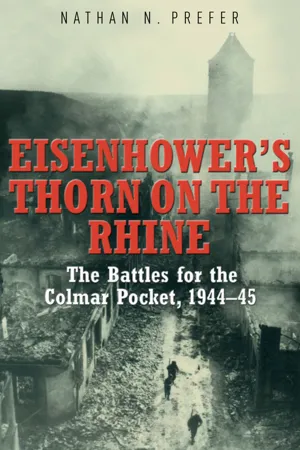
eBook - ePub
Eisenhower's Thorn on the Rhine
The Battles for the Colmar Pocket, 1944–45
- 360 pages
- English
- ePUB (mobile friendly)
- Available on iOS & Android
eBook - ePub
About this book
Information
1
THE SIXTH ARMY GROUP
It was December 1944, and the Allies had managed to push a mere 22 miles inside the German border. Fighting since early June had cleared France and Belgium of German forces. More recently Holland had been partially liberated by a massive Anglo-American-Polish airborne and ground offensive which had opened a corridor through the country, but in the end had failed to bring Allied forces into northern Germany. The U.S. Ninth Army had cleared the Roer River Plain, and the First Army had bled itself heavily in clearing the Huertgen Forest. The First Canadian Army had cleared the French Channel coast and, after a critical delay, captured Antwerp, vital for logistic support of all the Allied armies. The British Second Army had finished clearing the Netherlands south and west of the Maas River. To the south, the U.S. Third Army had cleared Lorraine and reached the West Wall (“Siegfried Line”) along the Saar River. Further south, the 6th Army Group had occupied almost the entire west bank of the upper Rhine River except for a large German pocket around the French city of Colmar.
The 6th Army Group had almost not joined the battle in Western Europe. Strategic planners, heavily influenced by the American chiefs of staff, had originally planned a second invasion of France to support and join with the major landings in Normandy. The fate of this second invasion was heavily debated between the American and British planners, spurred by British Prime Minister Winston Churchill’s earnest desire to continue operations in the Mediterranean. After much argument, postponement and re-organization, the original plan to invade Southern France was executed on August 15, 1944.
Initial resistance was moderate, and the 6th Army Group advanced rapidly up the route towards the so-called “Belfort Gap.” Hard fighting took place around the French city of Montelimar before the beachhead could break out into open territory. Bypassing the Italian and Swiss Borders and leaving token forces to watch the German forces in Italy, the pursuit continued. Another heavy battle developed at Dijon, but the German forces were too weak to long delay the advancing Allies. Back along the Mediterranean coast, French forces fought hard for the French Mediterranean ports, particularly Marseille and Toulon, which were vital to maintain the advancing 6th Army Group. Their swift conquest of these cities allowed the Allies to obtain additional ports for logistical support, something that was sorely needed until the port of Antwerp could be restored to full service. It wasn’t until the advancing armies entered the Vosges Mountains that German resistance stiffened considerably, and the consequence was a delayed advance to the German border at the Rhine. In accordance with an agreement with the Supreme Allied Commander, General Dwight D. Eisenhower, 6th Army Group assumed command over its two armies—U.S. Seventh Army and French First Army—on September 15, 1944.
Additional stands by the Germans at Epinal, St. Dié, and on the Moselle River further slowed the advance, although the 6th Army Group kept pace with the equally delayed advances to their north. Nevertheless by mid-December 1944, the 6th Army Group was well entrenched along the Upper Rhine River. Only one glaring enclave remained in German hands west of the river—that which surrounded the city of Colmar.
Although the original responsibility for planning and launching the invasion of Southern France rested with General Sir Henry Maitland (“Jumbo”) Wilson in his capacity as Supreme Allied Commander, Mediterranean Theater, by September 6th Army Group had come under the command of General Eisenhower, Supreme Commander, Allied Expeditionary Forces. General Eisenhower had a truly allied force under his command. The 21st Army Group included British, Canadian, Polish, French, Belgian, Czechoslovakian, Norwegian and other European troops in its ranks. The 12th U.S. Army Group consisted of mostly American troops. The newly added 6th Army Group added many more American and French troops to the mix.
During the latter stages of the planning for the invasion of Southern France it became apparent that because of multiple armies—of multiple nationalities—participating, control of such a diversified group would require an Army Group Headquarters. Having already set up an advanced planning and administrative headquarters under his chief deputy, General Wilson eventually activated the 6th Army Group and appointed that same deputy, Lieutenant General Jacob L. Devers, as the commanding officer.
Jacob Loucks Devers was born September 8, 1887, in York, Pennsylvania. He was commissioned into the artillery from West Point in 1909, and served on the staff of the Field Artillery School during World War I. Captain Devers instructed at West Point 1919–24 before graduating from the Army’s Command and General Staff School. By 1940, he was a brigadier general and commanding the 9th Infantry Division. It was in 1940 in Panama that Devers first met General George C. Marshall, the United States Army Chief of Staff. General Devers made a good impression on Marshall, who closely watched and mentored Dever’s future career. Major General Devers then commanded the Armored Force between July 1941 and May 1943. Promoted to lieutenant general, he was Commander of the European Theater of Operations, U.S. Army, from May 1943 until January 1944, when General Eisenhower took over. Pleased to be out from under all the political maneuvering surrounding the coming Allied invasion of Northern France, General Devers went to the Mediterranean Theater of Operations as deputy supreme commander, the position he held when General Wilson created the 6th Army Group.
General Devers would command two distinct armies under this new headquarters. The most experienced was the Seventh U.S. Army, commanded by Lieutenant General Alexander McCarrell Patch, Jr. Born November 23, 1889, at Fort Huachuca, Arizona, he attended Lehigh University before graduating from West Point in 1913. Commissioned into the infantry, he served on the Mexican border in 1916 before commanding a machine gun battalion in France during World War I. Between tours of teaching at Staunton Military Academy, he graduated from the Command and General Staff School and the Army War College. By 1941, Alexander M. Patch, Jr. was a brigadier general in charge of training at Fort Bragg, Georgia. Promoted to major general, he was sent to the Pacific and ordered to organize the Americal Division from individual units on Samoa and neighboring islands. General Patch led this division in the Guadalcanal Campaign before commanding the III and IV Corps between 1943 and 1944. Promoted to lieutenant general in August 1944, Patch was bringing his IV Corps headquarters to Italy when he was, instead, given command of the Seventh Army and directed to lead it in the invasion of Southern France.
General Patch’s command was equally experienced. Formed and activated at sea off the coast of Sicily as it sailed to invade that island in July 1943, Seventh Army and the British Eighth Army completed that invasion in a month of bitter fighting. When its first commander, Lieutenant General George S. Patton, was relieved of command, it languished on Sicily, passing most of its combat units to the Fifth U.S. Army for the invasion of mainland Italy. When planning for the invasion of Southern France began in earnest, a planning group, known as Force 163, was organized and eventually absorbed into the Seventh Army staff. At this time, consisting of just a skeleton headquarters and a few service units, the army was without a commander. General Patton had left for England and General Mark W. Clark, then commanding Fifth Army in Italy but slated to command Seventh Army when it re-entered combat in France, had not taken command. In effect, the senior officer present, Brigadier General Garrison H. Davidson, the Army’s engineer officer, directed planning early in 1944.
General Clark’s command of the Seventh Army was another casualty of the Allied landings at Anzio, in Italy. Because the intensity of operations there required General Clark’s full attention, it was decided in February to replace General Clark with General Patch, who had only recently arrived in the Mediterranean Theater, bringing his IV Corps headquarters with him. The Seventh Army finally had the commander who would lead them back into combat in Europe.
The other major component of 6th Army Group was the First French Army, sometimes known as Army “B.” General Charles de Gaulle, President of the French Committee of National Liberation, and Chief of French Armed Forces, pressed for a senior command for a French officer in the newly formed attack force. He demanded this for the prestige of France and to strengthen his own Committee of National Liberation. But political problems intervened, and both President Franklin D. Roosevelt and Prime Minister Winston S. Churchill refused to agree to anything beyond the military sphere. Forced to accept American conditions, he agreed to submit the Army of Free France to overall American command. Because the French commitment, some seven or eight divisions plus support troops, would be greater initially than the American contingent, the French insisted on a senior French commander. Initially rejected, this demand later was granted, resulting in the formation of the First French Army. General de Gaulle, without American knowledge or consent, immediately appointed General Jean de Lattre de Tassigny as commander of all French ground forces participating in the Southern France operations. At the time, General de Lattre commanded Army “B,” a higher French headquarters controlling most of the French ground troops in the Mediterranean. After some discussion, General de Gaulle and General Wilson agreed that once two or more French corps were ashore in Southern France, General de Lattre could activate Army “B,” later designated the First French Army.
Jean-Marie Gabriel de Lattre de Tassigny was born February 2, 1889 at Mouilleron-en-Pareds, in the Vendée region of France. He entered the French Military Academy at St. Cyr in 1908 and upon graduation chose the cavalry as his branch of service. After serving in combat with the horse-mounted cavalry until 1915, he transferred to the infantry. Sixteen months at Verdun at the height of that ferocious battle found him at the end of the war as a battalion commander, with four wounds and eight battle citations. He then served in North Africa where he was severely wounded and invalided home. Colonel de Lattre served on the General Staff and commanded an infantry regiment at Metz before attaining general rank in March 1939. He commanded the 14th Infantry Division in the Battle of France and in the Armistice Army under Petain, but in September 1941 was posted to North Africa as part of the Vichy forces. Reassigned to the 16th Infantry Division in Southern France, he was arrested when he refused to obey orders to welcome the German Army into unoccupied France. Sentenced to ten years imprisonment, he escaped with the help of family and the French underground and made it to London, where he joined General de Gaulle. After organizing and training much of de Gaulle’s forces, he received his appointment to command French Army “B.”1
Like the U.S. Seventh Army, the French First Army had much experience in this war. Besides containing thousands of veterans of the 1940 Battle of France, many of its units had fought the Germans and Italians in North Africa and Italy. Indeed, its mountain troops had been heavily relied upon by General Clark in his struggle through the mountains of central Italy. Although some of its units were without combat experience, they would learn quickly under the tutelage of experienced officers and veterans.
Although the invasion and subsequent pursuit to the Rhine had gone as well as any other operation under Supreme Headquarters, Allied Expeditionary Forces (SHAEF), 6th Army Group had a hidden problem that would plague its operations throughout the push into Germany. Although difficult to pinpoint and never very obvious, there was discomfort between Generals Eisenhower and Devers. Many at SHAEF headquarters viewed the 6th Army Group as an “outsider,” or “orphan outfit.” By and large this was due to the fact that although the Army chief of staff, General Marshall, had personally approved of the appointment of General Devers to command the army group, General Eisenhower had reservations. Back before the war there had been rivalry between Generals Eisenhower and Devers with respect to their careers. Both had graduated from West Point, General Devers the senior by several years. Yet now General Eisenhower was the senior commander by one grade in rank. Neither had seen combat service in World War I yet both had achieved high positions by the outbreak of the current war. General Eisenhower was assistant chief of staff for Marshall while Devers was chief of the new Armored Force. General Devers had commanded the U.S. Army’s European Theater of Operations until replaced by General Eisenhower. It was known that Devers had been on Marshall’s “short list” to command the invasion of France, Operation “Overlord,” and that General Eisenhower had promoted his own candidate, Lieutenant General Omar N. Bradley, for that post. General Eisenhower had also persuaded Marshall to remove both Devers and his air commander, Lieutenant General Ira Eaker, commanding the 8th U.S. Army Air Force, from England to Italy. General Eisenhower had surrounded himself with old friends, including Generals Bradley and George S. Patton, pulling the latter from the Mediterranean Theater. Yet when pressed by Marshall to accept Devers in his Theater of Operations, Eisenhower agreed, saying his earlier doubts were based upon impressions and vague references to Devers that he had heard over time, which appears to be misleading. General Eisenhower must also have been aware that like himself, Devers’ career was closely watched by Marshall. Eisenhower agreed that based upon Devers’ record in the Mediterranean Theater of Operations, he would accept him “cheerfully and willingly.” Some have commented that the real motivation for Eisenhower’s decision was the fact that his forces were pinned down in Normandy, and his knowing that Devers’ appointment would go further to ensure an invasion of Southern France (then again under review) that would bring relief to his own stalled forces.2
Nor was the French command free of personality clashes. General de Lattre soon inherited from the American Army the 2nd French Armored Division (Division Blindée), commanded by Major General Jacques Philippe LeClerc de Hautecloque. General LeClerc, also a career French Army officer and graduate of St. Cyr, had never surrendered after the fall of France in 1940, and had instead escaped from a hospital where he was being treated for wounds and made it to England where he joined the Free French Forces. Since then he had raised, organized and trained the 2nd French Armored Division. During much of this time he had served under American command, and had led his unit in combat since mid-summer. He viewed General de Lattre and others who had once surrendered to the Germans and served Vichy as defeatist and disloyal to the honor of France. At one point LeClerc refused to serve under de Lattre, calling his army “corrupted and spoiled.”3
Further complicating matters in the French Army were the absorption of thousands of former resistance fighters. French units early in the campaign consisted mostly of North African soldiers who fought exceedingly well in North Africa and Italy, but whose bodies were unused to the cooler climates of northern Europe. As a result many were detailed to garrison duties in the south of France. To replace these essential troops, many thousands of Free French resistance fighters were sent into the infantry and armored divisions of the French First Army as replacements. These men had a variety of backgrounds and political agendas, and trust between them was often lacking. Indeed, so bad did this situation become at times that General Patch seriously considered withdrawing the French Corps from the front line. Even General Eisenhower would later acknowledge to General Bradley that only his desire to allow the French to participate in the liberation of their nation prevented him from assigning the Seventh Army to Bradley’s 12th Army Group and using the French as garrison troops. In the end, only the common goal of liberating France and defeating the Germans held the First French Army together.
Indeed, the French Army remained divided throughout the war. In 1942 there were two groups claiming to represent the French Armed Forces. General de Gaulle commanded one and the other, in North Africa, was led by Admiral Jean Louis Xavier Francois Darlan, who was as interested in politics as he was in helping the Allies. He not only controlled most French ground forces in North Africa, but as an Admiral also controlled the powerful French Fleet stationed there to keep it out of the hands of Germany. It was only when Admiral Darlan was assassinated that the two halves of the French Armed Forces came together, albeit with difficulties that lingered throughout the war. Nevertheless in January 1943, General Henri Honoré Giraud, who succeeded Admiral Darlan, signed an agreement with the American president, Franklin D. Roosevelt, which provided for the creation of a French battle corps that would encompass three armored and eight infantry divisions. The necessary support establishment of tank destroyers, reconnaissance, engineers, antiaircraft and medical units would be included. The American policy was to equip the French with modern military equipment and to maintain a French Army of about 250,000 men.4 Supplies for these forces would come from the “common pool” of Allied, mostly American, logistical support quantities. All told, a force of 11 divisions and an air force of 450 aircraft were to be created, with the customary support and logistical units. The Allies were quick to include in the agreement that nothing in it bound them to re-equip the re-built French National Army after hostilities ceased.
From the very beginning the French had a manpower problem. While they could draw from their North African colonies sufficient manpower to initially staff several divisions, they could not rely on a steady supply of replacements and reinforcements. Nearly all of their manpower reserves were in occupied France. In order to get the new program moving, they elected to fill the combat units in the first three divisions, leaving the support units unstaffed. This did not meet the American military’s conditions, and the support units had to be staffed as the combat units were being built. By May 1943 the 2nd Moroccan Infantry Division, or 2nd Division d’Infanterie Morocaine, was staffed and in training. The 3rd Algerian Infantry Division (3rd Division d’Infanterie Algerienne) and 4th Moroccan Mountain Division (4th Division Marocaine de Montagne) soon followed. Additional units, not included in the agreement with the Allies, were also being created using British, French and American materiel not a part of the original agreement. These included a separate 8,000-man infantry brigade and a regiment of Tabors, native African mountain soldiers.5 A shock battalion was also raised.6
While this was going on, the two sides of the French command came together in June and July to work out a mutual agreement on future operations. They d...
Table of contents
- Cover
- Title Page
- Copyright
- Contents
- Maps
- Chapter 1: The Sixth Army Group
- Chapter 2: The French October Offensive
- Chapter 3: Seventh Army’s October Offensive
- Chapter 4: St. Dié
- Chapter 5: Forming the Colmar Pocket
- Chapter 6: The Belfort Gap
- Chapter 7: Stalled on the Rhine
- Chapter 8: December 1944
- Chapter 9: Operation Nordwind
- Chapter 10: Strasbourg, Again
- Chapter 11: Operation Cheerful
- Chapter 12: Colmar
- Chapter 13: February 1945
- Chapter 14: Conclusion
- Appendix A: Allied Order of Battle
- Appendix B: Organization of German Military Units
- Notes
- Bibliography
Trusted by 375,005 students
Access to over 1.5 million titles for a fair monthly price.
Study more efficiently using our study tools.
Frequently asked questions
Yes, you can cancel anytime from the Subscription tab in your account settings on the Perlego website. Your subscription will stay active until the end of your current billing period. Learn how to cancel your subscription
No, books cannot be downloaded as external files, such as PDFs, for use outside of Perlego. However, you can download books within the Perlego app for offline reading on mobile or tablet. Learn how to download books offline
Perlego offers two plans: Essential and Complete
- Essential is ideal for learners and professionals who enjoy exploring a wide range of subjects. Access the Essential Library with 800,000+ trusted titles and best-sellers across business, personal growth, and the humanities. Includes unlimited reading time and Standard Read Aloud voice.
- Complete: Perfect for advanced learners and researchers needing full, unrestricted access. Unlock 1.5M+ books across hundreds of subjects, including academic and specialized titles. The Complete Plan also includes advanced features like Premium Read Aloud and Research Assistant.
We are an online textbook subscription service, where you can get access to an entire online library for less than the price of a single book per month. With over 1.5 million books across 990+ topics, we’ve got you covered! Learn about our mission
Look out for the read-aloud symbol on your next book to see if you can listen to it. The read-aloud tool reads text aloud for you, highlighting the text as it is being read. You can pause it, speed it up and slow it down. Learn more about Read Aloud
Yes! You can use the Perlego app on both iOS and Android devices to read anytime, anywhere — even offline. Perfect for commutes or when you’re on the go.
Please note we cannot support devices running on iOS 13 and Android 7 or earlier. Learn more about using the app
Please note we cannot support devices running on iOS 13 and Android 7 or earlier. Learn more about using the app
Yes, you can access Eisenhower's Thorn on the Rhine by Nathan N. Prefer in PDF and/or ePUB format, as well as other popular books in History & Military & Maritime History. We have over 1.5 million books available in our catalogue for you to explore.