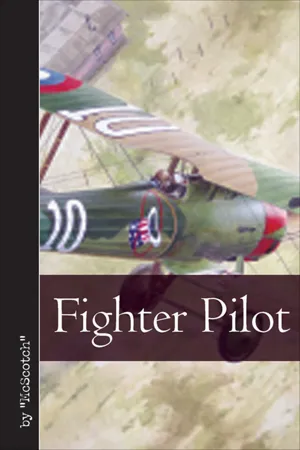
"McScotch" himself describes his book and pays tribute to a colleague in this note, which appears at the front of the volume:
"This book consists of the reminiscences of an ordinary fighter pilot of the R.F.C. who had the privilege of serving in one of the leading Fighter Squadrons and who had the honor of being the friend of the supreme fighter of all the Air Forces, that indomitable and lovable patriot, 'MICK' MANNOCK, V.C., D.S.O., M.C."
Available records and publications show "McScotch" himself as a fighter pilot with 40 Squadron, holding the rank of lieutenant and then captain. He is credited with 12 kills of German opponents.
This is a detailed and exciting account of squadron life and shows the bravery and true comradeship of these flyers.
- 276 pages
- English
- ePUB (mobile friendly)
- Available on iOS & Android
eBook - ePub
Fighter Pilot
About this book
Information
CHAPTER I
ON a serenely warm afternoon at the end of May 1917 I was being whirled along the pave road between St. Omer and Aire on my way to join 40 Squadron of the Royal Flying Corps. The road, one of those permanent monuments to the intentions of Napoleon, leading straight to the English Channel, was lined by tall poplar trees which appeared as if they were going to fall over us as the R.F.C. tender tore along at something like fifty miles an hour. The steel-studded tyres maintained a high-pitched whistle as they feverishly gripped the whinstone blocks of the road, the clear fresh country air sang in our ears.
The pilot sitting between the driver and myself,’ Basset, was the cause of the haste. He had been sent to St. Omer to collect me from the ‘Pilots’ Pool’, and in explanation for allowing me only five minutes in which to pack my belongings had said :
“ Got to get back quickly. Something ‘on’ tonight.”
As the car sped along between the rows of trees he dropped into a morose silence, staring straight ahead of him as if there were something at the end of the road of which he was afraid. In reply to myquestions about the squadron and the ‘machines’, he answered only in monosyllables. Poor Basset, something was going to happen but not until the next morning.
It was my first journey to the ‘line’, that magic and tragic word that embraced the whole of the battle areas of Northern France and Flanders.
On that road, along which so many were never to return, the taciturn attitude of my travelling companion gave me time to think. After two years in the infantry at home I had come to the conclusion that at twenty, with two years of very nondescript training mostly as a specialist in bombing and musketry, I was not in any way qualified to accept responsibility for the lives of a platoon of men. All through my training the thought of twenty-two lives depending on my word of command had appalled me and, on confiding my fears to a friend, I was given some very acceptable and practical advice. This friend, who had been sent to France in the first month of the war and who was killed in France the day before the Armistice, had said : “The right job for you is in the Flying Corps. Fellows like you that need ‘holding down’ can do ten times as much good in the air as you ever will on the ground.’’
Two or three more months passed without any sign of being sent overseas, so I had transferred to the Flying Corps. Even then the thought of having the life of an observer in my hands made me determine to become a single seater or ‘scout’ pilot; I wanted to fight alone, relieved of the knowledge that a mistake on my part would cost another fellow his life. Besides, the endorsement on my ‘Training Brigade Transfer Card’ written in red ink ‘ Rotary Scout Pilot’ meant much more to me than the certainty that I was going to be clear of responsibilities. The title, an honourable one from 1916 to 1918, although meaningless nowadays, translated into modern terminology signifies a ‘Single-seater fighter who is capable of flying aeroplanes with rotary engines’. Single-seaters were originally called ‘scouts’ because they were designed to act as the ‘eyes’ of the infantry ; the latter, confined to the trenches, were, through the single-seater, given some knowledge of the enemy dispositions and movements.
By 1917, however, the term ‘scout’ no longer applied; reconnaissance work was carried out by two-seater machines, and single-seaters were relegated (or promoted) to the more aggressively active task of offensive and defensive fighting. The ‘scouts’ fought in the vanguard of every attack in 1917 and 1918 ; their spectacular work made them appear as the gladiators of the war, particularly after Captain Ball, the V.C., had brought the single-seater pilot into the limelight by demonstrating the destructive value of a spirited fighter. Every ‘scout’ was, at least, entitled to hope that the coveted decoration was already under his pillow. Until the end of the war the single-seater pilot waged an individual battle against the enemy, for even when with his flight or his squadron, his success and chances both of victory and life lay in his own hands and depended to a considerable extent on his own spirit and the intelligence he applied to his ‘job’ of shooting down the enemy machines.
So it was that on the way to joining 40 (Scout) Squadron at Bruay, I had a definite feeling of fulfilment. The red endorsement on my card had beenthe first part of my ambition. I was at last going to take my part in the Great War, to kill the country’s enemies and to meet new friends, to live at such a ‘pitch’ that the memory of it is as fresh to-day as when it all happened. What it was really going to be like or what it was going to mean to me I had no suspicion. At any rate, there was no premonition, no fear in my mind, my only emotion was anticipation.
The car passed through one town, and on entering the market square of another, Lillers, Basset climbed out to dash into a bakery. He was in a terrific hurry, as if ‘Cutty Sark’ were on his heels, and when he came out carrying parcels of bread and cakes he almost gasped : “We ought to do it !”
The car continued its race along a now dusty road, while I wondered why Basset was in such unseemly haste, but his preoccupied manner discouraged questions. I was curious to know ; to get a glimpse of what was ‘going to happen’. Everything that had to do with war, the real war I mean, the war of killing, and the war that went on within the fellows’ minds was a subject worthy of investigation, but it was not until several days later that I found out the reason for Basset’s fear. One or two pilots had been suspected of evading patrols through subterfuges, and Basset, to prove that he did not belong to that gutless and fortunately rare type, was hurrying back so that he would be in time for a flight patrol, even when his early return meant inconvenience to me, to the driver, and risk to the car with its three occupants.
We stopped at a closed level crossing in Bruay ; Basset took out his watch, glanced at it and immediately relaxed, “We’ve done it all right.”
As we finally slowed down alongside an aerodromeon which four or five Nieuports were standing, he thanked the driver, jumped out, and hurried into one of the canvas Bessaneau hangars.
The camp was about a hundred yards up a lane on the left-hand side of the road and consisted of ten or eleven small brown canvas Armstrong huts surrounding a red ash tennis court with a large black wooden mess hut standing twenty yards away on the north side. There was a game in progress, and the sight of four fellows, three of whom were in flannels, playing an energetic game of tennis ‘up the line’ came as a great surprise to me. I had thought only of khaki and the duty side of fighting, not of the relaxation between times. The general impression surrounding the camp was that of a peaceful tennis club at home.
I asked one of the pilots who were sitting round in deck-chairs where I might find the Commanding Officer.
“You’re the new fellow ?” he asked. And on my admitting that I was he gave me a cheery welcoming smile.
“That’s the C.O. over there,” indicating a young rather florid-faced youth at the far side of the net. “But you had better not disturb him till the set is finished.”
The latter, when the ‘over’ was finished, waved his racquet to me. “You the new pilot ? See you later when we’ve won this set.”
This informal greeting struck me as being unusual— no fuss, no formality.
The sun was beating down on the court and the perspiring players fought a well-contested game. Overhead the noise of five rotary engines almost deafened us as a flight fell into formation. It wasthe first time I had seen a whole flight of the same type of machine together and was fascinated by the aluminium-coated Nieuports circling round as they fell into a ‘V ‘-formation behind a machine with streamers on the struts and tail. They were going out to fight, Basset was in one of them. It would soon be my turn.
When the set was finished, the C.O. came over to me and, after making fun of my long and (to an Englishman) rather unpronounceable Scotch name, asked me if I had ever flown a Nieuport.
On being told that I had, he called out to the others : “Come on, here’s a fellow from Smith Barrie’s squadron who has flown a Nieuport. Let’s watch what he can do ! “
This was another surprise ; I was not even being allowed to unpack, find a hut, or to get into flying-togs, but was to be hurled forthwith into the air to ‘show them what I could do ”.
Major Smith Barrie commanded No.I Reserve Squadron at Gosport, a ‘scout’ instructional squadron which was regarded as the training centre for ‘stunt pilots’ ! From the C.O.’s remarks it was obvious that he expected ‘something’ from me.
Mechanics dragged out a Nieuport, someone lent me a flying cap, and I climbed into the cockpit, confident that I was going to give a demonstration of my capabilities. It almost invariably happens that when this feeling predominates over caution the result is an anti-climax. Through the kindness of the adjutant at the ‘Pilots’ Pool’ I had managed to borrow an old Nieuport at St. Omer and had put in five or six hours’ flying, during which I had performed every possible evolution. The one ‘stunt’ that had beatenme was the ‘loop’, but when I learnt that Captain Ball was reputed to ‘have broken his heart’ attempting to ‘loop’ a Nieuport the annoyance at my failure was not so acute.
There were many interesting features about the Nieuport. Her wing span was no more than twenty-seven feet, the upper plane being almost twice the breadth of the lower one. The sole support between the planes, apart from the centre section, was a ‘V’-shaped strut on either side and, because of this and the fact that only two landing wires and two flying wires were necessary, the planes presented a smart and tidy appearance. The whole fuselage, planes and tail plane were painted with aluminium dope which merited her the name of ‘Silver Hawk’ from the infantry. The engine was a no h.p. Le Rhone, a nine-cylinder rotary engine, controlled by a ‘throttle’ lever, and a ‘mixture’ lever operated by the pilot’s left hand.
With this double adjustment it often proved exceedingly difficult to obtain the correct firing mixture for an engine and until a pilot became accustomed to his own there was always some danger of ‘choking’ it and stopping the propeller. At St. Omer I had learnt that it required nearly three thousand feet of vertical dive to restart an engine ; so that ‘losing one’s prop’ close to the ground entailed a hurried landing. The top speed on the level was about 95 m.p.h., a speed which, to road hogs and pilots of modern aeroplanes, may appear ludicrous for a ‘fighting machine’, but in 1916 when the Nieuport was first brought into action against the German Fokker, this speed represented the fastest that was attainable by a war aeroplane.
Unlike modern aircraft built for pleasant flying, the war machine did not require to be stable. In fact, one of the reasons for the efficiency of the Nieuport was that she was inherently unstable. A pilot had to ‘fly’ all the time he was in the air for, immediately he relaxed his hold on the ‘joy-stick’ and rudder, she would push her snub nose up into the air and, after completing a turn of a ‘roll’, spin slowly and insistently to the ground. This proclivity made her an excellent fighting machine, for once a pilot understood these idiosyncrasies he could utilise them to assist in the carrying-out of quick manoeuvres. I doubt whether any war aircraft of either side ever surpassed the Nieuport in ease of control in the type of flying we had to employ in aerial ‘dog fights’
Such was the machine I was supposed to ‘stunt’ for the edification and amusement of seasoned war pilots.
The result was almost a fiasco ; but it found me a friend.
In my haste to get into the air, I evidently did not pay sufficient attention to the throttle and mixture controls. When I had climbed to 1,000 feet the engine coughed, spluttered and, to my utter disgust, stopped altogether with one blade of the propeller standing defiantly straight up in front of me. At 1,000 feet there was no room to dive to restart the engine, so, determined that I should at least perform one of No. I Reserve Squadron’s pet ‘stunts’,I allowed the Nieuport to stall gently and then, as her nose went down, kicked her into a spin.
At that time in England, except in No. I Squadron, to get into a ‘spinning nose-dive’ was regarded as certain death, and although it was occasionally used by war fliers when avoiding enemy scouts who had succeeded in getting above them, it was rarely practised close to the ground. The newspapers then always described it as ‘Deadly Spinning Nose-dive’, scaremongering which probably had its demoralising influence on many pilots who lacked confidence in themselves or their instructors. To get a machine out of a spin one had to do the opposite of what one would at first sight expect. As the machine was pointing to the ground the natural reaction was to pull the joy-stick back to raise her nose, but the only way to stop the spin was to push the stick forward as if for diving, and to wait until the machine turned the spinning nose-dive into a straight dive before straightening out. At No. I R.S. all of us had become so expert at this that we could land straight from the last turn of a spin.
Without the engine propelling her, the Nieuport, that afternoon, behaved like a perfect little lady. She dropped her nose gently, turned round into the first turn of the spin with an easy grace and, still properly under control, commenced to spin slowly to the ground. With only the sound of the air whistling past the struts and wires I felt perfectly happy, watching the ground swirling round underneath and rising to meet me. At the correct moment I eased the joystick forward, straightened out, and did a perfect landing on the middle of the aerodrome.
I waited for the mechanics to start the engine, but when they ran out to me one of them said : “I think the Major would like to speak to you, Sir.” I had quite forgotten the effect the ‘spin’ might have on the onlookers and, much to my amazement, on approaching the C.O. he turned away from me and walked towards the road.
Hurrying after him I stammered : “I’m sorry, Sir,” but with a wave of his hand to show he did not want to speak to me, he walked on. The other pilots avoided me, so, disconsolate, perplexed and annoyed, I strolled towards the hangar. The attitude of the C.O. seemed quite unreasonable. Admittedly I had failed to control an engine but I had certainly landed the machine whole.
Muttering rebelliously to myself, I caught sight of a tall weather-beaten pilot almost shaking with mirth. Anger nearly got the better of me ; I glared at him until, nodding in the direction in which the C.O. had disappeared, he said :
“He hadn’t much to say to you, had he ?”
Something in his healthy ruggedness arrested me.
‘‘No, it was a pretty miserable show, wasn’t it ?” I replied, wondering what devilment made this strange pilot laugh. “But why didn’t he wait until I explained ?”
“Because he was absolutely speechless. They all thought you were ...
Table of contents
- Cover
- Vintage Aviation Library
- Title
- Copyright
- Dedication
- Contents
- List
- Chapter I:
- Chapter II:
- Chapter III:
- Chapter IV:
- Chapter V:
- Chapter VI:
- Chapter VII:
- Chapter VIII:
- Chapter IX:
- Chapter X:
- Chapter XI:
- Conclusion:
Trusted by 375,005 students
Access to over 1.5 million titles for a fair monthly price.
Study more efficiently using our study tools.
Frequently asked questions
Yes, you can cancel anytime from the Subscription tab in your account settings on the Perlego website. Your subscription will stay active until the end of your current billing period. Learn how to cancel your subscription
No, books cannot be downloaded as external files, such as PDFs, for use outside of Perlego. However, you can download books within the Perlego app for offline reading on mobile or tablet. Learn how to download books offline
Perlego offers two plans: Essential and Complete
- Essential is ideal for learners and professionals who enjoy exploring a wide range of subjects. Access the Essential Library with 800,000+ trusted titles and best-sellers across business, personal growth, and the humanities. Includes unlimited reading time and Standard Read Aloud voice.
- Complete: Perfect for advanced learners and researchers needing full, unrestricted access. Unlock 1.5M+ books across hundreds of subjects, including academic and specialized titles. The Complete Plan also includes advanced features like Premium Read Aloud and Research Assistant.
We are an online textbook subscription service, where you can get access to an entire online library for less than the price of a single book per month. With over 1.5 million books across 990+ topics, we’ve got you covered! Learn about our mission
Look out for the read-aloud symbol on your next book to see if you can listen to it. The read-aloud tool reads text aloud for you, highlighting the text as it is being read. You can pause it, speed it up and slow it down. Learn more about Read Aloud
Yes! You can use the Perlego app on both iOS and Android devices to read anytime, anywhere — even offline. Perfect for commutes or when you’re on the go.
Please note we cannot support devices running on iOS 13 and Android 7 or earlier. Learn more about using the app
Please note we cannot support devices running on iOS 13 and Android 7 or earlier. Learn more about using the app
Yes, you can access Fighter Pilot by "McScotch" Mannock in PDF and/or ePUB format, as well as other popular books in History & World War I. We have over 1.5 million books available in our catalogue for you to explore.