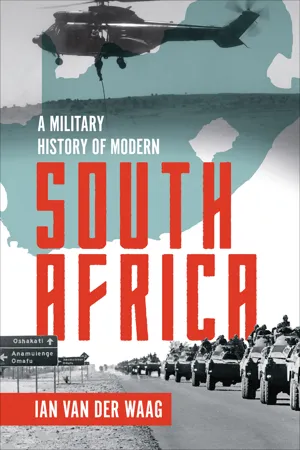
The story of a century of conflict and change—from the Second Boer War to the anti-apartheid movement and the many battles in between.
Twentieth-century South Africa saw continuous, often rapid, and fundamental socioeconomic and political change. The century started with a brief but total war. Less than ten years later, Britain brought the conquered Boer republics and the Cape and Natal colonies together into the Union of South Africa. The Union Defence Force, later the SADF, was deployed during most of the major wars of the century, as well as a number of internal and regional struggles: the two world wars, Korea, uprising and rebellion on the part of Afrikaner and black nationalists, and industrial unrest.
The century ended as it started, with another war. This was a flash point of the Cold War, which embraced more than just the subcontinent and lasted a long thirty years. The outcome included the final withdrawal of foreign troops from southern Africa, the withdrawal of South African forces from Angola and Namibia, and the transfer of political power away from a white elite to a broad-based democracy. This book is the first study of the South African armed forces as an institution and of the complex roles that these forces played in the wars, rebellions, uprisings, and protests of the period. It deals in the first instance with the evolution of South African defense policy, the development of the armed forces, and the people who served in and commanded them. It also places the narrative within the broader national past, to produce a fascinating study of a century in which South Africa was uniquely embroiled in three total wars.
- 420 pages
- English
- ePUB (mobile friendly)
- Available on iOS & Android
eBook - ePub
A Military History of Modern South Africa
About this book
Information
CHAPTER ONE
South Africa, 1899–1902: The Last Gentleman’s War?
The Anglo-Boer War, fought more than a century ago, has a fixed place in modern historical memory … Some part of that interest is certainly lingering popular nostalgia for a long-gone era, an imagined time before the advent of modern, industrial-scale mass slaughter, when men were supposed to have fought more honourably, or at least more politely … an image in which plodding but hardy British regiments fought clean and courageous engagements with decent Boer citizen commandos.1
Individual bravery, of the kind which takes no heed of personal risk, reckless heroic dash, they have not, nor do they pretend to have. Their system is entirely otherwise. They do not seek fighting for fighting’s sake. They do not like exposing themselves to risk and danger. Their caution and their care for personal safety are such that, judged by the standard of other people’s conduct in similar positions, they are frequently considered to be wanting in personal courage.2
At 5.50 am on 20 October 1899, a shot from a Krupp gun on Talana Hill entered the British camp at Dundee. The shell landed with a thunderous roar near the tent of Major General Sir William Penn Symons, sending dirt showering across the camp. A reality dawned. The shells that now streaked across the morning sky, shattering the pre-dawn stillness of the small Natal town, announced the arrival of a Boer army. Symons, who had, some hours before, carelessly disregarded the Boer van as nothing but a small raiding party, now realised his mistake. The British war machine swung into action. Officers and NCOs barked commands, whistles sounded and the troops of the 18th Hussars, three batteries of field artillery and four infantry battalions assembled rapidly to dislodge the Boers from the hill. The Second Anglo-Boer War, triggered when a Pretoria ultimatum expired on 11 October, had started in earnest.
Opinions as to what – or, perhaps more importantly, who – caused the war were many. Decades of escalating tension between Britain and the two small Boer republics – the Zuid-Afrikaansche Republiek (ZAR), or Transvaal, and the Orange Free State – had reached flashpoint at the time of the Jameson Raid in December 1895. By 22 September 1899, a wide-scale war in South Africa had become inevitable. Thoughtful explanations include the financial and moneyed interests of empire-builders like Cecil John Rhodes, the aggressive manoeuvring of Alfred Milner, the British High Commissioner in South Africa, in pursuit of British supremacy in southern Africa, and the position of the so-called Uitlander population on the Witwatersrand and in the towns of the Transvaal republic, as well as the tenacity of the Boers in the maintenance of their independence and way of life. For some, Milner had brought the war on; for others, it was the recklessness of Transvaal president Paul Kruger and his Volksraad (parliament). Whatever the causes, no one could foresee what the war would be like. Most hoped optimistically for a short war. But, instead, a modern war was fought over three long years. Both the British and the Boers fought for unlimited objectives – the British for supremacy, the Boers for greater independence – and a compromise was seemingly impossible. No short, restrained war would convince either side to yield. Few Boers shared General JH de la Rey’s concerns regarding the nature and impact of a war with Britain. While most Boers looked forward to a second Majuba – the British defeat that brought to a conclusion the First Anglo-Boer War, or Transvaal War, of 1880–1881 – the British predicted a swift and easy victory.3 But only a prolonged and brutal struggle would resolve the issue one way or the other.
The Second Anglo-Boer War was one of the crucial events in South African history and has been the subject of much research and reassessment. The battle for the naming of the war reflects the tremendous impact it had; the ‘South African War’, the ‘Second War of Independence’, the ‘English War’ and the ‘Boer War’ all insufficiently express the complexities. The Anglo-Boer War, perhaps too simplistically, is taken from the two main belligerents and is problematic. Firstly, it excludes the ‘other’ parties: the Cape Afrikaners, Australians, New Zealanders, Dutch, Belgians, Austrians, Russians, Germans, Frenchmen, Canadians, the Englishmen of Natal and the Cape, the Uitlanders and, of course, the thousands upon thousands of black South Africans.4 Furthermore, it was not the second conflict between Boer and Briton. Enumerating the events culminating at Slagtersnek (1815), Boomplaats (1848) and the Transvaal War of 1880–1881, the war that erupted in 1899 must number as the fourth Anglo-Boer War. The ‘Three Years’ War’, General CR de Wet’s terminology, is vague yet perhaps the best of a poor list.5 In South Africa, each of these terms is politically loaded. Yet, as General JC Smuts pointed out, this was in many respects a total war, among the first of the twentieth-century mould, and for this reason its ramifications for South Africa’s development were profound.6 Unsurprisingly, the war, the nature of the Boer armies and the way in which they held the world’s greatest superpower at bay, and for almost three years, was also of close interest to other powers with colonial interests in Africa.7 This chapter addresses these concerns.
The geopolitical landscape and the rival strategies
As the crisis had mounted, the various players – President Paul Kruger in Pretoria, President MT Steyn in Bloemfontein, the British government in London and Milner at the Cape – had considered their strategic options. Britain’s initial policy objective, to bring the Transvaal republic into the Empire by conquest and subjugation if necessary, required offensive operations and complete military victory. For the Boer republics, needing only to defend themselves, a stalemated war that eroded British determination and brought foreign assistance would suffice. Thus the strategic equation was simply stated. Britain had to conquer the republics before the Boers convinced the British populace and the British government that they were unconquerable; the Transvaal had succeeded in doing this in 1880–1881. In the meantime, the strategists for the opposing armies considered the geography, domestic and international politics and public opinion, the perceived intentions of the enemy, resources, including the nature and size of military forces, and the logistics of a campaign in southern Africa.
The topography and geography of South Africa presented a number of military challenges for the British. The general physical features of the operational theatre comprise a coastal region, rising gradually to an upland country, narrow on the east and west coasts, with terraced country or a gradual slope running up to the escarpment at which the great plateau starts. An interior tableland (the veld or veldt), some 1 000 to 2 500 metres above sea level, was flat or undulating and broken only here and there by solitary rounded hills (koppies). The veld sloped down gradually from east to west; all the major rivers flowed across the plateau to the Atlantic, where there were no ports of consequence for the British forces to utilise. An escarpment, which marks the transition, sometimes gradual, but generally abrupt, between the coastal region and the veld, commences near the Tropic of Capricorn in the northeast and runs parallel to the coast. As it passes southward, the mountains gradually become more precipitous until they rise to a height of 3 482 metres in the Drakensberg, in what was then Natal. From the southwestern end of the Drakensberg, the escarpment takes a westerly course and runs along ranges of mountains such as the Stormberg, the Sneeuberg, the Nieuveld and the Kornsberg, where for a time it merges in the parallel ranges north of Cape Town.8

Map 1: The four environments for war and politics in southern Africa
Source: I van der Waag, ‘Water and the ecology of warfare in southern Africa’, in JWN Tempelhoff, ed, African Water Histories: Transdisciplinary discourses (North-West University, Vanderbijlpark, 2005), p 124.
Terrain and logistical difficulties constrained military operations. While South Africa possessed a number of good anchorages and harbours, all of which (Cape Town, Port Elizabeth, East London, Saldanha Bay and Durban) were situated within the Cape and Natal colonies, there were few navigable rivers, and the only river of consequence, the Orange, flowed east-west. There was no inland water transportation. British troops would encounter problems the moment they left the coast. Rail appeared to be a panacea. Yet, from a military point of view, rail had many shortcomings, all of which would be highlighted during the coming war. While ramified rail networks had developed in Europe, rail was far less extensive at the imperial peripheries. In southern Africa, the main western line from Cape Town, via Kimberley and Mafeking, to Salisbury in Rhodesia, crossed at Orange River Bridge, near Hopetown. Surprisingly, the Boers’ strategic vision did not stretch to seizing this bridge or destroying it and more of the railway, which would have forced the British to undertake expensive repairs. Likewise at Springfontein, where the lines coming up from the three main Cape harbours converge onto a single track into Bloemfontein, and where the congestion during the war was considerable. In December 1900, General Sir Redvers Buller suggested that a lateral line be constructed linking the western line to Bloemfontein, but Lord Roberts, the commander-in-chief of the imperial troops in South Africa from 1900, would have none of it. The success of any British operation depended on the singletrack railway lines from the ports of the Cape and Natal colonies. A third line, opened in 1895, connected the Transvaal to the port of Lourenço Marques in Portuguese East Africa (Mozambique).
Although rail was the strategic key to all communications, the paucity of railways limited strategic options. Troops and supplies could be moved relatively easily to the railhead, but the effort required to progress beyond that point was immense. Moreover, railways predetermined the lines of advance, so sacrificing surprise, were vulnerable to enemy action, as the British would experience in South Africa from 1900, and required significant manpower to protect and maintain.9
The dual problems of transport and supply would dog the British columns. London tried to meet the dramatic shortage of horses in southern Africa by importing animals from the United Kingdom, Australasia and North and South America. Global variation in horseflesh, as Sandra Swart has argued, brought unanticipated difficulties, in variegated types of forage and riding habits, for example, while privation, combat stress and compromised immunity brought susceptibility to diseases.10 Buller had reason for his frequent complaints about the quality of horses and their shortage.11 Colonel (later General Sir) Frederick Maxse admitted, in June 1900, that the British had ‘not yet learned the secret of mobility in the field of action’.12 British operations were, as a result, limited at first to the area traversed by rail and, more so, by the lack of transport animals.
Four main theatres were evident as the strategists surveyed the prospective front lines, which stretched from the western and southern reaches of the highveld to the lowveld of the eastern Transvaal, an arc spanning more than 1 500 kilometres. The western theatre, extending from the Orange River to the town of Mafeking, consisted of two sub-theatres: the districts of Kimberley and Mafeking. This was not bountiful country. An invasion would be difficult for the British, despite an adequate railway running up from Cape Town into British Bechuanaland (Botswana). In many ways, this was a strategic dead end, forcing the British to channel deeper into the arid and semi-arid regions of western highveld and further and further away from their bases and depots. Here, on the plateau, the few rivers were of no value for transportation but excellent for defence against an army approaching from the south.
Lying between the east coast of Natal and the Drakensberg escarpment, the eastern theatre also had two sub-theatres: the Natal front itself and the lowveld border with Portuguese East Africa. Here geography again favoured the Boer republics. An invading British army would have the benefit of the railway line running up from Durban to the Witwatersrand. The Boers, however, would be able to use the rivers and mountains, in increasing measure as the advance moved inland and the co...
Table of contents
- Cover
- Title
- Dedication
- Copyright
- Contents
- LIST OF MAPS
- LIST OF FIGURES
- LIST OF TABLES
- ABBREVIATIONS
- Introduction
- Chapter One: South Africa, 1899–1902: The Last Gentleman’s War?
- Chapter Two: Integration and Union, 1902–1914
- Chapter Three: The First World War, 1914–1918
- Chapter Four: The Inter-war Years, 1919–1939
- Chapter Five: The Second World War, 1939–1945
- Chapter Six: Change and Continuity: The Early Cold War, 1945–1966
- Chapter Seven: Hot War in Southern Africa, 1959–1989
- Chapter Eight: The South African National Defence Force, 1994 to circa 2000
- NOTES
- SOURCES
- Plate section
Trusted by 375,005 students
Access to over 1.5 million titles for a fair monthly price.
Study more efficiently using our study tools.
Frequently asked questions
Yes, you can cancel anytime from the Subscription tab in your account settings on the Perlego website. Your subscription will stay active until the end of your current billing period. Learn how to cancel your subscription
No, books cannot be downloaded as external files, such as PDFs, for use outside of Perlego. However, you can download books within the Perlego app for offline reading on mobile or tablet. Learn how to download books offline
Perlego offers two plans: Essential and Complete
- Essential is ideal for learners and professionals who enjoy exploring a wide range of subjects. Access the Essential Library with 800,000+ trusted titles and best-sellers across business, personal growth, and the humanities. Includes unlimited reading time and Standard Read Aloud voice.
- Complete: Perfect for advanced learners and researchers needing full, unrestricted access. Unlock 1.5M+ books across hundreds of subjects, including academic and specialized titles. The Complete Plan also includes advanced features like Premium Read Aloud and Research Assistant.
We are an online textbook subscription service, where you can get access to an entire online library for less than the price of a single book per month. With over 1.5 million books across 990+ topics, we’ve got you covered! Learn about our mission
Look out for the read-aloud symbol on your next book to see if you can listen to it. The read-aloud tool reads text aloud for you, highlighting the text as it is being read. You can pause it, speed it up and slow it down. Learn more about Read Aloud
Yes! You can use the Perlego app on both iOS and Android devices to read anytime, anywhere — even offline. Perfect for commutes or when you’re on the go.
Please note we cannot support devices running on iOS 13 and Android 7 or earlier. Learn more about using the app
Please note we cannot support devices running on iOS 13 and Android 7 or earlier. Learn more about using the app
Yes, you can access A Military History of Modern South Africa by Ian van der Waag in PDF and/or ePUB format, as well as other popular books in History & 20th Century History. We have over 1.5 million books available in our catalogue for you to explore.