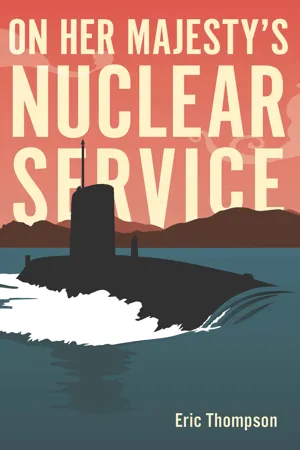
A journey inside the submarines that patrolled beneath the surface to keep the peace during the Cold War, from a Royal Navy officer and engineer.
During the Cold War, nuclear submarines quietly helped prevent a third world war, keeping watch and maintaining the deterrent effect of mutually assured destruction. For security reasons, very few knew the inside stories—until now. Eric Thompson is a career nuclear submarine officer who served from the first days of the Polaris missile boats until after the Cold War, ending up as the top engineer in charge of the Navy's nuclear power plants. Along the way, he helped develop all manner of kit, from guided torpedoes to the Trident ballistic missile system. In this vivid personal account of his submarine operations, he reveals what it was like to literally have your finger on the nuclear button.
He leads the reader through top-secret submarine patrols, hush-hush scientific trials, underwater weapon developments, public relations battles with nuclear protesters, arm wrestling with politicians, and the changes surrounding gender and sexual preference in the Navy. It is essentially a human story, rich in both drama and comedy, like the Russian spy trawler that played dance music at passing submarines. There was never a dull moment—but it was always a deadly serious game. Among other subjects, Thompson discusses:
• The two American nuclear submarines
Thresher and
Scorpion, which sank with no survivors during the Cold War
• The history of submarines, including the
Hunley a Confederate submarine during the US Civil War, which was the first sub to ever sink a ship—though it did so kamikaze-style
• What a submarine base is like
• How a Soviet sub in the Mediterranean was flushed out, earning the crew a crate of champagne from America
• The author's personal experience with the Polaris and Trident classes of submarine, and more
"Interesting, sometimes thought provoking, but above all an entertaining read." —
Nuclear Futures
- 336 pages
- English
- ePUB (mobile friendly)
- Available on iOS & Android
eBook - ePub
On Her Majesty's Nuclear Service
About this book
Information
CHAPTER 1
On Patrol
‘Nobody knows where the submarine goes
And nobody gives a damn.’
GRAFFITI IN A FLEET TENDER
June 1978 – HMS Revenge on patrol
The sudden roar came as a shock. It sounded like a jumbo jet taking off.
‘Steam leak in the TG room!’ a voice shrieked over the intercom.
The roar said it all. This was serious. The Turbo-Generator room was directly beneath me.
Frank Hurley and I exchanged glances. ‘Whot-da-fock!’ he exclaimed.
We were in the tail end of a nuclear submarine, locked-in behind the massive steel doors of the reactor compartment. Our space was filling with steam. I was Senior Engineer and on watch. My moment of truth had come.
I pressed the general alarm three times – baaaa baaaa baaaa: ‘Steam leak in the TG room,’ I screamed over full main broadcast. There were one hundred and forty men for’ard, not least the Captain. They needed to know; this was a whole boat emergency. In the heat of the moment I forgot to cancel full main broadcast. The entire crew would now be entertained by my new soprano voice – strange how panic reacts on the testicles.
I knew the emergency drill by heart: Shut both Main Steam Stops. That would shut off all steam to the Engine Room. At a stroke, it would kill the leak. It was no more difficult than switching off the bedroom lights but it would also scram the reactor, the pumping heart of the submarine; the plant would automatically go into Emergency Cooling and there was no recovery from that at sea. We would have lost our power source, be reduced to a dead ship. We would have to surface and signal for a tug. Unthinkable. Revenge was a Polaris missile submarine on Strategic Nuclear Deterrent patrol. She was the country’s duty guardian. We were the nation’s assurance that World War Three would not happen, not on our watch. We were in our top-secret patrol position. Our number one priority was to remain undetected. Surfacing and calling for a tug would mean breaching one of the country’s mosthighly guarded secrets – where we were. It would mean national humiliation. The credibility of our Nuclear Deterrent was at stake.
If I got it wrong now, the political ramifications would be incalculable. Jim Callaghan’s Government was riven by anti-nuclear sentiment. Many of his Labour MPs were proud to flaunt CND badges in public, none more so than Michael Foot, the left wing leader-in-waiting; this could be their golden opportunity. If the Deterrent appeared to fail, British nuclear strategy would be holed below the waterline. Britain could lose its place in the UN Security Council. The Americans could end our Special Relationship. These lofty anxieties flashed through my mind as I prepared to be poached alive.
The Main Steam Stops were operated by push buttons behind my head. I hit the starboard button first. Then a split-second thought occurred. There was a fifty-fifty chance I’d got it right first time. ‘Which side?’ I yelled into the microphone.
‘Starboard,’ came a strangulated reply, the voice of Leading Mechanic ‘Bungy Mack’, a twenty-year-old Liverpudlian on watch below.
Thank God I had not hit the port button for we would have lost all power. But the roar had not stopped. Holy shit! The leak was on the boiler side of the stop valve. One massive, nuclear-powered steam generator was discharging its steam into my airspace and could not be stopped. We were in a race against time. The boiler had to be emptied before it killed us.
There were eight of us on watch. Should I order evacuation now while we could still get out and leave the Prime Minister to deal with the politics? If I did, I would be court-martialled and hung out to dry. The submarine nuclear programme had zero tolerance for failure and I would be made a scapegoat. The roaring continued. The smell of wild steam was spreading fast.
‘Steady the Buffs,’ I called to the watch-keepers in front of me. That brought a smile to the face of ‘Flash’ Goodall; he normally supplied the deadpan quips like: ‘I’ve just read the Stores manual. There ain’t none.’
It is simply astonishing how the human brain accelerates in a crisis. In a high-speed skid, for example, everything seems to happen in slow motion. That’s because the brain has switched to survival mode; it is in hyper-drive. I was now multiplexing at the speed of light. Whilst scanning the vast array of dials before me, I was simultaneously preparing my court martial defence, trying to figure out the quickest way to empty a submarine boiler at sea, worrying about the political ramifications, considering evacuation, and wondering whether or not to scribble a farewell note to Kate in pencil on the back of a log sheet. As there was no risk of us sinking, she would get the note. She was my safe haven. She would still be there for me even if my career did hit the rocks, even if the Navy crucified me. I wondered what she was doing. How I wished I could say: ‘Love you,’ one last time.
Rapid emptying of a nuclear submarine boiler at sea is simply never done. In any case, the valves to do it were in the bowels of the TG room. How could anyone get to them? By now it would be filled with a suffocating blanket of scalding steam. It was hot enough at the best of times, well over one hundred degrees at the top of the ladder. If he hadn’t already evacuated, perhaps Bungy Mack could get below the steam cloud and wriggle through the bilges. Perhaps he was trapped down there. I was also responsible for the lives of my watch-keepers.
In the safety of the for’ard bunk spaces, my cabin mate, Lieutenant Commander Paul Thomas, and two off-watch Mechanicians, McDonagh and Murdoch, were reacting to the alarm. They had heard everything over full main broadcast and unknown to me, had donned fire-fighting suits and come back aft to help. They were already through the reactor tunnel and going down through the steam cloud in the hope of stopping the leak.
‘Blow the starboard boiler overboard,’ I ordered in the blind hope that Bungy could respond.
‘Blowing the starboard boiler overboard,’ Paul replied, scarcely audible against the roar of the steam, his microphone much closer to it than mine.
Blowing the hot contents of a high-pressure nuclear submarine boiler into cold sea at depth would be a first. We were about to create the world’s greatest ever man-made underwater flatulence. The entire whale population of the Northern Hemisphere was about to be gobsmacked. Submarines hundreds of miles away would hear our indiscretion but, with luck, not recognise it as British. I felt for the Captain. His instructions were to remain undetected and I was about to break cover without his permission. For him, it would be akin to having laid an ambush only to hear the regimental band strike-up. I was lucky. Paul Hoddinott was one of the finest Commanding Officers in the Royal Navy. He would understand. Lesser men would have been screaming at me over the Command telephone line – exactly what you don’t need in a crisis.
I was now stretching the hallowed nuclear safety rules. If cold seawater came flooding back into the empty boiler, it could damage the hot reactor loop, and we had no way of knowing when the boiler would be empty.
The roaring continued. Air temperature and humidity were rising fast; it was as if an army of Chinese laundrymen were working steam irons in the Manoeuvring Room. I called for a report from the Sound Room.
‘No farting heard.’
Gloom and despondency! The blow-down wasn’t working. The pressure differential wasn’t enough. We were too deep. The drain lines were too narrow. The boiler was merely dribbling overboard and while it dribbled, it remained at full pressure. We would be dead before it was empty. The heat intensified. We were running out of time. Should I evacuate now? We could still abandon the machinery spaces but that seemed like cowardice. And before I could, I would have to put the reactor to bed. I would have to turn us into a dead ship.
‘Stop blowing down,’ I ordered.
What now? I could think of only one other way of emptying a boiler full of steam. It was another obscure dockyard procedure never used at sea. In this, the main engines are bypassed; the steam is fed directly into the condenser. There, it is cooled and turned back into water. It would be like emptying the domestic hot water tank straight into the toilet.
‘Open the Starboard Main Steam Stop. Open the Starboard Dump Steam valve.’ I roared into the microphone with no idea if anyone could respond. The Main Steam Stops were quick shutting but had to be hand-cranked open. We had no watch-keeper for that.
For what seemed like an eternity, nothing happened. The roaring of the steam continued. The humidity was unbearable. Our time was running out. Then there was a mighty whoosh down the starboard steam range behind my back. Bless their brave hearts; Paul and his merry men had obeyed the order. The effect of opening these two valves was like letting go the neck of an inflated balloon. The boiler had been deflated. The roar of the steam had stopped.
On the panel in front of me, I watched the dial for the starboard reactor loop pressure fall to zero, as if in sympathy with the boiler. It was a silent statement of finality; a de-pressurised reactor loop cannot be re-pressurised at sea. The massive steam release had actually had a refrigerant effect. That I had not expected. We’d lost one of the reactor’s two loops. Worse still, in single loop, although a permissible configuration, we were restricted to quarter power. We could launch our missiles if ordered but our maximum speed was severely reduced. We had no reserve of power for any other emergencies like a major flood or avoiding collision and we were a long way from home. For the next eight weeks, we would be walking a tight rope; one machine failure could bring everything tumbling down.
Submarines on Deterrent patrol do not break radio silence. No one knew of our plight. No one would know for another eight weeks.
At the end of the watch I made my way forward. It was difficult to believe what had just happened. This had been for real; it was not a nightmare. We had been within a whisker of breaching our patrol but thanks to the courage and professionalism of the Backafties (the propulsion engineers), we had kept the show on the road. As I staggered through the Reactor Compartment tunnel into the eerie tranquillity of the Missile Compartment, it was as if I had entered another world in which sixteen one-and-a-half-metre diameter vertical tubes each containing a Polaris intercontinental ballistic missile with a nuclear warhead stood like silent sentinels.
The Missile Compartment contained the most powerful weaponry imaginable, each one of these warheads capable of destroying a city. If the rocket fuel in any of these missiles lit up, the submarine would be destroyed in seconds, just like the mighty Hood, Britain’s largest battleship, when a German shell scored a direct hit on her magazine and she literally disappeared in one gigantic explosion along with the 1418 men in her crew (three survived).
The order of the day in the Missile Compartment was serenity. The missiles had to be permanently ready for launch at fifteen minutes notice and that readiness was tested at random on a weekly basis, but for the bulk of their time the task of the missile-men was to preserve inertia. ‘Back Aft’ everything burned and turned; steam hissed through pipes, pumps coughed and spluttered, turbines whined and mechanics scaled ladders like hyperactive monkeys. I doubted if the handful of watch-keepers in the Missile Compartment had even been aware that on the other side of the Reactor Compartment, all hell had broken loose.
I smiled. On one of the tubes, a missile-man had stuck a large poster of a naked woman in front of which was a cycling machine; I guess that’s one way of relieving sexual energy on patrol. Further along, sitting on a swing slung between the first two missile tubes was Lord Charles, a well-known ventriloquist’s dummy and a remarkably accurate effigy of ‘Scruff’ Hewitt, the Polaris Systems Officer.
When I reached my cabin, I gazed into the mirror. I had grown a black bushy beard. The last time I had grown a beard was back in Otter and that had been a disastrous time in my career. Had I tempted Providence by growing it again? We had just suffered a major steam leak. We were in a crippled state. The beard had brought bad luck. It had to go. I stood razor in hand, poised to strike. But I did not believe in luck; nuclear submarines do not run on luck. To shave or not to shave, that was the question. I put the razor down but felt a knot in my stomach.
On my desk lay a message. It was Kate’s latest familygram. It read: Car broken down. Left in middle of road. Large bill expected. Love. Kate. She was wrestling with her own problems. She had two young children, a large Alsatian dog, an unreliable car, a house to manage, and a job. They also serve who only stand and wait. She would not consider herself to be standing and waiting.
At the beginning of each patrol, we made declarations on whether or not we wanted to receive bad news. I had opted to receive it on the basis that if anything disastrous happened to Kate or the boys, I wanted to be with them in spirit at the time and not weeks later. On reading that familygram, I changed my mind. I went straight round to the Wireless Office and amended my declaration. I did not want to hear any more bad news about the car.
When the dust had settled, we discovered the cause of the problem. An obscure drain line from the steam range inside the Reactor Compartment was led out into the Turbo-generator Room, a manned compartment, to allow manual operation when the plant was being warmed up in harbour. It had blown.
Our investigation also revealed that young Bungy Mack had managed to crawl under the steam cloud and wriggle his way through the bilges in a vain attempt to isolate the leak. He had been within three metres of it before being driven back by the heat. In doing so, he had ripped his back open whilst squeezing through a jungle of pipework behind the starboard turbo-generator. At the time, I had no idea he was attempting this. Had I ordered evacuation, he would not have heard the order and could have perished. On discovering his individual act of heroism, I wrote a citation for a bravery award.
CHAPTER 2
In the Beginning
‘Many are called but few are chosen.’
MATHEW 22.14
My father was not so lucky. His ship was sunk. German bombers sank it at Leros in the Dodecanese Islands on 26th September 1943 when I was still in my mother’s womb.
Until 1939, my father, a slim, diminutive, intensely private man of unimpeachable integrity and impeccably good manners, had been the very model of a law-abiding British citizen. In his own quiet way, he had been pursuing personal happiness as a Glasgow banker and part-time pianist in a local dance band. He had also been pursuing my mother with amorous inten...
Table of contents
- Cover
- Title
- Copyright
- Contents
- Acknowledgements
- Foreword
- Introduction
- 1 On Patrol
- 2 In the Beginning
- 3 The Four-Minute Warning
- 4 A New Religion
- 5 The Small Matter of a Journal
- 6 Welcome to Submarines
- 7 Resurrection
- 8 Corporate Constipation
- 9 God of the Underworld
- 10 Walter Mitty
- 11 Trials and Tribulations
- 12 Going Nuclear
- 13 Things That Go Bump in the Night
- 14 Fire Down Below
- 15 The Strategic Nuclear Deterrent
- 16 Senior Engineer
- 17 My Last Patrol
- 18 War and Peace
- 19 The Joint Service Defence College
- 20 Stealth
- 21 Squadron Life
- 22 The Directorate of Naval Lost Property
- 23 The Nuclear Business
- 24 The Chief Strategic Systems Executive
- 25 The Peace Dividend
- 26 ‘Commodore Eric’
- 27 Leros
- Glossary of Terms
- Plate section
Trusted by 375,005 students
Access to over 1.5 million titles for a fair monthly price.
Study more efficiently using our study tools.
Frequently asked questions
Yes, you can cancel anytime from the Subscription tab in your account settings on the Perlego website. Your subscription will stay active until the end of your current billing period. Learn how to cancel your subscription
No, books cannot be downloaded as external files, such as PDFs, for use outside of Perlego. However, you can download books within the Perlego app for offline reading on mobile or tablet. Learn how to download books offline
We are an online textbook subscription service, where you can get access to an entire online library for less than the price of a single book per month. With over 1.5 million books across 990+ topics, we’ve got you covered! Learn about our mission
Look out for the read-aloud symbol on your next book to see if you can listen to it. The read-aloud tool reads text aloud for you, highlighting the text as it is being read. You can pause it, speed it up and slow it down. Learn more about Read Aloud
Yes! You can use the Perlego app on both iOS and Android devices to read anytime, anywhere — even offline. Perfect for commutes or when you’re on the go.
Please note we cannot support devices running on iOS 13 and Android 7 or earlier. Learn more about using the app
Please note we cannot support devices running on iOS 13 and Android 7 or earlier. Learn more about using the app
Yes, you can access On Her Majesty's Nuclear Service by Eric Thompson in PDF and/or ePUB format, as well as other popular books in Technology & Engineering & Military Biographies. We have over 1.5 million books available in our catalogue for you to explore.