A comprehensive history of the brutal wilderness war that secured America's independence in 1777—by an author with "a flair for vivid detail" (
Library Journal).
With Musket and Tomahawk is a vivid account of the American and British struggles in the sprawling wilderness region of the American northeast during the Revolutionary War. Combining strategic, tactical, and personal detail, historian Michael Logusz describes how the patriots of the newly organized Northern Army defeated England's massive onslaught of 1777, all but ensuring America's independence.
Britain's three-pronged thrust was meant to separate New England from the rest of the young nation. Yet, despite its superior resources, Britain's campaign was a disaster. Gen. John Burgoyne emerged from a woodline with six thousand soldiers to surrender to the Patriots at Saratoga in October 1777.
Within the Saratoga campaign, countless battles and skirmishes were waged from the borders of Canada to Ticonderoga, Bennington, and West Point. Heroes on both sides were created by the score amid the madness, cruelty, and hardship of what can rightfully be called the terrible Wilderness War of 1777.
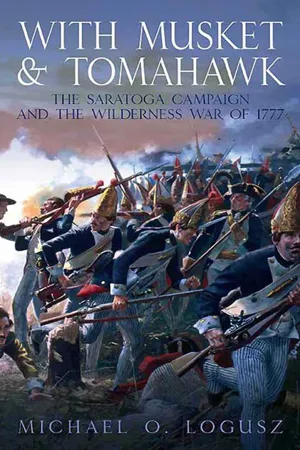
eBook - ePub
With Musket & Tomahawk Volume I
The Saratoga Campaign and the Wilderness War of 1777
- 437 pages
- English
- ePUB (mobile friendly)
- Available on iOS & Android
eBook - ePub
With Musket & Tomahawk Volume I
The Saratoga Campaign and the Wilderness War of 1777
About this book
Information
Notes
Chapter 1: Setting the Stage in the Northern Theater
1Henry F. Graff, America: The Glorious Republic (Boston: Houghton Mifflin Co., 1990), p. 143.
2Rupert Furneaux, The Battle of Saratoga (NY: Stein and Day, 1971), p. 20; Lieutenant-Colonel Joseph B. Mitchell and Sir Edward Creasy, Twenty Decisive Battles of the World (NY: The MacMillan Company, 1964), 2nd ed., p. 202. See also maps pp. 201 and 205. (Hereafter cited as Twenty Decisive Battles). For an extensive study of this, see John Luzader, Decision on the Hudson: The Saratoga Campaign of 1777 (Washington, DC: National Park Service Publications, 1975).
According to T. Harry Williams, The History of American Wars. From Colonial Times to World War I(NY: Alfred A. Knopf, Inc., 1981), p. 25, “The British objective was to suppress the rebellion and persuade the Americans to return to their allegiance to the empire.” (Hereafter cited as History of American Wars).
3Samuel Eliot Morison and Henry Steele Commager, The Growth of the American Republic(NY: Oxford University Press, 1952, 3rd Printing), p. 213. Of interest is that as early as 1767, Governor General Guy Carleton proposed: a “place of arms” in New York City, a citadel in Quebec, and a chain of forts through the Lake Champlain-Hudson River line. The entire defense system would stem from Quebec to New York City and would be utilized in suppressing any internal revolts. See also Furneaux, The Battle of Saratoga, p. 20.
4From hence forward through the entire book the term patriot—rather than rebel—will be used when referring to the Americans opposing England.
5John Luzader, The Saratoga Campaign of 1777, pp. 8–9; Furneaux, The Battle of Saratoga, p. 26; and George F. Scheer and Hugh F. Rankin, Rebels and Redcoats(NY: The New American Library, Inc., 1957), p. 285.
6Lord Germain’s position in itself helped to complicate the command situation. Prior to and during the Revolutionary War, the British command system was nothing but a highly complicated agency with numerous military and civilian departments. The American command system was much more simple and followed such a pattern—the Congressional Congress with its War Department, General George Washington, and the top ranking commanders of the Continental Armies.
7Hereafter simply referred to as “Thoughts…”
8Luzader, The Saratoga Campaign of 1777,p. 9.
9The Canada Army was the British Army based in Canada.
10Luzader, The Saratoga Campaign,p. 9.
11Ibid. According to Furneaux, neither Burgoyne nor Howe ever properly explain the word “junction.” See The Battle of Saratoga,p. 27.
12Luzader, p. 9. In his “Reflections Upon War in America,” which in 1775 was first presented to the British government, Burgoyne reasoned that the key to victory lay with the capture of New York City, soon followed by a coordinated junction between two British armies somewhere to the north of that city. The British Canada Army, advancing southward, was to perform a junction somewhere in the Hudson River Valley area with another British army advancing northward. Of interest is that Governor Carleton, though supportive of an offensive action in 1777, advocated that the main thrust should commence not from Canada (as he previously had advocated) but from Oswego located on Lake Ontario to strike through the Mohawk Valley towards Albany and the Hudson. See Piers Mackesy, The War for America, 1775-1783 (Nebraska: University of Nebraska, 1993), p. 114.
13Furneaux, p. 23.
In 1767, General Carleton recommended to “establish a place of arms” in New York City along with a chain of forts northward from New York City straight up to Quebec along the Champlain-Hudson River line. Carleton’s recommendation was based on the fact that British authorities, in both America and Canada, had begun to sense that a possible revolt was in the making. Fearing even the possibility of such a revolt, it was advocated that such a defense system would crush a rebeelion if indeed it should ever arise. In 1775, Carleton again advocated this defense plan and that same year it was endorsed by Lord Dartmouth, also a Colonial Secretary.
14According to some sources, the British adopted the strategy to divide the American colonies along the line of the Hudson River in 1776. To accomplish this, New York City would first be seized and used as a base of operations. See Joseph Plumb Martin, Private Yankee Doodle. Being a Narrative of Some of the Adventures, Dangers and Sufferings of a Revolutionary Soldier(Boston: Little, Brown and Company, 1962), p. 18.
Joseph P. Martin was a Revolutionary War soldier who, on 6 July 1776 enlisted in Connecticut. At the time of his enlistment, Martin was just 15 years old. At this time, Connecticut was tasked by the Continental Congress to reinforce the Continental Army in New York City. In response, Connecticut organized seven battalions. (Ibid., p. 15). Each recruit was to serve until 25 December 1776.
Martin soldiered in Captain Samuel Peck’s 3rd Company. This company was a part of Major William Douglas’s 5th Battalion which, in turn, fell under General James Wadsworth, Jr.’s’ brigade.
Shortly after participating in the fighting in New York City, Martin returned home. He did not serve in the winter battles. But on 12 April 1777, Martin re-enlisted. He entered Colonel John Chandler’s 8th Connecticut Continental Regiment. Martin remained in service for the duration of the war and, in 1777, saw much action in the Wilderness War of 1777.
15Luzader, p. 11. Both letters reached Lord Germain on 30 December 1776 in London, England.
According to R.E. Dupuy and T.N. Dupuy, “the entire affair—[campaign of 1777] originally conceived by Burgoyne—was bungled by Lord Germain who, as secretary of state for the colonies in Lord North’s cabinet, was in control of operations in America. There was no coordination. Burgoyne had been ordered to meet Howe, but Howe’s operations were left to his own discretion. The results were disastrous to England.” See “1777. British Plans. Northern Campaign, 1777” in The Encyclopedia of Military History from 3500 B.C. to the Present(NY: Harper and Row Publishers, 1977). (Revised Ed.)., p. 713. According to George Bancroft, “The conduct of the war on the side of Canada was left entirely to Lord George Germain; the chief command and the planning of the next campaign within the United States remained with Howe, who was strong in the support of Lord North and the King.” See “England Prepares For the Campaign of 1777” in The American Revolution (Boston: Little, Brown, and Company, 1875), Vol. III, 5th Edition, p. 312.
16Luzader, p. 11.
17Philadelphia was the capital of the newly established American nation. Undoubtedly it was in late 1776 (and even before Washington’s attack on Trenton and Princeton), that Howe was starting to first hold the view that Philadelphia needed to be taken. See “Howe’s Plans of Campaign” in Piers Mackesy, The War for America, 1775–1783, pp. 109–112; 116–118; 121– 124; and 157.
18Luzader, The Saratoga Campaign,p. 11.
19Howe also proposed to attack Virginia at this same time. Luzader, p. 11. See also Furneaux, The Battle of Saratoga,pp. 23–24.
Clearly, General Howe was now looking more and more at Philadelphia. Initially the British plan for 1777 was for General Burgoyne to move with an army southward to Albany to link up with General Howe moving simultaneously northward to Albany. But now, Howe was eyeing Pennsylvania more and more and decided to attack there first. (See also Robert Leckie, The Wars of America (NY: Harper Collins Publishers, 1992, Updated Edition), pp. 163–164. Howe might have even possibly believed that by moving into Pennsylvania, it would make it easier for Burgoyne to operate in the Northern theater.
20Luzader, p. 11; Furneaux, p. 23, cite Howe requested a reinforcement of up to 36,000 soldiers.
21Luzader, p. 11.
22Ibid. According to Furneaux, p. 24, “Howe allocated 10,000 troops for the purpose of taking Albany by an advance from New York.” At this time, Howe also “implied that the junction of the northern and southern armies would precede the attack on Philadelphia.” (Ibid.). However, as was soon evident, Howe changed his mind.
23This was never done. Of interest is that some Poles (both from the area of Poland controlled by the Austro-Hungarian Empire as well as the area controlled by Russia) did serve in Washington’s army. Two of Washington’s key officers, Colonel Thaddeus Kosciuszko and General Casimir Pulaski, were born in Poland. (Actually, Kosciuszko was born near Vilnius, a Baltic city within the Grand Duchy of Lithuania in 1746. Administered at the time by Russia, Kosciuszko’s father, a Pole employed in the Russian government, married a Lithuanian woman. And to this union was born America’s most famous military combat engineer).
24Luzader, p. 11; Furneaux, pp. 25-26.
25Martha Byrd, Saratoga: Turning Point In the American Revolution (England: Auerbach Publishers, Inc., 1973), p. 33. (Hereafter cited as Saratoga: Turning Point).
According to Furneaux, p. 25, “Howe’s radical change of plan was based on the inability of the [British] government to fulfill his demands for reinforcements, which would restrict his operations.” Howe was “also influenced by his desire to capture the rebel capital, a stronghold of loyalism and could be taken easily.” (Ibid.). As for any offensive toward Albany, it would be undertaken solely by an army operating from Canada. A minor movement could be undertaken in the lower Hudson area to support the major thrust, but Howe no longer favored a junction in Albany. (See page 25.)
According to Luzader, pp. 11–12, Howe began to increasingly favor an offensive into Pennsylvania. This in itself was a “major plan in strategy.” (Ibid., p. 12.)
Howe was, in fact, now thinking like a typical European general. European tactics frequently called for the capture of an opponent’s capital. Simply put, to capture a nation’s capital—in this case Philadelphia—was to win the war. Concluding that Washington would defend Philadelphia, Howe also reasoned that somewhere in its vicinity he would defeat the patriot army and afterwards capture the city. A series of mopping up operations here and there throughout the colonies would then suppress any remaining resistance.
26Luzader, p. 12.
27Ibid.
28Ibid. This was more in the form of a quick letter or dispatch.
29Ibid.
30Such as the dispatch of 29 December 1776.
31Luzader, pp. 12-13.
In March, 1777, both King George III and Lord George Germain approved a three-pronged campaign. But, as acknowledged by Oscar Theodore Barck, Jr., “Unfortunately, the third phase was not adequately planned, possibly because Burgoyne was so confident of his own overwhelming success in the venture that Howe’s role would...
Table of contents
- Contents
- Introduction: The Wilderness War of 1777
- The Strategic Dilemma in the Northern Theater
- Lord Germain’s Proposal
- General Burgoyne’s Plan to Advance on Albany
- The British Army in Canada
- The Northern Campaign Commences
- British Moves and Patriot Uncertainty
- Burgoyne Advances and Fort Ticonderoga Falls
- Cries of Retreat and Forest Combats
- The Battle of Hubbardton
- Fighting Off Marauders and Raiders
- Samuel Kirkland: Chaplain and Intelligence Agent
- Burgoyne’s Plan to Reach Fort Edward
- Bolstering Forces on Both Sides
- Burgoyne Hacks His Way South
- The Tragic Case of Jane McCrea
- The Battle of Bennington
- Schuyler Is Relieved of Command
- Images from Musket and Tomahawk
- The Patriots Raid Fort Ticonderoga
- The First Battle of Saratoga: Freeman’s Farm
- Troops Dig In and Patriot Generals Collide
- Burgoyne’s Strategy Unravels
- The Second Battle of Saratoga: Bemis Heights
- The British Begin to Collapse
- Burgoyne Surrenders
- Acknowledgments
- Notes
- Bibliography
Trusted by 375,005 students
Access to over 1.5 million titles for a fair monthly price.
Study more efficiently using our study tools.
Frequently asked questions
Yes, you can cancel anytime from the Subscription tab in your account settings on the Perlego website. Your subscription will stay active until the end of your current billing period. Learn how to cancel your subscription
No, books cannot be downloaded as external files, such as PDFs, for use outside of Perlego. However, you can download books within the Perlego app for offline reading on mobile or tablet. Learn how to download books offline
Perlego offers two plans: Essential and Complete
- Essential is ideal for learners and professionals who enjoy exploring a wide range of subjects. Access the Essential Library with 800,000+ trusted titles and best-sellers across business, personal growth, and the humanities. Includes unlimited reading time and Standard Read Aloud voice.
- Complete: Perfect for advanced learners and researchers needing full, unrestricted access. Unlock 1.5M+ books across hundreds of subjects, including academic and specialized titles. The Complete Plan also includes advanced features like Premium Read Aloud and Research Assistant.
We are an online textbook subscription service, where you can get access to an entire online library for less than the price of a single book per month. With over 1.5 million books across 990+ topics, we’ve got you covered! Learn about our mission
Look out for the read-aloud symbol on your next book to see if you can listen to it. The read-aloud tool reads text aloud for you, highlighting the text as it is being read. You can pause it, speed it up and slow it down. Learn more about Read Aloud
Yes! You can use the Perlego app on both iOS and Android devices to read anytime, anywhere — even offline. Perfect for commutes or when you’re on the go.
Please note we cannot support devices running on iOS 13 and Android 7 or earlier. Learn more about using the app
Please note we cannot support devices running on iOS 13 and Android 7 or earlier. Learn more about using the app
Yes, you can access With Musket & Tomahawk Volume I by Michael O. Logusz in PDF and/or ePUB format, as well as other popular books in History & Early American History. We have over 1.5 million books available in our catalogue for you to explore.