"Womer reveals his own inside account of fighting as a spearhead of the Screaming Eagles in Normandy, Holland, and the Battle of the Bulge" (
Tucson Citizen).
In 2004, the world was first introduced to
The Filthy Thirteen, a book describing the most notorious squad of fighting men in the 101st Airborne Division—and the inspiration for the movie
The Dirty Dozen. Now, Jack Womer—one of the squad's integral members and probably its best soldier—delivers his long-awaited memoir.
Originally a member of the 29th Rangers, which was suddenly dissolved, Womer asked for transfer to another elite unit, the Screaming Eagles, where room was found for him among the division's most miscreant squad of brawlers, drunkards, and goof-offs.
Beginning on June 6, 1944, however, the Filthy Thirteen began proving themselves more a menace to the German Army than they had been to their own officers and the good people of England, embarking on a year of ferocious combat at the very tip of the Allied advance in Europe.
In this work, with the help of Stephen DeVito, Jack provides an amazingly frank look at close-quarters combat in Europe, as well as the almost surreal experience of Dust-Bowl–era GI's entering country after country in their grapple with the Wehrmacht, finally ending up in Hitler's mountaintop lair in Germany itself.
"Jack Womer's story is entertaining, honest and forthright, just like the man. He does not shrink from describing what actually happened although occasionally one suspects just a hint of artistic license. However, there is nothing which is unbelievable given the chaotic and random nature of war." —
Army Rumour Service
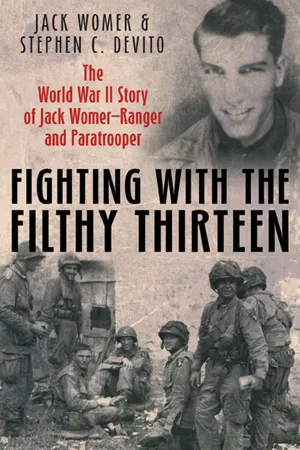
eBook - ePub
Fighting with the Filthy Thirteen
The World War II Story of Jack Womer—Ranger and Paratrooper
- 313 pages
- English
- ePUB (mobile friendly)
- Available on iOS & Android
eBook - ePub
Fighting with the Filthy Thirteen
The World War II Story of Jack Womer—Ranger and Paratrooper
About this book
Information
1.
MY EARLY YEARS

Life for me began on June 18 th, 1917 in Lewistown, Pennsylvania, an old Dutch town about 40 miles northwest of Harrisburg. I was the fourth child of Methodist parents, primarily of Dutch descent. My father, William Walker (“Walk”) Womer, worked in a steel mill in Lewistown, as did his father and grandfather. The mill was owned and operated by the Standard Axle Works, and my father worked as an open-hearth melter, which in those days was considered a good job.
I never saw much of him when I was young as he was always working in the steel mill. He worked very hard and liked to drink beer—lots of it. Despite the large volumes of beer he regularly consumed, I don't think he ever missed a day of work in his entire career, and he died a very old man. My mother, Roxie, was a housewife.
At the time I was born I had three older brothers, David, Benjamin and Herbert. David was about seven years older than me, Ben about six years older, and Herbert about five. My sister, Dolsie Jane (“Janey”), was born about a year after me. My parents would have another son, my younger brother Douglas, who was born during the 1920s.
AUNT DOLSIE
A few months after I was born my mother took ill, and it became increasingly difficult for her to care for four children. My father couldn't afford to hire a nanny to help manage the household and raise the children, so by the time I was about a year old my parents decided to send me to Sun-bury, Pennsylvania to live with my aunt Dolsie, my mother's sister. Sunbury is about 50 miles northeast of Lewistown, right on the Susquehanna River. By this time Janey had been born. Of the five children in my family at the time, I'm still not sure exactly why I was the one who was chosen to be sent off to live with Aunt Dolsie. It may have been because I was still a baby and my parents may have believed that sending me off to live with her would take the most stress off of my mother. While I'm certain that my parents’ actions were well intended, I've always held some resentment against them, particularly my mother, for sending me off when I was just a baby to live somewhere else.
My Aunt Dolsie lived alone in a small row house in Sunbury, close to the Susquehanna. Before I was born she had been married to a police officer, “Uncle Billy,” who was killed when a car ran over him. When she took me in she lived alone. She didn't have any children of her own, and she liked the idea of caring for me, which she did for about five years.
Aunt Dolsie was a very kind and decent God-fearing woman who gave to this world more than she took from it. She was the salt of the earth, and loved and cared for me not as her nephew, but as if I were her son, and I grew to love her not as my aunt but as if she were my real mother. Let me tell you from firsthand experience that when an infant is given to another woman to be cared for temporarily during the early years of the child's life, that “other woman” is the child's mother. In many respects I consider my Aunt Dolsie to be my real mother. Aunt Dolsie never had any children of her own, and from the time she began taking care of me when I was a year old until she died many years later I believe she considered me to be her son. Even years after I had stopped living with her, she often told me and my parents that she was going to leave me her estate after she died. Aunt Dolsie was the world to me. She read incessantly, and had a huge collection of books. She was very intelligent and well-informed, and knowledgeable on just about any subject.
When Aunt Dolsie was in her fifties she married a second time to an older man named Henry Wagner, who was divorced and worked for the railroad. His ex-wife had taken everything from him. Aunt Dolsie never prepared a will, and when she died Henry automatically inherited her entire estate, including everything she had planned on leaving me, which included her house and her extensive collection of books. Henry was well aware of what Aunt Dolsie had intended on leaving me, because she had told him. But after she passed away the old bastard kept everything she owned for himself and told me to get lost. So I wished him bad luck, and not too long afterwards he was hit and killed by a train!
MOVING TO MARYLAND
In 1922, while I was still living in Sunbury with my Aunt Dolsie, my father decided to move the family from Lewistown, Pennsylvania to Sparrows Point, Maryland so he could work in the open hearth furnaces of the Bethlehem Steel Company. Sparrows Point is located about 10 miles southeast of Baltimore, very close to the mouth of the Chesapeake Bay and Patapsco River.
The steel industry in the Baltimore area started in 1893 with the construction of a mill and shipyard by the Pennsylvania Steel Company. During World War I there was a large demand for steel and in 1916 Bethlehem Steel acquired the Pennsylvania Steel Company and increased its production in the Baltimore area. The local economy was soon dominated by the Bethlehem Steel Company. The demand for steel continued to rise after World War I ended in November 1918, and Bethlehem Steel was in need of experienced steel workers to meet this demand. To attract skilled workers such as my father, they offered steady work, more opportunity, higher wages, and a better quality of life for their families.
Along with the mills, Bethlehem Steel established a residential community for its workers adjacent to its steel mills and named it Sparrows Point. Workers could pay low rent (between $4 and $14 a month for a nine-room house) and get free home maintenance, company-subsidized churches and schools, easy access to credit, and a strong sense of community. Many of the company houses had indoor plumbing, gas for cooking and hot water, both gas and electric light connections, coal furnaces, and bathrooms—luxuries in those days that many families had not experienced previously. In return, Bethlehem Steel attracted and secured young, skilled laborers, who were more than willing to work hard and establish their roots in Sparrows Point.
From the time the company first set up its operations in Sparrows Point in 1916 until the 1980s, billions and billions of tons of steel were made by the men who worked there. The steel made at the Sparrows Point mills would be used for all sorts of purposes, such as automobiles, Campbell's soup cans, the hulls of ocean tankers, all sorts of guns and naval ships used during World War I, World War II, the Korean and Vietnam wars, the girders used to construct office buildings, and the wire and girder plates of suspension bridges, to name just a few uses. The steel used in the construction of the Golden Gate Bridge (California), the George Washington Bridge (New York), Chesapeake Bay Bridge (Maryland), and the Mississippi River Bridge at New Orleans was made in Sparrows Point. During the 1950s the Bethlehem Steel mills in Sparrows Point, Maryland was the largest steel manufacturing facility in the world.
So my parents, attracted by Bethlehem Steel's promise of steady work at higher wages, and with the expectations of a better quality of life, moved the family to Sparrows Point. Many other laborers from rural Maryland and Pennsylvania and the South—of Welsh, Irish, German, Polish, Russian, and Hungarian descent, as well as blacks—relocated to Sparrows Point for the same reasons. Bethlehem Steel dominated and controlled the whole area. Even the Sparrows Point High School prepared steelworkers’ sons for jobs at the mill. All of my father's sons, as well as the sons (and even grandsons) of many other steel workers, would eventually work for the Bethlehem Steel Company.
My father's superior skill level as a steel worker enabled him to be “assigned” to rent a six-room corner row house located at 1014 H Street, one block away from the section where the negroes lived. Row houses were little more than apartment-sized houses connected side-by-side to one another on a street. Our house was on the corner of the block, which was a little more comfortable than row houses between corner houses.
Of the six rooms in the small house my parents rented from the Bethlehem Steel Company, three were bedrooms, one was the bathroom, one was the kitchen and one was the dining room. At the time my family moved in to the row house there were six Womers living there: my parents, my sister Janey, and my three older brothers, David, Herbert and Ben. I was still living in Sunbury, Pennsylvania with my Aunt Dolsie.
My mother never worked. As did most mothers in those days, she stayed home and cleaned and managed the household, did the shopping, cooked our meals, cleaned our clothes, paid the bills, and tended to the other needs of the family. My father worked as a “first-helper” or “melter” in the open hearth, and his furnace was 69, number one in the plant.
Being an open-hearth melter was not easy, but it was one of the better jobs to have in a steel mill because it involved more responsibility and the salary was higher. It got quite hot in those open hearth furnaces, and a major requirement (and drawback) to being a melter is that you had to be able to tolerate the brutally high temperatures. My father was a crackerjack open-hearth melter—one of the best that ever worked at Bethlehem Steel's Sparrows Point facility.
In 1922, shortly after the family had settled in Sparrows Point, my mother wrote my Aunt Dolsie to tell her that she wanted to take me back to live with the rest of my family. By this time I was approaching five years of age, and Aunt Dolsie and I had become very attached to one another. Neither she nor I wanted me to leave Sunbury to live with my parents and siblings in Maryland. I wanted to stay in Sunbury in the worst way.
Aunt Dolsie pleaded with my mother that I should stay in Sunbury, and even offered to legally adopt me, but my mother said no. Aunt Dolsie was the world to me, and I've always resented my mother for not letting me stay with her. I cried and cried when I had to leave. From the first day when I arrived at my parents’ home in Sparrows Point I felt like an outsider in my own family. My parents, brothers and sister were all close with one another because they had all lived together and had bonded as family members naturally do. But because I had only lived with them for a year and had been separated for four years, I felt that I was viewed and treated more as a close relative rather than as a brother or son. I never did feel right, always as if I were an outsider.
In our house there were only three bedrooms, and there were now seven of us living there. My parents occupied one of the bedrooms, my sister occupied another, and my three older brothers (David, Benjamin and Herbert) and I had the back bedroom. When my younger brother Douglas (“Dogeye”) was born he stayed, at first, in my parent's bedroom and then later in my sister's. In those days there was no such thing as air conditioning, and in Maryland the summer months can be quite hot and humid. It got quite uncomfortable in those row houses during the summer months.
Every Sunday we put on our Sunday clothes and walked to the Methodist church to attend the services. My father would come along, but only if he wasn't working that day and food was served after the services. My brothers and I used to collect the donations made during the services. For awhile I attended Bible school, which was held every Wednesday at the church. My family lived in the row house in Sparrows Point from 1922 to 1930, and then we moved a few miles away to a more spacious, singlefamily home at 3015 Dundalk Avenue in the town of Dundalk.
LIFE IN SUNBURY, PENNSYLVANIA
Although I had to move to Sparrows Point, to be with my family, I didn't completely stop living in Sunbury with aunt Dolsie. As a compromise for taking me from Aunt Dolsie against her wishes and mine, my parents agreed to allow me to spend the summer months with her. Every June, as soon as the school year ended, my parents drove me up to Sunbury, and I wouldn't return home until the last week or so of August, when the next school year was about to begin. This started from the time I was in first grade until I was in high school. Sunbury was a wonderful place for a kid to live in those days, especially during the summer months. It probably still is.
Sparrows Point and Dundalk were primarily dedicated to the steel industry, and had lots of gigantic ugly brick steel mills with huge smoke stacks that operated 24 hours a day. In Sunbury there was a lot of wide-open space, and plenty to do. There was the Susquehanna River for boating, fishing and swimming, there were forests to hike, mountains to climb, freight trains to ride on, and plenty of other kids to play with. It was up in Sunbury that I learned how to climb mountains, fish, shoot a rifle, sail a boat and hop freight trains! My best childhood friends, Earl, Short, Orville, and Vivian Reichenbach, lived up in Sunbury. We had a lot of fun.
During my teenage years I would often sleep in the Reichenbach's home instead of Aunt Dolsie's house. I used to work as caddy on the golf course that was up there, getting paid 35 cents for nine holes. I gave all the money I earned at caddying to Aunt Dolsie. She never asked for it, but she didn't have very much and I knew that she needed it more than I.
The Susquehanna River runs right along Sunbury, and there were a lot of sail boats and row boats moored right along the shoreline. My friends and I did a lot of boating there, and I eventually became quite skilled at it. We spent a lot of time on the Susquehanna looking for adventure. Our boats had sails that were made out of sugar bags. We'd often sail to the small islands that are all over the place in the river, where we would relax in the summer sun, swim, fish or just sit around and talk.
My favorite childhood memories are hopping onto the freight trains up in Sunbury, which I started doing when I was about 14 years old. We'd hop freight trains going from town and stay on until we felt like getting off. Sometimes we would hop rides all the way to Harrisburg, which is about 50 miles south of Sunbury. It was wild and fun! When the freight trains came in through town they had to slow down, and that's when we would hop on to them. Hopping onto a train is not an easy thing to do, but with a little practice I learned to hop them just as well as any of my friends. It was a matter of running along side of the train after it had slowed down, and knowing just where and when to jump on.
Overall, I'd say I had a good childhood. The only part for which I was, and always remained, bitter was when my parents sent me away as a baby to live with my Aunt Dolsie for a few years. When I returned I never quite felt that I was part of the family. Aside from that, I can't complain about anything and enjoyed my childhood. It's good that I did because little did I know what lay ahead, just around the corner—the Great Depression of the 1930s and World War II.
2.
FIRST JOBS
I got my first real job in the early 1930s while I attended the Baltimore County Public School Number 6. I found work after school in a foundry located on Dundalk Avenue, right across the street from where we lived. They made steel parts for toilets and other things. Once the parts were manufactured they were stacked in a yard behind the foundry. My job was to help stack them, restack any that fell on the ground, and keep the yard clean of debris. I'd work weekdays after school and all day on Saturdays for a few cents an hour. I know...
Table of contents
- Cover Page
- Title Page
- Copyright
- Contents
- Dedication
- PREFACE AND ACKNOWLEDGMENTS
- THE 506th PARACHUTE INFANTRY PRAYER
- 1: MY EARLY YEARS
- 2: FIRST JOBS
- 3: MEETING MISS THERESA COOK: MY FUTURE BRIDE
- 4: THE OUTBREAK OF WORLD WAR II
- 5: DRAFTED INTO THE ARMY: PRIVATE JACK WOMER
- 6: BECOMING A STAGE PERFORMER
- 7: WAR GAMES IN THE CAROLINAS
- 8: THE JAPANESE ATTACK PEARL HARBOR
- 9: OFF TO EUROPE TO FIGHT HITLER
- 10: ARRIVING IN ENGLAND: FIRST IMPRESSIONS
- 11: VOLUNTEERING TO BECOME AN ARMY RANGER
- 12: OFF TO SCOTLAND
- 13: CAUSING TROUBLE IN DUNDALK!
- 14: BACK TO ENGLAND, AS RANGERS
- 15: RANGERS NO MORE
- 16: THE MAKING OF A PARATROOPER 1, 2, 3!
- 17: BECOMING ONE OF THE “FILTHY THIRTEEN”
- 18: LIFE AT THE WILLS' MANOR ESTATE, LITTLECOTE, WILTSHIRE
- 19: AN ENCOUNTER WITH WINSTON CHURCHILL
- 20: PRELUDE TO OVERLORD: THE INVASION OF FRANCE
- 21: D-DAY MISSION DISCLOSED
- 22: THE INVASION IS ON!
- 23: OFF TO A BAD START: JAMES GREEN'S PARACHUTE
- 24: D-DAY
- 25: D-DAY PLUS ONE
- 26: NO TIME TO CRY
- 27: GOO-GOO AND PEEPNUTS ARE KILLED
- 28: CARENTAN—A RED ROSE FOR A SOLDIER
- 29: BACK TO ENGLAND
- 30: OPERATION MARKET-GARDEN: THE BATTLE FOR HOLLAND
- 31: THE JUMP INTO HOLLAND
- 32: EINDHOVEN
- 33: THE KILLING OF CORPORAL JOSEPH J. OLESKIEWICZ
- 34: LIFE IN HOLLAND
- 35: GOODBYE TO HOLLAND
- 36: ON TO BASTOGNE: THE BATTLE OF THE BULGE
- 37: A USELESS REPLACEMENT
- 38: MIKE MARQUEZ AND THE SCREAMING MEE-MEES
- 39: CHRISTMAS DAY, 1944
- 40: STAYING WITH CIVILIANS
- 41: OH THOSE NINETY-DAY WONDERS!
- 42: TO THE FATHERLAND!
- 43: LIVING WITH THE ENEMY
- 44: THE WAR IN EUROPE IS OVER!
- 45: THE LAST PATROL
- 46: GOING HOME
- 47: SETTLING BACK INTO CIVILIAN LIFE
- 48: BRINGING PEACE TO THE HALE FAMILY
- 49: THE REMAINS OF THE DAY
Trusted by 375,005 students
Access to over 1.5 million titles for a fair monthly price.
Study more efficiently using our study tools.
Frequently asked questions
Yes, you can cancel anytime from the Subscription tab in your account settings on the Perlego website. Your subscription will stay active until the end of your current billing period. Learn how to cancel your subscription
No, books cannot be downloaded as external files, such as PDFs, for use outside of Perlego. However, you can download books within the Perlego app for offline reading on mobile or tablet. Learn how to download books offline
Perlego offers two plans: Essential and Complete
- Essential is ideal for learners and professionals who enjoy exploring a wide range of subjects. Access the Essential Library with 800,000+ trusted titles and best-sellers across business, personal growth, and the humanities. Includes unlimited reading time and Standard Read Aloud voice.
- Complete: Perfect for advanced learners and researchers needing full, unrestricted access. Unlock 1.5M+ books across hundreds of subjects, including academic and specialized titles. The Complete Plan also includes advanced features like Premium Read Aloud and Research Assistant.
We are an online textbook subscription service, where you can get access to an entire online library for less than the price of a single book per month. With over 1.5 million books across 990+ topics, we’ve got you covered! Learn about our mission
Look out for the read-aloud symbol on your next book to see if you can listen to it. The read-aloud tool reads text aloud for you, highlighting the text as it is being read. You can pause it, speed it up and slow it down. Learn more about Read Aloud
Yes! You can use the Perlego app on both iOS and Android devices to read anytime, anywhere — even offline. Perfect for commutes or when you’re on the go.
Please note we cannot support devices running on iOS 13 and Android 7 or earlier. Learn more about using the app
Please note we cannot support devices running on iOS 13 and Android 7 or earlier. Learn more about using the app
Yes, you can access Fighting with the Filthy Thirteen by Jack Womer,Stephen C. DeVito in PDF and/or ePUB format, as well as other popular books in History & Military Biographies. We have over 1.5 million books available in our catalogue for you to explore.