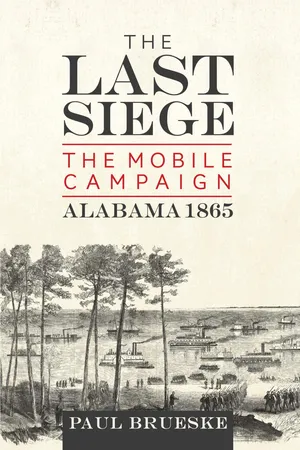
An in-depth history of the Confederate Army's last stand in Mobile, Alabama, a month after Gen. Lee's surrender at Appomattox Court House.
It has long been acknowledged that Gen. Robert E. Lee's surrender at the Battle of Appomattox ended the civil war in Virginia in April of 1865. However, the last siege of the war was the Mobile campaign, an often-overlooked battle that was nevertheless crucial to securing a complete victory. Indeed, the final surrender of Confederate forces happened in Alabama.
The Last Siege explores the events surrounding the Union Army's capture of Mobile and offers a new perspective on its strategic importance, including access to vital rail lines and two major river systems. Included here are the most detailed accounts ever written on Union and Confederate camp life in the weeks prior to the invasion, cavalry operations of both sides during the expedition, the Federal feint movement at Cedar Point, the crippling effect of torpedoes on US naval operations in Mobile Bay, the treadway escape from Spanish Fort, and the evacuation of Mobile. Evidence is presented that contradicts the popular notion that Mobile welcomed the Federals as a pro-Union town.
Using primary sources, this book highlights the actions of Confederate soldiers who fought to the last with sophisticated military tactics in the Confederacy's last campaign, which led to the final surrender at Citronelle, Alabama, in May.
- 304 pages
- English
- ePUB (mobile friendly)
- Available on iOS & Android
eBook - ePub
About this book
Trusted by 375,005 students
Access to over 1.5 million titles for a fair monthly price.
Study more efficiently using our study tools.
Information
CHAPTER ONE
Mobile is Threatened
Fourteen days, from March 26 to April 9, 1865, saw fewer than 6,000 Confederate soldiers hold off more than 45,000 determined Union soldiers at Spanish Fort and Fort Blakeley.1 Many of the Southerners were veterans of all the principal battles in the west. Most had been wounded at least once, yet they still came to fight. In February 1865, Southern Private Phillip D. Stephenson, 5th Company of the Washington Artillery, met an old comrade on his way to defend Mobile:
When I was on the train for Mobile, a soldier came to me and said, “Don’t you know me?” I did not. “I’m Ned Stiles,” said he. I was horror stricken. A skeleton he was, with the ashen hue of death upon him. He could hardly stand up. His rags were filthy and hung on him. Yet he was going to Mobile to rejoin his command! His awful wound was hardly healed, but there he was.2
The desperate defense of Mobile culminating in the siege of Spanish Fort and Fort Blakeley began on August 5, 1864, when Union Admiral David Glasgow Farragut, with 18 ships, including four ironclad monitors, supported by land forces under Major General Gordon Granger, attacked the Southerners guarding the lower entrance to Mobile Bay. Farragut, who had commanded the Federal sea assault on the Confederacy in the Gulf of Mexico from the beginning of the war, led his fleet past Fort Morgan’s powerful batteries and torpedo-mined waters at the mouth of the bay.3 After clearing the Confederate gauntlet, his armada defeated Admiral Franklin Buchanan’s small four-ship squadron, which included the powerful but slow ironclad ram CSS Tennessee, in the epic battle of Mobile Bay.4
Following the surrender of the CSS Tennessee, Fort Powell, the small fort that had guarded the Grant Pass entrance into the bay, was hopelessly vulnerable to Federal gunboat fire. Convinced that a continued struggle was futile, Fort Powell’s commander, Lieutenant Colonel James M. Williams of the 21st Alabama Infantry, ordered his garrison to spike their guns and evacuate at dark. To prevent the fort from falling into Federal hands, Williams had it blown up at 10:30 p.m. Two days later, on August 7, Dauphin Island’s Fort Gaines surrendered. Finally, on August 23, 1864, Fort Morgan fell to the Unionists, ending all blockade-running ventures out of Mobile Bay. Farragut’s important victory sealed the Port City and gave the Union control of the fortifications at the mouth of the bay. Not satisfied with the strategic success they had achieved, General Granger was eager to complete their primary mission, the capture of Mobile, immediately after the fall of Fort Morgan.5
A veteran of the Mexican War, Granger previously had fought at Wilson’s Creek, New Madrid, Corinth, Chickamauga, Missionary Ridge, and the battle of Mobile Bay. The 44-year-old New Yorker was aggressive and brave. “Reckless, handsome, ambitious, quick witted, and warm-blooded, he relished the pleasures as well as the honors of a soldier’s life,” one Union officer wrote of him.6 Journalist William Shanks, a contemporary of Granger, portrayed him as “a man without any sense of fear—[he] is more thoroughly indifferent to the dangers of battle than any man I ever remember to have met.”7 One newspaper further described him: “In appearance General Granger was of commanding stature; in manner he was easy and natural, and was agreeable in conversation. He was a strict disciplinarian, but was in no respect tyrannical. Obedience he enforced, and he was loved by his command as well as respected by those whom the fortunes of war made his enemies.”8 During the siege of Spanish Fort, Granger regularly visited his men on the front line. “Gen. Granger in the trenches,” wrote one officer from Wisconsin in his diary on April 2, “gave one of the boys all the tobacco he had.”9 Although Granger was widely recognized to be an admirable commanding general in media reports, and by the men who served under him, he was not universally admired by certain of his superior officers.
At the battle of Chickamauga, seeing General George H. Thomas in danger of being routed, Granger disobeyed orders and led his men into action in time to prevent catastrophe. For his actions that day, he became known as the “Savior of Chickamauga.” Despite Granger’s heroic exploits, General-in-Chief Ulysses S. Grant, who disliked him, instructed Major General Henry W. Halleck to tell General Canby, commander of the U.S. Military Division of West Mississippi, that he “must not put him in command of troops, for if he does it is certain to fail.”10 Fortunately for Granger, Canby ignored Grant’s suggestion and gave him command of the XIII Army Corps on February 18, 1865.11 Granger had earned Canby’s full confidence during the battle of Mobile Bay, where he led land operations against both Fort Gaines and Fort Morgan. President Abraham Lincoln called Granger’s cooperative effort with Admiral Farragut there a “brilliant success.”12

Union Major General Gordon Granger played instrumental roles in the battle of Mobile Bay in 1864 and as commander of the XIII Corps during the Mobile Campaign. (Courtesy of The Library of Congress)
Granger had actively requested permission to lead an expedition against the city even before the fall of Fort Morgan. On August 20, he wrote General Canby, “If it is the intention to make a dash on Mobile, the sooner it is done after the fall of Morgan the better.” He wanted to transport his troops up the bay on steamboats, disembark above Dog River and then march on the city.13
Although Mobile boasted strong lines of earthen fortifications, there were a sparse number of men defending it during most of the war. In hindsight, one could argue that Granger’s bold plan could have succeeded and prevented “all the work and bloodshed of the following spring.”14 At the time of the battle of Mobile Bay, the garrison had been depleted to reinforce the Army of Tennessee in the defense of Atlanta. Had the Federals known how few men defended Mobile, they could have then captured the city with minimal losses.15 “When the army of General Granger commenced its attack upon the defences [sic] of the lower bay, there were actually no troops in Mobile or the defenses of it upon the land side,” Major General Dabney H. Maury, commander of the Confederate District of the Gulf, wrote after the war. He believed that with a demonstration by Farragut’s fleet on the city artillery batteries, Granger would have successfully captured Mobile without serious loss.16
Though the battle of Mobile Bay cleared the way for an attack on the city, Canby, in agreement with Farragut’s assessment that Mobile would “be an elephant and take a large army to hold it,” denied Granger’s request. Though Canby still considered the capture of the city an unaccomplished objective, he believed it was “unwise to make any direct attempt upon Mobile until the cooperating land force can be largely increased.”17 Granger would have to wait eight months before Canby had enough men to launch the land campaign for Mobile.18 As the commander of the Military Division of West Mississippi’s reorganized XIII Corps, he would play a prominent role in the spring 1865 expedition.19
Immediately following the battle of Mobile Bay, there were fewer than 4,500 gray-coated soldiers near Mobile. Running low on ammunition and men, General Maury was desperate for reinforcements. Alarmed by the prospect of an imminent attack, he pleaded with his superiors for more men. The day after Fort Morgan fell, Maury even sent an urgent message to General Nathan B. Forrest, the legendary cavalry leader, pleading, “Come and help Mobile.”20 The Confederacy was not able to send help until after the battle of Nashville. Those reinforcements would come from the battered remnants of the Army of Tennessee.21
One of the first officers sent by the Confederacy to assist Maury was Brigadier General St. John R. Liddell, a 50-year-old Louisiana plantation owner. He had attended West Point briefly before being discharged in 1835 for poor academics and an alleged fight with a couple of classmates. Although he lacked extensive military training, he had proved to be a capable and hard-nosed commander at Perryville, Murfreesboro, Chickamauga, Stone’s River, and the Red River campaign. His biographer, Nathaniel C. Hughes, described him as “a participator, a doer, a fully engaged human being. Liddell was a violent man. He killed.”22 General Maury needed a replacement for General Richard L. Page, who was captured in late August 1864 with the surrender of Fort Morgan. The Confederacy determined Liddell was the right officer for the job and sent him to Mobile.23
Liddell had only been in south Alabama a couple of months when his help was needed to counter expeditions meant to menace and test the strength of Mobile’s defenses.24 Around November 1864, Union General John W. Davidson left Baton Rouge, Louisiana, on a raid toward Mobile. Maury responded by sending his cavalry from Baldwin County to meet the threat. U.S. forces under Colonel George D. Robinson at Fort Barrancas, learning of the depleted garrison, launched a raid against Pollard Station, a vital Confederate stores depot located just north of the Alabama state line, at the juncture of the Alabama & Florida and Mobile & Great Northern railroads. Colonel Robinson’s force consisted of approximately 3,000 African-American soldiers and over 200 cavalry troopers. “They devastated the country, burning houses and stripping the people, women and children, of every means of subsistence. They often ravished the women, who offered their concealed valuables without avail to these diabolical scoundrels for immunity from outrage,” recalled Liddell.25
In December 1864, upon receiving information on Robinson’s raid, Maury ordered back the cavalry as fast as he could. Although valuable time was lost, Colonel Charles G. Armistead, commanding the 16th Confederate Cavalry, still managed to move his brigade rapidly, covering 150 miles in 52 hours. Near northwest Florida’s Pine Barren Creek, Armistead’s cavalry caught up with Robinson’s expedition on their return to Fort Barrancas. From Little Escambia [River] to Pine Barren Creek “severe fighting took place.” Newspaper reports indicated Liddell’s men “pursued and severely punished the Pollard raiders.”26 General Pierre Gustave Toutant Beauregard, commander of the Military Division of the West, wrote that Armistead and his mounted soldiers fought with “spirit and gallantry,” killing 17 and wounding 64. Robinson was severely wounded in the engagement.27
In December 1864, Granger also launched a raid from Pascagoula toward Mobile’s western defenses. The Federal expedition prompted Alabama Governor Thomas H. Watts to issue an appeal for reinfo...
Table of contents
- Cover
- Title
- Copyright
- Dedication
- Contents
- Acknowledgments
- Preface
- Key Military Officers Referenced in the Book
- Summary of Principal Events
- Prologue
- 1 Mobile is Threatened
- 2 Eager for the Fray
- 3 Glisten with Federal Bayonets
- 4 The Advance Commences
- 5 At Last the Enemy were in Sight
- 6 Held with Great Pertinacity
- 7 Steele’s Column
- 8 We Respectfully Decline to be Relieved
- 9 The Treadway
- 10 It was a Glorious Sight
- 11 The Jig was Up
- 12 Evacuation
- 13 Your City is Menaced
- 14 All Our Joy was Turned to Sorrow
- 15 The Final Surrender
- 16 You are No Longer Soldiers
- 17 A Grand Period to this Rebellion
- Epilogue
- Appendix 1: The Lady Slocomb
- Appendix 2: Historical Locations of the Mobile Campaign Today
- Endnotes
- Bibliography
Frequently asked questions
Yes, you can cancel anytime from the Subscription tab in your account settings on the Perlego website. Your subscription will stay active until the end of your current billing period. Learn how to cancel your subscription
No, books cannot be downloaded as external files, such as PDFs, for use outside of Perlego. However, you can download books within the Perlego app for offline reading on mobile or tablet. Learn how to download books offline
Perlego offers two plans: Essential and Complete
- Essential is ideal for learners and professionals who enjoy exploring a wide range of subjects. Access the Essential Library with 800,000+ trusted titles and best-sellers across business, personal growth, and the humanities. Includes unlimited reading time and Standard Read Aloud voice.
- Complete: Perfect for advanced learners and researchers needing full, unrestricted access. Unlock 1.5M+ books across hundreds of subjects, including academic and specialized titles. The Complete Plan also includes advanced features like Premium Read Aloud and Research Assistant.
We are an online textbook subscription service, where you can get access to an entire online library for less than the price of a single book per month. With over 1.5 million books across 990+ topics, we’ve got you covered! Learn about our mission
Look out for the read-aloud symbol on your next book to see if you can listen to it. The read-aloud tool reads text aloud for you, highlighting the text as it is being read. You can pause it, speed it up and slow it down. Learn more about Read Aloud
Yes! You can use the Perlego app on both iOS and Android devices to read anytime, anywhere — even offline. Perfect for commutes or when you’re on the go.
Please note we cannot support devices running on iOS 13 and Android 7 or earlier. Learn more about using the app
Please note we cannot support devices running on iOS 13 and Android 7 or earlier. Learn more about using the app
Yes, you can access The Last Siege by Paul Brueske in PDF and/or ePUB format, as well as other popular books in History & American Civil War History. We have over 1.5 million books available in our catalogue for you to explore.