A German commander's "very readable and thought-provoking" study of Operation Barbarossa (
Military Review).
This book unveils a wealth of experiences and analysis about Operation Barbarossa, perhaps the most important military campaign of the twentieth century, from a perspective rarely encountered.
Hermann Hoth led Germany's 3rd Panzer Group in Army Group Center—in tandem with Guderian's 2nd Group—during the invasion of the Soviet Union, and together, these two daring panzer commanders achieved a series of astounding victories, encircling entire Russian armies at Minsk, Smolensk, and Vyazma, all the way up to the very gates of Moscow.
This work begins with Hoth discussing the use of nuclear weapons in future conflicts. This cool-headed postwar reflection, from one of Nazi Germany's top panzer commanders, is rare enough. But then Hoth dives into his exact command decisions during Barbarossa—still the largest continental offensive ever undertaken—to reveal new insights into how Germany could, and in his view should, have succeeded in the campaign.
Hoth critically analyses the origin, development, and objective of the plan against Russia, and presents the situations confronted, the decisions taken, and the mistakes made by the army's leadership, as the new form of mobile warfare startled not only the Soviets on the receiving end but the German leadership itself, which failed to provide support infrastructure for their panzer arm's breakthroughs.
Hoth sheds light on the decisive and ever-escalating struggle between Hitler and his military advisers on the question of whether, after the Dnieper and the Dvina had been reached, to adhere to the original idea of capturing Moscow. Hitler's momentous decision to divert forces to Kiev and the south only came in late August 1941. He then finally considers in detail whether the Germans, after obliterating the remaining Russian armies facing Army Group Center in Operation Typhoon, could still hope for the occupation of the Russian capital that fall.
Hoth concludes his study with several lessons for the offensive use of armored formations in the future. His firsthand analysis, here published for the first time in English, will be vital reading for every student of World War II.
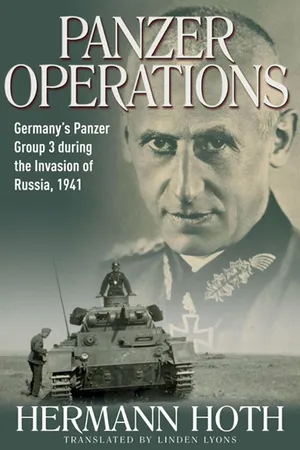
eBook - ePub
Panzer Operations
Germany's Panzer Group 3 During the Invasion of Russia, 1941
- 200 pages
- English
- ePUB (mobile friendly)
- Available on iOS & Android
eBook - ePub
Panzer Operations
Germany's Panzer Group 3 During the Invasion of Russia, 1941
About this book
Trusted by 375,005 students
Access to over 1.5 million titles for a fair monthly price.
Study more efficiently using our study tools.
Information
THREE

DESTRUCTION OF THE ENEMY IN THE BORDER AREAS
22 JUNE–1 JULY
PENETRATION TO THE VILNIUSLIDA ROAD: SURPRISE OF 22 JUNE 1941 (MAP 3)
Shortly after 3 a.m. on 22 June the four corps of the panzer group crossed the border in combat formation covered from behind by the artillery and from the air by the close support group of the VIII Air Corps. Meanwhile, the bombers of the air corps attacked the aerodromes of the Red Air Force in order to eliminate them.
The first day of the attack proceeded completely according to plan, achieving strategic surprise despite the large concentration of troops overnight along the Russo-German border. For Panzer Group 3 there was only one major surprise: all three fixed bridges assigned to the panzer divisions fell intact into German hands. A captured Russian pioneer officer stated that he had been under orders to blow up the bridges in Olita at 7 p.m. By adhering literally to this time he did not have the opportunity to carry out his orders. The LVII Panzer Corps, advancing through densely wooded and lake-rich terrain, encountered several well-defended obstacles which at first severely delayed the tanks of the 12th Panzer Division. Nevertheless, Merkine was taken in the afternoon and the destruction of the Neman bridges prevented. By the evening the panzer regiment was in action at Varena.
Close to the border east of Sejny both divisions of the V Corps had already come across entrenched enemy security detachments that fought to the last despite a lack of artillery support. The Russians time and again resisted tenaciously the advance to the Neman. Nonetheless, an advance detachment of the corps reached and crossed the river between Olita and Merkine.
The XXXIX Panzer Corps had committed both panzer regiments along the Suwalki-Kalvarija road against the threatening heights to the south of Kalvarija and had even drawn on parts of the 20th Motorised Infantry Division. Such strength proved to be unnecessary because the enemy retreated northwards, evacuating these heights and the fortifications on which a construction battalion had worked for three months. German tanks entered Olita by noon and secured the undamaged bridges. Since the following infantry and artillery were delayed, the fighting in the city continued into the evening. The 20th Panzer Division, circling around the north of Kalvarija, also met with resistance in the intermediate terrain, but likewise arrived in Olita in the evening.
The VI Corps ran into strong enemy resistance near Mariampol and only reached the Neman on 23 June, finding the bridge in Prienai destroyed.
South of the panzer group the northern wing of the adjacent unit, the 161st Division, had arrived at the Neman near Druskieniki. The northern adjacent unit, the II Corps, was attacking towards Kovno. North of the Neman, Panzer Group 4 was approaching the valley of the Dubysa. We only learnt later that the viaduct near Ariogala had successfully fallen into the hands of the LVI Panzer Corps on 22 June. There was also no news available regarding Panzer Group 2.
In the evening at the headquarters of Panzer Group 3 (east of Suwalki) we evaluated the position, based on the reports received and on our personal impressions, as follows: The capture of the three fixed bridges over the Neman succeeded due to the utter surprise of the enemy and his consequent disunity of leadership. We encountered parts of the three divisions expected in the Suwalki region. Opposite the northern panzer corps was a Lithuanian corps whose personnel was heavily permeated with Russian officers and commissars. They had hitherto put up a dogged defence. Apparently they were supposed to hold onto the left bank of the Neman. Enemy tanks and planes had not appeared. Aerial reconnaissance in clear weather had detected no movement east of the Neman. According to a captured Lithuanian officer, strong forces ought to be situated near Kovno. The intention of the enemy remained unknown. In such uncertainty could the panzer group push further or should it close the gap around the captured bridgeheads? What would be organised for 23 June?
There was no doubt for the staff of Panzer Group 3 that the advantages of the surprise attack would have to be exploited on the next day with all available strength. The panzer corps had to gain ground far to the east to prevent congestion on the bridges. It would have to be ensured that the bridges were fully utilised day and night to clear the western bank of the Neman. New orders were unnecessary per se. However, the unexpectedly rapid acquisition of the right bank of the Neman had created a new situation. It was particularly important to clear the remnants of the forces believed to be near Vilnius and to make use of every opportunity to capture the major road junction in the city. The XXXIX Panzer Corps therefore received orders to take the southern part of Vilnius on 23 June so that it could then advance on Mikhalishki. Given the uncertainty over the position of the enemy near Vilnius it seemed advisable to avoid bringing the LVII Panzer Corps eastwards over the Lida-Vilnius road, since it may have become necessary for both corps to cooperate to the southwest of Vilnius. However, it was hoped that the LVII Panzer Corps would soon be available to resume its advance on Oshmyany.
Furthermore, we requested the transfer of the V and VI Corps from the command of Panzer Group 3 to that of the army group so as to guarantee the maximum operational use of the panzer group. Meanwhile, technical preparations were being made for the relocation of the command post of the panzer group to the east bank of the Neman in Olita.
23 JUNE 1941: DISAPPOINTMENT (MAP 3)
After the surprising success of the first day of the attack the results of the second day fell short of expectations. This was due neither to the movements of the enemy nor to a failure of our troops and leaders but rather to the scale of unforeseen difficulties presented by the terrain. On this day the motorised units had to pass through the Rudnicka Forest, a sandy, hilly region covered with untouched natural woods that had probably never seen a motor vehicle. All the east-west routes marked on maps as roads turned out to be unmaintained dirt roads which placed almost unbearable demands on our equipment, especially the wheeled vehicles of French manufacture. Vehicles repeatedly became stuck in deep sand or broke down after surmounting a slope, thereby impeding the following march column due to the impossibility of bypassing obstacles on the narrow forest roads. The march column became ever longer, and movement frequently ceased. Since an unfolding of the column could not be considered, even weak enemy resistance at its head caused long standstills. The appearance of scattered parts of the enemy on the flank and to the rear further slowed the advance. Along with the impenetrable clouds of dust, forest fires, whether intentionally started by the enemy or caused in combat, intensified the problems our leadership confronted. The commanders at all levels tirelessly sought to sustain the momentum of the spearhead in order to reach the objectives of the offensive. Infantrymen and artillerymen consistently helped to free bogged-down wheeled vehicles. Small streams bridged by miserable wooden pathways were potentially hazardous, so pioneer troops were needed to make them passable. For the senior leadership, eager to forge ahead, it was an ordeal to witness this thorough suffocation of the ‘mobile’ units.
In detail, the day ran as follows: Decisive for the operation was the drive on Vilnius by the XXXIX Panzer Corps. Relieved overnight by the infantry, the panzer regiment of the 7th Panzer Division departed Olita in the early morning and came up against the Russian 5th Tank Division approaching from the troop training grounds in Varena. With experience from many tank battles in the Western campaign, the regimental commander, Colonel Karl Rothenburg, reported the annihilation of the enemy division in the ‘toughest tank battle to date’. The remnants fled to the northeast and in the next few days lost their last tanks in the Rudnicka Forest. The first determined attempt by the Russians to arrest the German advance had failed. The incoming reports throughout the day revealed that the opposing Lithuanian corps, after its courageous defence on 22 June, now began to disintegrate. The enemy, driven into the forests by the German air force, tried in some places to wage guerrilla warfare against our march columns, albeit without unified leadership. Also, despite consistently good weather, aerial reconnaissance failed to locate troop movements from the east to the Lida-Vilnius line and from Vilnius to the Neman. The enemy presumed to be near Vilnius was tied down by the attack of Army Group North on Kovno and by the advance of Panzer Group 4 on the Viliya. Strong enemy forces to the south of Vilnius were no longer to be expected, so the LVII Panzer Corps was ordered to head towards its original objective, Oshmyany. Rear parts of the corps (the 18th Motorised Infantry Division) would cover the vicinity to the south of Voronovo against forces from Lida.
As this order was given, the spearhead of the LVII Panzer Corps (the 12th Panzer Division) had long yet to reach its intermediate objective, Voronovo. It struggled with similar difficulties to those of the XXXIX Panzer Corps, passing through the southern part of the Rudnicka Forest after routing weak enemy forces near Varena.
There were two factors that particularly hampered the advance of the LVII Panzer Corps. 2000 vehicles of the VIII Air Corps, including heavy trucks loaded with telegraph poles, followed the 19th Panzer Division, which in the early hours of 23 June proceeded through Suwalki and Sejny to the Reich border and then halted along the march route. As the momentum of the forward divisions slowed due to difficulties with the roads, some of the air force vehicles pushed past the stationary 19th Panzer Division and crossed the Neman at the earliest possibility. They very soon bogged down on the deteriorating roads and obstructed the advance of the fighting troops. Other disturbances resulted from the attempt of the V Corps, after it crossed the Neman, to closely follow the mobile units. As it happened, this was useful since there were still many enemy units, unaffected by the armoured thrusts, in the area between the ‘tank roads’. So even after a few days an enemy battalion with artillery in the woods behind the frontline was compelled to fight. The high command of the Ninth Army had instructed the corps ‘to do everything possible to keep up with Panzer Group 3’, for which an advance motorised detachment was established and authorised to use the ‘tank roads’. It was inevitable that such movements, beyond the control of the panzer corps, would cause further traffic problems.
Because of these difficulties faced by the onslaught, the spearhead of the LVII Panzer Corps only arrived at Voronovo, on the Lida-Vilnius road, on 23 June. It had thus travelled at least 70 kilometres. The 19th Panzer Division only crossed the Neman early on 24 June and then followed the 18th Motorised Infantry Division.
The XXXIX Panzer Corps also failed to reach its goal for the day. In the afternoon of 23 June parts of the panzer regiment of the 7th Panzer Division exited the Rudnicka Forest and made it to the Lida-Vilnius road only a few kilometres to the south of Vilnius. The commander of the division, Major-General Hans Freiherr von Funck, thought about bypassing Vilnius to capture Mikhalishki. He contemplated entering Vilnius with the panzer regiment alone. The wheeled vehicles of the division lagged far behind. We received no messages from the 20th Panzer Division, operating to the southwest of Vilnius. Machine-gun fire could be heard, but what was happening there was unknown.
Having landed at this time at the command post of the 7th Panzer Division to the south of Vilnius, I made the following decision: The reconnaissance in the direction of Mikhalishki would continue. The Viliya crossing at Niemenczyn, northeast of Vilnius, was to be taken. The attack on the southern part of Vilnius would be executed only after enough of our infantry forces and artillery drew near, if necessary at dawn on 24 June rather than in the darkness of 23 June. I was guided by the consideration that the seizure of the city was only a secondary aim. Sending the panzer regiment there by itself would have weakened the main thrust of the division.
24 JUNE 1941: TRIUMPH AND FURTHER DISAPPOINTMENT (MAP 4)
As a result of the aforementioned difficulties of the advance, on the evening of the second day of the attack significant parts of Panzer Group 3 still remained on the western bank of the Neman. Panzer Group 3 ordered that the vehicles of the VIII Air Corps would have to stop overnight and clear the tank road for the combat troops. We accepted that our aerodromes could not be relocated to the eastern bank of the Neman at this time. This severed the direct line of communications between the air force and the staff of the panzer group, gravely impacting upon air support for the ground troops. A different solution would probably have been needed in the presence of a powerful Russian air force, and indeed the disadvantages were evident in the next few days with increased enemy air activity.
Army Group Centre put Panzer Group 3 under its command and detached the V and VI Corps from the panzer group. It emerged that on 23 June Panzer Group 2 had reached Rozana, 45 kilometres south of Slonim (see map 2), and had pushed further on to Slonim in deep echelon formation. The enemy near Bialystok retreated to Slonim. The northern adjacent unit, the II Corps, had yet to overcome enemy resistance west of Kovno. The southern corps of Panzer Group 4 encountered little opposition against its advance on Ukmerge.
In the woods to the southwest of Vilnius an increasing number of stragglers of the Lithuanian corps surrendered after ridding themselves of their Russian commissars. In the morning of 24 June the LVII Panzer Corps reported that the forward group of the 18th Motorised Infantry Division was under attack by strong enemy forces to the south of Voronovo, and that the 12th Panzer Division was leaving Voronovo to move on Oshmyany.
The XXXIX Panzer Corps had occupied Vilnius with the 7th Panzer Division in the early hours of the morning after a minor skirmish, and the enemy withdrew across the Viliya. The city was flagged in Lithuanian colours, our troops were jubilantly welcomed, and the panzer regiment of the division then advanced on Mikhalishki. The 20th Panzer Division had reached Vilnius, while the 20th and 14th Motorised Infantry Divisions were on their way there, though their formations extended back to the west of Olita. Early aerial reconnaissance had found no enemy movements from the Western Dvina towards the Minsk-Vilnius line. In contrast, the Novogrudok-Lida road was piled with troops.
WHAT WERE THE CONSIDERATIONS OF THE STAFF OF PANZER
GROUP 3 IN THE MORNING OF 24 JUNE? (MAPS 4, 5, AND 6)
GROUP 3 IN THE MORNING OF 24 JUNE? (MAPS 4, 5, AND 6)
The enemy forces around Bialystok began to retreat in order to evade the threat of encirclement, the operational objective of Panzer Groups 2 and 3. On this day Panzer Group 2 made contact with the enemy near Slonim, thereby blocking and preventing Russian use of the Bialystok-Baranovichi-Minsk railway. Enemy forces near Lida attempted to escape northwards. Their urgency to do so intensified in the next few days as the southern corps of the Ninth Army advanced on both sides of Grod-no. Consequently, the portion of the 18th Motorised Infantry Division south of Voronovo may have temporarily been in a difficult position. It was crucial to bring up the rear regiment of the division. From an operational perspective, the northward push of the enemy from Lida would surely lead to his ruin if the LVII Panzer Corps persisted with its advance on Molodechno, cutting the Lida-Molodechno-Polotsk railway line.
The threat from Vilnius was eliminated. The objective set by the army group, Molodechno-Lake Naroch, was likely to be achieved by the spearheads of both panzer corps during the course of the day. It then had to be decided whether to move from there against the Russian route of retreat, Minsk-Borisov, or whether to proceed with the encirclement of the enemy by heading in the direction of Vitebsk, or whether to cross the Western Dvina on both sides of Polotsk. The goal of the entire operation, to prevent the enemy from regrouping on the other side of the Dnieper and the Western Dvina, would most effectively be achieved by the rapid occupation of the territory between these two rivers. At the time this necessitated a frontal attack through Glubokoye towards Vitebsk against a presumably weak enemy. On the left flank the advance of the LVI Panzer Corps on Dünaburg provided sufficient protection for the time being. The southern wing could be safeguarded against an enemy retreat northwards through Minsk by bringing up an adequate number of motorised infantry divisions. If the panzer group moved against the Minsk-Borisov line in order to force the enemy still west of the Berezina into battle, Russian reinforcements would inevitably gain time to establish themselves behind the Western Dvina and the Dnieper. Crossing over the Western Dvina on both sides of Polotsk made no sense, because a plan for coordination between Panzer Groups 3 and 4 to the north of the river was lacking.
I therefore reported to the army group that my intention was to bring forward the four panzer divisions to the Dokshitsy-Glubokoye line on 24 June so as to continue with the encirclement of Lida and Minsk by driving on Vitebsk. In the event that this was approved, the necessary orders were prepared. The LVII Panzer Corps was to reinforce the area south of Voronovo (especially with artillery) as soon as possible, seize the Molodechno railway junction, and send both panzer divisions alongside one another over the Viliya through Smorgon towards Dokshitsy. The XXXIX Panzer Corps had to cross the Viliya in Mikhalishki and Niemenczyn and drive with both panzer divisions north of Lake Naroch towards Glubokoye. The 20th and 14th Motorised Infantry Divisions were put on standby near Vilnius for an advance on Voronovo or Oshmyany.
When almost everything was ready a radio message from Army Group Centre was received in which Brauchitsch rejected my proposal. The panzer group was instructed to veer southeast from the Vilnius vicinity, take the high ground north of Minsk, and cooperate closely with Panzer Group 2 in the encirclement of the enemy retreating before the Fourth and Ninth Armies.
This order came as a blow for the headquarters of Panzer Group 3, which had been ready to shift its command post from Olita to Voronovo. All the efforts of the troops in the last few days, ‘charging ahead on the left wing of the army group’ to reach the Orsha-Vitebsk line and encircle the enemy, seemed to have been in vain. In our view the main forces of the enemy were still located between Bialystok and Novogrudok. In the coming days he would probably attempt to escape eastwards over the Dnieper, but if he withdrew through Minsk towards Orsha, Panzer Group 3 would need to intercept him at the Orsha-Vitebsk line. Before the Russian campaign, Bock and I had agreed on the idea of an elastic encirclement as opposed to establishing and retaining a rigid line around an enveloped enemy. I therefore made a...
Table of contents
- Cover
- Title Page
- Copyright
- Contents
- Preface
- Maps
- ONE Introduction
- TWO Background
- THREE Destruction of the Enemy in the Border Areas, 22 June–1 July
- FOUR At Hitler’s Headquarters, 26–30 June 1941
- FIVE From Minsk to the Western Dvina, 1–7 July 1941
- SIX The Battle of Smolensk, 8–16 July
- SEVEN Closing the Smolensk Pocket, 16 July–18 August
- EIGHT Moscow, Kiev, or Leningrad
- NINE The Operations of the Battle of Vyazma
- Conclusion
- Epilogue : Hermann Hoth’s Career after the Battle of Vyazma by Linden Lyons
- Appendices
- Notes
- Bibliography
Frequently asked questions
Yes, you can cancel anytime from the Subscription tab in your account settings on the Perlego website. Your subscription will stay active until the end of your current billing period. Learn how to cancel your subscription
No, books cannot be downloaded as external files, such as PDFs, for use outside of Perlego. However, you can download books within the Perlego app for offline reading on mobile or tablet. Learn how to download books offline
Perlego offers two plans: Essential and Complete
- Essential is ideal for learners and professionals who enjoy exploring a wide range of subjects. Access the Essential Library with 800,000+ trusted titles and best-sellers across business, personal growth, and the humanities. Includes unlimited reading time and Standard Read Aloud voice.
- Complete: Perfect for advanced learners and researchers needing full, unrestricted access. Unlock 1.5M+ books across hundreds of subjects, including academic and specialized titles. The Complete Plan also includes advanced features like Premium Read Aloud and Research Assistant.
We are an online textbook subscription service, where you can get access to an entire online library for less than the price of a single book per month. With over 1.5 million books across 990+ topics, we’ve got you covered! Learn about our mission
Look out for the read-aloud symbol on your next book to see if you can listen to it. The read-aloud tool reads text aloud for you, highlighting the text as it is being read. You can pause it, speed it up and slow it down. Learn more about Read Aloud
Yes! You can use the Perlego app on both iOS and Android devices to read anytime, anywhere — even offline. Perfect for commutes or when you’re on the go.
Please note we cannot support devices running on iOS 13 and Android 7 or earlier. Learn more about using the app
Please note we cannot support devices running on iOS 13 and Android 7 or earlier. Learn more about using the app
Yes, you can access Panzer Operations by Hermann Hoth, Linden Lyons in PDF and/or ePUB format, as well as other popular books in History & German History. We have over 1.5 million books available in our catalogue for you to explore.