"Fascinating . . . a must read for those who are interested in the Normandy, Market Garden, and Ardennes Operations" (Henrik Lunde, author of
Hitler's Preemptive War).
This is the complete wartime history of one of the largest German paratrooper regiments, the 6th, from its initial formation in the spring of 1943 to its last day at the end of the war. With numerous firsthand accounts from key members reporting on their experiences, they describe the events of 1943–45 vividly and without compromise.
These accounts reveal previously unknown details about important operations in Italy, Russia, Belgium, and Holland, and on the Normandy Front, the last German Parachute drop in the Ardennes, and the final battle to the end in Germany.
With over 220 original photographs, many from private collections and never before published, this book fully illustrates the men, their uniforms, equipment, and weapons. Also included is an appendix with maps, battle calendar, staffing plans, a list of field numbers, and the Knight's Cross recipients of the regiment. Having earned the respect of the Allied forces who fought against it during World War II, this work will inform current readers of the full record of Fallschirmjäger Regiment 6, and why the Allied advance into German-held Europe was so painstaking to achieve.
"The great value of Griesser's superb, richly detailed, and fabulously illustrated work is that it fills in a very wide gap in our knowledge about one of Nazi Germany's elite branches of service . . .
The Lions of Carentan represents a treasure trove for anyone interested in German airborne forces." —Flint Whitlock, author of
If Chaos Reigns
FJR 6’s jump training was not neglected in 1943. Due to their capability to conduct air landings via parachute drops and military gliders, the regiment was one of the few that could be deployed for airborne assaults without considerable restructuring.
The history of FJR 6 began on 13 February 1943, with the creation of the 2nd Fallschirmjäger Division (2 FJD). Major Egon Liebach took command of the newly organized regiment. An experienced paratrooper and troop leader, he had already taken part in the battle of Crete in May 1941, and his headquarters lay in Vannes in the French Bretagne. The 2nd Battalion, FJR 6 (II./FJR 6), was created from the former 4th Battalion, Sturmregiment (Assault Regiment). The personnel the 1st and 3rd Battalions came from the veterans of the famous Ramcke Brigade (named after General Hermann-Bernhard ‘Gerhard’ Ramcke) – the trial battalion of the XI Fliegerkorps (Air Corps) – and the 100th Luftwaffen-Jäger-Batallion z.b.V. (Luftwaffe Rifle Battalion for Special Use). Other men included those fresh from jump training/parachute school. Some of these Fallschirmjäger were old hands at soldiering, and had volunteered for the paras following service on the Eastern Front. This diverse mixture of individuals would quickly form into a hard-hitting troop.
Major Liebach could, to a great extent, count on the battle experience of his ‘old warriors’. Field exercises and close combat quickly become the focus of training for FJR 6, and the example set by the veterans guided the younger soldiers. Despite the fact that all members of the regiment were graduates of the parachute schools, they received further instruction in combat parachute deployment. In addition, they were trained in operations from military gliders, including a novel dive-glider.
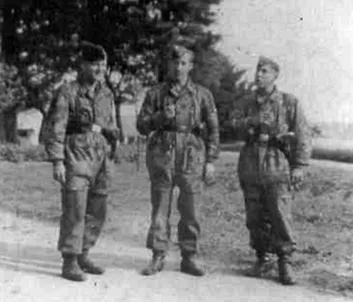
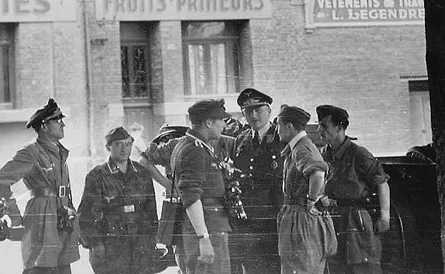
Three men, seen in the first hours of the creation of FJR 6, pose in Bretagne for a souvenir picture.
Such training prepared FJR 6 for carrying out a broad range of air assault missions. The regiment also received considerable firepower; heavy companies were equipped with 7.5cm recoilless guns in addition to mortars and heavy machine guns. In terms of strength, the rifle squads consisted of 12 men, instead of nine, and the additional paratroopers built a second machine-gun troop in their squad. At this point in time, the 2nd Battalion was still stationed in Mourmelon, serving as an instruction battalion for the groundfighting school of the Luftwaffe.
The 2nd Battalion received a leading role in a major exercise: an air assault on the Mourmelon airfield itself. Dietrich Brehde, at the time an Oberleutnant and platoon leader in the 6th Company, here describes the mission:
According to the starting position, a Fallschirmjäger Battalion, represented by a company, was responsible for taking the Mourmelon airfield from the air. Beforehand, a howitzer battery that controlled the airfield from a firing position near the Ferme de Buy, an abandoned farmstead, was supposed to be taken out by a surprise attack. For this, a platoon of gliders with drogue parachutes would land directly in the confined space of the firing range and neutralize the artillery.
The personnel of the artillery school also located at Mourmelon played the ‘enemy’. The artillerymen were unaware of how the attack would take place. Because they were dealing with Fallschirmjäger, they naturally were counting on a parachute jump.
The Fallschirmjäger launched their attack from Reims, and the platoon that was to assault the artillery position with gliders decamped early in Mourmelon in order to be able to depart on time. They arrived so early in Reims that the platoon leader decided to stop over at the soldiers’ rest centre. Just after he and his men had entered the centre and sat down, a chubby Heeres-Oberst [army colonel] stormed over in a raging fury, verbally attacking the unsuspecting lieutenant; he asked him if he was the leader of this commando, from which unit he came, and to present his pay book. Such a disgrace had never happened to him, the Oberst, in his whole life, he claimed. He was so worked up that it took a while before the Leutnant could even begin to understand what he was going on about.
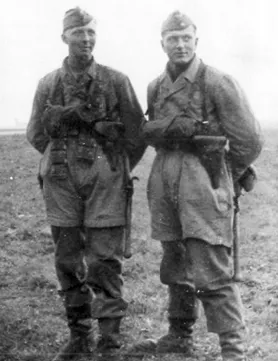
Two Fallschirmjäger pose for the camera in a quiet moment. They are wearing the second model olive-green coveralls with built-in trouser legs. The man on the left has a bandolier for 20 clips (each with five shots of ammunition) for his Karabiner 98k rifle. According to regulations, he is wearing his gasmask across his chest in the canvas bag issued for Fallschirmjäger. (His comrade is wearing his gasmask bag in the same way.) In order to avoid injuries when jumping, and especially during landing, the conventional gasmask canister was not issued to Fallschirmjäger. Both men have Luger pistols worn in holsters on the front left of their waist belts.
On their trip though the city, a few of the ‘heavenly dogs’, as they were called, in the last car had made a game out of throwing detonators from practice hand grenades onto the sidewalk; they had exploded with a loud rattle, terrifying the passersby. They had been so wrapped up in having fun that they had missed the fact that the German commanding officer of the station in Reims, namely this Oberst, had been among the civilians; along with the French, he had been forced to take to his heels in the face of the cracking detonators. After the Leutnant had identified himself and understood the full particulars of the situation, he apologized for the misdeeds of his men and tried to spark the Oberst’s interest in the upcoming exercise. He told him about the dive-gliders with the drogue parachutes and explained that the young soldiers, who otherwise were kept on a tight leash, wanted to blow off some steam before this complicated operation. The Oberst thought at first that the Leutnant was pulling his leg about the dive and the drogue parachutes, and he forbade him from making such jokes. He calmed down only after seeing a written training document. Finally the Fallschirmjäger and the Oberst parted ways on friendly terms, and if time hadn’t been pressing, the senior officer probably would have bought them another drink.
At the airfield there was no more waiting. The three gliders were towed up to over 2,000m altitude and released. Silently they volplaned towards their objective. In each plane, 12 men sat astride a bench, one behind the other. The sidewalls [of the glider] were constructed so that they could be thrown off in the landing, so that all the men could jump out of the plane at the same time. The Leutnant flew with the ‘chain leader’ in the middle plane, the other ‘chain dogs’ followed on the left and right…
Soon the goal became identifiable, even from this great height. The buildings were as big as coffee beans from this distance, and the landing zone in front was not bigger than a 10 Pfennig stamp. Maintaining height, the aircraft glided silently forward over the objective. Then finally the chain leader pressed the control stick far forward, and the plane shot sharply down; both ‘chain dogs’ followed close behind. The air current began to roar; the whole plane trembled, and the fragile wings shuddered suspiciously under the pressure. The ground began to rush ever closer, and they could make out the weapons in firing range and an audience across the street.
The pilot was yanking and yanking on the lever, but nothing was happening. He pulled the plane out of the dive without the drogue parachute; that manoeuvre pushed the men hard against the bench. Like an arrow, the large glider shot under a power line towards a long stretch of stables; it lost the ends of both wings against light posts. With a lurch, the pilot ripped the plane to the left into a tight hole between the buildings, in order to avoid a front-on collision with the stable wall. In the process, the wings were completely torn off, and, in a cloud of brick and mortar dust and roofing tiles, the body of the plane crashed sideways into a wall of a neighbouring building.
The Fallschirmjäger unbuckled themselves in lighting speed and jumped with a hurrah out against the concerned artillerymen, who were rushing to help them with first aid kits. Instead, they were pelted with practice hand grenades and taken prisoner. The drogue parachutes of the two chain dogs also did not open, and they made an equally dangerous crash landing that knocked over a freestanding toilet, which thankfully had nobody in it.
On the ‘commanders hill’, over a thousand observers, including three generals, could watch this part of the exercise from close by. They were all impressed with the lightning speed of the attack, because no one, neither the observers nor the artillery, nor even the personnel in charge, had noticed the approach of the three machines out of the sun, before they had careened into firing position like lightning from the sky.
The happiest part of the whole thing was that there were no serious injuries; the failure of the three drogue parachutes could easily have lead to a catastrophe. The fact that the exercise occurred without losses was entirely thanks to the presence of mind and the flying abilities of the three pilots. After the spectacular prelude, the exercise played out according to plan. An attack by the dive-bombers followed, with practice bombs dropped on the enemy position, then the parachute jump of a company on the landing field of Mourmelon. All in all, a nice success for the battalion. But one topic was the subject of much discussion over the next few days: the crash landing of the gliders near the Ferme de Buy.
The troop never figured out why the drogue parachutes failed on all three machines, after they had always functioned perfectly in the pre-exercise training. It can hardly have been a coincidence.
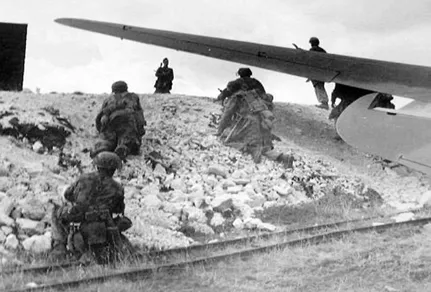
After the landing in gliders during an exercise, the Fallschirmjäger move without delay to attack the army’s artillery position. Major Liebach placed great value on training that was as close to reality as possible. He took his assignment as the senior training supervisor of his regiment very seriously. Every phase of FJR 6’s manoeuvres was analyzed thoroughly and discussed with the officers and NCOs. Liebach’s supervisors and subordinates viewed him as a brave and methodical leader.
On 27 May 1943, FJR 6 was transferred with 2 FJD to southern France, near Combe-St Gervais, Vallabrix and Goudargues. II./FJR 6, had already moved into quarters, establishing themselves at the end of April on the troop drill ground La Courtine near Clermont-Ferrand. They also took on the role of the instruction battalion.
Despite their transfer, owing to an expected invasion by the Allies in southern France, as the strategic reserve of the Oberkommando der Wehrmacht (OKW; Supreme Command of the Armed Forces), the troops’ training was continued with high intensity. Combat practice and jump duty still occupied a big chunk of the available time, so that Major Liebach could still justifiably claim to have under him one of the best-trained and most hard-hitting units within the Fallschirmjäger.
When the...
Table of contents
Front Cover
Title Page
Copyright Page
Contents
Preface
Chapter 1: The Initial Organization, 1943
Chapter 2: Deployment in Italy, 1943
Chapter 3: Deployment in Russia, 1943/44
Chapter 4: The Reorganization in Cologne-wahn, 1944
Chapter 5: Deployment in Normandy, 1944
Chapter 6: Deployment in Holland, 1944
Chapter 7: Deployment in the Eifel Region, 1944
Chapter 8: Parachute Mission in the Ardennes, 1944
Chapter 9: The Final Battle in the Homeland, 1945
Chapter 10: Peace
Appendices
Photographic Appendix
Trusted by 375,005 students
Access to over 1.5 million titles for a fair monthly price.
Study more efficiently using our study tools.
Frequently asked questions
Yes, you can cancel anytime from the Subscription tab in your account settings on the Perlego website. Your subscription will stay active until the end of your current billing period. Learn how to cancel your subscription
No, books cannot be downloaded as external files, such as PDFs, for use outside of Perlego. However, you can download books within the Perlego app for offline reading on mobile or tablet. Learn how to download books offline
Perlego offers two plans: Essential and Complete
Essential is ideal for learners and professionals who enjoy exploring a wide range of subjects. Access the Essential Library with 800,000+ trusted titles and best-sellers across business, personal growth, and the humanities. Includes unlimited reading time and Standard Read Aloud voice.
Complete: Perfect for advanced learners and researchers needing full, unrestricted access. Unlock 1.5M+ books across hundreds of subjects, including academic and specialized titles. The Complete Plan also includes advanced features like Premium Read Aloud and Research Assistant.
Both plans are available with monthly, semester, or annual billing cycles.
We are an online textbook subscription service, where you can get access to an entire online library for less than the price of a single book per month. With over 1.5 million books across 990+ topics, we’ve got you covered! Learn about our mission
Look out for the read-aloud symbol on your next book to see if you can listen to it. The read-aloud tool reads text aloud for you, highlighting the text as it is being read. You can pause it, speed it up and slow it down. Learn more about Read Aloud
Yes! You can use the Perlego app on both iOS and Android devices to read anytime, anywhere — even offline. Perfect for commutes or when you’re on the go. Please note we cannot support devices running on iOS 13 and Android 7 or earlier. Learn more about using the app
Yes, you can access The Lions of Carentan by Volker Griesser in PDF and/or ePUB format, as well as other popular books in Storia & Storia tedesca. We have over 1.5 million books available in our catalogue for you to explore.