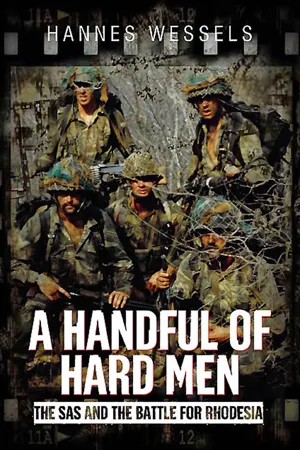
A biography of a Special Forces soldier who battled the forces of Mugabe and Nkomo, earning a reputation as a military maestro.
During the West's great transition into the post-colonial age, the country of Rhodesia refused to succumb quietly, and throughout the 1970s, fought back almost alone against Communist-supported elements that it did not believe would deliver proper governance. During this long war, many heroes emerged, but none more skillful and courageous than Capt. Darrell Watt of the Rhodesian SAS, who placed himself at the tip of the spear in the deadly battle to resist the forces of Robert Mugabe and Joshua Nkomo.
It is difficult to find another soldier's story to equal Watt's in terms of time spent on the field of battle and challenges faced. Even by the lofty standards of the SAS and Special Forces, one has to look far to find anyone who can match his record of resilience and valor in the face of such daunting odds and with resources so paltry. A bush-lore genius, blessed with uncanny instincts and an unbridled determination, he had no peers as a combat-tracker—and there was plenty of competition. The Rhodesian theater was a fluid and volatile one, in which he performed in almost every imaginable fighting role: as an airborne shock-trooper leading camp attacks, long range reconnaissance operator, covert urban operator, sniper, saboteur, seek-and-strike expert, and, in the final stages, as a key figure in mobilizing an allied army in neighboring Mozambique. After twelve years in the cauldron of war, his cause slipped from beneath him, however, and Rhodesia gave way to Zimbabwe.
When the guns went quiet, Watt had won all his battles but lost the war. In this fascinating biography we learn that in his later years, he turned to saving wildlife on a continent where animals are in continued danger, devoting himself to both the fauna and African people he has cared so deeply about.
- 277 pages
- English
- ePUB (mobile friendly)
- Available on iOS & Android
eBook - ePub
About this book
Information
CHAPTER 1
My country, right or wrong
This is my land my home,
I yearn not
For that strange unfamiliar place called Europe
I am an African
A white African.
—CHAS LOTTER
REBELLION
In the lives of most nations there comes a moment when a stand has to be made for principles, whatever the consequences. This moment has come to Rhodesia.
I call upon all of you in this historic hour to support me and my government in the struggle in which we are engaged. I believe that we are a courageous people and history has cast us in a heroic role. To us has been given the privilege of being the first Western nation in the last two decades to have the determination and fortitude to say: ‘So far and no further.’
We may be a small country but we are a determined people who have been called upon to play a role of worldwide significance. We Rhodesians have rejected … appeasement and surrender.
We have struck a blow for the preservation of justice, civilisation and Christianity—and in the spirit of this we have thus assumed our sovereign independence.
God bless you all.
—RHODESIAN PRIME MINISTER IAN DOUGLAS SMITH UNILATERALLY DECLARING INDEPENDENCE FROM BRITAIN
With the British government led by Harold Wilson insisting on ‘No Independence before Majority Rule’ (NIBMAR) Rhodesian Prime Minister Ian Smith decided the black rule that would soon follow spelled doom for his country and decided it was time to go it alone. On 11 November 1965, surrounded by his cabinet, he reached for his pen and signed a document that signalled open rebellion against the Crown. Not since the American Declaration of Independence was promulgated in 1776 has such an event taken place. It was a unilateral declaration of independence (UDI) and the die was cast; the country would soon be at war with the world. At midday Rhodesians sat riveted to their radios as Smith told them of his momentous decision.
DARRELL WATT
One young man listening to that fateful broadcast was Darrell Watt. “I was at school when we heard the news. There was uncertainty about what it all meant. I was quite frightened. I spoke to my Dad who was pro-Smith so I took my cue from him. I was reminded that many of my forebears were soldiers so if there was going to be a fight I was up for it.
“My dad was born in Bulawayo in 1921 and went to Milton Boys’ High where he was head boy. At eighteen he was called up for service in the Second World War and after training in Salisbury he was railed to Cape Town where he, along with his Rhodesian contingent, was shipped to Liverpool and on to Catterick in Yorkshire. In 1941 he was deployed to Algiers as part of the 78th British Infantry Division. He did not like it there because of the lack of hygiene. From there he went to Tunisia and took part in the battles against Rommel’s Afrika Korps. From there he was evacuated to Italy and trekked to Rogio and Taranto via Sicily. The advance north through Italy was a tough one and he told me of his high regard for the German soldiers. The weapon they appear to have most feared was the German 88mm with its high velocity and low trajectory.
“The Battle at Monte Casino left the biggest impression on him and he never quite got over the terrible loss of life he witnessed there. Wounded by shrapnel and sick with yellow fever, he was hospitalised in Bari on the coast before continuing the march into Austria. His final battles were in the Po Valley west of Naples. He also spoke highly of the civilised way in which the Germans soldiers conducted themselves.
“His lasting impression at the end of the war was Britain’s ingratitude. He was told to find his own way home. My grandmother nursed in both world wars and gave me her medals before she died.
“I was born in Fort Victoria in April 1949 but we moved to Gwelo and I went to school at Thornhill Boys’ High. Eventually my family ended up in Salisbury. All I can remember about life in Fort Victoria was sitting on the bonnet of my Dad’s old Citroën and having a hornet sting me on the arse. It was bloody painful, and I’ve been careful where I sit ever since.
“I loved the bush from an early age. I had access to surrounding farms and ranches, most of which were situated in open country teeming with game. I learned about the natural world from my black friends. It was the first part of a long learning curve that would help me in ways I never dreamed of then.
“My father, being in the Rhodesian Department of Water Development, used to spend a lot of time in the Tribal Trust Lands6 providing water to the black people and when not in school I used to travel with him. He was typical of so many of the Rhodesian civil servants; he was out in the field working hard to help the Africans improve the quality of their lives. This is something the world never wanted to know about. With my father on his government bush trips I met men from the Game Department like Paul and Clem Coetzee.
“School mirrored life in Rhodesia—very tough but very fair. People often wonder why young Rhodesians were so quick to make the transition from schoolboy to soldier. I think the toughness of the country’s education system had a lot to do with this. While I did not shine in the classroom, I did play rugby for the 1st XV
“When they told me I had to repeat Form IV I informed my parents I’d had enough, talked my Dad into buying me an old Land Rover and rifle, and headed to Gwaai Forest Area in Matabeleland to work for Allan Savory.”
Savory, a brilliant but controversial wildlife expert, was about to make his mark in the Rhodesian political and military arenas. A former game ranger in Northern Rhodesia, he was an opinionated forward-thinker who would win a seat in parliament as a member of Ian Smith’s Rhodesian Front Party, only to later defect and align himself with the African Nationalists.
“Initially we camped at Amandundumela up on the hill in Gwaai and there we culled [shot] eland and sable which were there in numbers surplus to the carrying capacity of the area. Today I gather there is almost nothing left but then the numbers needed to be controlled. Later I moved to Liebigs Ranch in the south-east Lowveld. Then Allan and his associates formed a company called the Rhodesia Meat Company.
“We were paid according to the number of animals we shot and I was getting quite good at this. I ended up being the top earner and this irritated the senior guys who had more experience than me. Mike Bunce, who was a veteran, got so pissed off he wanted to beat me up a couple of times. I was only seventeen and I think they saw me as a bit of an upstart earning more than they were. £1 was a lot of money then and in one month I made £400 which was enough to buy a vehicle. This shocked everyone. I reached a point where I became highly effective with my 30.06. My trackers were Shangaans; one was Jacob and the other Philemon. We would hunt on foot and run the animals down. The problem was what we shot had to be loaded and processed and that was a lot of work. One day Jacob said he had enough and we must stop shooting. I said no, we must continue but he bolted with my bag of bullets, shouting at me as he ran away, ‘You have shot sixteen zebra out of one herd and we have to load them; we have had enough; you must stop now!’ Then he went and hid in the bush till dark. It sounds excessive but the game numbers were so high that there had to be a managed reduction to protect the habitat.
“Jacob and Philemon helped me learn the lessons of the bush which would later keep me alive. They were tremendous trackers. We would practise back-tracking human and animal spoor back to the vehicle. I learned how to age spoor and identify an animal that was tiring. Vegetation was a good way to age tracks and ‘aerial’ spoor helped identify numbers. Termite activity and the rate at which blood dried were important to timings. They also taught me how to anticipate the direction an animal was going, a difficult lesson to learn.
“While my black friends taught me the vital basics, Savory had a big impact. With his help I learned the additional skills that enable one to survive in the bush. Probably most importantly I learned how to anti-track. I never forgot those lessons and am convinced this is the reason that I and most of the men I commanded, survived.
“Lessons well learnt were the value of the extended line rather than a single file where walking on top of tracks makes the trail easier to follow; choosing your footfalls to avoid soft ground; flat soles without treads; walking in rivers wherever possible; using hessian sacks to traverse sandy soil.”
It was while perfecting the skills of the hunter that Watt received his compulsory military service call-up papers to join intake 89 in June 1967. He travelled to Llewellin Barracks in Bulawayo by train, with no real idea of what to expect. “On our arrival in Bulawayo there were the Red Caps [military police] and regimental police shouting out orders. We were herded onto waiting trucks—a bit like cattle, really—and taken to Llewellin Barracks. I did not realise it then but a big story was about to unfold.”
THE WIND OF CHANGE
In a sense an important chapter in that ‘story’ began in 1957 when Ghana (formerly the Gold Coast) became independent of Britain and Kwame Nkrumah assumed power. Europe then began ‘freeing’ its colonies with extravagant haste as African Nationalism took root across the continent. Rhodesians looked on in horror as mostly chaos, carnage and bloodshed followed.
Southern Rhodesia’s African Nationalists began seeking external schooling, believing it was denied them at home. Many also sought sanctuary from government watch-lists, banning orders and proscriptions.
They headed to communist-bloc institutions where they rubbed shoulders with like-minded anti-colonial activists, all of whom regarded Nkrumah as a hero. It was at this time that Robert Mugabe took up a teaching post in Ghana and married his first wife, Sally.
Within the Rhodesian dynamic an early tribal split saw Joshua Nkomo head up the Zimbabwe African People’s Union (ZAPU) with Soviet patronage and Ndabaningi Sithole the Zimbabwe African National Union (ZANU) with Chinese help.
In 1963 ZANU sent five candidates on a military course to China. Among them was future Zimbabwean government minister Emmerson Mnangagwa. Ghana and Tanzania also offered Chinese-run military institutions. In 1964 the first Ghanaian-trained group was flown to China to be trained as instructors. In 1965 a group of twenty-eight candidates underwent training in Cuba. In the same year the infamous ‘Crocodile Gang’ which included Mnangagwa became the first graduates of the Itumbi Reefs academy near Chunya in south-west Tanzania. They would return to the country and murder Petrus Oberholzer in the Eastern Districts of Rhodesia and set a precedent for the many farm murders to follow.7 Josiah Tongogara, who would go on to become ZANU’s military leader, was in the second in take.8 By the fourth intake the number of recruits had risen to a hundred and twenty. In 1966 ZANU sent eleven recruits including Tongogara to the Nanking Military Academy in China.
Scandinavian countries were especially sympathetic to African Nationalism and offered educational and professional assistance to young Rhodesians. This facility was often exploited to dupe recruits into attending military camps.
Contrary to the popular view that white oppression was driving thousands of recruits into the arms of Communist-bloc instructors, Bhebhe and Ranger, both sympathetic to the Nationalist cause, concede this in their book Soldiers in Zimbabwe’s Liberation War: “As a result of the dearth of volunteers, both ZAPU and ZANU engaged in a policy of forced conscription in Zambia … ZAPU and ZANU … decided to employ … press-ganging. Many young men originally from Rhodesia and living in the Mumbwa rural area and in Lusaka were press-ganged into going for training.”
Deception, they write, was also used. “Both ZAPU and ZANU made it their custom to welcome such students at the airports but instead of finding themselves in colleges and universities as they had intended, they found themselves whisked off to military training camps.”
Josiah Tungamirai who would later command the Zimbabwe Air Force and Ernest Kadungure who would be a minister in Zimbabwe’s first cabinet were both products of the forced recruitment programme that laid the foundation for armed resistance.
CHAPTER 2
The regiment has been,
is, will always be his life
and his reason for life.
—CHAS LOTTER
FORMATION OF THE SAS
The Special Air Service (SAS) originated in the desert war of North Africa. With Erwin Rommel rampaging and the Allied forces reeling, British commanders sought a means to destroy the Luftwaffe on the ground and to disrupt the enemy’s lines of communication. A young British subaltern named David Stirling sent parachutists behind German lines to destroy an airfield.9 Stirling was convinced that small groups maximising the element of surprise could inflict losses disproportionate to their numbers.
Although that first operation was a disaster, requiring the Long Range Desert Group to rescue the men, the seeds were sown. Made up from LRDG troops containing Rhodesian volunteers, the unit had destroyed more than 400 enemy aircraft, also airfields, fuel, munitions ...
Table of contents
- Cover
- Title
- Copyright
- Contents
- Dedication
- Acknowledgments
- Author’s Note
- A Brief History of Rhodesia
- CHAPTER 1
- CHAPTER 2
- CHAPTER 3
- CHAPTER 4
- CHAPTER 5
- CHAPTER 6
- CHAPTER 7
- CHAPTER 8
- CHAPTER 9
- CHAPTER 10
- CHAPTER 11
- CHAPTER 12
- CHAPTER 13
- CHAPTER 14
- CHAPTER 15
- CHAPTER 16
- CHAPTER 17
- CHAPTER 18
- Appendix A: The Unilateral Declaration of Independence
- Appendix B: SAS Roll of Honour
- Endnotes
- Bibliography
- Plate section
- Title
- Copyright
- Dedication
- Contents
- Note from Andre Scheepers
- Acknowledgements
- 1 Schoolboy to Soldier
- 2 Into the SAS
Trusted by 375,005 students
Access to over 1.5 million titles for a fair monthly price.
Study more efficiently using our study tools.
Frequently asked questions
Yes, you can cancel anytime from the Subscription tab in your account settings on the Perlego website. Your subscription will stay active until the end of your current billing period. Learn how to cancel your subscription
No, books cannot be downloaded as external files, such as PDFs, for use outside of Perlego. However, you can download books within the Perlego app for offline reading on mobile or tablet. Learn how to download books offline
We are an online textbook subscription service, where you can get access to an entire online library for less than the price of a single book per month. With over 1.5 million books across 990+ topics, we’ve got you covered! Learn about our mission
Look out for the read-aloud symbol on your next book to see if you can listen to it. The read-aloud tool reads text aloud for you, highlighting the text as it is being read. You can pause it, speed it up and slow it down. Learn more about Read Aloud
Yes! You can use the Perlego app on both iOS and Android devices to read anytime, anywhere — even offline. Perfect for commutes or when you’re on the go.
Please note we cannot support devices running on iOS 13 and Android 7 or earlier. Learn more about using the app
Please note we cannot support devices running on iOS 13 and Android 7 or earlier. Learn more about using the app
Yes, you can access A Handful of Hard Men by Hannes Wessels in PDF and/or ePUB format, as well as other popular books in History & Military Biographies. We have over 1.5 million books available in our catalogue for you to explore.