- 240 pages
- English
- ePUB (mobile friendly)
- Available on iOS & Android
eBook - ePub
About this book
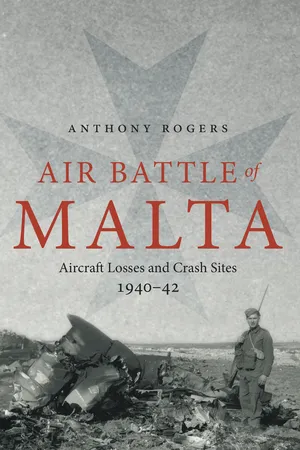
In the Second World War, Malta was besieged for nearly two and a half years, during which time a decisive air war was waged between Britain, Italy and Germany.This is part of that story, from the early days in June 1940, when only a few Gladiator biplanes were available to combat Italian bombers and fighters, to the intervention of the Luftwaffe and the tenuous defense by outclassed Hurricanes, culminating in the desperate months of fighting following the arrival on Malta of the Spitfire in March 1942.What became of the many aircraft destroyed over the Maltese Islands, and what was the fate of their pilots and crews?More than a thousand aircraft were lost. Many crashed into the Mediterranean; others came down on Malta and the neighboring island of Gozo. This book focuses on the latter some 200 British, Italian and German machines, and the fate of their pilots and crews. It reveals where those airplanes fell, thus providing a record that will continue to be valued by future generations.This comprehensive volume documents all known aircraft crash sites in and around the Maltese Islands and provides the circumstances of each loss are related in detail with accounts from both sides.In Germany especially there are many still unaware of the fate of family members who never returned after the Second World War. This book reveals what happened to some who even today are still officially listed as missing.
Information
CHAPTER 1
JUNE–AUGUST 1940
Malta is the largest of the Maltese Islands. Gozo and Comino are nearby and just to the north. Other, uninhabited, islets complete the archipelago, which is situated in the middle of the Mediterranean, south of Sicily and almost equidistant from Gibraltar in the western approaches and Suez in the east.
Measuring just 17½ miles by 8¼, Malta boasts an excellent natural harbour and has provided a succession of rulers with an enviably dominant position. In 1814, Malta freely became part of the British Empire, serving as an ideal base for the Royal Navy, the Army and, more than a century later, the Royal Air Force.
With the threat of a European war, in the summer of 1939, the Committee of Imperial Defence approved a long-term air defence programme in recognition of Malta’s strategic importance. The plan was designed to improve existing anti-aircraft (AA) capabilities and also took into account the requirement for fighter aircraft. Malta had already been provided with its first radio direction-finding (radar) station; there was an aerodrome at Ħal Far in the south-east and at Ta’ Qali in the centre of the island. Construction on a third aerodrome near Luqa in central-eastern Malta was also well underway. In addition, there was a seaplane station on the south-east coast at Kalafrana and seaplane facilities at nearby Marsaxlokk and towards the north-west at St Paul’s Bay.
On 10 June 1940, when Italy entered the war against Britain and France, Luqa aerodrome was not yet operational, and there were only thirty-four heavy anti-aircraft (HAA) guns, eight Bofors (light) anti-aircraft guns and twenty-four searchlights available. There were also several Royal Navy Gloster Sea Gladiators recently taken over by the RAF.1 At dawn on 11 June, 2a Squadra Aerea of the Italian Regia Aeronautica commenced operations against Malta. Eighteen Macchi C.200s escorted some fifty-five Savoia-Marchetti S.79s across the 60 miles of sea that separate Malta from Sicily.2 Ħal Far, Kalafrana and the Dockyard area were each targeted. Three of Malta’s Gladiators intercepted the raiders in what would be the first of countless aerial engagements during the next two and a half years.
The outdated biplanes of Malta’s Fighter Flight were the sole aerial defence for nearly two weeks following Italy’s declaration of war. Eventually, they would be immortalised as ‘Faith’, ‘Hope’ and ‘Charity’ (notwithstanding the fact that there were at least four aircraft on strength and others stored in crates). Reinforcements did not arrive until 21 June, when two Hurricanes were assigned to the Fighter Flight after they landed at Luqa en route to the Middle East. On the 22nd, six more Hurricanes arrived, three of which were retained in Malta.3
The RAF achieved its first victory that same day. Two Gladiators were scrambled to intercept an S.79. Flying Officer William ‘Timber’ Woods carried out an initial attack, but without visible result. Next to attack was Flight Lieutenant George Burges. The Italian machine, with its twin engines on fire, fell in the sea off south-east Malta. There were two survivors, both of whom became prisoners of war. The next day, Burges accounted for an MC.200. This, too, crashed offshore. The pilot baled out and was taken prisoner. In the morning of 3 July, Flying Officer John Waters pursued an S.79 and was credited with its destruction when it came down off the coast. When Waters returned to base he was attacked by Fiat CR.42s and crash-landed as a result. The pilot was unhurt, but the Hurricane was a write-off. On 6 July, anti-aircraft gunners claimed an Italian bomber shot down, and the following day Woods was credited with the destruction of an S.79. After four weeks of war, Malta’s modest defence had proven more than a match against a far more powerful adversary. But it was still very early days.
Malta had been at war for one month when, at approximately 07:45 hours on 10 July 1940, the air raid sirens’ banshee wail heralded the approach of some twenty S.79s.4 Even though they were behind schedule and had missed the rendezvous with their fighter escort, the bombers continued with their mission, concentrating primarily on the Dockyard, Manoel Island, Tarxien and Żabbar. As billowing dust clouds from numerous bomb bursts rolled across the landscape, the Italians were intercepted by Hurricanes of the island’s Fighter Flight. Two S.79s were destroyed in addition to those damaged.
One S.79, believed to have been that piloted by Sottotenente Luigi Illica Magnani of 192a Squadriglia B.T., was shot down by Flying Officer ‘Timber’ Woods and crashed offshore. Flying Officer Frederic Taylor attacked the other. The 195a Squadriglia B.T. machine, with Sottotenente Felice Filippi at the controls,5 was the first enemy aircraft to fall on Maltese soil. It came down in flames just behind the seventeenth-century De Redin Tower, east of Fort San Leonardo, severely damaging the nearby Post RA6, which was occupied by personnel of B Company, 1st Battalion The Dorsetshire Regiment. Three soldiers suffered extensive burns: Private George Le Provost and Lance Corporal Maurice Malcolm died two days later. Civilian casualties were reported to be one killed and three injured.
At least one airman baled out of the stricken Italian bomber, only for his parachute to catch fire. Neither he, nor any of those from either of the aircraft shot down, is known to have survived.6 There were also casualties, including at least one fatality, among returning bomber crews.
Shortly after 09:00 hours on 16 July, a dozen CR.42 biplanes of 23o Gruppo Autonomo C.T. appeared over Malta on reconnaissance. They were engaged by a Hurricane Mk I, flown by Flight Lieutenant Peter Keeble, and a Gladiator piloted by Flight Lieutenant George Burges. Keeble apparently engaged a CR.42 just before two biplanes got on his tail. In spite of every effort, Keeble was unable to evade his pursuers. Among those watching events from the ground was South African Pilot Officer Roger ‘Jock’ Hilton-Barber:
His engine was obviously hit and smoking pretty badly, but it was quite amazing because the CR.42 was on his tail and followed him right down and in fact crashed very close to where he did. One thought was that the CR.42 had been shot down by ground fire, but I don’t know that he wasn’t concentrating so much on shooting Peter down that he just went straight in.7
The CR.42 was indeed claimed as having been brought down with light machine-gun fire by C Company headquarters, 1st Battalion The Dorsetshire Regiment.8 Some unconfirmed accounts also indicate that the two aircraft collided in mid-air shortly before both crashed near Wied il-Għajn. In any event, Keeble was the first RAF fighter pilot to be killed in the defence of Malta. The Italian pilot, Tenente Mario Benedetti, was still alive when rescuers arrived at the scene. He died soon afterwards in hospital.
‘Faith’, ‘Hope’ and ‘Charity’, the three Gladiator biplanes which helped to defend Malta against the Regia Aeronautica, have become part of Maltese folklore. However, prior to hostilities, the aircraft carrier HMS Glorious had offloaded eighteen Sea Gladiators to be stored in crates at Malta. Three were subsequently taken back on board, and three were dispatched to Egypt. Of the remainder, six were assembled for service in Malta, and six used for spares. Yet, because no more than three Gladiators were seen in the air at any one time, it was widely believed that these were all there were. It is not known who christened the machines ‘Faith’, ‘Hope’ and ‘Charity’, or even when. Neither is it certain which aircraft, if any, were actually referred to by name.9
Of the operational Gladiators, just one was shot down in combat, and while the crash site has yet to be positively identified, it is fitting that the circumstances of that loss are included here.
During the morning of 31 July, Flying Officers Woods, Taylor and Hartley took off in their Gladiators to intercept an S.79 escorted by between seven and nine CR.42s of 23o Gruppo Autonomo C.T. In the ensuing action, ‘Timber’ Woods claimed a CR.42: Capitano Antonio Chiodi was reported missing after his fighter crashed some 5 miles off Grand Harbour. In turn, Flying Officer Hartley was shot down in Gladiator N5519; the likely victor was Sergente Manlio Tarantino.10 Hilton-Barber recalled:
Peter Hartley must have been hit in his centre tank because his Gladiator burnt just like a magnesium flare – an actually brilliant light in the sky, and it was a very lovely day, typical Malta summer day, very hot, clear blue sky, no clouds.
He actually baled out after his aircraft caught fire and he fell into the sea. He was very badly burnt, particularly about the knees and arms and face. In those days we, of course, flew in khaki shirts and shorts and stockings and it was, of course, the exposed portion of his body that got damaged. He spent a very long time in hospital and was eventually evacuated to UK, but I believe made a good recovery and flew again later on.11
According to at least one report, Gladiator N5519 fell just offshore, close to Ras il-Fenek, in south-east Malta.12 Hartley was rescued by a boat from Kalafrana and admitted to the Station Sick Quarters suffering from shock and third-degree burns. Soon after, he was transferred to the military hospital at Mtarfa. He did indeed return to flying duties in the UK and the Middle East, but was eventually reassigned a ground role due to continuing problems with his injuries.
Those on Malta were only too aware of the urgent requirement for more and better fighters. On 30 July, ‘The “Fighter ’Plane” Fund, Malta’ was launched to enable the public to purchase their own aircraft for the islands’ defence. In three months, enough was raised to pay for two Spitfires. These were duly assembled and christened ‘Malta’ and ‘Ghawdex’, the latter after the Maltese name for the neighbouring island of Gozo. Ironically, neither machine ever reached Malta. Both were released to 74 Squadron in May 1941. W3210 ‘Malta’ was reported missing during a sortie over northern France on 27 June 1941, while W3212 ‘Ghawdex’ was eventually transferred to the Royal Navy.13
Operation ‘Hurry’ was the first attempt to reinforce Malta with fighters from an aircraft carrier. At dawn on 2 August, twelve Hurricane Mk Is of 418 Flight took off from HMS Argus to be flown 380 miles to Luqa. There they were to join surviving fighters to form 261 Squadron. For the flight the aircraft were divided into two groups of six, each led by a Skua. Two hours and twenty minutes later the first machine landed at Luqa. The second to approach was Hurricane N2700 flown by Sergeant Fred Robertson. According to Pilot Officer ‘Jock’ Hilton-Barber:
He [Robertson] and two sergeant pilots arrived in a vic of three over Luqa. He came in very, very low doing a very fast beat-up, followed by a roll off the top by himself and upward Charlies by his Numbers 2 and 3 … Robertson made a typical carrier-type, split-arse approach … very low and very steep turn and, as he was doing his final turn to line up with the runway, his motor cut – it was very audible to us on the ground – and he flicked over to the right on to his back and ploughed into the ground upside down. I think he went through three … stone [field] walls … Well, we were very shattered to say the least. This was our first reinforcement, pilots and aircraft, and we’d been really looking forward to this, and we wrote him off, but fantastic as it may sound, Robertson only had minor concussion and was flying again two days later.14
The officer commanding (OC) Luqa rushed to the scene, helped the dazed pilot into his car and drove him to the Medical Inspection (MI) Room at Luqa Camp. Robertson would record in his log book that the Hurricane’s petrol gauge was faulty. This had presumably misled him into thinking that he had more fuel than was actually the case and may have contributed to the accident.
The rest of the Hurricanes and one Skua landed without mishap. The other Skua landed heavily on one wheel and slid along on its port wing for about 200 yards before crashing over the air raid shelter near Luqa’s control tower. The crew escaped unhurt.
CHAPTER 2
SEPTEMBER–DECEMBER 1940
Malta was to experience a new mode of aerial attack when 96o Gruppo Bombardamento a Tuffo became the first Italian unit to be equipped with Junkers Ju 87 Bs. Operations against the island commenced on 4 September with the dive-bombing of Delimara by five so-called Picchiatelli.
At 10:40 hours on 17 September, the air raid sirens signalled the approach of twelve Picchiatelli escorted by at least two dozen fighters. The dive-bombers (some of which were seen to have the Balkenkreuz on their wings) concentrated on Luqa aerodrome, where a Wellington and a Hurricane were burnt out and considerable damage was caused to a hangar, huts and water supplies.
In the air a brief but fierce encounter took place as ground defences and RAF fighters retaliated. Recently promoted Flying Officer ‘Jock’ Hilton-Barber attacked a Ju 87 B flown by Sergente Maggiore Luigi Catani on his first sortie over Malta. Catani, a former fighter pilot, promptly turned towards the Hurricane, the two aircraft firing at each other in a series of head-on attacks that ended with the Picchiatello crashing into the sea off Mtaħleb. Catani was captured soon afterwards. The gunner, Primo Aviere Francesco Di Giorgi, was killed (as was the gunner of another Ju 87 that returned to Sicily after being badly damaged).
Meanwhile, a CR.42 was reported by ground observers to be in difficulties over the west coast. The pilot, Sottotenente Francesco Cavalli of 70a Squadriglia C.T., baled out and...
Table of contents
- Cover
- Title
- Copyright
- Contents
- List of Illustrations
- Acknowledgements
- Introduction
- 1 June–August 1940
- 2 September–December 1940
- 3 January–April 1941
- 4 May–December 1941
- 5 January–February 1942
- 6 March–April 1942
- 7 May 1942
- 8 June–September 1942
- 9 October 1942
- 10 November–December 1942
- Appendices
- Notes
- Bibliography
Trusted by 375,005 students
Access to over 1.5 million titles for a fair monthly price.
Study more efficiently using our study tools.
Frequently asked questions
Yes, you can cancel anytime from the Subscription tab in your account settings on the Perlego website. Your subscription will stay active until the end of your current billing period. Learn how to cancel your subscription
No, books cannot be downloaded as external files, such as PDFs, for use outside of Perlego. However, you can download books within the Perlego app for offline reading on mobile or tablet. Learn how to download books offline
Perlego offers two plans: Essential and Complete
- Essential is ideal for learners and professionals who enjoy exploring a wide range of subjects. Access the Essential Library with 800,000+ trusted titles and best-sellers across business, personal growth, and the humanities. Includes unlimited reading time and Standard Read Aloud voice.
- Complete: Perfect for advanced learners and researchers needing full, unrestricted access. Unlock 1.5M+ books across hundreds of subjects, including academic and specialized titles. The Complete Plan also includes advanced features like Premium Read Aloud and Research Assistant.
We are an online textbook subscription service, where you can get access to an entire online library for less than the price of a single book per month. With over 1.5 million books across 990+ topics, we’ve got you covered! Learn about our mission
Look out for the read-aloud symbol on your next book to see if you can listen to it. The read-aloud tool reads text aloud for you, highlighting the text as it is being read. You can pause it, speed it up and slow it down. Learn more about Read Aloud
Yes! You can use the Perlego app on both iOS and Android devices to read anytime, anywhere — even offline. Perfect for commutes or when you’re on the go.
Please note we cannot support devices running on iOS 13 and Android 7 or earlier. Learn more about using the app
Please note we cannot support devices running on iOS 13 and Android 7 or earlier. Learn more about using the app
Yes, you can access Air Battle of Malta by Anthony Rogers in PDF and/or ePUB format, as well as other popular books in History & Military & Maritime History. We have over 1.5 million books available in our catalogue for you to explore.