- 256 pages
- English
- ePUB (mobile friendly)
- Available on iOS & Android
eBook - ePub
About this book
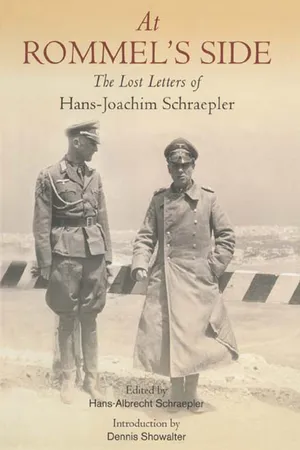
Erwin Rommel, Hitler's so-called 'Desert Fox', is possibly the most famous German Field-Marshal of WWII. He is widely regarded as the one of the most skilled commanders of desert warfare and, in contrast to other leaders of Nazi Germany, is considered to have been a chivalrous and humane officer. The letters of his adjutant provide a unique picture of Rommel during his time in Libya. Hans-Joachim Schraepler was by Rommel's side in North Africa for ten crucial months in 1940-41. During that time, he wrote to his wife almost every day. In most cases, the correspondence went via the usual channels but occasionally he used other methods to avoid the censor's gaze.Through his letters, Schraepler supplies a vivid image of the first phase of the North Africa campaign. He covers the siege of Tobruk, the capture of Benghazi, and the difficulties experienced by those fighting in Cyrenica and the wider North African theatre. He also complains that the Italian were poor Allies, lacking training and leadership, and that Berlin regarded North Africa as a theatre of only secondary importance.Schraepler also provides insights into Rommel's character—his dynamism and tactical skill, along with the growing 'cult of personality' which seemed to surround him. One of his unofficial tasks, for example, was to respond in Rommel's name to much of the fan mail that arrived at the Afrikakorps HQ.Hans-Albrecht Schraepler was only seven years old when his father died. The cache of letters was held by his mother and remained untouched for sixty years. His father's last letter, found the day of his death, remains unfinished.
Information
Contents
Foreword
Introduction
1 The Beginning
2 The Background Career
3 Dusk
4 The Context of the Letters
5 The Adjutant’s Letters (20 February–19 April 1941)
6 Outside Tobruk (19 April–11 July 1941)
7 Clouds (5 August–4 October 1941)
8 General Erwin Rommel
9 The Message (5 October–7 December 1941)
Epilogue
Index
Foreword
I discovered the bundled letters of my father, Lieutenant Colonel Hans-Joachim Schraepler, adjutant of the Deutsches Afrika Korps, after my mother died in 2001. He wrote his first letter from Tripoli on 20 February 1941, his last on 9 December 1941. He wrote to my mother almost every day, either early in the morning, at noon, late in the evening or in the middle of the night, whenever time and fighting at the front permitted. Altogether I found more than 400 pages.
His last words were deeply marked by the depressing withdrawal of the Afrika Korps under British pressure and by the information that his wife’s cousin, General Walter Neumann-Silkow, had succumbed to the serious wounds received the day before.
I knew, of course, that my father had joined the cavalry of the Weimar Republic after finishing school, progressing in his military career in Pomerania, a former Prussian province, during a politically difficult period for Germany and Europe. North Africa was an unknown continent for him and his comrades. His letters reveal the importance of his conservative and traditional background to his ability to withstand the hard and exhausting conditions of war in the desert.
The letters also show his doubts about the policy of the Berlin regime after the invasion of the Soviet Union. Today we know that, despite initial successes, the war against Stalin would not be finished by the winter and the country had no intention of surrendering. For my father, as for many others, the realisation of this was crushing.
His letters were often written in a hurry or in sections, depending on the changing war situation. But they were always full of information about the war in the desert, Rommel’s leadership, British strategy and his observations as an adjutant in the Afrika Korps functioning as he did between the staff and fighting troops. By the end of 1941 he rarely found calm moments to inform my mother about his condition or to note down his reflections as the situation at the front continued to deteriorate. The German troops suffered from lack of supplies on the ground and British supremacy on land, at sea and in the air.
His letters are informative and precise, and mention interesting details without getting bogged down. They also indicate his professional experience and present military and strategic views which, above all, show his loyalty to Rommel; and they do not hide a certain reserve regarding the regime in Berlin, as he is conscious, without mentioning it, of his ‘oath of fidelity to Führer and Reich’ (made on the instructions of the minister of war of 2 August 1934).
They touch on topics like the strategic difficulties of the front in North Africa that were characterised by the particular context of North Africa in the international war. The letters are unique documents: they describe Rommel, the commanding general of the Afrika Korps, later of the Panzergruppe ‘Afrika’, without neglecting the situation at the front, which had the distinction of being the only deployment of German troops on another continent during World War II on the one hand, yet which was both geographically close and strategically important.
He describes not only the phases of the war front in Libya in 1941, the lengthy and unsuccessful siege of Tobruk and the famous Panzerschlacht (tank battle) of Sollum, but he also assesses the personality and strategy of Rommel, criticising him if he had reasons to, repeatedly mentioning how hard the demands of this war were for each soldier in the merciless desert without any natural protection or other options.
I found his assessment of the British adversary particularly interesting: he saw that their war stratagems were not always recognised by the German side, and that it was their need to defend the interests of the British Empire in the Mediterranean – including the Suez Canal and the Red Sea needed for access to the Indian Ocean and the British colonies – that was motivating the war in North Africa. He realised that this was in contrast to the way Berlin politics continually revised war ambitions in other theatres.
My father did not hesitate to express his concern about the outcome of the North Africa campaign. It started to come up in his letters a few weeks after the attack on the Soviet Union in June 1941. Overall, I feel that in his letters my father knew exactly what he was talking about and to whom he had been writing such frank letters.
The letters are bold. They are even courageous. Only a few of his letters show the familiar signs of censorship. Owing to his position in the Afrika Korps, my father was always well informed and he constantly identified comrades leaving for Germany to whom he could entrust his letters on some occasions to avoid the official field post.
Almost every letter confirmed my impression of his deep understanding of military affairs, from his time in a regiment of cavalry of the Reichswehr, the army of the Weimar Republic, when it was confronting deep changes in Germany after the end of World War I; and of his strong beliefs as officer and soldier: his loyalty to Germany, his affiliation to the Wehrmacht, his relationship with his comrades and his feelings for his family.
When reading the letter dated 25 August 1941, I remembered a conversation with my mother. I had asked her how her husband, my father, would have accepted the end of World War II with its far-reaching consequences for Germany, Europe and the world on the whole. She seemed to be surprised, for she hesitated a short moment before giving an answer. She looked at me and told me that she believed that he would not have regretted having chosen a career in the army; but he would have regretted belonging to a Wehrmacht whose supreme command had forgotten its role and function in a state where tradition, national feelings and progress are linked for the benefit of the country.
Hans-Albrecht Max Schraepler
Introduction
A staff officer’s job is seldom equated with any risks more serious than a paper cut But those who served close to Erwin Rommel had to be more than pen-pushers and map-readers. In France and in North Africa Rommel did not command – he led from the front, and his presence defined the front Hans-Joachim Schraepler was a professional officer who began his career in the Reichswehr cavalry in 1922. Rearmament and expansion under Adolf Hitler brought him to Thuringia in 1939, as adjutant to the newly organised 7th Panzer Division. Wounded in the early stages of the French campaign in 1940, he impressed Rommel sufficiently that after he recovered the general asked him to join the staff of the Afrika Korps in the spring of 1941.
Schraepler’s surviving letters to his wife add significantly to our understanding of the dynamics of the desert war in its early stages. From the beginning he and the rest of Rommel’s personal staff were consistently under shell fire and air bombardment. As adjutant Schraepler was responsible for replacing damaged and broken-down vehicles – no easy task in the empty desert, where even a clever staff officer could not ‘organise’ things fro...
Table of contents
- Cover
- Half Title Page
- Title Page
- Copyright Page
- Dedication
- Contents
Trusted by 375,005 students
Access to over 1.5 million titles for a fair monthly price.
Study more efficiently using our study tools.
Frequently asked questions
Yes, you can cancel anytime from the Subscription tab in your account settings on the Perlego website. Your subscription will stay active until the end of your current billing period. Learn how to cancel your subscription
No, books cannot be downloaded as external files, such as PDFs, for use outside of Perlego. However, you can download books within the Perlego app for offline reading on mobile or tablet. Learn how to download books offline
Perlego offers two plans: Essential and Complete
- Essential is ideal for learners and professionals who enjoy exploring a wide range of subjects. Access the Essential Library with 800,000+ trusted titles and best-sellers across business, personal growth, and the humanities. Includes unlimited reading time and Standard Read Aloud voice.
- Complete: Perfect for advanced learners and researchers needing full, unrestricted access. Unlock 1.5M+ books across hundreds of subjects, including academic and specialized titles. The Complete Plan also includes advanced features like Premium Read Aloud and Research Assistant.
We are an online textbook subscription service, where you can get access to an entire online library for less than the price of a single book per month. With over 1.5 million books across 990+ topics, we’ve got you covered! Learn about our mission
Look out for the read-aloud symbol on your next book to see if you can listen to it. The read-aloud tool reads text aloud for you, highlighting the text as it is being read. You can pause it, speed it up and slow it down. Learn more about Read Aloud
Yes! You can use the Perlego app on both iOS and Android devices to read anytime, anywhere — even offline. Perfect for commutes or when you’re on the go.
Please note we cannot support devices running on iOS 13 and Android 7 or earlier. Learn more about using the app
Please note we cannot support devices running on iOS 13 and Android 7 or earlier. Learn more about using the app
Yes, you can access At Rommel's Side by Hans-Joachim Schraepler in PDF and/or ePUB format, as well as other popular books in History & Military Biographies. We have over 1.5 million books available in our catalogue for you to explore.