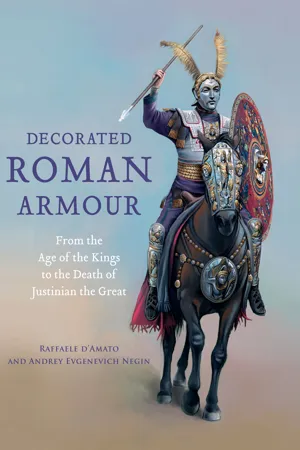
eBook - ePub
Decorated Roman Armour
From the Age of the Kings to the Death of Justinian the Great
- 392 pages
- English
- ePUB (mobile friendly)
- Available on iOS & Android
eBook - ePub
Decorated Roman Armour
From the Age of the Kings to the Death of Justinian the Great
About this book
From the time of the Bronze Age, the warriors of all tribes and nations sought to emblazon their arms and armour with items and images to impress upon the enemy the wealth and power of the wearer. Magnificently decorated shields were as much a defensive necessity as a symbol of social status. Equally, decorative symbols on shields and armour defined the collective ideals and the self-conceived important of the village or city-state its warriors represented.Such items were therefore of great significance to the wearers, and the authors of this astounding detailed and extensively research book, have brought together years of research and the latest archaeological discoveries, to produce a work of undeniable importance.Shining Under the Eagles is richly decorated throughout, and as well as battlefield armour, details the tournament and parade armour from Rome's the earliest days.Dr Andrey Negin is candidate of historical sciences (Russian PhD), member of the department of history of the Ancient World and Classical Languages of Nizhny Novgorod State University named after N.I. Lobachevsky (Russian Federation). He has carried out fieldwork on ancient Roman armour and has published books and numerous articles on Roman military equipment.Dr Raffaele D'Amato is an experienced Turin-based researcher of the ancient and medieval military worlds. After achieving his first PhD in Romano-Byzantine Law, and having collaborated with the University of Athens, he gained a second doctorate in Roman military archaeology. He spent the last year in Turkey as visiting professor at the Fatih University of Istanbul, teaching there and working on a project about the army of Byzantium. He currently work as part-time researcher at the Laboratory of the Danubian Provinces at the University of Ferrara, under Professor Livio Zerbini.
Information
Topic
HistoriaSubtopic
Historia militar y marítima1
DECORATED ARMOUR IN THE AGE OF THE KINGS
(753–509 BC)
THE ARMAMENT OF THE EARLY ROMAN WARRIOR
The panoply of the warrior of the age of romulus, as well as of the warriors of the age of the Kings, was usually the military accoutrements of the european late Bronze age warrior, but was sometimes of very elaborate pattern. Basically the defensive armament of the elite warrior, the aristocratic leader of a tribal contingent or of a warrior band, was composed of a shield, a helm and armour, the offensive of a spear and a sword. However, it was in the protective equipment that the romans, under the influence of their neighbours, begin to apply particular care in the lavish decoration of their panoplies, linked with the sacred symbols of their primitive religion.
THE SHIELD
The shield or scutum was in use from the days of romulus and according to Plutarch the first king of rome replaced the bronze Argive shield (aspis or clipeus) with the sabine shield or thyréos (Greek name for the scutum1), i.e. a bigger shield. On the other hand, Diodorus siculus presented the thyréos as the first roman shield. It is however very difficult to know if Plutarch saw with his own eyes ancient bronze shields in the sacrarium of romulus and, considering the roman shields of his own age, wished to attribute to romulus the much more famous scutum or thyréos.2 According to Dionysius3 the clipeus was a copy of the Argive aspis and existed from the time of romulus.
Contemporary bronze figurines4 and decorative figures of warriors, in metal foil applied on fabric,5 show how during the period of the early kings shield decorations were of Villanovan style. The bronze Argive shield mentioned by Plutarch should therefore be understood to be the extensively embossed and decorated shields of the Villanovan Age, of which rome has provided some examples.
These defensive items, probably manufactured in etruria, most likely in tarquinii, were used both for ceremonial purposes and in battle6 in ancient times so-called ‘parade’ equipment in reality displayed the wealth and power of the wearer to the enemy and moreover the practical purpose of the weapon always took precedence over any ceremonial use. Depictions of fighting warriors and deities from the Villanovan period also attest to the use of these shields in battle, without compromising their importance as signs of social status.7
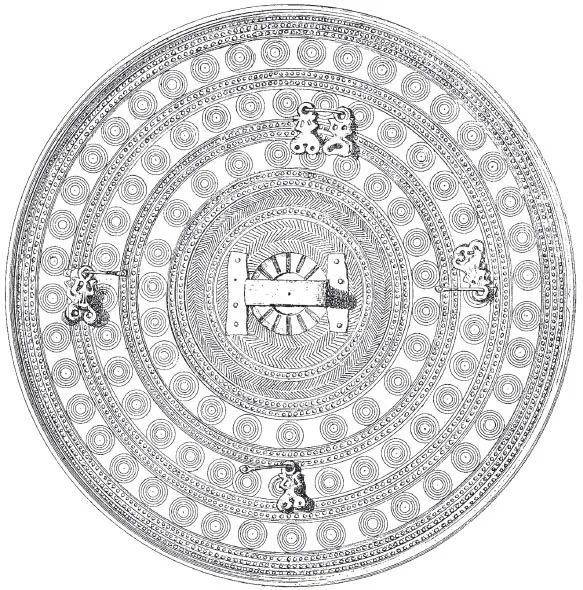
FIG. 1. Bronze shield from Corneto, identical to that from Esquiline grave 94, eighth century BC. (After Pinza, 1905, fig. 62)
These shields, as shown by the specimens found in Tarquinia (Tomba del Guerriero) and Verrucchio, were lined with leather.8 this fact, as already emphasised by saultner,9 is further proof that the long-held opinion that shields made from bronze sheets would have been, as were some helmets, just parade items and not intended for practical use in action, was wrong. The presence of leather (or some other organic perishable fabric) under the bronze sheet to absorb the impact of blows shows the shield was meant to be used in hand-to-hand combat.10 however, most modern scholars have tended to emphasise the purely ornamental function of such items, on the basis that, in some finds, the delicacy of the heavily-ornamented shield’s bronze sheet is proof of its exclusively ceremonial use. Other scholars support the thesis that these shields were solely employed as decorative objects, considering that some of them, in the Villanovan-etruscan milieu, were hung on the walls of graves.11 of course we cannot exclude an ornamental function for the shields placed – during the orientalizing Period – in female graves (e.g. grave 70 of laurentina or grave 17 of Pitino, near san severino marche). But this does not exclude the possibility that these shields could have been used in battle and then used to ornament the grave of a high-ranking woman, perhaps the wife of a prominent warlord.12 in any case, for most ancient graves, especially those of warriors, this interpretation is rejected. In iron Age etruria, the graves of eminent persons are usually characterised by full panoply, comprising functional defensive as well as offensive weapons:13 so there is not reason to exclude the possibility that these bronze shields also had a military use. In the passage from the earlier to the so-called orientalising period, the military elements of some funerary contexts seems no more functional, so they have been interpreted as parade items by some authors, especially the helmets and the shields covered with bronze sheets, placed in the graves of south etruria, on whose borders rome lies.
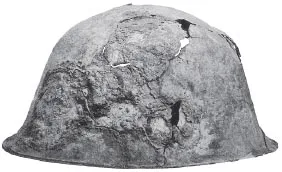
FIG. 2. Bronze helmet from Rome, Esquiline grave 94, eighth century BC. (After Pinza, 1905, tav. XI, 11)
In considering this point, we must remember that social evolution differed between northern and southern etruria in precisely this orientalising period, in aspects of social life associated with weapons: hunting, training, symposium.14 these differences are visible also in the deposition of the weapons in graves: while in northern etruria the combination of weapons seems to mirror effective uses, in south etruria and in rome the weapons are rare, if not entirely absent, in some graves. In this singular situation, indeed, the wealth of the armament would have been only intended to legitimise the socio-economic hierarchy within the group.15 however, this prestige would have not been of a value reflected outside the group, if we accept the theory that the Villanovan community would have brought into battle simple weapons of offense, or were only wearing modest garments made of perishable materials and devoid of metal components. Recent studies have shown how this metal protection was perfectly suited for battle,16 although only the wealthiest men could afford the full panoply (helmet, shield, breastplate) fashioned from beaten bronze and with embossed decoration.17
Further support for the thesis that the bronze-sheet shields were used in actual combat is that it would not have been in the mentality of the ancients merely to use costly and beautiful weapons domi and not bellique, i.e. only during feasts or religious ceremonies in time of peace. Such weapons were also worn in wartime, to show the power and wealth of the wearer and of his community.18
The display on the battlefield and especially before of the enemy of symbols of wealth received originally also had a tribal collective value: the demonstration of well-being throughout the village, indicating its importance. Examples of this were the famous roman bronze ancilia shields, derived from a model ‘fallen’ from heaven and preserved by the college of the salii.19 they were considered a collective treasure of particular religious value and as objects of fundamental importance for the entire community.
This Villanovan shield was formed of thin sheets of laminated bronze, decorated with repoussè ornamentation, fixed over, as in the Achaean and archaic Greek shields, with a padding of hardened leather or wood, all materials which generally perished over time.20 Virgil, describing the archaic bronze latin shields, speaks of a lining of seven layers of leather.21 the bronze surface of the shield, whose structure recalled the Argive one, was embossed with geometrical patterns an...
Table of contents
- Cover
- Title
- Copyright
- Contents
- LIST OF PLATES
- ACKNOWLEDGEMENTS
- INTRODUCTION
- 1 DECORATED ARMOUR IN THE AGE OF THE KINGS (753–509 BC)
- 2 DECORATED ARMOUR IN THE AGE OF THE CONSULS (509–27 BC)
- 3 DECORATED ARMOUR OF THE PRINCIPATE (27 BC–AD 284)
- 4 DECORATED ARMOUR OF THE PRINCIPATE IN ARCHAEOLOGICAL CONTEXT
- 5 DECORATED ARMOUR OF THE DOMINATE (AD 284–565)
- NOTES
- BIBLIOGRAPHY
- Plate section
Trusted by 375,005 students
Access to over 1.5 million titles for a fair monthly price.
Study more efficiently using our study tools.
Frequently asked questions
Yes, you can cancel anytime from the Subscription tab in your account settings on the Perlego website. Your subscription will stay active until the end of your current billing period. Learn how to cancel your subscription
No, books cannot be downloaded as external files, such as PDFs, for use outside of Perlego. However, you can download books within the Perlego app for offline reading on mobile or tablet. Learn how to download books offline
We are an online textbook subscription service, where you can get access to an entire online library for less than the price of a single book per month. With over 1.5 million books across 990+ topics, we’ve got you covered! Learn about our mission
Look out for the read-aloud symbol on your next book to see if you can listen to it. The read-aloud tool reads text aloud for you, highlighting the text as it is being read. You can pause it, speed it up and slow it down. Learn more about Read Aloud
Yes! You can use the Perlego app on both iOS and Android devices to read anytime, anywhere — even offline. Perfect for commutes or when you’re on the go.
Please note we cannot support devices running on iOS 13 and Android 7 or earlier. Learn more about using the app
Please note we cannot support devices running on iOS 13 and Android 7 or earlier. Learn more about using the app
Yes, you can access Decorated Roman Armour by Raffaele D'Amato,Andrey Evgenevich Negin in PDF and/or ePUB format, as well as other popular books in Historia & Historia militar y marítima. We have over 1.5 million books available in our catalogue for you to explore.