- 256 pages
- English
- ePUB (mobile friendly)
- Available on iOS & Android
eBook - ePub
About this book
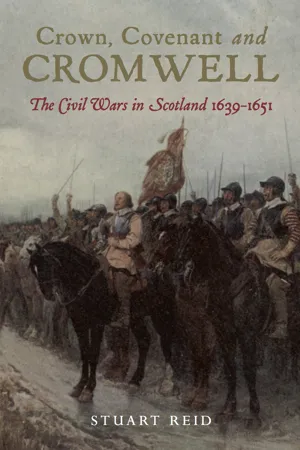
Crown, Covenant and Cromwell is a groundbreaking military history of the Great Civil War or rather the last Anglo-Scottish War as it was fought in Scotland and by Scottish armies in England between 1639 and 1651. While the politics of the time are necessarily touched upon, it is above all the story of those armies and the men who marched in them under generals such as Alexander Leslie, the illiterate soldier of fortune who became Earl of Leven, James Graham, Marquis of Montrose and of course Oliver Cromwell, the fenland farmer and Lord Protector of England.Historians sometimes seem to regard battles as rather too exciting to be a respectable field of study, but determining just how that battle was won or lost is often just as important as unraveling the underlying reasons why it came to be fought in the first place or the consequences that followed. Here, Stuart Reid, one of Scotlands leading military historians, brings the campaigns and battles of those far off unhappy times to life in a fast-paced and authoritative narrative as never before.
Information
Chapter 1
Scotland, the Scots and the Art of War
When James VI of Scotland found himself become King James I of England in 1603 he undoubtedly regarded it as a happy event long anticipated if not entirely welcomed on both sides of the border. Half a century earlier England had gone to war with the aim of forcing the Scots to agree to a marriage between their then infant Queen Mary and her cousin, the marginally less infant King Edward, but despite inflicting a crushing defeat at Pinkie Cleugh, just outside Musselburgh, on 10 September 1547, the attempted coercion ended in failure. The Scots refused to surrender.1 Instead Mary married first a French prince and then her cousin, Henry Stewart, Lord Darnley. As the son and heir of the Earl of Lennox, Darnley had a fair claim to the Scottish throne in his own right, but it was the fact that both he and Mary were also grandchildren of King Henry VIII’s sister, Margaret Tudor, that eventually brought their son James, the Scottish king, to the English throne in succession to the childless Queen Elizabeth.
Hurrying south to take up his eagerly awaited inheritance before a native-born English candidate might emerge James was also making a fortunate escape from the seemingly endless round of rebellions, kidnappings, assassination attempts and coups, which passed for court life in sixteenth-century Scotland. The sad fact of the matter was that traditionally the Scots took a far more robust view of kingship than might be supposed from the later cult of romantic Jacobitism. Instead while the authority of the Crown was outwardly unquestioned, the man (or woman) who wore it was often a different matter entirely. All too often regime change in Scotland was effected by securing physical possession of the king and thenceforth acting in his name. After that austere and often exciting experience an opulent English court schooled in the cult of Gloriana must have seemed to James like something akin to paradise. While the king’s new courtiers might be just as disposed to intrigue and treachery as his old ones, they at least stopped well short of open warfare in the precincts of the palace and he could at last retire to his bed without too much fear of awakening to a ring of armed men intent on securing his person dead or alive.
Instead, as he boasted from Westminster in 1607: ‘Here I sit and govern it with my pen: I write and it is done: and by a Clerk of the Council I govern Scotland, which others could not do by the Sword.’2 It was perfectly true, but Scotland had not become England. James was king of both countries but they were not yet politically united – as they might have been had Edward married the young Mary. James’ Scottish kingdom remained an entirely separate realm in law, language and custom and, as he himself recognised only too well, this new-found complaisance was going to be enjoyed only for so long as he gave his Scottish subjects no cause to set aside old rivalries and combine against his distant authority. Consequently he stepped carefully with his proposed reforms and innovations, such as the reintroduction of bishops, but unfortunately his son and successor, King Charles I, had no such inhibitions. Having been brought south of the border at the tender age of three, Charles never fully appreciated the all-important political and cultural differences between his two kingdoms, and moreover utterly lacked the pragmatism that underpinned his father’s governance. King James, memorably lampooned as the ‘Wisest Fool in Christendom’, might have hopefully espoused the doctrine of the divine right of kings, but he still had the great good sense not to push his luck by actually trying to govern his kingdoms accordingly. Charles on the other hand really did appear to believe that as God’s anointed he could do no wrong, and so he embraced Absolutism long before Louis XIV of France made it respectable. As a result his belated Edinburgh coronation in 1633, fully eight years after James had shuffled off his mortal coil, was the prelude to disaster – to the National Covenant and to two decades of war.3
Covenant and Country
The widespread signing of the Covenant in 1638 – outwardly no more than an affirmation of Scottish adherence to the reformed church – unquestionably signalled the beginning of what one chronicler of the time aptly termed the ‘Trubles’. While it is easy to view the struggle simply as a religious war, it has rightly been remarked that in seventeenth-century Scotland ‘ecclesiastical issues alone, and ministers alone, could never bring about a revolution’.4 Instead the Covenant was also a response to a wide-ranging set of secular as well as religious grievances, which came about and grew over a long number of years. It is a measure of Charles’ political ineptitude that he encompassed his own downfall by initiating what was intended to be a revolution in both church and state – while simultaneously alienating all four of the country’s ‘Estates’.
Unlike Charles’ moribund English Parliament, the Scots legislature comprised not two discrete houses but four collegiate ‘Estates’. Traditionally there had been three, although the tenants in chief – that is those holding lands directly from the Crown – were themselves divided between the nobility, sitting in their own right as lords of Parliament, and the lesser tenants, who elected only a proportion of their number to serve as representatives for each shire, thus creating in effect another Estate. The others were the representatives of the royal burghs; and the representatives of the church or Kirk. It was the latter who proved controversial. Before the Protestant Reformation it was the bishops as lords spiritual who sat in Parliament, just as they did in England, but ousting the bishops in favour of Calvinist presbyteries gave this Estate into the hands not only of ministers of religion who owed no allegiance but to their God and their presbytery, but also opened it to the lesser lairds, burgesses and tradesmen serving as lay elders of the Kirk.
Almost by default John Calvin’s religious teaching had also brought about a far greater degree of democratic accountability in secular government, little dented by King James’ reintroduction of bishops as presidents of their presbyteries in 1610. Outwardly this particular measure might appear to have restored the political status quo, but in reality it was a compromise under which the new bishops found themselves to a degree accountable to their presbyteries on both temporal and spiritual matters.
Charles on the other hand had an altogether different notion of the power and the authority of the bishops, whom he regarded from the outset of his reign principally as an executive arm of his own personal authority. Simply put, his view was that since he was the head of the church, its officials were therefore his to command.
However another important cause of what was to follow can also be traced back to Charles’ accession to the Scottish throne in 1625 and to the Act of Revocation which accompanied it. The frequency with which Scotland was ruled by regents, acting in the name of infant monarchs, led to the convention that between the ages of twenty-one and twenty-five the king could revoke all gifts of land and property made during his minority, because he may have been unduly influenced by whoever was acting as regent at the time. There was no justification for such a Revocation in Charles’ case because he was already of age and indeed almost out of time when he succeeded his father. However not only did he go ahead and proclaim one in 1626, but against all precedent he also extended it backwards to encompass all disposals of both royal and ecclesiastical lands that had been made since 1540!
The significance of this distant and seeming arbitrary point in time was that it predated the death of King James V in 1542 and the Rough Wooing which followed as first England and then France sought to gain control of Scotland. It was a period of near anarchy, complicated by the Protestant Reformation and by power struggles between the various factions intent on securing the regency, which would later be dramatised by William Shakespeare as the central theme of Macbeth.5 In the end Scotland’s independence was maintained but it was a ruinously expensive business which saw the old Catholic Kirk shorn of its vast landholdings; taxed, mortgaged and otherwise secularised first to help pay for the war against England and latterly to the benefit of the Protestant Lords of the Congregation, who then fought to secure the Reformation and expel their soi-disant French allies. Now although most of those lost lands were to remain in the actual possession of their present occupiers, all the feus and other taxes attaching to them were to revert directly to the Crown. While the analogy is not an exact one, Charles was in effect proposing to convert the tenure of the lost lands from freehold to leasehold. By way of softening the blow, compensation for their revenues valued at ten years’ purchase was promised to the present owners, but the Exchequer was all but bankrupt and this was sagely regarded as unlikely to materialise. More importantly in a culture where the number of a man’s tenants and followers was still generally accounted of rather greater importance than more material indicators of wealth, the potential loss of those tenants and followers was a very serious matter indeed.
Outwardly Charles’ belated return to Scotland in 1633 might have begun promisingly enough with all the pomp and splendour a coronation demanded, and the Edinburgh militia even tricked themselves out in new white satin doublets, black velvet breeches, silk stockings and feathered hats especially for the occasion.6 No sooner had the necessary ceremonies been observed and the king departed southwards again than the real trouble began, for by then, in addition to the still festering matter of the Revocation, a number of other serious grievances had arisen.
Insofar as he ever deigned to explain himself at all, Charles’ ostensible justification for the dubious recovery of those former ecclesiastical lands was to enable him to employ their revenues to provide proper stipends for ministers of the church and also to finance radical changes in religious practice in parallel with Archbishop Laud’s concurrent remodelling of the Church of England. Such changes would see the return of full Episcopal government of the church untrammelled by presbyteries, together with a prescribed book of common prayer and Anglican forms of worship which appeared little altered from those of the Catholic Church.
Unfortunately for the king’s ambition, this enforced counter-reformation, suspected by many as heralding a complete return to Catholicism, alienated the Protestant population at large and deepened the resentment of those whose revenues were ostensibly to be diverted to the purpose. By November 1637 opposition to the king’s policies was nearly universal. Instructions to use the prayer book had generally been ignored and the few attempts to read it only provoked rioting. Royal authority evaporated and in the absence of a formally constituted parliament the ordinary running of the country was soon being conducted by noblemen, lairds, burgesses and ministers serving together on a variety of ad hoc boards or ‘Tables’.
Finally, in flat defiance of the law forbidding the signing of private bands or agreements binding men to support each other either personally or in pursuit of a common object, on 28 February 1638 the first signatures were being applied to a general band7 known as the National Covenant, pledging the Scots nation to the defence of the Protestant religion. The king was not explicitly challenged by the text of this Covenant, but as the perceived threat to the reformed Kirk came from him alone there was no mistaking the significance of what was being signed.
Throughout that year negotiations aimed at averting the impending crisis were conducted between the Tables and the king’s commissioner, James, Marquis of Hamilton. In fairness to the much criticised Hamilton, he was in an impossible position with nothing but the empty authority of the Crown to back him up against men whose ancestors had once declared at Arbroath that the king of Scots ruled only by the consent of his people and that he could be deposed if he misused the powers entrusted to him. Moreover Hamilton was not unsympathetic to their cause and consequently the role he played was an equivocal one – on the one hand publicly acting for the king in the council chamber and yet at the same time secretly encouraging the Covenanters, as the dissidents were now known, to stick by their demands.
The result was inevitable. Charles, finding his servants unwilling or unable to uphold his authority, resolved to crush the Covenanters by force, while they for their part equally stoutly resolved to resist him. And so before embarking on the campaigns of Leslie, Montrose and Cromwell, a brief look at Scotland’s strategic geography and the art of war as it was to be practised in the mid-seventeenth century is in order.
Going to the Wars
Other than a few garrison soldiers and ceremonial bodyguards, there were no standing armies on either side at the outset of what eventually grew to become the War of the Three Kingdoms. It is a commonplace to preface histories of the time with comments as to the lack of military knowledge or experience to be found in countries that had been at peace for generations. In a broad sense this was true, but there were always soldiers in Ireland and an expeditionary force had been mustered for a half-hearted war with France in the 1620s. Far more importantly, in addition to countless individuals who had tried their luck in the seemingly never-ending wars in the Netherlands, or Germany, or even farther afield in Poland and Muscovy, military contractors (including the Marquis of Hamilton) had recruited whole regiments for the Swedish service in the 1630s. There was therefore a deep pool of professional expertise available to raise, mould and train armies according to the very latest doctrines, and as war became inevitable both sides scrambled to secure the services of these veterans.
Most of them as it happens were Scots, and, while many having no doubt left their country for their country’s good never returned home again, more than enough of them responded to the Covenanters’ invitation and ‘cam in gryte numberis vpone hope of bloodie war, thinking (as thay war all Scottis soldiouris that cam) to mak wp thair fortunes vpone the rwin of our kingdome.’8 There were sufficient in fact to permit the Covenanters the luxury of interlarding every regiment with professional soldiers who knew their business. If a nobleman was placed at the head of a regiment then his second-in-command would be a veteran of the German wars, and if each company within that regiment was led by a bonnet laird, then he too would have an old soldier for his ensign and one or two others as sergeants. South of the border the process was never as formalised, but Charles too did his best to ensure that in 1639 his infantry regiments at the very least were led by experienced soldiers.
The rank and file of course were a different matter. In England the king’s regiments were at first intended to be drawn from the county Trained Bands – a militia supposedly drawn from the propertied classes who had a proper stake in defending the country and maintaining the peace: ‘none of the meaner sort, nor servants; but only such as be of the Gentrie, Freeholders, and good Farmers, or their sonnes, that are like to be resident’. Each of those respectable country gentlemen was assessed according to his means as being capable of providing arms for himself, either as a cavalryman or a foot soldier, and if wealthy enough for his sons and tenants too. Inevitably, although the law required personal service, all too often those who actually appeared were Oliver Cromwell’s infamous ‘decayed serving men and tapsters’, or as a professional soldier named William Barriffe grumbled: ‘Porters, Colliars, Water-bearers, & Broom men, are thrust into the rooms of men of better quality, as though they themselves were too good to do the King and their Country service.’9 They behaved dismally during the first encounters with the Scots in 1639 and 1640, and therefore when the civil wars got under way in earnest in the 1640s King Charles settled for taking their weapons and equipment and instead left it to his officers to recruit the men they needed by whatever means they chose. His rebellious English Parliament did likewise, and initially filled the ranks of its regiments with enthusiastic volunteers. In the fullness of time, as that early enthusiasm waned, both parties eventually resorted to an ad hoc form of conscription, simply demanding that the local authorities turn over the men required without troubling themselves overmuch as to how they were to be found.
In Scotland, although in some areas the very first regiments were through necessity levied directly by local noblemen and lairds from among their tenants and dependants, most soldiers were raised under the old fencible system. By custom and law, and irrespective of status, all those men aged between the traditional ages of sixteen and sixty were liable to turn out as required for up to forty days’ service. In January 1639 as the crisis deepened instructions were circulated by the Tables for the forming of local committees of war. They were charged with managing the process by first carrying out a series of preliminary musters or Wapenschaws (weapon-showings) to establish the extent of the available manpower, whittle them down to a manageable pool of young and unmarried men who were actually fit for service, and then as directed by the government to levy out one man in four or occasionally one in eight from the rolls and form them into regiments.
The local committees of war were also responsible for clothing, equipping, feeding and even paying them for those forty days. John Spalding recorded of a contingent raised in Aberdeen in 1644 that each soldier was provided with two shirts, coat, breeches, stockings and bonnet, bands and shoes . . . each was to have six shillings (Scots) a day, and each twelve a baggage horse and cooking utensils.10 It sounded impressive, but if their services were required beyond that forty-day period responsibility then passed to the ...
Table of contents
- Title Page
- Copyright Page
- Table of Contents
- Illustrations
- Chronology
- Introduction
- Chapter 1 - Scotland, the Scots and the Art of War
- Chapter 2 - Treason Never Doth Prosper
- Chapter 3 - Blue Bonnets Over the Border
- Chapter 4 - With Brode Swordis but Mercy or Remeid
- Chapter 5 - Bitter Winter
- Chapter 6 - We Gat Fechtin’ Oor Fill
- Chapter 7 - High Noon
- Chapter 8 - An End and a New Beginning
- Chapter 9 - The King in the North
- Chapter 10 - Curs’d Dunbar
- Chapter 11 - The Last Hurrah
- Appendices
- Notes
- Bibliography
- Index
Trusted by 375,005 students
Access to over 1.5 million titles for a fair monthly price.
Study more efficiently using our study tools.
Frequently asked questions
Yes, you can cancel anytime from the Subscription tab in your account settings on the Perlego website. Your subscription will stay active until the end of your current billing period. Learn how to cancel your subscription
No, books cannot be downloaded as external files, such as PDFs, for use outside of Perlego. However, you can download books within the Perlego app for offline reading on mobile or tablet. Learn how to download books offline
Perlego offers two plans: Essential and Complete
- Essential is ideal for learners and professionals who enjoy exploring a wide range of subjects. Access the Essential Library with 800,000+ trusted titles and best-sellers across business, personal growth, and the humanities. Includes unlimited reading time and Standard Read Aloud voice.
- Complete: Perfect for advanced learners and researchers needing full, unrestricted access. Unlock 1.5M+ books across hundreds of subjects, including academic and specialized titles. The Complete Plan also includes advanced features like Premium Read Aloud and Research Assistant.
We are an online textbook subscription service, where you can get access to an entire online library for less than the price of a single book per month. With over 1.5 million books across 990+ topics, we’ve got you covered! Learn about our mission
Look out for the read-aloud symbol on your next book to see if you can listen to it. The read-aloud tool reads text aloud for you, highlighting the text as it is being read. You can pause it, speed it up and slow it down. Learn more about Read Aloud
Yes! You can use the Perlego app on both iOS and Android devices to read anytime, anywhere — even offline. Perfect for commutes or when you’re on the go.
Please note we cannot support devices running on iOS 13 and Android 7 or earlier. Learn more about using the app
Please note we cannot support devices running on iOS 13 and Android 7 or earlier. Learn more about using the app
Yes, you can access Crown, Covenant and Cromwell by Stuart Reid in PDF and/or ePUB format, as well as other popular books in History & British History. We have over 1.5 million books available in our catalogue for you to explore.