An in-depth look at the army of Africa's Zulu kingdom leading up to their epic battle against the British army in 1879.
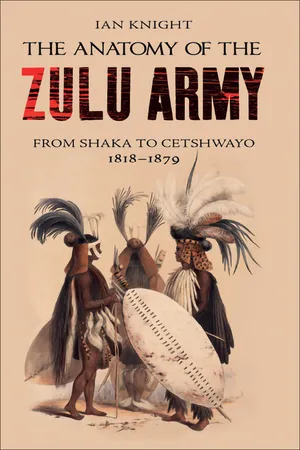
Forces of the independent Zulu kingdom inflicted a crushing defeat on British imperial forces at Isandlwana in January, 1879. The Zulu Army was not, however, a professional force, unlike its British counterpart, but was the mobilized manpower of the Zulu state. Ian Knight details how the Zulu army functioned and ties its role firmly to the broader context of Zulu society and culture.
The Zulu army had its roots in the early groups of young men who took part in combat between tribes, but such warfare was limited to disputes over cattle ownership, grazing rights, or avenging insults. In the early nineteenth century the Zulu nation began a period of rapid expansion, and King Shaka began to reform his forces into regular military units.
Ian Knight charts the development and training of the men that formed the impi, which later operated so successfully under King Cetshwayo. Knight analyzes the Zulu's fighting methods, weapons, and philosophy, all of which led to the disciplined force that faced the British army in 1879.
"For me, this is the Zulu bible—everything you need to know about this warrior race over a 60-year period during the 19th Century. The battles fought are legendary and well covered many times over in other books, but Knight's "anatomy" goes much deeper. The book explains why the Zulu Army was so fearsome and effective, by exposing how each warrior was virtually nurtured into the role from birth and remained loyal until death." —David H. Smith,
Military Modelling
- 282 pages
- English
- ePUB (mobile friendly)
- Available on iOS & Android
eBook - ePub
About this book
Information
Topic
HistoriaSubtopic
Historia del siglo XIXCHAPTER 1
Breaking the Rope
There is an old story told in Zululand, even today,1 about the rivalry between the British empire and the independent Zulu kingdom on the eve of the 1879 Anglo-Zulu War. Like all good stories, it is almost certainly apocryphal, and it seems to have gained its greatest currency in the last years of the nineteenth century, when the full impact of the Zulu military defeat had become obvious to all levels of society. The story refers to a time before the war, which even then was assuming all the mythic status of a vanished golden age; King Cetshwayo kaMpande was on the throne, and the kingdom had never seemed richer or more powerful. Yet the true situation was very different, for in fact the balance of regional power had already shifted south across the Thukela river, to the neighbouring territory of Natal, where the British had ruled since 1843. The British and the Zulus were being propelled into conflict by deep political and economic rivalries, the full implications of which were scarcely recognised in the Zulu heartland. When the first tensions arose, so the story has it, King Cetshwayo sent a container of millet, uphoko, to Natal’s Secretary for Native Affairs, Theophilus Shepstone. It was a gesture which implied both a boast and a veiled threat, a warning not to interfere in the affairs of a strong nation: ‘If you can count the number of grains in this uphoko, the king’s message ran, ‘then you will have counted the number of the Zulu people.’ Shepstone, who was never one to shirk a theatrical gesture himself, immediately sent back to the king a bullock hide. ‘Ah,’ he is said to have replied, ‘but if you can count the hairs on this hide, then you will know how many are the English.’
It is, of course, a story that is only poignant with hindsight, for by the time it became widely believed, the bitter underlying truth of the parable was all too apparent. Tension had given way to military confrontation, and the Zulus, whose military prowess had been renowned across southern Africa, had been broken and humiliated. On no less than three occasions, their army had defeated the British in the field: once, at Isandlwana, that defeat had been as spectacular as any endured by the imperial power in the nineteenth century.2 Yet in the end, the courage of the Zulu people had proved an ineffective armour against the might of European industrial technology. The grand heroic charges of the massed amabutho, the king’s regiments, had withered before the storm of shot and shell, and the invaders, thrusting right into the heart of the Zulu country, had defeated the king on the very threshold of his royal homestead. The great settlements which embodied the power of the Zulu royal house were razed to the ground, and Cetshwayo himself captured and sent into exile. Few Zulu families escaped without a father, brother or son being struck down or wounded in the struggle. In the bitter years that followed, the country fell apart into civil war, and the people were drawn increasingly into a colonial system which dismissed their culture and traditions and valued them only as a source of cheap labour. King Cetshwayo’s container of millet was indeed spilt upon the ground, and the hairs on the hide of European ascendancy grew more luxuriant than ever.
The coming of the whites
Ironically, early relations between the British and the Zulu kingdom had been good. European settlement in the sub-continent dated back to 1652, when the Dutch East India Company had occupied the Cape peninsula, establishing a victualling station for their ships on the long haul from Europe to the profitable markets of the Indies. Although the company proved reluctant to expand into the hinterland, it was unable to contain its own settler population, that mixture of Dutch, German and French religious refugees who came in time to think of themselves as Afrikaners – white Africans – or, with simple pride, Boers – farmers. As the settler community expanded slowly eastward, so it clashed with the robust African societies who inhabited the rolling downland of the eastern Cape. In 1806, as part of the fall-out from the wide-ranging conflicts in post-Revolutionary Europe, Britain took over control of the Cape from the Dutch, inheriting a complex and tense situation which deteriorated still further over the next half-century.
By the 1870s, a deep-rooted antagonism had sprung up between the Afrikaners, who had established two independent republics in the interior, the Orange Free State and the Transvaal, and the British, who held the Cape and Natal on the eastern seaboard. Sandwiched in between, their political and economic independence steadily eroding, lay the remains of the original black groups. The constant friction between all of these people was increasingly resolved at the expense of the blood of the British red-coat, and by a constant drain on the exchequer. Not until diamonds were discovered at Kimberley in 1867 did the region offer any potential return on Britain’s investment, and the politically fractured state of the region hampered the introduction of an effective infrastructure to exploit the mineral wealth. Grasping the nettle, the Colonial Office in London hit upon a scheme, tried with some success in Canada, which it called Confederation. The idea was to bring all of the disparate parties together under British rule, ostensibly for their own good. Ironically, the Transvaal was the first to be absorbed, since its fragile economy and chaotic administration made annexation an easy British option. In 1877, after the most cursory and selective sampling of Boer opinion, British troops raised the Union Flag in Pretoria.
With the Transvaal, however, came a festering border dispute with the Zulus. The two states abutted each other along the foothills of the inland mountain range known to the Africans as Kahlamba, ‘the barrier of upturned spears’, and to the Boers as the Drakensberg – the Dragon Mountains. When the first Boers had trekked away from British rule at the Cape in the 1830s, and settled the Transvaal, the border had remained largely undefined, but by the 1870s population pressure on both sides had thrown the issue into relief, and on several occasions it had threatened to erupt into violence. It was at this point that a new British High Commissioner, Sir Henry Bartle Frere, arrived in the Cape, with a brief to push through the Confederation policy as swiftly as possible.
Frere and Confederation
Ironically, it was Frere, who wished to see the Zulu kingdom destroyed, who was largely responsible for focusing outside attention on one of its major institutions, its army. Advised by expansionists within the settler community, who saw in Zululand a block to Natal’s economic development, and by missionaries frustrated at their lack of success in Zululand, Frere came to believe that the Zulus were a potential threat to the Confederation scheme; he saw the Zulu monarch as the ‘head and moving spirit’ behind a wave of unrest that swept through the black population across the region as Britain tightened its grip. Furthermore, Zulu intransigence offered an ideal opportunity for a little judicious wielding of British military might, which would serve as a useful example to any other groups who might be inclined to oppose Confederation.3
Frere began a propaganda campaign with the aim of mobilising opinion, both among the settlers of British southern Africa and inside the Colonial Office in London, behind the cause of armed intervention. Fuelling his arguments with imagery borrowed from the missionary community in Zululand, he characterised the Zulu kingdom as a ruthless and godless despotism, which exercised unnatural restraint over its army, and kept its own civilian population in check by the unsubtle use of naked force. ‘I would not for an instant question,’ he wrote to the Colonial Secretary, Sir Michael Hicks Beach, in December 1878,4
our responsibility for putting an end to a system which locks up all the manhood of the country in a compulsory celibacy, considered by the despot necessary for the efficiency of his army, that army having no possible use but to threaten us or other friendly people who surround him, a system which massacres hundreds of young women who refuse at his bidding to become the wives of elderly soldiers to whom they are sold off, a system which destroys all private property and industry, which forbids all improvements by civilisation or education, and relies solely on a regular course of murder and plunder by armed bands of the King’s soldiers for the replenishment of the royal exchequer.
This image, of course, reveals more about the preoccupations of Victorian Britain than it does about the Zulu kingdom, based as it is on the virtues of the Christian marriage contract, the ennobling power of labour, and the sanctity of private property. Yet Frere had couched his message well; in England, the picture of the swaggering and truculent Zulu bully was sure to be decidedly unappealing to the public school-educated élite which controlled the government and civil service, while the implied threat of hordes of young black warriors, seething with a sexual frustration somehow transmuted to bloodlust and poised to sweep down upon helpless white families, must have had genteel young ladies swooning clear across the Home Counties. In South Africa, too, Frere’s vision of the ‘faithless and cruel’ King Cetshwayo and his army, ‘forty to sixty thousand strong, well armed, unconquered, insolent, burning to clear out the white man’, struck a chord, for the history of colonial Natal and its northern neighbour had been inextricably entwined, and for a generation many white settlers had been living under the shadow of the Zulu threat.
Zululand and Natal
The Zulu kingdom had emerged early in the nineteenth century, expanding from a heartland along the middle reaches of the White Mfolozi, until it exerted control over considerable tracts of country south of the Thukela river, the area known to the European world as Natal. When the first British traders had arrived in 1824, the Zulu king, Shaka kaSenzangakhona, had granted them land around the bay of Port Natal – the region’s only viable harbour – and from this tiny anarchic settlement all British claims in the region had stemmed. Within a few years the Zulus had abandoned their claims to Natal, and the British colony had slowly developed, but those early years had been marked by occasional ruptures in the good relations between the two states which had been so spectacular that they were seared into the folk memory of the settler community. When in 1838 the first Boers crossed the Drakensberg mountains into Natal, a particularly brutal war had broken out between them and King Dingane, Shaka’s successor. In the ensuing campaigns, the Zulu army had swept into Natal twice, once massacring Boer civilians in the foothills of the inland mountains, and once sacking the settlement at Port Natal itself. Although there were no further clashes between Natal and the Zulu kingdom in the years between 1840 and 1879, occasional discontent within Natal’s black population, and political friction inside Zululand, were enough to keep alive the feeling of vulnerability among Natal’s whites. In 1878 a local newspaper articulated this insecurity:
Hitherto we have lived in a species of phantasmagoria of Zulu scares. We have been all our lifetime subject to bondage, our Colonists may well say, by reason of this black shadow across the Tugela … it is believed that an effective demonstration of British power will be required before the Zulu power shall cease to be such a disquieting element in South-East Africa…. Such a nation must of necessity form a constant menace to the peaceable European communities beyond their borders…. Civilisation cannot co-exist with such a condition of things beyond its outskirts.5
Frere’s highly charged rhetoric intensified these fears, but it did beg a number of interesting questions. It assumed, for one thing, that the Zulu army was indeed a threat (of course it was only so if the Zulu monarch chose to unleash it) and that the Zulu people felt themselves to be oppressed by their own political system. Yet these issues were not Frere’s primary concerns, and neither was he being entirely honest in his depiction of the Zulu danger. Had he been asked he might, like Shepstone, have pointed to the bullock skin as an indication of how the balance of power really lay. Although Frere enjoyed only tepid support for a forward policy among Colonial Office officials in London, the military resources of the British empire world-wide were almost limitless, and it was inconceivable that Britain, once committed, would allow itself to be defeated by the Zulus. Frere was keen to break the independent power of the Zulu kingdom, in keeping with the Confederation scheme and its broader aims: the fact that he was prepared to embark on a war at all was indication enough that he did not expect to lose. In short, whatever real or imagined threat the Zulu army posed to Natal, it was of the greatest value to Frere as a scapegoat.
Nor was Frere short of issues with which to provoke a confrontation. In 1873 a party of Natal officials had attended the installation of Cetshwayo kaMpande as Zulu king, and during the vaguely farcical proceedings, they had proclaimed a number of ambiguous conditions upon which Frere was to claim Natal’s support for Cetshwayo rested. Although there is evidence that the Zulu regarded these laws’ in a very different light, Frere was later able to cite incidents of their apparent infringement to justify his aggressive posturing. A commission was also appointed to look into the disputed Transvaal border, and Frere confidently expected it to refute the Zulu claims. He was somewhat disappointed, therefore, when in fact it upheld them, but a minor border transgression of July 1878 played into his hands. Citing it as proof of the Zulu king’s hostile intentions, Frere’s representatives presented an ultimatum to Cetshwayo’s envoys on the banks of the Thukela river in December 1878. Frere demanded that the Zulus comply with all its demands within thirty days; among these were two clauses relating directly to the Zulu army:
– That the Zulu army should be disbanded and only brought together with the permission of the Great Council of the nation assembled, and with the consent also of the British government.
– That every Zulu on arriving at man’s estate should be free to marry, the King’s permission be no longer required.6
To make such demands on an independent monarch betrayed a finely honed degree of imperial arrogance; Frere knew King Cetshwayo could not afford to comply. He understood that the Zulu army was inextricably entwined with the apparatus of the Zulu state, and that the king could not abandon it without undermining the very mechanisms of his own power–base. It was, indeed, a fundamentally different organisation from the British equivalent of the time. The Zulu soldier was not a full-time professional like his British counterpart and the Zulu army was no self-contained institution, separate from civilian life and governed by its own laws, custom and tradition; it was rather a citizen army which placed an obligation of service on every Zulu man for part of his life, but which was deeply rooted in the customs and practices of his culture.7
The Zulu way of life
African settlement of the area now known as Zululand and Natal predated the formation of the Zulu kingdom by several thousand years. Archaeologists have discovered evidence of African Bronze Age settlement in the Thukela valley which dates back to the sixth century. By the sixteenth and seventeenth centuries, the north-eastern coastal belt was evenly settled by black groups who belonged broadly to the same culture and spoke recognisably the same language. To give a label and a name to this culture presents problems of terminological exactitude which have tormented academics for nearly a century: because of the enormous impact the later history of the Zulu kingdom has had upon public consciousness throughout the world, it is conveniently referred to by the term Zulu. In fact, the true Zulu were merely the ruling élite which dominated the kingdom from the nineteenth century, and just a small part of the culture which has become associated with their name. Many groups belonging to the same culture lived in areas never conquered by the Zulu kings, and never gave their allegiance to them, although their lifestyle was largely the same.
It was a lifestyle which revolved around a dependency on cattle that framed the human relationship with the natural environment. Cattle were not only an important source of food – they were o...
Table of contents
- Cover
- Title Page
- Copyright
- Contents
- List of Illustrations
- List of Maps
- Foreword
- Introduction and Acknowledgements
- Chapter 1: Breaking the Rope
- Chapter 2: Drinking the King’s Milk
- Chapter 3: The Love Charm of the Nation
- Chapter 4: The Sacred Coil of the Nation
- Chapter 5: Drinking the Dew
- Chapter 6: Seeing Nothing but Red
- Chapter 7: Wet with Yesterday’s Blood
- Glossary of Zulu Military Terms
- Zulu Amabutho
- Principal Zulu Campaigns
- Senior Zulu Commanders
- Bibliography
Trusted by 375,005 students
Access to over 1.5 million titles for a fair monthly price.
Study more efficiently using our study tools.
Frequently asked questions
Yes, you can cancel anytime from the Subscription tab in your account settings on the Perlego website. Your subscription will stay active until the end of your current billing period. Learn how to cancel your subscription
No, books cannot be downloaded as external files, such as PDFs, for use outside of Perlego. However, you can download books within the Perlego app for offline reading on mobile or tablet. Learn how to download books offline
Perlego offers two plans: Essential and Complete
- Essential is ideal for learners and professionals who enjoy exploring a wide range of subjects. Access the Essential Library with 800,000+ trusted titles and best-sellers across business, personal growth, and the humanities. Includes unlimited reading time and Standard Read Aloud voice.
- Complete: Perfect for advanced learners and researchers needing full, unrestricted access. Unlock 1.5M+ books across hundreds of subjects, including academic and specialized titles. The Complete Plan also includes advanced features like Premium Read Aloud and Research Assistant.
We are an online textbook subscription service, where you can get access to an entire online library for less than the price of a single book per month. With over 1.5 million books across 990+ topics, we’ve got you covered! Learn about our mission
Look out for the read-aloud symbol on your next book to see if you can listen to it. The read-aloud tool reads text aloud for you, highlighting the text as it is being read. You can pause it, speed it up and slow it down. Learn more about Read Aloud
Yes! You can use the Perlego app on both iOS and Android devices to read anytime, anywhere — even offline. Perfect for commutes or when you’re on the go.
Please note we cannot support devices running on iOS 13 and Android 7 or earlier. Learn more about using the app
Please note we cannot support devices running on iOS 13 and Android 7 or earlier. Learn more about using the app
Yes, you can access The Anatomy of the Zulu Army by Ian Knight in PDF and/or ePUB format, as well as other popular books in Historia & Historia del siglo XIX. We have over 1.5 million books available in our catalogue for you to explore.