A comprehensive illustrated overview of the dynamic operations that have saved lives in hostage situations around the world.
Based on strategies proven successful in numerous incidents, including the landmark SAS rescue at Prince's Gate, London, and compiled by an author with intimate and practical knowledge of the field, this book explains why the success of a rescue is often determined in the hours leading up to confrontation. Once an incident is contained, a large share of the responsibility for a successful conclusion rests with the hostage negotiator, whose job is to save the lives of both hostage and hostage-taker. But if negotiations fail, it becomes necessary to send in the hostage-rescue team to resolve the situation by force and skill.
Hostage Rescue Manual explains the complex factors that determine the entry methods undertaken by a team, with discussion of the pros and cons of stealth versus dynamic approaches, plus the significance of distraction in securing successful site entry. Operations in widely differing locations from nuclear power plants to airliners are detailed, as are the range of special weapons available to the men and women tackling each incident. We learn of the multiple roles played by participants, such as the use of snipers as intelligence sources.
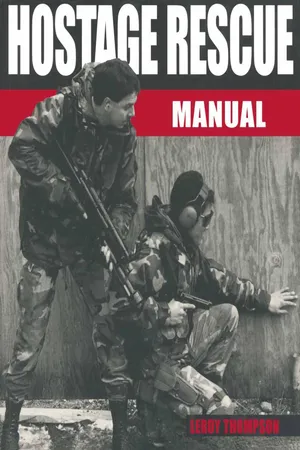
With vivid photographs and diagrams of rescue units in action,
Hostage Rescue Manual is the complete reference work on counter-terrorist procedures all over the world. This revised edition updates the book with an entirely new section devoted to developments in hostage rescue, among them operations in Russia and Iraq, since first publication.
eBook - ePub
Hostage Rescue Manual
Tactics of the Counter-Terrorist Professionals, Revised Edition
- 208 pages
- English
- ePUB (mobile friendly)
- Available on iOS & Android
eBook - ePub
About this book
Trusted by 375,005 students
Access to over 1.5 million titles for a fair monthly price.
Study more efficiently using our study tools.
Information
Contents
List of Plates
Preface
Glossary
| Chapter 1: | Containing the Incident and Establishing a Perimeter
|
| Chapter 2: | Intelligence
|
| Chapter 3: | Hostage Negotiation
|
| Chapter 4: | Snipers
|
| Chapter 5: | Entry and Clearing Techniques in Hostage and Barricade Situations
|
| Chapter 6: | Weapons and Equipment
|
| Chapter 7: | Stealth or Surreptitious versus Dynamic Entry
|
| Chapter 8: | Special Considerations in Operations Against Buildings
|
| Chapter 9: | Operations Against Vehicles and Trains
|
| Chapter 10: | Operations Against Ships and Aircraft
|
| Chapter 11: | Conclusions and General Principles
|
| Appendix 1: | Synopsis of Actual Incidents Cited in the Text |
| Appendix 2: | Data Sheet — Hostage-Taker Data Sheet — Hostage |
| Appendix 3: | Hostage Negotiator’s Psychological Check List |
Recommended Reading
Index
List of Plates
Appearing between pages 113 and 128
| 1 | Migrating across terrain during training |
| 2 | Infiltrating a site from the roof |
| 3–4 | Training with gas masks |
| 5 | Airboat patrol at the Kennedy Space Center |
| 6 | The partnership between sniper and entry team |
| 7 | The Princes Gate Assault |
| 8 | Insertion via helicopter |
| 9–10 | Competitive training on evacuation and rappelling |
| 11 | Two-man team prepares for entry |
| 12 | Five-man team prepares to assault |
| 13 | Sniping rifles: the Accuracy International PM |
| 14 | Shotguns: the Scattergun Technologies Remington 870 |
| 15 | Shooting close to the hostage |
| 16 | The sniper ‘hide’ |
| 17 | Mounting lights onto weapons |
| 18 | Distraction devices: the stun grenade |
| 19 | Marksmanship: the Glock 20 semi-auto pistol |
| 20 | Realistic training scenarios |
| 21 | The suppressed pistol |
| 22 | Automatic pistols: the Colt Government Model.45 |
| 23 | Submachine guns: The Heckler & Koch MP5SD |
| 24 | Chemical munitions and grenade launcher |
| 25 | Folding stock sniping rifle, with camouflage |
| 26–27 | Assaulting a bus from the front of the vehicle |
| 28–29 | Assaulting a bus from the rear |
| 30 | External view of an assault on a transit bus |
| 31 | Training to ‘wet jump’ for operations at sea |
Preface
When hostages are taken, the incident evokes a combination of horror and empathy among a country’s population. At the same time, unless a response is carefully planned and successfully carried out, a government can appear impotent or non-responsive to the dangers facing its citizens. Often, the details of hostage incidents are kept from the press and the population to protect the hostages and those tasked with saving them. As a result, though incidents may end through negotiation or through armed action by security elements, only the sketchiest details of how the operation was carried out are normally available.
In this work I’ve attempted to assemble a guide through the process of hostage rescue both for men and women who work in security-related fields and those who want to understand better the missions and skills of those who silently protect society from those who would use the threat to innocents to extort concessions. Much of the information contained in this work is based on my own experience in training hostage rescue units in various parts of the world, while other information is based on standard operating procedures of some of the most successful international, national, state and local SWAT or Tactical Teams.
It must be borne in mind, however, that rescue tactics and standard operating procedures will differ greatly from country to country based upon form of government, culture, religion and myriad other factors. In some countries, for example, hostages of a certain race, sex, or caste might be considered more valuable hostages than others. Even in democracies, where theoretically all are equal, a rich, influential hostage will naturally be expected by hostage-takers to prompt a significant response from authorities and the media. Cultural influences may also play an important part in how an incident transpires. For example, at least one incident in the United States was resolved because the leader of the hostage-takers was disconcerted by the necessity of performing bodily functions in close proximity to the hostages. His fastidiousness influenced him to end the incident peacefully and more quickly than would have been likely otherwise. (For a synopsis of actual incidents referred to throughout the text, please see Appendix 1.)
The differences in police authority will also influence the handling of a hostage incident. In Great Britain where only a limited number of police are armed, for example, it may take longer to have armed containment personnel on the scene, though the use of armed response vehicles has allowed a much faster response than formerly. On the other hand, the weapons culture in the United States is such that as many as 50% of homes contain firearms of some kind. The likelihood of encountering an armed suspect in a ‘hostage’ or ‘barricade’ situation is therefore much greater than in the UK and US HR units train accordingly, placing greater emphasis on the need to secure a site on entry and confront – rather than simply contain – the terrorist.
The issue of investment prompts further distinctions in practice. It may be surprising to the layman to learn that one of the largest markets for HR work is occupied by smaller teams with tight budgets, who are often tasked with maximising the limited resources to which they have access. At the other extreme, wealthier countries with highly trained police or military rescue units will be more likely to have access to the most modern and most sophisticated equipment and weapons, as well as intensive training programmes.
The more authoritarian the government, generally the more likely there will be pressure on response units to act quickly to end the incident to prevent the perception of the government as weak. More democratic governments, on the other hand, will be under pressure to place great emphasis on the lives of the hostages.
As a result, the tactics I have presented in this work are by no means the only ones which have been or are being used by hostage rescue units. I do feel that the tactics and procedures included in this work offer a sound basic understanding of the steps necessary to plan and implement a successful rescue. It must be remembered, too, that tactics for rescuing hostages will continue to evolve as equipment, weapons and threats evolve. Highly specialised and classified techniques will not be included in this volume of work.
I have endeavoured to help the reader understand that a successful hostage rescue operation is a mosaic composed of many skills and many individuals, each of vital importance. While the negotiator attempts to use his empathy and understanding of psychology to end an incident peacefully, he is also gathering intelligence which may assist an entry team if they are needed. Through technological and other means, intelligence experts are constantly upgrading and updating their intelligence about the hostage-taker, hostages and site. Silently observing the incident, preparing to end it with one precision shot if necessary, are the snipers and observers. Meanwhile, the entry team – the men in black wearing gas masks and carrying submachine guns – refine their plan in case they are called upon to provide the ‘final option’.
From the initial establishment of a perimeter to contain a hostage incident, until its successful conclusion through negotiation, the ‘green light’ order to a sniper, or a dynamic entry, the Hostage Rescue Manual allows the reader to follow the progress of a hostage rescue incident in detail.
Leroy Thompson, St. Louis, Missouri, 2001
Glossary
| Ammo | Ammunition |
| Ammo | Ammunition |
| BDU | US military camouflage |
| BTSP | Boat Tail Soft Point |
| CAD | Computer Assisted Drafting |
| CP | ...
Table of contents
- Cover
- Half Title
- Title
- Copyright
- Contents
Frequently asked questions
Yes, you can cancel anytime from the Subscription tab in your account settings on the Perlego website. Your subscription will stay active until the end of your current billing period. Learn how to cancel your subscription
No, books cannot be downloaded as external files, such as PDFs, for use outside of Perlego. However, you can download books within the Perlego app for offline reading on mobile or tablet. Learn how to download books offline
Perlego offers two plans: Essential and Complete
- Essential is ideal for learners and professionals who enjoy exploring a wide range of subjects. Access the Essential Library with 800,000+ trusted titles and best-sellers across business, personal growth, and the humanities. Includes unlimited reading time and Standard Read Aloud voice.
- Complete: Perfect for advanced learners and researchers needing full, unrestricted access. Unlock 1.5M+ books across hundreds of subjects, including academic and specialized titles. The Complete Plan also includes advanced features like Premium Read Aloud and Research Assistant.
We are an online textbook subscription service, where you can get access to an entire online library for less than the price of a single book per month. With over 1.5 million books across 990+ topics, we’ve got you covered! Learn about our mission
Look out for the read-aloud symbol on your next book to see if you can listen to it. The read-aloud tool reads text aloud for you, highlighting the text as it is being read. You can pause it, speed it up and slow it down. Learn more about Read Aloud
Yes! You can use the Perlego app on both iOS and Android devices to read anytime, anywhere — even offline. Perfect for commutes or when you’re on the go.
Please note we cannot support devices running on iOS 13 and Android 7 or earlier. Learn more about using the app
Please note we cannot support devices running on iOS 13 and Android 7 or earlier. Learn more about using the app
Yes, you can access Hostage Rescue Manual by Leroy Thompson in PDF and/or ePUB format, as well as other popular books in History & Military & Maritime History. We have over 1.5 million books available in our catalogue for you to explore.