- 240 pages
- English
- ePUB (mobile friendly)
- Available on iOS & Android
eBook - ePub
About this book
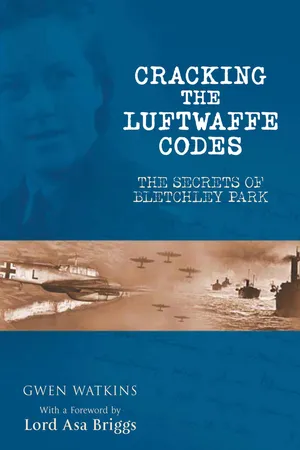
An intriguing page-turning and personal account of that most secretive of wartime institutions, Bletchley Park, and of the often eccentric people who helped to win the war Beryl BainbridgeBletchley Park, or 'Station X', was home to the most famous code breakers of the Second World War. The 19th-century mansion was the key center for cracking German, Italian and Japanese codes, providing the allies with vital information. After the war, many intercepts, traffic-slips and paperwork were burned (allegedly at Churchill's behest). The truth about Bletchley was not revealed until F. Winterbotham's The Ultra Secret was published in 1974. However, nothing until now has been written on the German Air Section. In Cracking the Luftwaffe Codes, former WAAF (Women's Auxiliary Air Force) Gwen Watkins brings to life the reality of this crucial division. In a highly informative, lyrical account, she details her eventful interview, eventual appointment at the 'the biggest lunatic asylum in Britain', methods for cracking codes, the day-to-day routine and decommissioning of her section.
Information
Chapter 1
In the Beginning
MY FATHER ENLISTED in the Royal Army Medical Corps (RAMC) in 1915, when he was just eighteen. He must have seen appalling sights during the First World War, and have handled men who were suffering terribly, but he never once spoke about his war – to his family at least. I have watched television programmes of veterans from both wars, and they too break down almost at once, and can rarely tell of their experiences. My father possessed a beautiful silver medal given him by the Belgian government for an ‘acte de courage et de dévouement’, together with an immense framed testimonial lavishly illustrated with further acts of courage, such as ladies in transparent nightgowns being rescued from burning houses, children being saved from various predicaments, a baby being held out to a mother who was fainting, having obviously thought it dead, and other interesting scenes. This, though an object of inexhaustible fascination to me in my childhood, was never associated in my mind with any part of my father’s life. He remained silent about his war all his life, but his younger brothers said that it had changed him for ever.
I was born four years after his demobilisation in 1919, and I grew up never once reading or hearing about the horrors of war. For me and my contemporaries, war was a subject of romance. We read Ernest Raymond, whose Tell England – a bestseller – was about three young lieutenants who went through Gallipoli and France with only the most glamorous of wounds, and who died with noble sentiments on their lips. To John Buchan war was a glorious game; to Ian Hay it meant scenes of muscular laughing Highlanders sitting in the trenches in sunshine, competing on who could kill most ‘cooties’ from their shirts. J. M. Barrie wrote wistful plays about young soldiers (always officers) waiting ‘beyond the veil’ for their loved comrades to join them.
We were brought up on the poetry of Rupert Brooke and his fellow poets, who regarded war as a wonderful opportunity to escape from the dullness of ordinary life; but our school anthologies contained no poems by Wilfred Owen or Siegfried Sassoon, who showed war in all its wasteful horror.
We had never seen anything like C. S. Lewis’s description of his experiences in the First World War, near Arras. ‘Through the winter, weariness and water were our chief enemies. I have gone to sleep marching and woken again and found myself marching still. One walked in the trenches in thigh gumboots with water above the knee; one remembers the icy stream welling up inside the boot when you punctured it on concealed barbed wire … The war – the frights, the cold, the smell of HE (high explosive), the horribly smashed men still moving like half-crushed beetles, the sitting or standing corpses, the landscape of sheer earth without a blade of grass, the boots worn day and night till they seemed to grow to your feet …’ No, we read nothing like that.
My friends who volunteered immediately for the Second World War, desperate that if they waited they would not get into Air Crew, had, I know, no vision of themselves trapped in a blazing plane, intolerably mangled or burned. We had not even any idea that war could involve ordinary clerical work, cleaning, boredom – war meant to us drama and romance, and we could not wait to take part.
So, resisting all efforts by my teachers and parents to persuade me to stay on at school and go to university, I applied on my seventeenth birthday to join the WAAF and was put on Deferred Service. This meant that you had to go home and wait until one day, without any warning, you were told to report to some distant point. I thought I would earn some money while waiting, and became a temporary clerical officer in the Aliens Department of the Home Office, which had evacuated itself at the beginning of the war to a rather plush hotel on the West Cliff at Bournemouth. This was full of young people like myself waiting to be called up, who had replaced the civil servants of military age who had volunteered or been called up. The elderly higher clerical officers who remained were aghast at the irruption into their hitherto cloistered corridors of this crowd of young people who thought nothing of laughing and talking during working hours, or of rushing down to the basement supposedly in search of a file, but really to gossip and giggle with their friends. Our elders were like flustered mother ducks trying to round up their ducklings. But we had all been well brought up and well educated, and we did do our work; only we did it much faster than it had been done in former leisured days. After working for Higher Certificate exams, the Home Office was a doddle.
My job, which was interesting, was concerned with the ‘aliens’, most of whom had lived and worked peacefully in Britain for thirty or forty years, and had been suddenly interned on the Isle of Man under the infamous Regulation 18B. There were with them a number of refugees from the growing oppression of the Nazis. These, though most of them were completely innocent, might have been spies sent over by the Germans, and had therefore to be investigated. All the internees were frantic to get back to their businesses and their families, and the volume of correspondence we had to deal with was very large indeed. My job was to open the letters, translate them if necessary, summarise and docket them and hand them on to my boss for evaluation and decision. We did not always see eye to eye.
I remember one day we had an anguished letter from a young Austrian who had escaped, penniless and without luggage, from a place whose name was not at that time as familiar as it was to become after the war – Dachau. It was not then a concentration camp, merely a labour camp where fit men could serve out their prison sentences working for the Third Reich – without pay, of course, and on a nearly starvation diet, with very brutal guards. According to this correspondent, many men died under this cruel regime, and he would perhaps have suffered the same fate had he not decided to get away. He had with great difficulty, and undergoing many hardships, managed to arrive in England to serve in the war against the Nazis, only to find himself interned as soon as he reported himself to the authorities. My boss did not believe his story, on the reasonable grounds that the Germans, who like us needed all the manpower they could get, were not going to treat their workforce so stupidly as to waste it. I pointed out that that was exactly the argument used by slave owners to defend their workforce, and that Charles Dickens had rubbished that argument by pointing out that, in all the advertisements for missing slaves, the description of the runaways showed that almost all had undergone brutal treatment and suffered horrific injuries. My boss was a senior civil servant, and not at all used to opposition from his inferiors; but, staring grimly at me, he did reread the letter, and reluctantly put aside his big ‘R’ stamp (for rejection). I pleaded that the young man at least merited some kind of investigation; and, while meeting my former boss much later, I heard that the Austrian was serving in the Pioneer Corps.
But, strangely, a much sterner view was taken of a letter from a rather whiny young Italian complaining of horseplay in his hut. He had apparently had his penis painted blue while deeply asleep one night. My boss immediately scrawled a docket demanding that the camp commandant at once investigate this behaviour. He was astounded to see me giggling, and it turned out that a large part of his indignation was due to the fact that a young lady should be forced to read such disgusting language. There is no doubt that the Civil Service had become somewhat hidebound; and no doubt either that I should never have made a civil servant.
I was called up in 1942, and was sent with another fifty girls to RAF (Royal Air Force) Innsworth, a few miles out of Gloucester. Here we spent three days being kitted out, being taught the rudiments of marching, listening to lectures and learning how to identify an officer, and how and when to salute (never unless both of you are wearing a cap, since you are not saluting a person but the king’s commission, represented by the cap badge. Watch out for films about the war, and see how often this mistake is made). As we were all lined up in front of a WAAF officer to give her details of our civilian life, I had the exquisite pleasure of hearing a pleasant girl in front of me, on being asked what her job had been, say ‘I was a tart’ and seeing the officer’s dropped jaw and staring eyes. The girl responded helpfully, ‘I don’t work from the streets – I have my own flat. And I’m quite high class; I only go with officers.’ I never saw that girl again, but if she remained in the Service I should think she would have managed to carry on her former trade very successfully.
On the third day we had to sit Trade Tests. I had always been very good at exams and found them easy, but to my horror I discovered that I could hardly do any of these. I couldn’t do mathematical progressions once they got into the twenties; I couldn’t fit upside-down shapes into a dodecahedron; I couldn’t see from diagrams how to change fuses or fit fan belts. The only thing I could do was write a short essay on why I wanted to join the WAAF.
The next day the whole intake was sent for six weeks’ initial training to Morecambe. Oh, heavenly Morecambe, with not a single tourist desecrating that marvellous bay! I still feel a great nostalgia when I think of it. We were billeted in houses where formerly bathing costumes had hung on the balcony railings and sand shoes dried on the window sills, and we were fitter than we had ever been, exercising all day in the sunshine and healthy sea air. We were trained in drill by a guardsman, and soon recognised the fascination of moving in synchronised figures, like a corps de ballet. Where at first we had stumbled and limped on route marches of one mile, by the end of the six weeks we were marching gaily for ten miles, singing all the way.
A group of old men used to follow the various squads about, for the pleasure of seeing nubile young girls doing PT in blouses and shorts. When I was teasing one of these once, he told me that they had little interest in girls, but were waiting to see the Germans invade across the flat Morecambe sands. ‘Because then they’ll get a surprise, won’t they, when they start to sink in the quicksands? And we’ll watch ’em go down, and when we sees only their helmets, we’ll laugh till we bust!’
On the last day we had a glorious passing-out parade, after which we assembled to hear which trade we were to follow and to which station we were to be posted. I was in deep gloom, because those Trade Tests must have been assessed, and I was afraid I would be put in the lowest (and worst paid) group, the aircrafthands, who did all the menial jobs no one else wanted to do; so I was mightily relieved to hear that I was to be a clerk/general duties, in grade four. Even a clerk could have fun, if you were posted to an interesting station, a fighter or bomber command, or radar, or a balloon site. But oh, what horror, what disappointment! I was posted back to dull old Innsworth, to work in the RAF Records Office!
I was not to know then that this posting would subsequently lead on to another, which I would not have missed for worlds.
Chapter 2
Setting the Record Straight
GLOUCESTER WAS A CHARMING small city in those days, with very little traffic in its old streets, and Beatrix-Potter-like timbered shops all round the Close. Doubtless they were as much infested with mice as the original Tailor’s, and they certainly smelled of damp and poverty, but they sold second-hand books and trumpery antiques, and were fascinating to poke through. The city’s one defect was that, since it lay in a deep bowl or saucer, surrounded by its lovely hills – Robinswood, Birdlip and Coney – it rested also in a bath of what we should now call smog, because in those days coal was used for every purpose (cooking, heating and industry) except in full summer. A local lady explained its effect to me in this way, ‘You see, m’dear,’ [all friends, enemies and strangers were ‘m’dear’] ‘… you see, we takes in the mist when we’m born, and it don’t leave us till our last breath; and so we’m not bright. We’m good-hearted, but we’m not bright.’ They were good-hearted, kind, generous and helpful, but they were undoubtedly slow of comprehension; and these were the only people that RAF Records was able to employ as part-time clerks. Many of them had left school at fourteen and worked on farms or as housewives, and were not really fitted to do clerical work. They were darlings, and would bring home-made cakes in to share with the small number of WAAFs who worked alongside them, and they loved to chat, and they worked quite slowly, finding the filing and sorting rather difficult.
The result was that, although the system of record keeping was simple and in theory should have worked perfectly, its simplicity demanded one essential – that the filing should be kept up to date; and it never was. Most of the ladies had homes and children to go to, and could only work part time, and although the small band of WAAFs worked until six o’clock six days a week, we never had enough time. The consequence was that the record cards were always in a muddle.
It should have been as clear as day. In our room we dealt only with airmen below the rank of warrant officer. All officers’ records were dealt with in a sacred room never entered by ordinary WAAFs, and aircrew too were dealt with separately (presumably since the huge number of deaths and horrific injuries were not to be known by the rank and file). So in our room every RAF station had its record cards in a large metal box, called a bin. Each clerk sat at a table with her bin before her, or sometimes the bins of two small stations. Each bin had a number of tall stiff cardboard dividers, filed alphabetically by trade: armourer, baker, cook, dog handler and so on. Each record card had the surname and Christian name of the bearer in capital letters on the left-hand side and his or her trade in capital letters on the right-hand side.
Every morning an ‘update’ from your particular station was put on your table. It listed every change that had taken place in the personnel of that station: who had been sent to hospital or on a course; who had taken Trade Tests to upgrade his qualifications; who had changed trade; who had been promoted; who had been put on a serious charge. Thus it contributed to all the minutiae necessary for an airman or airwoman’s record while in the Air Force. If a person were dismissed or left, you extracted his card from your bin and took it to an LACW (Leading Aircraftwoman) who sat at a table in front of the room. You also took his card out if he had been posted to another station, and the LACW would take it to his new station. She would also bring to your table the cards of any personnel who had been posted to your unit, and you would file them under their trade. So, basically, all you had to do was to enter the details on the update on each record card named in it. Simple. If you knew the name, the trade and the station, you should theoretically be able in a few moments to put your hand on any card needed.
Theoretically. The trouble was partly that the ladies worked part time and would depart in a hurry, often leaving the day’s update uncompleted. Then when they came in the next day, they would try to finish the previous day’s update, while often having to leave the current day’s update unentered, so that they got further and further behind. Then they often forgot to file by trade, and would slip a card in alphabetically somewhere by surname, or if an airman’s name were Cook or Baker he might be filed under those trades. So the bins were not up to date, and the cry would frequently go up ‘I can’t find this card!’ You were supposed to cross off the names on the update as you entered the details, and then hand it in to the LACW. (I had thought she looked rather glum when I first saw her; and now I knew why. She was supposed to be the troubleshooter for the room, but there was too much trouble there for any one girl.) The updates had more and more unentered names on them, because the card could not be found. The WAAFs worked pretty well, and when the ladies were not there we would go round their bins trying to fill in their incomplete updates; but the confusion filtered down to every bin. It was clear that something must be done.
I had found out that you could get promoted by taking tests. They were, unlike the daunting Trade Tests, only applicable to your own trade, and were the sort that I could, as a French friend of mine used to say, do with both hands tied behind my head. So I rapidly became a corporal. Now I had some real authority – not much, but some.
I found the officer nominally in charge of our room, whom we hardly ever saw, because he was in charge of more rooms than he could manage, and told him we needed to reorganise the bins. He told me that on no account must there be any disorder in the bins, as it was vitally important that we should at any moment be able to find any card at all. I took this as a kind of silent permission, and asked him to request from every station the list which it must have of its own personnel, and left before he could raise any objection. In a few days we had our lists, and we could then begin on our reorganisation. The first thing to do was to go round to every bin with its list, and take out every card that should not be there. We put all these cards into a huge bin on the front table. Our little band of WAAFs worked like the devil, coming in after the evening meal, and some even came in for part of their day off. Nobody can have any idea of how many RAF stations there were in Britain in wartime. (We did not, thank Heaven, deal with stations abroad.) In the mornings the ladies cast envious eyes on the huge bin, being convinced that their missing cards were in there, which they undoubtedly were; but they were sternly forbidden to meddle.
At last we began to make progress, and had actually begun to file in their proper bins the formerly misfiled cards, when one Saturday an immensely senior RAF officer came round the various rooms allegedly on a visit of inspection, but really, I think, to fill in a dull weekend. He was of course escorted by our officer and a deferential WAAF officer. He strolled round our tables, and then caught sight of the big bin, still half full, on the front table. He asked what was its function, and looked inquiringly at our officer, who naturally had no idea, and looked inquiringly at me. I said meekly that there were some cards which had accidentally been misfiled, and that we were in the process of filing them correctly. This brought on a very strong reproof to our officer, that it was essential every card should always be in its correct place, otherwise the whole records system was useless. The irony is, that if the bins had been in their former total confusion, the air commodore would have walked round placidly, and congratulated us on our hard work!
As I went to the door to close it after the visitors, I heard our officer say ‘she has only very recently been promoted to corporal, and evidently hasn’t got the hang of the work yet. We must put someone else in to take over.’ This was too much! I seethed with rage, and muttered under my breath ‘Judas! Beastly man! Horrible creature!’ (There were not at that time the range of expletives for young ladies that are available now.) I went straight to the WAAF commanding officer and put in a request for a posting. You were supposed to give a reason for this, such as that you needed to be nearer to your invalid mother, who had just had a stroke. My reason was that it would be better if I were at a station where my languages could be useful to the war effort. The CO pointed out languidly that we all had qualifications which had in wartime to be temporarily abandoned for the greater good. I brought out my trump card: I said that the flying officer in charge did not find my work satisfactory. This was dangerous ground. There was no such thing then as a personality clash – or at least no language to describe it. Any WAAF who hinted at such a thing would have to be posted as far away as possible. The CO said that she would consult my boss, and would see what could be done to meet my request.
Chapter 3
David
ON A BLEAK DAY LATE in 1941 a young man stood on the windy railway platform at Cambridge. He was waiting for a train to take him to what he knew only as a rather seedy railway junction called Bletchley. The train he was waiting for was nicknamed the Cantab Crawler, and it was much beloved of dons wishing to spread out their manuscripts in empty carriages, because even in wartime it was so slow that very few people used it. It steamed gently out of Cambridge on a single line, halting at such bustling metropolises as Gamlingay and Pot-ton, until it crept bashfully into Bletchley, where it was l...
Table of contents
- Front Cover
- Title Page
- Copyright Page
- Dedication
- Contents
- List of Illustrations
- Preface
- Foreword
- Introduction
- Acknowledgements
- 1 In the Beginning
- 2 Keeping the Record Straight
- 3 David
- 4 The Interview
- 5 Talk about the Park
- 6 German Air Section
- 7 David Gets to Work
- 8 Within the Gates
- 9 Making Friends
- 10 Living Quarters
- 11 Changes
- 12 Orchestra
- 13 The Camp
- 14 The End of the Park
- 15 Afterwards
- Appendices
- Select Bibliography
- Glossary
Trusted by 375,005 students
Access to over 1.5 million titles for a fair monthly price.
Study more efficiently using our study tools.
Frequently asked questions
Yes, you can cancel anytime from the Subscription tab in your account settings on the Perlego website. Your subscription will stay active until the end of your current billing period. Learn how to cancel your subscription
No, books cannot be downloaded as external files, such as PDFs, for use outside of Perlego. However, you can download books within the Perlego app for offline reading on mobile or tablet. Learn how to download books offline
We are an online textbook subscription service, where you can get access to an entire online library for less than the price of a single book per month. With over 1.5 million books across 990+ topics, we’ve got you covered! Learn about our mission
Look out for the read-aloud symbol on your next book to see if you can listen to it. The read-aloud tool reads text aloud for you, highlighting the text as it is being read. You can pause it, speed it up and slow it down. Learn more about Read Aloud
Yes! You can use the Perlego app on both iOS and Android devices to read anytime, anywhere — even offline. Perfect for commutes or when you’re on the go.
Please note we cannot support devices running on iOS 13 and Android 7 or earlier. Learn more about using the app
Please note we cannot support devices running on iOS 13 and Android 7 or earlier. Learn more about using the app
Yes, you can access Cracking the Luftwaffe Codes by Gwen Watkins in PDF and/or ePUB format, as well as other popular books in History & British History. We have over 1.5 million books available in our catalogue for you to explore.