- 320 pages
- English
- ePUB (mobile friendly)
- Available on iOS & Android
eBook - ePub
About this book
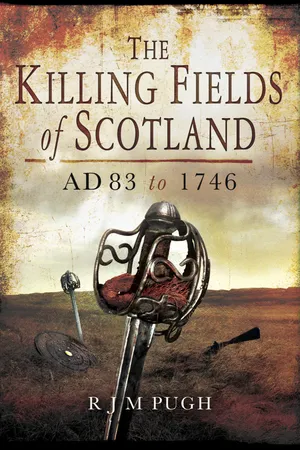
Most people are familiar with references to Scottish battles such as Bannockburn and Flodden but know little if anything about those events. Rugby and soccer fans outside Scotland may wonder at the sign 1314 held up by Scottish fans and not know that it is the date of the Battle of Bannockburn when an English king was defeated on Scottish soil. The battle is also commemorated in Scotlands unofficial national anthem, The Flower of Scotland. Battles fought on Scottish soil include those of the Scottish Wars of Independence, those occasioned by the English Civil Wars and the Jacobite Rebellions. This book tells the stories of these battles and many others fought in Scotland from the Roman victory at Mons Graupius in AD 83 to the defeat of Bonnie Prince Charlie at Culloden Moor in 1746.
Information
Chapter 1
The Roman Occupation
The Roman occupation of Britain lasted from AD 43, when the Emperor Claudius, or, to give him his full name, Tiberius Claudius Drusus Claudius, or, to give him his full name, Tiberius Claudius Drusus Nero Germanicus (10BC – AD54) sent his legions to conquer the southern part of the island. The legions remained in Britain until AD 410, when they abandoned Hadrian’s Wall, recalled to Rome to defend the Eternal City against the Visigoths. Thirty-four years after the Claudian invasion, the Emperor Titus Flavius Vespasianus, or Vespasian (AD 9 – 79) appointed Julius Agricola (AD 37 – 93) as governor of Brittania, as Britain was then known. In the third year of his governorship, Agricola was said to have ‘discovered new nations’1 – meaning peoples – in the northern part of Britain known to the Romans as Caledonia, named after the tribe which lived there.
Between AD 80 and 83, Agricola, the ablest of the Roman generals, first subdued the Lowlands of Scotland, extending the limits of the Provincia Romana as far as a line from the Firth of Clyde to the Firth of Forth. In AD 81 Agricola constructed a network of twenty forts from Clyde to Forth covering a distance of eighty miles to protect the southern part of Caledonia. (This chain of forts would form the route of the wall built in AD 123 by a later governor, Titus Aurelius Fulvus Pius Antoninus; the Antonine wall, built on a sandstone base and topped with turf only ran for thirty miles but it was strengthened by many more forts per mile than Agricola’s wall.)
After establishing his defensive line, Agricola returned to southern Britain, content for the moment with the progress he had made. He consolidated his partial conquest of the north by creating 1,300 miles of roads from the river Tyne in Northumberland into Caledonia. However, in AD 83, the Caledonians began to resist the Roman invaders; that year, the warrior tribes wiped out the Ninth Legion in Galloway, which brought Agricola north with a large army. On this occasion, he began his campaign in the west, subduing Galloway, then marched north at the head of 17,000 legionaries and 3,000 cavalry, intent on subjugating the entire region.
Agricola’s army was supplied by Roman galleys hugging the eastern seaboard. During his progress, he met with little resistance and was able to build an impressive fort at Ardoch, Perthshire. Ardoch is a classic example of Roman military and engineering skills in planned entrenchments adapted to suit the geographical conditions and the terrain.
However, despite his unopposed advance, the Caledonian tribes were gathering in strength, united in their determination to be rid of the invaders. The subsequent battle of Mons Graupius, fought in the autumn of AD 83, was neither the first nor the last confrontation between the Romans and the Caledonians. However, it is unique in that we are fortunate in having a well-written account of the battle. For this historians are indebted to the Roman historian and writer Gaius Cornelius Tacitus, Agricola’s son-in-law. Tacitus was present on the field of Mons Graupius and provided posterity with a detailed, eyewitness account of the action – albeit embellished – but not written until AD 98. Tacitus’s De Vita et Moribus Julii Agricolae (The Life and Death of Julius Agricola) is a pious tribute to his father-in- law, extolling his virtues and achievements, written five years after Agricola’s death. More of this follows.
Our knowledge of the main tribes of Scotland – the Caledonians and the Maetae – at the time of Agricola’s campaign is sketchy and obscure. Tacitus described the Caledonians as large-limbed and red-haired. According to an account by Cassius Dio (AD 155 – post 229) a Roman consul in AD 211,2 a contemporary of and praetor (chief magistrate) in the reign of Emperor Lucius Septimus Severus (AD 146 – 211), the Caledonians and the Maetae ruled various sub-tribes; the Maetae occupied the region close to Hadrian’s Wall in Northumberland, the Caledonians occupying the rest of north Britain. Neither tribe built walled towns or settlements; they lived in tents, wattled structures and crannogs – the name given in both Ireland and Scotland to artificially-constructed platforms supported by piles driven into the beds of rivers and lochs which served as domestic habitations as well as places of refuge in time of war. The native tribes depended on hunting, agriculture and pillage for their survival. Cassius Dio tells us that, on their foraging expeditions, the Caledonians subsisted on a special kind of compressed food which apparently satisfied both hunger and thirst3 – rather like their descendants, the Highland clansmen who could survive on a bag of oatmeal mixed with water. The Caledonians possessed chariots drawn by small but sturdy ponies – possibly the breed known as garrons – and the tribesmen carried dirks and short spears with a bronze knob on the un-business end of the haft which they beat against their small shields to intimidate the foes upon whom they advanced – rather in the manner of the impis of King Cetewayo during the Zulu war with Britain in 1879. The Caledonians also bore long swords with a cutting edge but lacking a point, somewhat unwieldy and not suited to close-quarter combat. Caledonian warriors were fleet of foot and extraordinarily brave; Tacitus admired their courage and skill in war. They went into battle practically naked so that the animal images tattoed on their bodies could be seen, thus intimidating their enemies. (The Roman soldiers called the Caledonians Picti, or the Painted People.) Such were the men against whom Agricola led his legions in the autumn of AD 83.
Mons Graupius
Precisely why the Caledonians chose to attack the Roman legions at this point may well be explained by the time of year. The Romans may have burnt the harvest or appropriated the grain needed to feed the native population during the coming winter. The force which confronted Agricola was a confederacy of disparate tribes united under a local tribal leader, whom Tacitus identifies as Calgacus. Of this man, we know nothing apart from the speech attributed to him by Tacitus before the battle of Mons Graupius – the Grampian Mountain.4
Calgacus’s Latinized name may derive from the Celtic Calg-ac-os ‘The Swordsman’, or perhaps the Irish Calgach, meaning ‘Possesser of a Blade’. (In the tenth century, the area around Morayshire was known to Scottish kings as ‘The Swordlands.’) Whatever the truth of it, Tacitus describes Calgacus as ‘the most distinguished for [sic] birth and valour among the [Caledonian] chieftains’.
There were, of course, many chieftains in the Caledonian host facing Agricola, but Calgacus alone is named. On that autumn day 30,000 Celtic warriors were positioned on the upper slopes of an unidentified mountain or moor, looking down on 20,000 Roman infantry and horse. Agricola ordered his cohorts forward. As they advanced uphill, the intimidating host of half-naked warriors greeted them with hoarse war cries and imprecations until one man stepped from the throng, calling for silence so that he might address them. Tacitus records Calgacus’s words as follows:
battles have been lost and won before, but never without hope. We were always there in reserve. We, the choicest flower of Britain’s manhood, we the last men on earth, the last of the free, have been shielded before today by the very remoteness and seclusion for which we are famed … [to] robbery, slaughter, plunder, they [the Romans] give the lyric name of Empire … the Romans have created a desolation5 and they call it peace …
Fine words worthy of William Wallace and Winston Churchill, designed to stir a people’s blood in the coming fight – if indeed Calgacus ever spoke them. Setting aside the fact that, in all probability, neither Calgacus nor Tacitus were conversant in each other’s tongue, it is also extremely unlikely that Tacitus could have been within earshot of Calgacus and the Caledonian host. The words Tacitus put into a barbaric warrior’s mouth owe more to fiction than historical fact. Calgacus’s speech is couched in the manner of perfect, measured Latin prose and we cannot accept it as genuine. Tacitus had an altogether different motive for attributing this speech to Calgacus, as we shall presently learn.
At the commencement of the battle of Mons Graupius, Tacitus tells us that both sides hurled missiles at each other – Roman pilum (javelin), Caledonian javelin and rocks and stones. After these preliminaries, Agricola ordered forward 8,000 of his soldiers, six cohorts of Batavian and Tungrian auxiliaries, men who would bear the brunt of the battle. No doubt the auxiliaries advanced in the famous Roman testudo (tortoise) formation of three sides, the heads of the soldiers protected by their long shields held aloft. When they neared the Caledonian front line, the veteran auxiliaries shook out into battle formation to prepare for close-quarter combat with their gladii (short swords).
Tacitus describes how the Caledonian chariots raced across the slopes of the battlefield, driving aggressively against the 3,000 Roman cavalry and momentarily throwing them into confusion. However, it was a different matter attacking the disciplined lines of Roman infantry, marching forward in faultless step. Confounded by the solid mass of Roman troops and the broken ground, the Caledonian charioteers lost their initial impetus, becoming intermingled with each other, which further reduced their effectiveness.
The Batavian and Tungrian auxiliaries were gripped by a bloodlust; veterans well trained in the use of the gladius, they smashed into the mass of Caledonian warriors, striking their faces with the bosses of their long shields and stabbing with their short swords, ideally suited to hand-to-hand combat. This frontal attack wrong- footed the Caledonians; then the arrival of the re-organized 3,000 Roman cavalry on their flanks spread panic in the brawling mob. The Caledonian host shivered, then crumbled in the onslaught on their front and flanks. The host quickly disintegrated, the warriors fleeing in panic. In what must have lasted only a few minutes, Agricola had won the day, committing only slightly more than half his entire force. This may have been deliberate; Agricola probably husbanded the rest in reserve for mopping-up or reinforcing the Batavian and Tungrian cohorts if they had come to grief.
The carnage was great. When night fell, 10,000 Caledonian warriors lay stark and stiff in the heather. Twelve centuries would pass until a defeat of similar magnitude would befall Scotland.6 According to Tacitus, Agricola suffered only 400 casualties. Even so, he allowed 20,000 tribesmen to escape into the surrounding mountains – hardly a desirable result, given the nature of the type of warfare practised by the Caledonians. Agricola’s force was now equal in number to his enemy and half of his men were as yet untried. Why did he fail to follow up his spectacular victory? We shall never know.
Tacitus’s account briefly described the scene on the day following the battle:
The next day revealed the effects of the victory more fully. An awful silence reigned on every hand; the hills were deserted, houses [sic] smoking in the distance, and our scouts did not meet a soul.
Viewing the devastation of burning, smoking settlements, Tacitus may have reflected on the nature of the politics, if not the morality, of the Pax Romana.
The precise location of the battle of Mons Graupius has never been accurately or satisfactorily identified. Some accounts7 favour the Perthshire moor or muir of Ardoch whose topographical and physical features seem to fit the description in Tacitus’s narrative. Also, General William Roy’s Military Survey of Scotland8 includes a detailed report on the Roman camp at Ardoch; Roy estimated that the camp was capable of accommodating an army of 30,000, a figure suspiciously close to the strength of Agricola’s army.
However, on balance, most accounts9 consider the battle took place near Bennachie, in Aberdeenshire. In this author’s view Bennachie seems more likely for two reasons; it is only eighteen miles inland from the Aberdeenshire coast and we know that Agricola’s army was provisioned by the Roman navy. Also, Tacitus calls the battle Mons Graupius – the Grampian Mountain. After his victory, Agricola probed further north into Morayshire, beyond the Grampians, creating a further ten stations or marching camps, remains of which can still be seen today.
Despite the victory...
Table of contents
- Dedication
- Title Page
- Copyright Page
- Table of Contents
- List of Illustrations
- List of Abbreviations
- Acknowledgements
- Foreword
- Introduction
- Chapter 1 - The Roman Occupation
- Chapter 2 - The Dark Ages
- Chapter 3 - The Early Middle Ages
- Chapter 4 - The Wars of Independence: 1296 – 1313
- Chapter 5 - The Wars of Independence: Bannockburn, 1314
- Chapter 6 - The Wars of Independence: 1329 – 1371
- Chapter 7 - The Stewart Dynasty: 1371 – 1541
- Chapter 8 - The Rough Wooing and Mary, Queen of Scots: 1542 – 1568
- Chapter 9 - Civil Wars: 1594 – 1654
- Chapter 10 - The Killing Time: 1666 – 1688
- Chapter 11 - Jacobites: 1689 – 1719
- Chapter 12 - Jacobites: 1745 – 1746
- Appendix
- Select Bibliography
- Index
Trusted by 375,005 students
Access to over 1.5 million titles for a fair monthly price.
Study more efficiently using our study tools.
Frequently asked questions
Yes, you can cancel anytime from the Subscription tab in your account settings on the Perlego website. Your subscription will stay active until the end of your current billing period. Learn how to cancel your subscription
No, books cannot be downloaded as external files, such as PDFs, for use outside of Perlego. However, you can download books within the Perlego app for offline reading on mobile or tablet. Learn how to download books offline
Perlego offers two plans: Essential and Complete
- Essential is ideal for learners and professionals who enjoy exploring a wide range of subjects. Access the Essential Library with 800,000+ trusted titles and best-sellers across business, personal growth, and the humanities. Includes unlimited reading time and Standard Read Aloud voice.
- Complete: Perfect for advanced learners and researchers needing full, unrestricted access. Unlock 1.5M+ books across hundreds of subjects, including academic and specialized titles. The Complete Plan also includes advanced features like Premium Read Aloud and Research Assistant.
We are an online textbook subscription service, where you can get access to an entire online library for less than the price of a single book per month. With over 1.5 million books across 990+ topics, we’ve got you covered! Learn about our mission
Look out for the read-aloud symbol on your next book to see if you can listen to it. The read-aloud tool reads text aloud for you, highlighting the text as it is being read. You can pause it, speed it up and slow it down. Learn more about Read Aloud
Yes! You can use the Perlego app on both iOS and Android devices to read anytime, anywhere — even offline. Perfect for commutes or when you’re on the go.
Please note we cannot support devices running on iOS 13 and Android 7 or earlier. Learn more about using the app
Please note we cannot support devices running on iOS 13 and Android 7 or earlier. Learn more about using the app
Yes, you can access The Killing Fields of Scotland by R.J.M Pugh in PDF and/or ePUB format, as well as other popular books in History & Military & Maritime History. We have over 1.5 million books available in our catalogue for you to explore.