- 160 pages
- English
- ePUB (mobile friendly)
- Available on iOS & Android
eBook - ePub
About this book
On 14 April 1471 the forces of Lancaster under the Earl of Warwick and those of York under Edward IV clashed at Barnet in Hertfordshire in one of the decisive battles of the Wars of the Roses. In a bloody encounter the two armies fought to resolve a bitter dynastic dispute that had already fuelled twenty years of war. Warwick's death and Edward's victory changed the course of English history.In this new guide to the battle, David Clark, one of the leading battlefield historians, gives a gripping account of the fighting and of the intrigue that led to it, and he provides a full tour of the battlefield itself.
Trusted by 375,005 students
Access to over 1.5 million titles for a fair monthly price.
Study more efficiently using our study tools.
Information
Contents
| Introduction: Battlefields of the Wars of the Roses | |
| Timeline: The Wars of the Roses in Context | |
| Chapter One | Contemporary Sources The Paston Letters |
| Chapter Two | The Wars of the Roses Richard, Duke of Gloucester |
| Chapter Three | The Battle of Barnet: Prelude Marching Orders |
| Chapter Four | The Battle of Barnet The Madness of King Henry VI |
| Chapter Five | The Battle of Barnet: The Aftermath Acts of Attainder |
| Chapter Six | Epilogue |
| Chapter Seven | Exploring the Battlefield William Shakespeare and the Battle of Barnet |
| Chapter Eight | Folklore Seeking Sanctuary |
| Chapter Nine | Articles of War Firearms |
| Chapter Ten | Modern Interpretations of the Battle of Barnet The Wars of the Roses: A Marxist Interpretation |
| Further Reading | |
| Further Information | |
| Index |
Introduction
BATTLEFIELDS OF THE
WARS OF THE ROSES
DESPITE MUCH RAISING OF AWARENESS, British battlefields are still an endangered species, continually threatened by the creeping sickness of housing developments, ubiquitous industrial estates and, more recently, sprawling dual-carriageways. Major casualties of the latter epidemic include the English Civil War battlefields of Newbury (1643) and Naseby (1645), and the Jacobite battlefield of Killiecrankie (1689).
In terms of survival, the battlefields of the Wars of the Roses (1455–1487) have fared quite well, despite five and a half centuries of ‘progress’ having taken their toll of essentially urban locations. Not all of the desecration is modern. The Victorians, for example, were pestilent innovators and, as early as 1852, Richard Brooke (Visits to Fields of Battle in England of the Fifteenth Century) could write of the Battle of Wakefield: ‘There are now no traces of Wakefield Green: all of it has been enclosed, and several portions of it are built upon.’ Similarly, in 1896, C.R.B. Barrett (Battles and Battlefields in England) wrote of the difficulties he experienced in drawing battle plans, referring to instances in which ‘the topography of a place has been so changed by the hand of man as to render sketching impossible’.
Alternatively, a growing appreciation of the value of battlefields as source material for the historian is exemplified in the provision of visitor centres and on-site battle plans – as at Wakefield and Towton respectively. Perhaps the real threat to Wars of the Roses battlefields lies in their historical remoteness. In the popular imagination, the Wars of the Roses have retreated into the Dark Ages. Long eclipsed by a series of more significant global conflicts, they seem to many of us as distant as the Norman Conquest. All that remains are passing references in Shakespeare, and perhaps a cursory acquaintance with the mystery of the Princes in the Tower. The study of Wars of the Roses battle sites is important, therefore, not only in order to help preserve the sites themselves, but as a means of keeping in touch with a momentous period in English history.
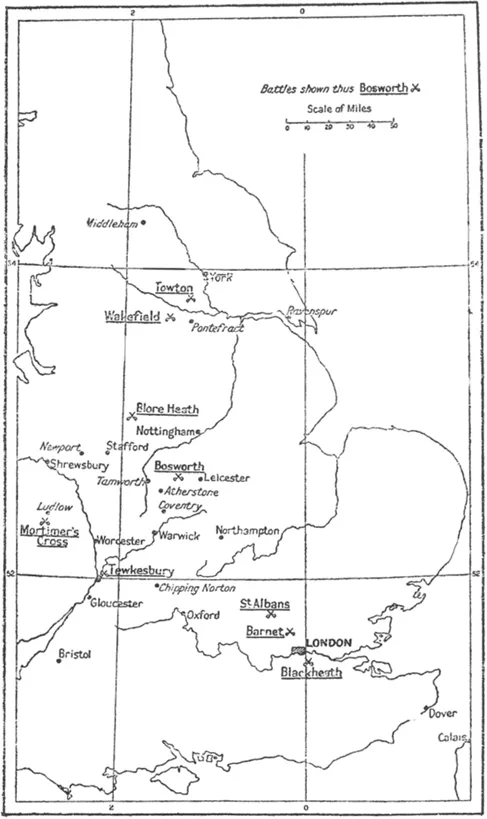
Map of major battlefields of the Wars of the Roses, from Hilaire Belloc’s Warfare in England Best known today as the author of ferociously amusing verses for children, Belloc was also a respected historian and Warfare in England remains an excellent introduction to its subject
In all, there are seventeen major ‘Roses’ sites, viz:
St Albans (22 May 1455) (Y) Fought in the old town of St Albans, to the north of the Cathedral.
Blore Heath (23 September 1459) (Y) Two and a half miles to the east of Market Drayton. Battlefield monument.
Ludford Bridge (13 October 1459) (L) Adjoining Ludlow.
Northampton (10 July 1460) (Y) The fighting was focused on Northampton Castle, levelled in 1879 to facilitate expansion of the railway station. Only the Postern Gate remains, built into the wall by the station entrance. At the time of writing (2006), there are plans to demolish even this surviving fragment. Towards the end of the twentieth century, the southern approaches to the battlefield via Hunsbury Hill disappeared beneath a housing development.
Wakefield (30 December 1460) (L) The battle was fought to the south of Wakefield at Kirk Sandall, the site of the Norman castle – long since reduced to fragments of masonry. The landscape to the east is urbanized, but portions of the battlefield to the north and west remain open. Visitor centre.
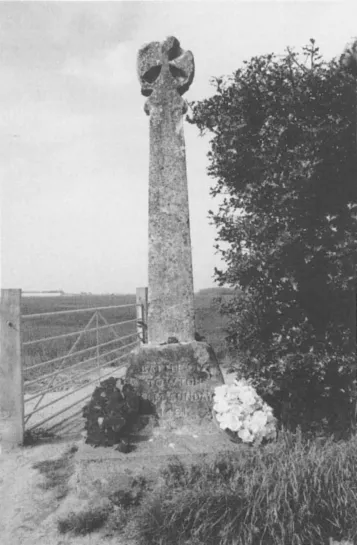
The battlefield of Towton. This, the largest battle of the Wars of the Roses, was fought on Palm Sunday, 1461. As at Barnet, the weather was an important factor in the outcome. On this occasion the packed Lancastrian ranks were blinded by driving snow.
Mortimer’s Cross (2 February 1461) (Y) Five miles to the northwest of Leominster. Battlefield monument.
St Albans (17 February 1461) (L) The Second Battle of St Albans was fought to the north of the old town between Barnard’s Heath and Sandridge.
Ferrybridge (27–28 March 1461) (Y) Prelude to Battle of Towton, focused on the bridge over the River Aire.
Towton (29 March 1461) (Y) Three miles to the south of Tadcaster. Battlefield monument.
Hedgeley Moor (25 April 1464) (Y) Six miles to the south-east of Wooler. Battlefield monument.
Hexham (15 May 1464) (Y) Two miles to the south-east of Hexham.
Edgcote (26 July 1469) (L) Six miles to the north-east of Banbury. Precise location uncertain.
Empingham (12 March 1470) (Y) Straddling the present-day course of the A1, five miles to the north of Stamford.
Barnet (14 April 1471) (Y) Ten miles to the north of London. Battlefield monument.
Tewkesbury (4 May 1471) (Y) Precise location uncertain. Probably to the south of the town, around ‘Margaret’s Camp’. Battlefield monument.
Bosworth (22 August 1485) (L) Precise location uncertain. Probably two miles to the south of Market Bosworth. Visitor centre.
Stoke Field (16 June 1487) (L) Three miles to the south of Newark. Battlefield monument.
Simple arithmetic shows that the White Rose of York (Y) enjoyed a greater number of victories, but Henry Tudor, representing the Red Rose of Lancaster (L), struck what we now recognize to be the final blows at Bosworth and Stoke Field. Occasionally, two further encounters are added to the tally. On 17 June 1497 Henry VII put down a rebellion (against his taxation policy) at Blackheath; and a little later in the same year, between 17 and 18 September, the Yorkist pretender Perkin Warbeck, accompanied by 8,000 rebels, attacked Exeter but was repelled.
Only one of the major battlefield sites (Northampton) has disappeared entirely, although several (Blore Heath, Mortimer’s Cross, Towton, Hedgeley Moor, Hexham, Edgcote, Empingham, Bosworth and Stoke Field) owe their preservation entirely to their rural settings. In the case of St Albans, enough of the medieval street pattern has survived to enable us to follow the course of both ‘Roses’ battles which occurred here.
The Battle of Barnet
The battles which initially appeared to have settled the issue in favour of the House of York are those which occupy the semi-urban locations of Barnet and Tewkesbury. Althou...
Table of contents
- Cover
- Half Title
- Title
- Copyright Page
- Table of Contents
Frequently asked questions
Yes, you can cancel anytime from the Subscription tab in your account settings on the Perlego website. Your subscription will stay active until the end of your current billing period. Learn how to cancel your subscription
No, books cannot be downloaded as external files, such as PDFs, for use outside of Perlego. However, you can download books within the Perlego app for offline reading on mobile or tablet. Learn how to download books offline
Perlego offers two plans: Essential and Complete
- Essential is ideal for learners and professionals who enjoy exploring a wide range of subjects. Access the Essential Library with 800,000+ trusted titles and best-sellers across business, personal growth, and the humanities. Includes unlimited reading time and Standard Read Aloud voice.
- Complete: Perfect for advanced learners and researchers needing full, unrestricted access. Unlock 1.5M+ books across hundreds of subjects, including academic and specialized titles. The Complete Plan also includes advanced features like Premium Read Aloud and Research Assistant.
We are an online textbook subscription service, where you can get access to an entire online library for less than the price of a single book per month. With over 1.5 million books across 990+ topics, we’ve got you covered! Learn about our mission
Look out for the read-aloud symbol on your next book to see if you can listen to it. The read-aloud tool reads text aloud for you, highlighting the text as it is being read. You can pause it, speed it up and slow it down. Learn more about Read Aloud
Yes! You can use the Perlego app on both iOS and Android devices to read anytime, anywhere — even offline. Perfect for commutes or when you’re on the go.
Please note we cannot support devices running on iOS 13 and Android 7 or earlier. Learn more about using the app
Please note we cannot support devices running on iOS 13 and Android 7 or earlier. Learn more about using the app
Yes, you can access Barnet 1471 by David Clark in PDF and/or ePUB format, as well as other popular books in History & Ancient History. We have over 1.5 million books available in our catalogue for you to explore.