- 224 pages
- English
- ePUB (mobile friendly)
- Available on iOS & Android
eBook - ePub
About this book
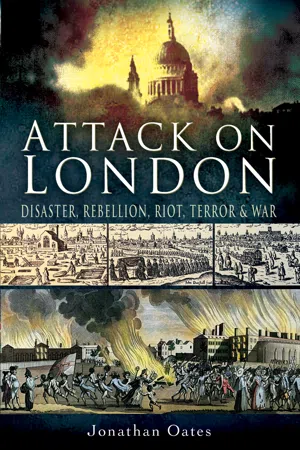
Generations of Londoners from Roman times to the present day have confronted natural and man-made threats to their city. Disasters, rebellions, riots, acts of terror and war have marked the long history of the capital—and have shaped the character of its people. In this evocative account Jonathan Oates recalls in vivid detail the perils Londoners have faced and describes how they coped with them. Jack Cade's Rebellion and the Gordon Riots, the Great Plague and the Great Fire, Zeppelin raids, the Blitz, terrorist bombings—these are just a few of the extraordinary hazards that have torn the fabric of the city and wrecked the lives of so many of its inhabitants. This gripping narrative gives a fascinating insight into the tragic history of the city and it reveals much about the changing attitudes of Londoners over the centuries.
Information
Chapter 1
Early Crises 1381—1642
Without doubt very many, in the horror and consternation of eight and forty hours, paid and underwent a full penance and mortification for the hopes and insolence of three months before.1
Even though London has been relatively safe from foreign attack, compared with other capital cities, hostile armies from within Britain have threatened it over the centuries. This is because their leaders wanted to challenge the government and monarchy of the day, often to overthrow it or at least to alter government policy. This posed the risk of fighting in or near London, accompanied by the fear that triumphant soldiery might then plunder the city. Not all Londoners sided with the government, if course — many shared the aims of its opponents . . .
The Peasants’ Revolt 1381
England was in a state of turmoil in the late fourteenth century. Plague — the Black Death — had created social upheaval and the desire for political reform. The new king, Richard II (1377—1399), was only ten years old on his accession. Their troubles were not at an end. A number of poll taxes had been levied in England in the new king’s reign. These were charged per head of population, in order to help finance the ongoing war in France. However, the tax of 1381 was the last straw, especially as it was set at one shilling per person: treble the previous rate. Attempts at enforcement sparked off the revolt. Added to this was the concern about French raids on the coastal towns and hostility to political mismanagement and criticism of the Established Church. Finally, there was the wish to have serfdom abolished. In June 1381 agricultural workers from across the south-east of England marched on London, camping on Blackheath prior to their final descent. Their principal leaders were Walter Tyler and John Ball.
Many Londoners sympathised with the rebels because, as ever, the capital constituted a divided society. Only a quarter of citizens had full political rights; the majority — including craftsmen and labourers — could not vote, sit on juries or hold political office. They had no reason to love the city elite and many shared the views of the rebel leaders. In fact, many mutineers were probably Londoners and, as suggested by one chronicler, coordinated their actions with those of the rural workers.
But it wasn’t just London’s poor who participated in the rebellion. Paul Salisbury was a wealthy citizen who had designs on his neighbour’s property. During the worst of the revolt’s excesses, Salisbury and a band of armed men went to the house of William Baret, who held a deed of property ownership Salisbury claimed was his by right (though not by law). Baret and his family were thrown out of their house and forced to surrender the deed. Salisbury then went to Thames Street and assaulted Joan Fastolf, whose husband had a number of property deeds Salisbury wanted. Taking these — and some alcohol — the assailants celebrated their victory.
As one might expect, most of the privileged City elite opposed the rebels. The Lord Mayor, Sir William Walworth, had sent a deputation of aldermen to meet with the rebels on Blackheath in order to dissuade them from advancing on the city. But one of the aldermen, John Horn, was later accused of encouraging the rebels to advance, claiming that Londoners would welcome them ‘as a lover his loved one.’ On the following day, Horn asked a city clerk to provide him with a banner bearing the royal arms. Holding the flag aloft, Horn then led the rebels into the city. Other aldermen are said to have assisted the rebels (although their names may have been blackened by political opponents): William Tongue was accused of opening the city gates, while Walter Sibley allegedly opened London Bridge.2
Once inside, the rebels opened prisons, sacked the Tower, ransacked the homes of the King’s ministers and murdered the Archbishop of Canterbury. Monastic property in Clerkenwell was also destroyed. Many Londoners almost certainly joined with them in destroying the prisons, such as the Fleet and Marshalsea gaols. Unpopular minorities were also in great danger. Londoners attacked Flemish merchants — granted special trading privileges denied to others — chopping off their heads and displaying them on poles. Lawyers and tax gatherers — also unpopular with most Londoners — were hunted down and slain.
The mutineers also tried wringing major concessions out of the young Richard II. Walworth stood with the King when he parleyed with the rebels at Mile End. On the first meeting, the young King agreed to meet the rebels’ demands. This was a crucial moment, for many of the rebels from Essex and Hertfordshire quit the revolt, thinking they had achieved their goal, but their departure only served to embolden those in London loyal to the King and Mayor.
Richard met the rebels on a second occasion, at Smithfield, on 15 June. Here Wat Tyler made fresh demands. What happened next is uncertain but the threat of violence was in the air and Walworth struck Tyler, who was later beheaded. Richard then drew the rebels northwards to Clerkenwell, allowing Walworth’s men to regain control of the city. The young King’s bravery had been crucial. The leaderless rebels soon dispersed and the revolt was over. Despite the young King’s promises of pardons to the peasants, his political advisers had the final word and they ordered the execution of many participants. Yet the rebellion had succeeded in ending the hated poll taxes, which were not introduced again until the seventeenth century, and then only as a short-term measure.
The Peasants’ Revolt has a reputation among the political Left that it does not deserve. Its memory was evoked in the late 1980s in response to the Conservative government’s controversial reintroduction of the ‘poll tax’ (now known as Council Tax) and favourable comparisons were made between anti-government demonstrators and Tyler’s rebellious peasants. This overlooks the wanton murders perpetrated by the rebels, especially the massacre of foreign merchants.
Jack Cade’s Rebellion 1450
Richard II’s reign ended unhappily with his deposition and murder. Yet his Lancastrian successors had variable success. By the reign of Henry VI (1422—1471), matters at home and abroad were in a sorry state. The war in France was coming to a disastrous close and Henry’s government was seen as inept and corrupt. In May 1450 the men of Kent marched on London once more, this time led by Jack Cade, who went by the alias of ‘Mortimer’. As before, the rebels gathered on Blackheath. By 11 June the mutineers had massed a force several thousand strong. Henry VI told them to disperse, which they did on 18 June and the danger seemed to be over. But when a detachment of the King’s troops were defeated in an ambush near Sevenoaks — having unwisely pursued the rebels — the insurrection was rekindled. Inflamed by victory, the rebels marched on Southwark, hoping for support in London.
The King wished to leave London, but the city authorities — who had business links with the royal household and therefore a strong financial stake in the matter — were alarmed. Apparently, according to one contemporary source:
the Mayor of London with the Common Council of the City came to the king asking him that he would stay in the city, and they would live and die with him, and pay for his household costs for a half year; but he would not, but took his journey to Kenilworth.3
Despite the King’s desertion on 25 June, the city authorities put London into a state of defence. Gates were guarded day and night, as were wharves and lanes leading to the Thames, and ballistae (giant crossbows) deployed. Meanwhile, restrictions were placed on the sale and removal of arms and armour from the city, and agents sent to spy on the rebels.
When Cade returned to Blackheath on 29 June, the city’s Common Council, after some discussion, decided to negotiate with him. The King’s flight had sapped their morale, so caution became their watchword. Alderman Robert Horne was opposed to parleying with the rebels but the council slapped him in gaol. And so Alderman Thomas Cooke, a draper, went to meet Cade. He was informed of the rebels’ demands — weapons, horses and money — and Cade was granted entry to London.
Cade’s men entered London on 3 July, having obtained the keys to London Bridge and their numbers were soon swelled by locals. In fact, as in 1381, many Londoners welcomed the rebels, at least initially, supporting attacks on authority figures such as Alderman Malpas, an unpopular MP, whose house was plundered. In the words of a chronicler:
They despoiled him and bore away many goods of his, and especially much money, both of silver and gold, the value of a notable sum.4
Cade’s demands — which many Londoners thought reasonable — included political reform and the removal of the King’s ‘evil’ advisers. Lord Saye was one of those targeted, being promptly executed by the rebels. Murder and mayhem followed, with locals joining rebels in summary beheadings and the ransacking of property. Alderman Horne barely escaped death by bribing his attackers with 500 marks. Meanwhile, Cade’s political opponents were denounced at ‘trials’, held during Guildhall sessions to provide a semblance of legality. Although some Londoners, including Charlton, the Mayor — participated in the dubious proceedings, many judges refused to attend, leaving those present overawed by Cade’s followers.
By 5 July, however, London’s mood was turning against Cade. Members of the Common Council began plotting his removal, seeking help from soldiers at the Tower. Thus, on the evening of that day, locals led by Lord Scales, an experienced soldier, marched across London Bridge, armed and ready for battle. These men were probably those who had most to lose from plunder — the Mayor, aldermen and the prominent citizens. The fighting took place on the bridge during the small hours and was the bloodiest battle ever fought in London since the Boudiccan revolt. A chronicler wrote:
And the same night the Mayor and Sheriffs and my Lord Scales and Matthew Gowghe and the Common Council of London went to London Bridge, and they fought from nine o’clock at evening till eleven in the morning, and at last the captain set the drawbridge on fire.5
After hundreds were killed, the rebels dispersed, encouraged by promises of pardons. Cade was eventually located and killed, his head set on London Bridge. Several of his followers were also executed. Yet, despite this reassertion of authority, Henry and his government faced a more serious rebellion in 1455, when the Duke of York’s forces defeated their army at St Albans and the country slipped into periodic civil war, culminating with the fall of the House of Lancaster and the murder of Henry VI in 1471.
Londoners had been divided in their allegiances in 1450. Some shared the rebels’ grievances and joined them, at least temporarily. The authorities, once the King left, were in a quandary: they were instinctively opposed to the rebellion but unsure how to deal with the threat. Once violence erupted in the streets in a drunken orgy, they were able to rally the populace and, under military guidance, defeat the rebels in open battle.
Sir Thomas Wyatt’s Rising 1554
The sixteenth century was no less a time of turmoil than previous epochs. The religious policies pursued by Henry VIII and his son Edward VI were divisive, creating numerous factions of Protestants and Catholics. When the latter died in 1553 there was a contest for the throne, with the late King’s chief adviser, the Duke of Northumberland, attempting to make his new daughter-in-law, Lady Jane Grey, Queen, instead of Henry VIII’s eldest daughter, Mary. Yet he had little support and to the delight of Londoners, the Catholic Mary was crowned Queen in 1553. She was seen as the rightful successor following the death of her childless brother. But she courted unpopularity the following January by announcing her intention of marrying Philip II of Spain, the predominant Catholic ruler in Europe. Public annoyance was initially limited to pelting Philip’s envoys with snowballs but quickly escalated into a full-blown insurrection of Kentish men, led by Sir Thomas Wyatt.
Wyatt began with only 3,000 followers — many members of the county gentry opting to stay neutral — and his chances looked slim. The government acted swiftly, ordering the Duke of Norfolk to lead the City of London’s Trained Bands against Wyatt at Rochester. These citizen soldiers were among the capital’s best troops, for though they were only part-time soldiers, they at least possessed proper weapons and some rudimentary training. However, the men of the Trained Bands, perhaps by a pre-arranged signal, declared their allegiance for Wyatt, shouting ‘We are all Englishmen!’ One of their captains advocated an immediate march on London, declaring: ‘For London, they said longed sore for their coming, which they would by no means protract without breeding great peril and weakness to themselves.’ When the remnant of the force retuned to London, the sight ‘was almost no less joyous to the Londoners.’6
Many in London were clearly not sorry to see the royal forces defeated. But not all were of this view. The City made preparations to defend London. Forces of armed volunteers were formed by the livery companies of the City of London. These were mercantile companies, each representing a different trade, such as the vintners for the wine trade and so on. The borough of Southwark was ordered to furnish a bodyguard of eighty men for the Queen. Gunpowder, weapons and munitions were retained in the City. Mary was resolute in the hour of crisis and unlike Henry VI in 1450, stood her ground and remained in the capital. Her bravery inspired Londoners to rally to her defence, whatever misgivings they may have had about her religion and intended marriage. The Mayor and aldermen took it upon themselves to raise a force of 1,000 men and it was said that, at a civic dinner on the following day, the servants came wearing arms and armour. Even lawyers were so accoutred. These measures prevented Wyatt’s men from progressing to the City from Southwark.
Yet many Londoners were not so supportive of Mary, especially when, on 1 February, Wyatt’s men arrived at Southwark. In fact, the reception given to the rebels was enthusiastic, as a chronicler noted:
they were suffered peaceably to enter [...] without repulse or any stroke struck either by the inhabitants or by any other [. . .] they all joined themselves to the said Kentish rebels, taking their part; and the said inhabitants most willingly with their best entertained them.7
Responses like this, however, may have been prompted by fear or lack of resolute leadership, rather than active support for the rebellion. Yet Wyatt kept his followers in check, limiting looting to the Bishop of Winchester’s palace. He gained some support here from some of the Southwark men, who deserted their posts and joined Wyatt. Others just went home.
But the rebels found their immediate advance via London Bridge blocked, so they marched westwards and crossed the Thames at Kingston, site of the next accessible bridge. Eventually, on 7 February, they advanced towards Ludgate. Many Londoners were fearful. A chronicler wrote that on that morning, there was:
much noise and tumult was everywhere: so terrible and fearful at the first was Wyatt and his army coming to the most part of the citizens who were seldom or never worst before to have or here any such invasions to the city.8
There was little opposition to the rebels until Ludgate was reached. Recognising Wyatt, a tailor of Watling Street had had the gates closed. Wyatt implored the Londoners to support him against the ‘miserable tyranny of strangers [that] shall oppress them’, but few did. The rebellion was almost at an end and Wyatt’s force was overwhelmed by Loyalist forces at Temple Bar. There was little fighting. Roughly a quarter of the rebels that we know of were from London, the rest being Kentish. A total of 750 rebels were captured. Many were executed, not only Wyatt, but also Lady Jane Grey and 400 men.9
Despite this victory, Mary’s popularity slumped when she pursued her attempts to return England to the Roman Catholic Church. From 1555, some of her Protestant opponents (about 300) were burnt at the stake. Yet the martyrs at Smithfield and elsewhere helped create a lasting memory among the Protestant English of the horrors of Catholicism. Mary was known as ‘Bloody’ Mary. Anti-Catholicism among Londoners was indeed to be a feature of London life for over two centuries, as we will see. Finally...
Table of contents
- Title Page
- Copyright Page
- Table of Contents
- Acknowledgements
- Introduction
- Chapter 1 - Early Crises 1381—1642
- Chapter 2 - From Restoration to Revolution 1660—1688
- Chapter 3 - The Eighteenth and Nineteenth Centuries 1715—1887
- Chapter 4 - The World Wars 1914—1945
- Chapter 5 - Post-War Perils 1958—2007
- Conclusion
- Notes
- Bibliography
- Index
Trusted by 375,005 students
Access to over 1.5 million titles for a fair monthly price.
Study more efficiently using our study tools.
Frequently asked questions
Yes, you can cancel anytime from the Subscription tab in your account settings on the Perlego website. Your subscription will stay active until the end of your current billing period. Learn how to cancel your subscription
No, books cannot be downloaded as external files, such as PDFs, for use outside of Perlego. However, you can download books within the Perlego app for offline reading on mobile or tablet. Learn how to download books offline
Perlego offers two plans: Essential and Complete
- Essential is ideal for learners and professionals who enjoy exploring a wide range of subjects. Access the Essential Library with 800,000+ trusted titles and best-sellers across business, personal growth, and the humanities. Includes unlimited reading time and Standard Read Aloud voice.
- Complete: Perfect for advanced learners and researchers needing full, unrestricted access. Unlock 1.5M+ books across hundreds of subjects, including academic and specialized titles. The Complete Plan also includes advanced features like Premium Read Aloud and Research Assistant.
We are an online textbook subscription service, where you can get access to an entire online library for less than the price of a single book per month. With over 1.5 million books across 990+ topics, we’ve got you covered! Learn about our mission
Look out for the read-aloud symbol on your next book to see if you can listen to it. The read-aloud tool reads text aloud for you, highlighting the text as it is being read. You can pause it, speed it up and slow it down. Learn more about Read Aloud
Yes! You can use the Perlego app on both iOS and Android devices to read anytime, anywhere — even offline. Perfect for commutes or when you’re on the go.
Please note we cannot support devices running on iOS 13 and Android 7 or earlier. Learn more about using the app
Please note we cannot support devices running on iOS 13 and Android 7 or earlier. Learn more about using the app
Yes, you can access Attack on London by Jonathan Oates in PDF and/or ePUB format, as well as other popular books in History & British History. We have over 1.5 million books available in our catalogue for you to explore.