- 256 pages
- English
- ePUB (mobile friendly)
- Available on iOS & Android
eBook - ePub
About this book
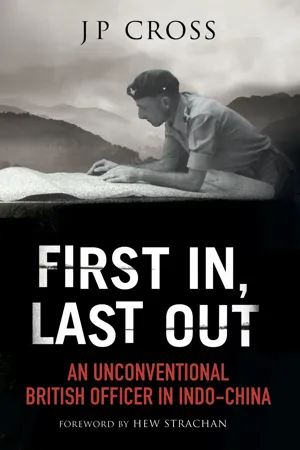
This is the astonishing tale of two episodes in the life of Colonel J P Cross, jungle fighter and linguist extraordinaire.As a young officer at the end of the war against Japan in 1945, he took part in counterinsurgency operations against the Vietminh at a time of chaos and confusion. Sent to the area to help disarm the defeated Japanese, Cross found himself commanding a battalion of the very same troops against the Vietminh.That period provides the backdrop to Crosss experiences as British Defence Attache to Laos between 1972 and 1976. His mastery of the languages of the region allowed him rarely accorded access to high Laotian political circles.Allowed to wander at will even by the Communists, he was in the unique position to survey the subterfuge and rivalry surrounding an overlooked yet fascinating sideshow to the Vietnam War. A remarkable man, J P Cross provides an absorbing account of his life amidst the cut and thrust of Laotion politics.
Trusted by 375,005 students
Access to over 1.5 million titles for a fair monthly price.
Study more efficiently using our study tools.
Information
PART I:
COCHIN-CHINA 1945–46
‘WHEN THE WATER LEVEL FALLS, THE ANTS EAT THE FISH …*
* Start of Laotian proverb
1
BLACK FLAGS OF SURRENDER FLEW …
“May we stop and buy a horizontal bomb?”
I turned to my Gurkha driver and asked him to repeat his request as I was sure I had not heard him correctly.
‘’May we stop and buy a horizontal bomb? There’s a mobile canteen on our way back and I can get one there.”
It was shortly after the atom bombs had been dropped in the last days of the war. We were on our return from Headquarters 20 Division where I had been sent to collect a rarity in those days, an issue of beer. I had been serving with Gurkhas for all of eight months and had managed a fair degree of fluency, but this beat me.
We could spare the time and I was intrigued. We soon reached the canteen, one of a small fleet of converted trucks that visited units. Run by a gallant band of women called the Women’s Auxiliary Service (Burma), it provided a basic and much appreciated service of necessities and, until they ran out, char and wads. I told the driver and his mate to go and see what was in the canteen and get a cup of tea. I sat back and waited.
I was twenty years old. Recently commissioned, I had been posted to the first battalion of the First Gurkha Rifles (1/1 GR) in Burma a few weeks before, having been trained for jungle warfare and service with Gurkhas for the past year in India. On my arrival, having steeled myself to fight the Japanese and reluctant to postpone my first moment of truth, I found the situation quiet. I fretted over the inevitable anticlimax caused by unexpected inactivity but I dared not be bored. A soft breeze stirred some metal strips that hung at the top of a pagoda opposite the parked vehicle, producing little ringing jingles, tinklingly mellifluous. There was a fragrance in the air, whether from joss or wild flowers I cannot remember.
As I mused about being so near the war though not yet a part of it, the two Gurkhas came back, looking slightly forlorn. They said that the canteen was no good as it did not have what they wanted. I sympathised.
“Didn’t you get any tea?”
“Oh yes, we got our tea all right but we could not find any horizontal bombs.”
So I had heard correctly, over the noise of the engine. “Do you really want a horizontal bomb?”
Yes, they did.
“The memsahib inside the canteen said that there weren’t any but we think we saw some.”
Rather facetiously I suggested it was an etam bomb they were looking for but soon realised my joke was in poor taste.
“No. It’s not like that. It is small and cool.”
In the end I went myself and asked one of the ladies if she had a horizontal bomb – one of the small, cool ones? The hapless woman was taken aback and, asking to be excused, went to consult her superior. I now wished I had never stopped at the canteen, thus avoiding this embarrassing situation. What exactly did I want? I made my strange request yet again only to be told that they had never heard of such a thing. I asked if I could call one of my men in – “just this once, please” – as they were sure some were in stock.
Reluctantly this was allowed (“We’re really too busy to answer such queries”) and my driver was allowed in. He looked around and, stiffening like a terrier scenting a rat, suddenly pounced on a small cardboard box on a shelf. He put his hand inside and, with the air of one who has known he was right all along, produced a small bottle.
“Lo, Saheb, a horizontal bomb,” he said with quiet satisfaction. I read the label which clearly showed its contents – Oriental Balm.
He paid for it and we left in silence. Neither of us would ever know how many similarly stupid mistakes of misunderstanding were to be made between Asians and non-Asians over the next thirty years.
The war in Europe had been over for three months when, on 6 August 1945, the atomic bomb was dropped on Hiroshima. That, and the bomb dropped on Nagasaki a few days later, changed the face of the world. One of the many effects was to produce a completely new situation in South East Asia.
At the Potsdam Conference in July 1945, it had been decided temporarily to divide what was then known as French Indo-China into two, the northern sphere to the Chinese (a political decision insisted upon by the Americans), the southern to the British.
Of course, it was not as simple as that; the Americans, with strong anticolonial feelings, treated the French as enemies and the British, as regards Malaya, Singapore, Hong Kong, Burma and India, not much better. The French were smarting, not least from loss of national prestige caused by wartime defeat, and were most desirous to regain their colony and rescue their prisoners of war. The British, not seeing Indo-China as their sphere of influence, wanted to sort their own problems out elsewhere, while the Vietnamese communists wanted to run their own country without the help of any outsider. The wellsprings of hatred of the French that flowed from the Vietnamese and of contempt of the Vietnamese that flowed from the French provided the fatal doses of poison that could not have had more explosive ingredients to a recipe already ripe for chaos. Despite much dedicated, if often misguided, effort, there had been too many lost chances and too many mistakes made through expediency, ignorance or inefficiency, for men’s passions to be quieted and for peace to be given a chance. The seeds of bitterness had already been sown; they were to flower foully for the next fifty years.
So much for the future: all we knew then was that momentous events were happening. The same evening that I brought back the beer, sitting in an upstairs room of a large Burmese house on stilts we used as a mess, the field telephone clanked its authority as we started to eat our supper. Slightly vexed, the adjutant went to answer it and then followed one of those infuriatingly elusive, one-sided conversations that had us hanging on his words even after the last good night.
The adjutant returned and put us out of our suspense by telling us that the Japanese had surrendered. Impromptu celebrations lasted well into the night, so it was with a distinct jolt next morning that we learnt the message of the previous evening was wrong and the Japanese had not surrendered. Quite the reverse, so went the new message: a large party was infiltrating to our north and we were to go and deal with it immediately…
Peace was declared a week later and we were thankful that the battalion had suffered no casualties during those last seven days, but that in no way countered an understandable tendency to lethargy.
Interest was revived and pressure re-applied by orders to move to French Indo-China, to disarm the Japanese and hand the country back to the French. Up to then our mental horizons had never been farther afield than Singapore and few of us had any but hazy notions of where French Indo-China was. I was detailed to pay a visit to the local Burmese head teacher and find out. He produced an atlas and I learnt where it was and that there were no less than five states with names that conjured up shades of schoolboy stamp albums: Cambodia, Laos, Tonkin, Annam and Cochin China. We were destined to go somewhere named Saigon that few of us had heard about and none of us could otherwise have placed without that atlas.
The battalion packed up, painting all the stores with a code name, MASTERON. The day before we were due to move we were ordered to repaint them all as MASTERDOM. I marvelled, in my innocence, how the army could take such matters so seriously. Official farewells to the villagers were paid and the battalion made its way by train to Rangoon – I drove the engine part of the way – ready for the next stage of its journey to an unknown country.
In early September we sailed in SS Rajula, touched at Singapore and, within five days or so, reached the coast of Cochin China. From Cap St Jacques upriver to Saigon we took in details of this new land, so depressingly like parts of the one we had just left. As all seemed so calm the men did not look upon it with any more tactical interest than is inbred in soldiers who have survived a hard war. But the calm was illusory.
‘All Japanese forces in French Indo-China have been ordered to fly a black flag, denoting surrender.’ That edict made a great impression on me, as indeed did the rules of conduct laid down for our relations with the surrendered Japanese forces:
…There will be no fraternising whatever between Japanese and Allied forces. In dealing with Japanese your behaviour will be guarded and coldly polite. You will, in the case of senior Japanese officers, use their correct titles. You will not shake hands with them… In no case will British and Japanese officers feed in the same room, nor will tea be offered at any meeting. Any Japanese who come to receive orders or report should be kept at arm’s length, e.g. with a table between you and them, and they should not be allowed to sit at the same table…
All Japanese officers had to salute Allied soldiers of all ranks.
To me there was something fitting and poignant about having a black flag. For too long the Rising Sun of the Japanese flag had dominated too many places and now their sun was set. The Japanese, who had swept all before them at the start of the war, had been ordered to stop fighting. In Burma, where they had lost the war, that made sense to them. In Indo-China, where there had been no fighting, losing the war made no sense. Luckily for the Allies the emperor’s edict was final and the Japanese conformed. The rules of conduct, the restrictions and petty embarrassments were not harsh but designed to humble by loss of face.
The Vietnamese we came into contact with, condescendingly called Annamites by the French, were small, lithe people with faces not unlike the Chinese but, in the main, darker skinned. Their language was beyond any of us, a high-pitched twittering as of many sparrows. The only way we could talk to them directly was by using French but even that had its problems as not all of them spoke it and those who did had an accent unfamiliar to our ears. If that was not enough, so little rapport was there between the locals and their colonial masters that we British had to speak French well enough to be understood but badly enough to be taken for someone who was not French. We were, initially, accepted in a friendly way.
The French, pro-Vichy colonials –who was it who so aptly said that only French colonials like French colonials? – should have been in charge of Saigon but they were so ineffectual they soon had to hand their duties over, but to whom? We had been detailed to collect and back-load Japanese military stores from various installations so were unable to take on those French responsibilities. The only people who could were the Japanese, but French national pride, or what was left of it, baulked at their soldiers handing over duties to the Japanese, even if the Japanese could have been persuaded to take them over from the French. A compromise was reached: the British would take over from the French in the morning and hand over to the Japanese in the evening. In the event all went smoothly, but there was one moment of tension when one Gurkha guard commander, a naik (corporal), found that his opposite number, a second lieutenant, had to draw his sword to salute with. Discipline on both sides prevailed but the Gurkha looked uncomfortable till the sword was sheathed.
Tension again surfaced that evening when the French took over from the British who were guarding the residence of General Leclerc, the senior French military officer. A Guard of Honour from both countries was drawn up in front on either side of two flag poles. For some reason, known only to the planners, 1/1 GR had to provide a small party of men both to haul down the Union Jack on Last Post being sounded and unfurl the Tricolor when Reveille was blown. The parade, attended by both civil and military dignitaries, was a solemn affair.
After preliminaries, arms were presented and officers saluted. Last Post was played and the Union Jack slowly hauled down. As soon as that was completed the bugler started blowing Reveille. The NCO in charge of the flags, the naik, had been briefed on the importance of the occasion but he had tied both knots on the French pole too tightly, the one at the base and the other that held the Tricolor. He could not get it open with his fingers even with frantic tugging so, horror! he bent down and undid the lower knot using his powerful teeth. The rope swung free, was tugged, but now the upper knot was seen to be too tight.
By this time Reveille had been blown and a strained look became apparent on some of the faces of both spectators and participants. The very honour of France was at stake should her flag be disgraced. Anxiety was palpable as the naik looked at the offending rope as he decided how to tackle this new and even more knotty problem. He sat down, took his boots off and then, horror of all horrors, he was observed drawing his kukri. He looked up at the tightly furled flag and, for one dreadful moment, ghastly visions of mutilated flags and ropes and flag poles must have occurred to many. But, watched by all in utter fascination – tired arms still in the saluting position – he swarmed up the pole and forced the knot open with the blade, supremely oblivious that he had saved a nation’s honour.
The command ‘Order Arms’ was given and the ceremony continued as if nothing unusual had happened. After the parade, apart from a little stiffness in the arms, all was bonhomie. The French were full of praise, vastly impressed by this show of initiative. «Ah, les Gorkhas, très galants, très magnifique. Nous n’avons jamais vu…»
Although none of us knew it at the time, we were to become embroiled in what is now known as Communist Revolutionary Warfare. Mao Tsetung’s doctrine, also practised by his formidable lieutenants-by-proxy, Ho Chi Minh, personality spokesman for North Vietnam, and General Vo Nguyen Giap, had insidiously started to spread in Asia. It set a pattern for the next two decades and more, of unrest and violence in one guise or another. Gone, for the most part, were the pitched battles of conventional armies as we knew them, changed were the priorities of the principles of war. The tactic of terror needed no front line nor the gospel of grief any slit trench. Slogans and ideas did not fill the belly, nor rice the mind, yet hungry men spurned food and thoughtful men disdained normal logic. What was this strange new happening and what moved men so violently? Surely not entirely the hatred of the European, nor solely the love of revolution? These two facets were, maybe, the catalyst that gave the impetus to swing the pendulum that moved the ratchet wheel that slipped the cog that started to change the face of the world that John Roast Beef and his Gallic neighbours had built. This was to be further changed by the two superpowers to the detriment of millions: three cheers for America? or three Tsars for Russia?
It is easy to forget that it is only when the pendulum has swung its full course does the ratchet wheel move at all. Movement is life, no movement is death, yet in action the reverse was often nearer the truth, and we were there to fight, not to philosophise. When I first tried to put my thoughts together, Indo-China/Vietnam had not soured men’s souls nor had the post-war rash of history books yet analysed cause and effect. I put down my thoughts as they were then.
Not long after we arrived it was evident that there was going to be trouble between the French civilians and the local population. The man in overall charge of the forces in the south was Major General Douglas Gracey. His orders were to control the area surrounding the two Japanese headquarters, one in Saigon itself and the other, at Dalat, a hill station not far away. Gracey found himself in an unenviable position, squeezed from many sides: by the French and the Vietminh (the shortened form of Vietnam League of Independence), by Lord Louis Mountbatten, the Supreme Commander, who was not only ambitious and politically motivated but was also at personality odds with him, by a labour government in Great Britain that was not sympathetic to matters colonial and heavily in debt, by the viceroy and commander-in-chief in India wanting his army back without getting involved in someone else’s war, by Indian politicians to whom the presence of Indian troops helping restore French colonialism (and Dutch in Java) was anathema and by the Japanese army which was ‘undefeated’.
The situation quickly deteriorated as the Vietminh came to realise that the French were to be given back control of the country, and incidents of shooting were a nightly occurrence. Both Saigon and its Chinatown, Cholon, were dangerous places. The arrogance of the French towards their colonies has been well documented; the cruel exploitation and brutal maltreatment and contempt of the Tonkinese, Annamites and others in Indo-China shown during that phase manured seeds of bitterness and frustration already sown and a burning desire to be rid of their masters. General Giap (a student of Napoleon) the military commander of the Vietnamese main force and guerilla armies, who was to prove more than a match for both the French and the Americans, and Ho Chi Minh, the political boss who outwitted all adversaries, were both rampantly anti-French. Such bitterness does not accrue overnight. I know these feelings not to be the product of some leftwing historian’s imagination. It was bitter irony for so many Vietnamese that, when the northern communists did eventually prevail, communism was as much a failure as it has been everywhere, with its mismanagement, corruption, privilege, repression, intransigence and cru...
Table of contents
- Cover
- Copyright
- Title
- CONTENTS
- List of Illustrations
- Glossary
- Dramatis Personae
- Foreword by Hew Strachan
- Antescript
- Part I: Cochin-China 1945–46
- Part II: Laos 1972–76
- Postscript
- Looking Back: 70 and 40 Years Later
Frequently asked questions
Yes, you can cancel anytime from the Subscription tab in your account settings on the Perlego website. Your subscription will stay active until the end of your current billing period. Learn how to cancel your subscription
No, books cannot be downloaded as external files, such as PDFs, for use outside of Perlego. However, you can download books within the Perlego app for offline reading on mobile or tablet. Learn how to download books offline
Perlego offers two plans: Essential and Complete
- Essential is ideal for learners and professionals who enjoy exploring a wide range of subjects. Access the Essential Library with 800,000+ trusted titles and best-sellers across business, personal growth, and the humanities. Includes unlimited reading time and Standard Read Aloud voice.
- Complete: Perfect for advanced learners and researchers needing full, unrestricted access. Unlock 1.5M+ books across hundreds of subjects, including academic and specialized titles. The Complete Plan also includes advanced features like Premium Read Aloud and Research Assistant.
We are an online textbook subscription service, where you can get access to an entire online library for less than the price of a single book per month. With over 1.5 million books across 990+ topics, we’ve got you covered! Learn about our mission
Look out for the read-aloud symbol on your next book to see if you can listen to it. The read-aloud tool reads text aloud for you, highlighting the text as it is being read. You can pause it, speed it up and slow it down. Learn more about Read Aloud
Yes! You can use the Perlego app on both iOS and Android devices to read anytime, anywhere — even offline. Perfect for commutes or when you’re on the go.
Please note we cannot support devices running on iOS 13 and Android 7 or earlier. Learn more about using the app
Please note we cannot support devices running on iOS 13 and Android 7 or earlier. Learn more about using the app
Yes, you can access First In, Last Out by J.P. Cross in PDF and/or ePUB format, as well as other popular books in History & Military Biographies. We have over 1.5 million books available in our catalogue for you to explore.