An action-packed military biography of a British fighter pilot and his rise through ranks during World War I.
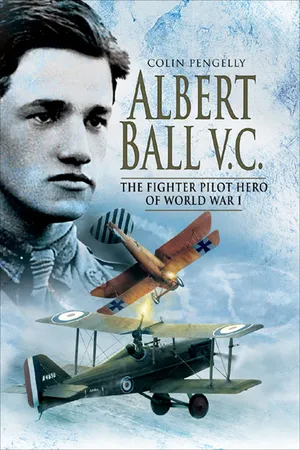
World War I pilot Albert Ball's invincible courage and determination made him a legend not only in Britain but also amongst his enemies, to whom the sight of his lone Nieuport Scout brought fear.
Ball enlisted in the British army in 1914 with the 2/7th Battalion (Robin Hoods) of the Sherwood Foresters, Notts, and Derby Regiment. By October, 1914, he had reached the rank of Sergeant and then became Second-Lieutenant to his own battalion in the same month. In June, 1915, he trained as a pilot in Hendon. Then in October, he obtained Royal Aero Club Certificate and was transferred to the Royal Flying Corps. He further trained at Norwich and Upavon, being awarded the pilot's brevet in January, 1916. In May, he opened his score, shooting down an Albatros C-type over Beaumont. Days later he shot down two LVG C-types, while flying his Nieuport 5173.
Captain Albert Ball made his final flight on May 7, 1917, when he flew as part of an eleven-strong hunting patrol into action against Jagdstaffel 11, led by Lothar Von Richthofen. Albert was pursuing the Albatros Scout of Lothar, who crash-landed, wounded. Then many witnessed Albert dive out of a cloud and crash. He died minutes later in the arms of a French girl, Madame Cecille Deloffre. Ball rose from obscurity to the top rank of contemporary fighter pilots in only 15 months. In that period, he had been awarded the MC, DSO, and two Bars, and was credited with at least 44 victories.
- 208 pages
- English
- ePUB (mobile friendly)
- Available on iOS & Android
eBook - ePub
About this book
Information
CHAPTER ONE
The Formative Years
Albert Ball was born in the family home at 301 Lenton Boulevard (now numbered 245 Castle Boulevard) Nottingham on the 14 August 1896. He was the third child and first son of Albert and Harriet Ball. His father, who was born on 20 July 1863, was a dealer in land and property having changed from the original calling of being a plumber. He had been an ambitious man and from the time that he entered his father’s plumbing business he prospered. The business expanded and in the trade directory for 1895 G. Ball and Son are shown as operating from three addresses. He had married Harriet Page in July 1886, the daughter of Henry Page from Oldbrook, Derbyshire. Their first child, Hilda, was born in August 1887 but lived only a few days. She was followed by a further daughter, Lois, born in 1892; Albert in 1896 and Cyril born in 1898. As his business prospered Albert Ball Senior moved gradually up the housing ladder into more opulent properties. From Lenton Boulevard he moved to Mettham Street soon after his son’s birth; then to 60 Sherwin Road in 1900 and finally to Sedgeley House at 43 Lenton Road.
Albert Ball Senior had been born and bred a Nottingham man and was to devote a large part of his life to public service in the city. He served as a councillor, alderman, mayor and finally lord mayor in 1935. His services to the City were recognised by a knighthood and he became an accomplished public servant. Among the enterprises in which he took a special interest was the Gas Department. He had joined the Gas Committee in 1901, became Chairman in 1907 and remained in this post until 1945, a few months before his death. He was successful in re-establishing public trust in the Gas Department after the ‘Gas Scandal’ of 1930 in which the Chief Clerk was found guilty of fraudulent practices on a grand scale. Although he was successful in re-establishing trust in the operation of the gas service in Nottingham, there were persistent rumours that he himself had been more deeply involved in the scandal than appeared to be the case. In his private business affairs there have been suggestions that he was involved in some sharp practice in his land deals. It is alleged that, due to his position on the Council, he became aware of properties and land which were likely to be purchased in the future and that he bought them and, when the time came he resold to the Council at a profit, something today which would be called ‘insider trading’. Nothing, however, has come to light to show anything which was not strictly correct in his dealings and which was not in accordance with the conventions of the time.
Nottingham was a thriving and important centre for industry. The city was dominated by the imposing structure of the castle overlooking the city centre and it boasted the largest town square in Europe. The town was made a City in 1897 as part of Queen Victoria’s Jubilee Celebrations. It was the home of the legendary figure of Robin Hood but in later years had become famous as a centre for the Lace Trade. Subsequently, as the Industrial Revolution gained momentum, although the manufacture of lace remained a major industry, the town became more industrialised and by the time Albert Ball was born in 1896 three major commercial enterprises, which were to become household names, had become established there. Jesse Boot had been born in Nottingham and, from inheriting his mother’s herbal shop, had built up the trade and had opened a large store in Nottingham in 1884 (the first of the Boots Stores). Also based in Nottingham were Raleigh Bicycles, making the most of the Victorian enthusiasm for the pastime, and Players Tobacco. It was, therefore, a thriving and expanding town and this created opportunities for men like Albert Ball senior to make money from the buying and selling of property and land. By the end of the 1890s he had realised his ambition to enter local politics and in November 1899 he had been elected as a Councillor for the Castle Ward of Nottingham, the beginning of a long career of public service. Harriet Ball seems to have been a good mother and a well respected Lady Mayoress to her husband (and his brother) as he rose in social standing. For Harriet, family was everything and particularly her eldest son. Albert fully reciprocated her love and his surviving letters include many to his mother dashed off in moments of relaxation.
The family was enjoying the prosperity of late Victorian and Edwardian Britain and was a happy and close knit group. Sedgeley House, where Albert’s family moved to, was a large imposing house in the Park District. It had extensive gardens that allowed plenty of room for the Ball children to play. It was close to the castle and had views over the Nottingham Canal with the River Trent in the distance. Albert Ball developed a fascination for anything mechanical. He had a room at the top of the house, which was always kept as his so long as the family occupied the house.
Albert Ball senior enjoyed a close relationship with all his children but particularly with his eldest son. The two were very much alike and the son developed the same business acumen as his father. To Albert, the life and business achievements of his father were something to admire and emulate. Even while serving in France Albert Ball had his mind on the family business and completed deals with his squadron mates for cars, motor cycles and even plots of land in the Nottingham area.
Despite dabbling in many areas including kite flying and the newly founded Boy Scout movement, there was no doubt about his main interest in life, a passion for mechanical and engineering devices. In a shed in the garden, in which a radio receiver was installed, he received messages from abroad. The young Albert had an enquiring mind and he conducted various experiments with anything that interested him, particularly of a mechanical kind, and eventually he and his friends, could strip down and reassemble a petrol engine and get it to run again.This led to his first love for motorcycles and then for cars and this background, supplemented by his education at Trent College, would give him sufficient mechanical capability so that, when he joined the RFC, he was able to work on his own aircraft engine, a talent which he shared with James McCudden. Of equal use in his subsequent career as a fighter-pilot was his interest in shooting. At which he became increasingly expert. This was an interest his father encouraged him to follow.
Ball’s adventurous spirit manifested itself on occasions. He was said to have decided to run away to sea, when he was allegedly at Trent College, but what drove him to this step, if it ever happened, is not recorded. If he had such an idea, and he was said to have got as far as boarding a steamer at Liverpool before he decided to return home, I have come across nothing in his correspondence to prove that this event ever happened. It is related in the first biography to be written of him by Walter Briscoe who, it must be assumed, spoke to members of his family while preparing his work, but the fact that Ball never mentioned it himself does make it of doubtful authenticity. The adventurous side of his nature and his lack of fear, a later feature of his aerial tactics, was shown when on his 16th birthday he joined a local steeple-jack in climbing to the top of a factory chimney and apparently feeling completely at home in what, to many people would have been considered a dangerous situation. However, if there was a desire to go to sea and explore the world it did not remain with him. When war came in 1914 he volunteered for the Army and not the Royal Navy.
Albert Ball’s education began when he attended the local Church School in Lenton. He was later followed there, and, to his other schools, by his brother Cyril. From the Church School he moved on to Grantham Grammar School (a boarding school) and then to Nottingham High School in September 1907. Previous pupils at Nottingham High had included: J.D. Player (of Players Cigarette fame), Jessie Boot (of Boot’s Chemists) and the novelist D.H. Lawrence who didn’t enjoy the experience! When Ball joined the school the Headmaster was George Turpin, himself an old Boy, a science graduate from Cambridge who had been headmaster since 1901. The school offered the chance for pupils to become involved in areas other than academic; there were extensive sports facilities and in 1905 a rifle range had been opened of which, no doubt, Albert Ball made use.
Like most schools of its type Nottingham High had an Officer Training Corps (OTC). The school records show that Ball joined this organisation in January 1910 but seems to have attended only seven parades, two in October and five in November before leaving the school in December 1910. As an illustration of the toll which the Great War took on the manhood of Britain, the page which lists Balls name as a member of the OTC includes twenty-one other names of which at least four can be traced as having been killed during the War. Apart from Albert Ball there was one other Victoria Cross winner from the school, a former master, Theodore Hardy, who served as a Chaplain with the Lincolnshire Regiment and won the VC, DSO and MC but was killed on the 18 October 1918. His VC had been won for rescuing wounded men under fire without regard for his own safety.
From Nottingham High School the brothers moved to Trent College at Long Eaton, just outside Nottingham, in January 1911. Trent was a minor Public School which, with fees of £75 a year, was well within the reach of a man of such newly made wealth as Albert Ball senior and matched the aspirations he had for his eldest son. Apart from the influence of his father,Trent College was to be the other major factor in shaping the character of Albert Ball. He and his brother were allotted to F Dormitory and Albert was entered in Form VC where his form master was G.J. Thomas.1
When Albert and Cyril entered Trent College it had been open for nearly fortythree years, having been established for the sons of Church of England parents. The headmaster was the Reverend John Savile Tucker who had been in the post since 1895 and was to retire the year after the Ball brothers arrived at the school. The character of Tucker, a forbidding and remote man, was imprinted on the school and its pupils. The regime was austere and the day started with a wake up call at 6.25am and compulsory cold baths. Living conditions were Spartan with basic food (which many pupils supplemented with ‘tuck’ from outside sources) and ineffective central heating.
The school concentrated on bodies as well as minds and frequent long walks were organised by the school for masters and pupils which merit a mention in the letters home which Albert sent to report on his progress. He was not a natural athlete and did not take easily to sport, but did enter various internal school competitions. Punishments for misbehaviour varied from the task of writing lines for minor infringements up to a beating from the Head Master for anything of a serious nature. If there was one facet of his character which was formed by his time at Trent College it was his sense of duty, to family, college and finally to his country.
Book learning was something with which he struggled and he was never to achieve a really satisfactory level in the main subjects, which today would be called the‘core curriculum’.However,he did not like to be without a goal to strive for and in practical subjects he displayed an increasing ability and aptitude. One of his earliest letters, undated but presumably from some time in 1912 Ball told his parents that he was building a model electric launch which‘carries 48 lb and is looking very decent’. He also wrote that he had been studying technical drawing and was ‘able to draw quite decently, and also understand a drawing’.
In the middle of 1912 he began to consider the end of his time at Trent and what he was to do about his future career. He needed guidance and advice as to what his future career should be and what qualifications he would need to succeed in that career. He told his parents:
Well I have not got on especially well at Trent as regards knowledge, but I think that I have made a slight improvement. I have got a great love for my school and shall be very sorry in many ways to leave, but I think that if I get into a good business I shall be spending my life in a much more profitable way and bringing the best out of myself, I shall try my level best to be a good and straight forward business man, and follow to the best of my ability in my Father’s footsteps.
I am anchious to know what I am going to be when I (grow up) (deleted) leave and I do hope Father is looking about well. I think there is still a lot of money to be made in the way of making small electric lighting plants for countryhouses. Many people have invented these sets but they are all so large and need so much looking after. I should like to be placed in a large Electric Engineering factory where they make all kinds of Machinery from the Dynimo to the power to drive it.
I should like to have a chance to work my way up from the bottom and try to get to the top. I think that the place for me is where there is plenty of work and bussel so that I can keep my mind to it and not be troubling with other things.2
His parents advised him to seek an interview with the headmaster so that he could receive some guidance as to what subjects he would need to study in order to achieve his ambition. The headmaster was now Geoffrey Foxall Bell who had replaced Tucker earlier in the year, and Ball accepted the suggestions of his parents that he should seek an interview:
Well I shall think tomorrow about what I should like to be. I shall also consult the Head about the subjects I am to take. I shall then write to you another letter and tell you what my idea is if you agree I shall work hard until next Summer. Then try my luck if you will allow me. Of course it is a very important matter and has to be thought of . . .3
At the resulting interview with the headmaster he was told to do extra maths and drawing with a view to becoming an engineer.
He advised me to start at the practical end of engineering. Then after I have had a year at that I have then to take the theory. Then try to pass an exam. Well the Head thinks that Engineering is the right thing, so if it pleases you I will be an Electrical Engineer.
Well I shall try at School for 1 more year, and then see what I can do. Well I was 7 out of 15 this week 8 above Cyril.4
He reported to his father later that the master taking him for the extra maths was very pleased with his progress. His weak point remained his spelling, which remained a characteristic of his letters home. He was also puzzled by the meaning of some words and attributed this to ‘slacking in the past’.
The extra year at Trent College meant a lot of hard work for Ball, but he was determined enough on his future to know that effort spent now would repay itself in later years. This final year also seems to have reawakened his interest in the OTC with which he had dabbled at Nottingham High School and he joined the corps at Trent. He was not naturally a boy who enjoyed the type of discipline and routine which being in the OTC called for but he felt he had to persevere for the sake of his duty to his parents. No doubt he did enjoy the opportunities for improving his shooting which being in the OTC presented.
The time finally came for him to complete his education and leave Trent College at the end of the summer term in 1913. The school had shaped the character and attitudes he was to show for the rest of his life as well as developing his mind and body. It had reinforced his sense of duty to family and country. It was this sense of duty which had sent him out to France for the last time in April 1917 and kept him there when his nerves were stretched to breaking point and in his heart wanted only to be home with Flora his fiancée. This willingness to continue to perform his duty to his country was not unique to Ball. It manifested itself in many men who found the war hell and almost unendurable but they did endure because they thought it was the ‘right thing to do’. Albert Ball was now ready to join the ‘real’ world, which, to him, meant following his father’s example and succeed in a business career. In the year left to him before the outbreak of war he proceeded with his intended career of becoming an electrical engineer.
Upon leaving Trent, parental influence secured for him a place at a small firm called Universal Engineering in Castle Boulevard, Nottingham. It was a small electrical and brass foundry concern and was an ideal place for the young Albert Ball to start his career. Because he was living at home no correspondence exists for this period but he appeared to very happy with his new world and immersed himself in the daily business of the firm, learning his trade and experimenting with his own ideas whenever he got the chance.
He had barely a year before his plans and dreams for the future were rudely interrupted by the declaration of war on Germany. The war, which was to shatter the old Europe and reshape the map of the world, arose from nationalist aspirations in the Balkans when Serbian extremists assassinated the Archduke Franz Ferdinand in Sarajevo on the 28 June. This event, which probably did not even register on the consciousness of Albert Ball, or many of his contemporaries, grew via the Austrian ultimatum to Serbia, the involvement of Russia in support of the Serbs, then the involvement of Germany in support of Austria, followed by the inclusion of France by means of her alliance with Russia. The involvement of Britain was caused by Germany violating the neutrality of Belgium, of which Britain was a guarantor. Although this was the ostensible cause for Britain entering the War the real reason remained, as it had always been over the centuries, the balance of power. The challenge represented by the industrial and military power of Germany was recognised by Britain and the likelihood was that unless Britain entered the war France would be defeated and Germany would become the dominant continental power and leave Britain with no allies with which to face her. However, despite the naval threat, war against Germany was considered unthinkable in some quarters. The Times wrote on 1 August that, ‘We consider ourselves ...
Table of contents
- Cover
- Title Page
- Copyright
- Contents
- Introduction
- Chapter 1: The Formative Years
- Chapter 2: The Call to Arms
- Chapter 3: Flying with No.13 Squadron
- Chapter 4: Flying with No.11 Squadron The Ace in the Making
- Chapter 5: The 'Rest Cure' Ball with No.8 Squadron
- Chapter 6: The Rising Star Ball's Combats, August 1916
- Chapter 7: The Consummate Fighter Pilot Combats, September to October 1916
- Chapter 8: Leave and Home Establishment
- Chapter 9: With No.56 Squadron February to March 1917
- Chapter 10: Back to France, April 1917
- Chapter 11: The Final Days, 1-7 May 1917
- Chapter 12: The Last Patrol
- Appendix 1: 'TheWonderful Machine'
- Appendix 2: The Austin-Ball Scout
- Appendix 3: List of No.56 Squadron Pilots up to May 1917
- Appendix 4: Victories List
- Bibliography
- Index
Trusted by 375,005 students
Access to over 1.5 million titles for a fair monthly price.
Study more efficiently using our study tools.
Frequently asked questions
Yes, you can cancel anytime from the Subscription tab in your account settings on the Perlego website. Your subscription will stay active until the end of your current billing period. Learn how to cancel your subscription
No, books cannot be downloaded as external files, such as PDFs, for use outside of Perlego. However, you can download books within the Perlego app for offline reading on mobile or tablet. Learn how to download books offline
Perlego offers two plans: Essential and Complete
- Essential is ideal for learners and professionals who enjoy exploring a wide range of subjects. Access the Essential Library with 800,000+ trusted titles and best-sellers across business, personal growth, and the humanities. Includes unlimited reading time and Standard Read Aloud voice.
- Complete: Perfect for advanced learners and researchers needing full, unrestricted access. Unlock 1.5M+ books across hundreds of subjects, including academic and specialized titles. The Complete Plan also includes advanced features like Premium Read Aloud and Research Assistant.
We are an online textbook subscription service, where you can get access to an entire online library for less than the price of a single book per month. With over 1.5 million books across 990+ topics, we’ve got you covered! Learn about our mission
Look out for the read-aloud symbol on your next book to see if you can listen to it. The read-aloud tool reads text aloud for you, highlighting the text as it is being read. You can pause it, speed it up and slow it down. Learn more about Read Aloud
Yes! You can use the Perlego app on both iOS and Android devices to read anytime, anywhere — even offline. Perfect for commutes or when you’re on the go.
Please note we cannot support devices running on iOS 13 and Android 7 or earlier. Learn more about using the app
Please note we cannot support devices running on iOS 13 and Android 7 or earlier. Learn more about using the app
Yes, you can access Albert Ball VC by Colin Pengelly in PDF and/or ePUB format, as well as other popular books in History & Military Biographies. We have over 1.5 million books available in our catalogue for you to explore.