- 320 pages
- English
- ePUB (mobile friendly)
- Available on iOS & Android
eBook - ePub
About this book
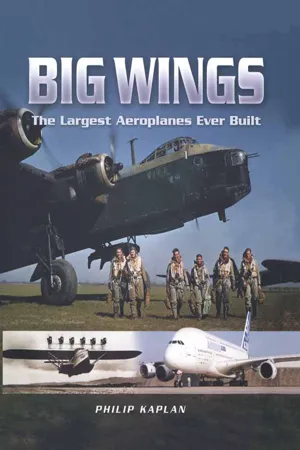
In the history of aviation there have been many attempts to produce aircraft of extraordinary proportions to expand the limits of technology and create new performance standards. With few exceptions, the early attempts did not become the successes envisaged until post-World War II when such aircraft as the Boeing B-52 long-range heavy bomber and the Boeing 747 'Jumbo Jet' airliner changed the face of aviation in both the military and civil roles. Big Wings is a well-researched, highly informative and sometimes nostalgic look at the sixteen most significant giants of the air. Each chosen aircraft is introduced and its raison d'?tre explained, then follows an in-depth review of the successful and failed technical aspects of the design, its operational history, first-hand accounts from those that had flown the aircraft and finally some startling facts and statistics. The aircraft selected are as follows: Military—Douglas B–19, Boeing B-29, Consolidated B-36, Northrop B-49 and Boeing B-52, Airliners—Bristol Brabazon, Boeing 747 and Airbus A380, Heavy Lifters—Messerschmitt Me323, Consolidated XC-99, Lockheed C5 and Antonov AN-225, Flying Boats—Dornier Do-X, Martin JRM Mars, Hughes HK-1 and Saunders Roe Princess.
Information
CONTENTS
BOMBERS
DOUGLAS B-19
SHORT STIRLING
BOEING B-29
NORTHROP XB-35 AND YB-49
CONVAIR B-36
BOEING B-52
NORTH AMERICAN XB-70
AIRLINERS
BRISTOL BRABAZON
BOEING 747
AIRBUS A380
FLYING BOATS
DORNIER DO-X
MARTIN JRM-1 MARS
HUGHES HK-1
SAUNDERS-ROE PRINCESS
HEAVY LIFTERS
MESSERSCHMITT ME321 AND ME323
CONVAIR XC-99
LOCKHEED C-5
BOEING KC-10
ANTONOV AN124 AND AN225
BOEING C-17
DOUGLAS
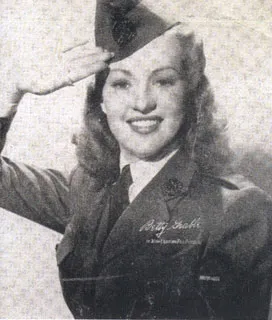
A publicity still, Betty Grable, from the movie A Yank in the RAF
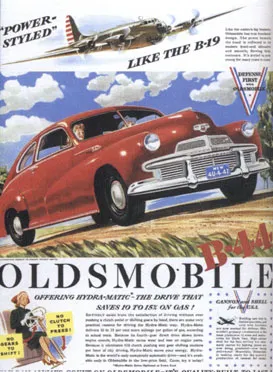
Ad for the 1942 Oldsmobile … ‘Power-Styled like the B-19’
Donald W. Douglas Jr joined his father’s company, Douglas Aircraft, in 1939, four years after the company had received a contract from the US Army Air Corps for preliminary and detailed design, mock-up construction and testing of components for what would be the largest land-based aircraft built in the USA during the Second World War, the B-19 bomber.
Douglas Jr was born in 1917, and was educated in mechanical engineering at Stanford University, Palo Alto, California. He continued his studies at the Curtiss-Wright Technical Institute in Glendale, California, where he read aeronautical engineering. It seems clear that his father, Donald Wills Douglas, intended to groom his son to become president of Douglas Aircraft and would brook no short-cut path to the top for the young man who began his association with the company as an engineer in the strength group. His father, determined that Don Jr would be well grounded in all aspects of the firm, saw that the young man was assigned a wide variety of positions in many different departments of the plant. Don Jr gradually rose through the ranks and in 1943, at the height of the war, was appointed to his first important supervisory job at Douglas, that of manager of flight test. In that role he oversaw the flight testing of nearly every aircraft type manufactured by the company. In the early post-war years he became director of the testing division and was responsible for type certification of the famous DC-6 and DC-7 airliners. He was made a company vice-president and board member in the early 1950s and in 1957 was named president of Douglas Aircraft, a role he served in until the company was merged with the St. Louis aircraft manufacturer, McDonnell Aviation, in 1967. He then served as senior corporate vice-president of the McDonnell Douglas Corporation until 1989. During his long career with the plane makers, Don Jr had an important role in the development of nearly all the significant Douglas aircraft models–except one. He had come along a little too late for the B-19.
In the mid-1930s the world was moving relentlessly towards war in both Europe and the Pacific and some American military planners believed it essential that the US Army Air Corps investigate the possibilities of building an experimental bomber with enormous range and hitting power. They wanted to find the limits of technology and capability in that time and get them all into one extraordinary aeroplane.
It was called Project D, classified top secret and visualized to be a “proof-of-concept” design and not necessarily a production aircraft. When the Army solicited involvement by the major aircraft manufacturers of the day, only the Douglas and Sikorsky companies expressed interest and preliminary discussions were held with both firms. Now known as the BLR, for Bomber, Long Range, the Douglas design proposal was designated XBLR-2.
Both Sikorsky and Douglas had been asked to construct wooden mock-ups of their proposed designs and these were evaluated by the Army Air Corps in March 1936. The Douglas design prevailed and the Sikorsky proposal was terminated. Douglas was given until 31 March 1938 to produce the prototype aeroplane.
The XBLR-2 was meant to be a kind of flying battleship, an advanced all-metal stressed-skin bomber capable of hauling up to 18,700 lb of bombs with a maximum range of 7,700 miles. Her cruising speed was to be 135 mph, with a top speed of 224 mph at an altitude of 15,500 feet. Her service ceiling was to be 23,000 feet and she would be powered by four Wright R-3350-5 18-cylinder air-cooled radial engines rated at 2,000 horsepower each, driving three-bladed constant-speed propellers. Her total internal fuel capacity of 10,350 US gallons would enable her to remain aloft for up to fifty-five hours. A low-winged monoplane, XBLR-2 was to be fitted with a retractable tricycle landing-gear arrangement, a system then considered relatively uncoventional. Each giant main wheel was eight feet in diameter.
As the United States limped through the Depression years of the thirties, research and development funding for American military projects was necessarily quite limited, forcing a slow pace of progress on the new plane. Later in 1936, the BLR designation was superseded by the redesignation B-19 and the prototype under construction was designated XB-19 in November 1937.
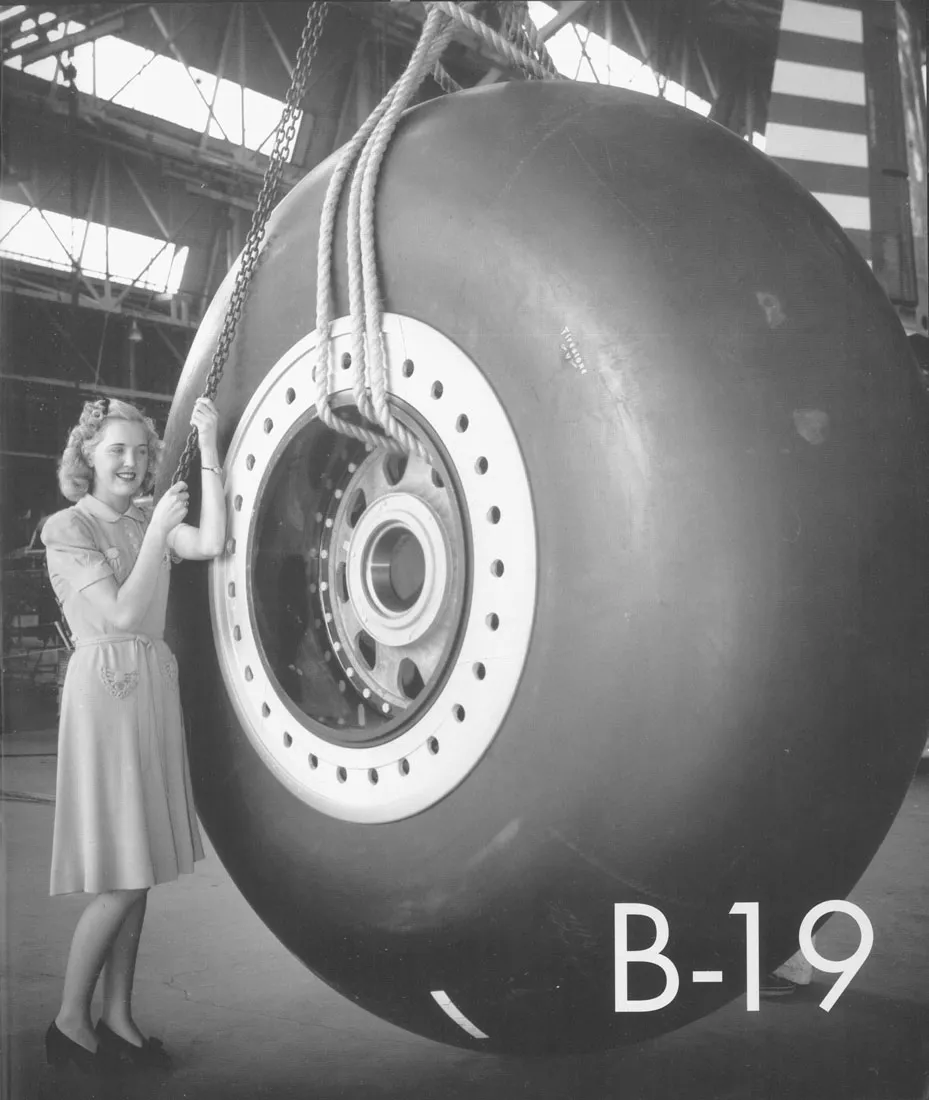
Douglas employee Dorothy Rush with a B-19 main landing-gear wheel.

The XB-19 under construction in the Douglas Aircraft plant at Clover Field, Santa Monica, California, in June 1941. More than three years behind schedule, the plane’s maiden flight took place on 27 June 1941 piloted by US Army Air Corps Major Stanley Ulmstead. The bomber was flown that day to March Air Force Base, near Riverside, California, and turned over to the Army for thirty hours of evaluation.

The Depression years dragged on and the XB-19 continued to slip further and further behind in its production schedule owing to the insufficient developmental funding by the Army Air Corps. The company had to use a lot of its own money to help in the funding of the project. And it had to divert a number of its key design personnel to the XB-19 from other aircraft development work with better prospects for eventual large-scale production than the big bomber offered.
Other problems dogged development of the XB-19, not least being the ever-increasing weight of the plane as its components and structures were refined. The added weight, of course, would result in diminished performance characteristics with the intended engines. This factor, coupled with various technological advances achieved in the aircraft industry during the three years since the start of the project, now rendered the XB-19 virtually obsolete even before she had been assembled. All of these considerations weighed heavily on the board of Douglas Aircraft, forcing a decision to recommend to the Army Air Corps in late August 1938 that the giant bomber project be cancelled.
The Army Air Corps, while cognizant of the Douglas company’s position, and still unable to help with improved funding for the project, remained determined to see the XB-19 to fruition. The Army’s Materiel Division instructed Douglas to continue the bomber project, albeit at a pace too slow to please anyone involved. But by 1940, with the war in Europe already a year old, it became clear to the Army Air Corps that the proposed performance of the B-19 would be insufficient to meet newly evolving needs, making the plane less important militarily, and eliminating the reason for the secret classification of the project. It was removed from that classification and soon became the subject of much media speculation about what was behind America’s development of an extraordinary new ultra-long-range bomber by a nation not (yet) at war.
The work on construction and assembly of the big bomber went on inexorably in an enormous production hangar of the Douglas plant at Santa Monica’s Clover Field and was finally completed in May 1941. To put her in a modern perspective, the physical dimensions of the XB-19 can be readily compared to today’s Boeing 747–400 jumbo jetliner. The 212-foot wingspan of the Douglas bomber was slightly greater than that of the jumbo; her tail reached a height of just under 43 feet, while that of the 747 is 63 feet. The maximum gross weight of the B-19 was 162,000 lb, while that of the jumbo is something over 800,000 lb. The length of the bomber was 132 feet and that of the 747 is 231 feet.

The XB-19 at the March Field, California, base 27 June 1941
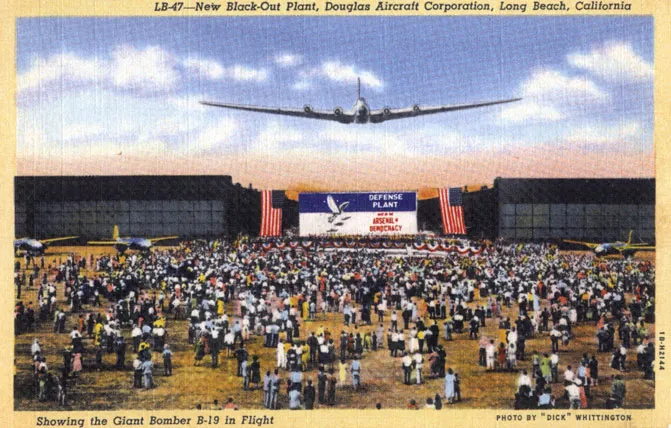
The XB-19 over the Douglas Long Beach, California, plant in 1941.
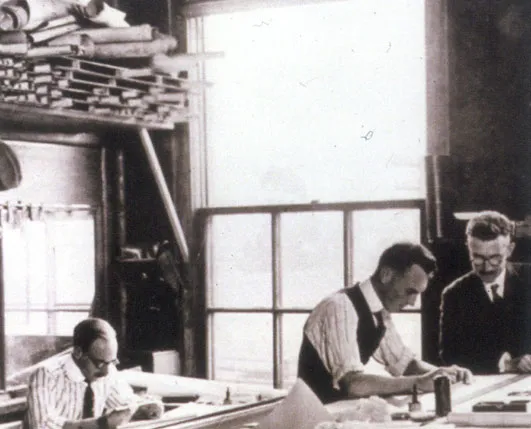
Donald Wills Douglas (right) in his Wilshire Boulevard, Santa Monica, factory in 1922
The B-19 was meant to be capable of striking an enemy target thousands of miles from her base in the United States, and on such a mission she could accommodate either eight 2,000 lb bombs, sixteen 1,100 lb bombs or thirty 600 lb bombs in her internal bombbay. She could also carry up to 2,000 lb of bombs on ten underwing racks and her maximum bomb-load capacity was 37,100 lb.
To defend herself, the big plane was armed with one 0.37mm cannon and one 0.30 calibre machine-gun in the nose and forward dorsal turrets, one 0.50 calibre machine-gun in the tail position and one each in the ventral turret, the right and left fuselage positions and the rear dorsal turret. There were additional 0.30 calibre machine-guns on both sides of the bombardier’s position and below the tail plane on both sides.
The bomber was to be operated by a crew of sixteen: an aircraft commander, a pilot, co-pilot, navigator, engineer, bombardier, radio operator, and nine gunners. Added capacity for an additional relief crew of eight including two flight mechanics, could be accommodated in a compartment over the bombbay, with six bunks and eight seats. The mechanics could access the engines in flight via passages in the wing. The plane was equipped with a galley for preparing in-flight meals, but the prototype aircraft did not have self-sealing fuel tanks or any armour to protect the crew.
Thousands of Douglas workers, Santa Monica residents and other southern Californians had gathered at Clover Field on 27 June 1941 to watch Army Air Force Major Stanley Ulmstead and a six-man crew take the XB-19 up for the first time. The maiden flight was brief, uneventful and three years behind schedule. Major Ulmstead flew the huge bomber east to March Field in Riverside County, turning it over to the Army for Air Force evaluation and manufacturer flight ...
Table of contents
- Cover
- Half Title
- Full Title
- Copyright Page
- Contents
Trusted by 375,005 students
Access to over 1.5 million titles for a fair monthly price.
Study more efficiently using our study tools.
Frequently asked questions
Yes, you can cancel anytime from the Subscription tab in your account settings on the Perlego website. Your subscription will stay active until the end of your current billing period. Learn how to cancel your subscription
No, books cannot be downloaded as external files, such as PDFs, for use outside of Perlego. However, you can download books within the Perlego app for offline reading on mobile or tablet. Learn how to download books offline
Perlego offers two plans: Essential and Complete
- Essential is ideal for learners and professionals who enjoy exploring a wide range of subjects. Access the Essential Library with 800,000+ trusted titles and best-sellers across business, personal growth, and the humanities. Includes unlimited reading time and Standard Read Aloud voice.
- Complete: Perfect for advanced learners and researchers needing full, unrestricted access. Unlock 1.5M+ books across hundreds of subjects, including academic and specialized titles. The Complete Plan also includes advanced features like Premium Read Aloud and Research Assistant.
We are an online textbook subscription service, where you can get access to an entire online library for less than the price of a single book per month. With over 1.5 million books across 990+ topics, we’ve got you covered! Learn about our mission
Look out for the read-aloud symbol on your next book to see if you can listen to it. The read-aloud tool reads text aloud for you, highlighting the text as it is being read. You can pause it, speed it up and slow it down. Learn more about Read Aloud
Yes! You can use the Perlego app on both iOS and Android devices to read anytime, anywhere — even offline. Perfect for commutes or when you’re on the go.
Please note we cannot support devices running on iOS 13 and Android 7 or earlier. Learn more about using the app
Please note we cannot support devices running on iOS 13 and Android 7 or earlier. Learn more about using the app
Yes, you can access Big Wings by Philip Kaplan in PDF and/or ePUB format, as well as other popular books in History & Military & Maritime History. We have over 1.5 million books available in our catalogue for you to explore.