- 208 pages
- English
- ePUB (mobile friendly)
- Available on iOS & Android
eBook - ePub
About this book
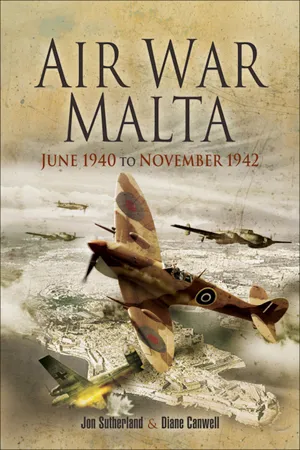
This is the story of the historic air defense of Malta by the WRAF against the combined attacking forces of the Italian and German air forces. The island was poorly equipped when Italy declared war on Britain in June 1940 and its only defense against air attack at the outset of war were 34 heavy and 8 light antiaircraft guns, one radar set and four Gladiator biplane fighters. The first air raids came on 11 July and from then on were an almost daily feature of life for the Maltese occupants and the island was in a state of siege. The loss of this strategic point in the central Mediterranean would threaten the major supply routes to the British Army in North Africa and deprive the Royal Navy of a vital base. Although hard-pressed at home and standing alone against Hitlers Europe, every effort was made by Britains government to get supplies, munitions and replacement aircraft to enable the island to withstand the naval and airborne onslaught. Convoy after convoy attempted to get through, Hurricane and Spitfire fighters were launched from aircraft carriers with only sufficient fuel for a one-way trip to the island. Many did not survive these heroic flights. Many famous British ships were lost due to torpedo and air attack, including the carriers Ark Royal and Eagle and the battleship Barham. The siege was finally raised on 20 November 1942.This book follows the islands wartime history, describing the heavily outnumbered WRAF defense against the many air-raids and how the small bomber force took the battle to Italian shores. It is a tale of outstanding bravery by the British forces and the Maltese people.
Information
CHAPTER ONE
THE OUTPOST OF THE BRAVE
When war was declared in September 1939 Malta seemed to be far from the probable battlefields of the new World War. Around it were either friendly or neutral countries. The Mediterranean was controlled by the British and the French and when Admiral Sir Andrew Cunningham moved the Mediterranean Royal Navy command to Alexandria, leaving just a pair of cruisers, two destroyers and a flotilla of submarines in Malta, the island seemed to be even less in danger of attack. Mussolini had already declared that he would remain neutral in the war between Britain, France and Germany.
However, Mussolini, by June 1940, was seriously considering his position. Italy had seen Germany overwhelm Poland and then strike west, sweeping all before them and forcing Holland, Belgium and then France to buckle under the blitzkrieg spearheaded by the Luftwaffe.
On 10 June 1940, addressing an adoring crowd in Rome, Mussolini declared war on France and Britain. He believed the time was ripe to bring his country into the war before Germany claimed all the spoils. He had already ordered elements of the Italian air force south into Sicily and had prepared outline plans for attacks on Malta. With France on the verge of collapse the whole of the Mediterranean strategy carefully constructed by the British and the French was about to unravel and the vast Mediterranean would have to be policed by Cunningham’s naval forces alone. What had been a friendly, non-belligerent coastline, just 60 miles from Malta, was now occupied by an ambitious Italian air force, eager to display its prowess and its modern machines.
The Italian navy was ready to step into the void that was left by the defeated French. How could the tiny garrison on Malta be expected to hold out? How would it be possible to sustain 300,000 people who could only grow 30 per cent of the food they needed? It was an island that produced little meat and milk and was desperately short of water, except in the rainy season. All the air assets that could stand in the way of the Italian air force were three remaining Fleet Air Arm Gloucester Gladiator biplanes, Faith, Hope and Charity. The biplanes were still in packing cases at Kalafrana and had been left behind when HMS Glorious had left the island. Permission was needed to even unpack the cases: permission was received and then rescinded. There were more delays and finally the aircraft could be pieced together. Six volunteer RAF pilots were hurriedly trained to fly them.
Nothing could have prepared the island for the ordeal that it was about to face. Over twenty years after the battle for the supremacy of the air above the islands former war correspondent, Alan Moorehead, wrote:
The greatest of the battles for supply fell upon Malta. This was now turned into a hell. Malta was a base for British submarines and aircraft preying on the Axis’ lines of supply to Libya. In the spring of 1942, the Axis decided to obliterate that base and they wanted to starve it as well. Right through the spring they turned such a blitz upon Malta as no other island or city had seen in the war. It was a siege of annihilation. One after another all the other great sieges were eclipsed — England and Odessa, Sebastopol and Tobruk. Malta became the most bombed place on earth.
Literally, years of neglect had left Malta without any credible air defences. In June 1940 all British air assets were being carefully protected for what would become the battle of Britain. Britain could not spare a single Hurricane or Spitfire, nor could they risk any other aircraft to defend the skies over the islands. Yet if Malta was to fall into the hands of the Italians or Germans the Mediterranean route between Britain and Egypt would be compromised. Axis aircraft, submarines and surface vessels could then interdict any convoys or attempts to reinforce Egypt. Any fight for Malta would be a fight to the end. If the Maltese or the garrison led by the Governor, Lieutenant-General William Dobbie, had any illusions that the conflict would pass Malta by, this was shattered at dawn on 11 June 1940, just six hours after Italy declared war on Britain and France.
What preparations were possible had been made, even before war had broken out in 1939. Sir Charles Bonham-Carter had been the Governor of the island in 1939. He had encouraged the creation of District Committees across the islands, so there would be some form of local government and these committees could recruit air raid wardens, organize air raid shelters, first-aid stations and casualty clearing centres. Air raid wardens were trained and allocated particular areas. They were expected to send delegates to provide monthly reports to a central committee set up by the governor. The committee was also concerned with food and rationing. By the end of 1939, 365 men and 236 women had become air raid wardens. Gas masks had been distributed: this was a necessary step, particularly considering the indiscriminate use of gas that the Italians had made against tribesmen in Abyssinia.
Old passageways and tunnels were opened up in ancient defence works. These would provide useful shelter during air raids. Areas of housing directly close to the dockyards would have to be evacuated and additional military personnel would need billets. Systematically the authorities began hoarding food and ammunition. An early decision was made to concentrate the defence on the island of Malta itself and effectively leave Gozo and Comino undefended.
A blackout practice was carried out on the night of 2 to 3 May 1940. It lasted from 22.00 hours until the following dawn. On 11 May air raid warning practice commenced at 19.00 hours. Residents cleared the streets of Valletta in minutes, they observed blackout regulations and cars were parked and left.
The previous day Sir William Dobbie, now Acting Governor, called for volunteers for a force of special constables. On 20 May ‘licensed sportsmen and other persons capable of using a gun‘ were asked to join the Home Defence Force. It seemed that if the enemy were to arrive then it would probably be by parachute. Amazingly, within three days of the call for the Home Defence Force volunteers, 3,000 people had presented themselves. The volunteers would become known as the Malta Volunteer Defence Force. They were issued with steel helmets and given brassards with the letter ‘v’ on them.
On 27 May a curfew was imposed from 23.00 to 05.00 hours. The Central Hospital at Floriana and Blue Sisters at St Julian’s were prepared to accept casualties from air raids. Two other hospitals were set up, one at the Mater Boni Consilii School at Paola and the other at the Bugeja Technical Institute at Hamrun.
Malta had every reason to fear the Italian air force (Regia Aeronautica). It boasted 5,400 aircraft, most of which were either in Italy or North Africa. Around 2,000 of the aircraft were being used for flight practice and training, but they had a front line strength of 975 bombers and 803 fighters and fighter bombers. In addition they had 400 reconnaissance aircraft, eighty transports, 285 maritime reconnaissance aircraft and a further 400 older, mainly biplanes, based in Italian East Africa.
At this point in the war the primary Italian bomber was the Savoia-Marchettism 79 (Hawk). It was a three-engine aircraft capable of being used in a straightforward bomber role, carrying 2,200 lb of bombs, or in an anti-shipping role, carrying two torpedoes. It had a cruising speed of 200 mph and a maximum speed of 225 mph. It was powered by three, Alfa Romeo RC34, 750 hp engines. The best fighter was the Macchi C200, with a maximum speed of 300 mph. It was powered by a Fiat A74, 840 hp engine and had a pair of 12.7 mm machine guns. In addition to this the Italians deployed CR42 and CR50 fighters and Fiat BR20M bombers.
On the ground at Malta, to resist a potential invasion, were the 2nd Battalion Devonshire Regiment, the 2nd Battalion Queens Own Royal West Kent Regiment, the 1st Battalion Dorsetshire Regiment and the 2nd Battalion Royal Irish Fusiliers. A further battalion of Maltese infantry would soon become the 1st Battalion of the Queens Own Malta Regiment. Completing the defence force for September 1939 was the 7th Anti-aircraft Regiment of the Royal Artillery. In addition, just a month before the first Italian attack, the 8th Battalion Manchester Regiment arrived in May 1940. On paper the ground force was now classed as a division. Anti-aircraft defences were also beefed up, with the arrival of the 27th Heavy Anti-Aircraft Regiment.
It was just before 07.00 on 11 June 1940 that ten S79s appeared over the coast, making for Hal Far. Almost immediately a second wave of fifteen S79s made for the dockyard and Valletta’s two main harbours. A third wave seemed to be making for the seaplane base at Kalafrana. The bombers were escorted by Macchi 200s.
Flight Lieutenant George Burges was sitting on the lavatory when the alert was sounded. He ran out to his Gladiator, along with two of his colleagues. Unfortunately they could not get high enough before the bombs started dropping over the Grand Harbour. Aloft Burges could see Hal Far, his own airfield, in smoke from the first wave of bombs. Burges chased a second wave of bombers, but when the Italians saw him they just sped up and left the Gladiator in their wake. The Italians had hit Valletta, Hal Far, Portes-des-Bombes, Marsa, Sliema and other targets. They had managed to kill seven servicemen, eleven civilians and injure 130 more.
The Italians returned in the afternoon with more attacks on Hal Far, Valletta and the Grand Harbour. The Hal Far based Gladiators again tried to respond and the anti-aircraft defences tried to engage the enemy. By the end of the day there had been eight air raid alerts, of which five had become bombing raids. The Italians had been flying at heights of between 10,000 and 15,000 ft, making it difficult for the Gladiators to engage them.
Finally the all clear was sounded and that evening all service personnel were told to report immediately for duty. The bars and clubs in Valletta were swept by military police, who ordered the servicemen back to their units.
Governor Dobbie issued an Order of the Day:
The decision of His Majesty’s Government to fight until our enemies are defeated will be heard with the greatest satisfaction by all ranks of the Garrison of Malta. It may be that hard times lie ahead of us, but I know that however hard they may be, the courage and determination of all ranks will not falter, and that with God’s help we will maintain the security of this fortress. I call on all officers and other ranks humbly to seek God’s help, and then in reliance on Him to do their duty unflinchingly.
The experience of the first attack played heavily on the minds of the servicemen and civilians of the island. The night before the attack Air Chief Marshal Sir Robert Brooke-Popham had attended an official dinner party laid on by the Governor, when he was interrupted by Flight Lieutenant Burges, who informed him that the Italians had declared war. Brooke-Popham’s assistant, Air Commodore Sammy Maynard, had hoped that they would have at least forty-eight fighters, or four squadrons, to defend Malta. Maynard was a New Zealander and he had only happened on the Gladiators in their packing cases by chance back in March 1940.
After the first day’s attack Maynard put it to the Gladiator pilots that new tactics were needed in order to deal with any future attacks. Squadron Leader Jock Martin, who was in command of the Gladiator flight, agreed with him that the Gladiators’ only chance to intercept the Italians was to be above the bombers as they approached. The solution seemed to be that the pilots would have to take it in turns to sit in their cockpits on the ground, ready to take off as soon as the enemy had been spotted. However, with an inadequate number of crew members properly trained to cover the daylight hours from 05.00 to 20.00 hours meant that each man would have to spend four hours sitting in a cockpit, followed by four hours of rest.
The ground crews would also need to work night and day, not only to keep the Gladiators aloft, but also to ensure that the airfield remained open. They would have to cannibalise whatever parts they could lay their hands on from the stores. They utilised parts from a Royal Navy Swordfish (the Gladiator was renamed a Gladfish). They also fitted three-bladed propellers to the Gladiators to improve their climb. Maintenance crews would also have to use parts from Blenheim bombers just to keep Faith, Hope and Charity flying.
The exodus of civilians from Valletta began the day after the first attack. As J. Storace recalled at the time:
Women with bundles on their heads or with bundles hanging from their arms, carrying babies, with one or two children holding onto their skirts, with a boy or girl pushing a pram loaded with the most essential belongings, crowded the road, walking without a destination in view, but leaving their beloved homes, abandoning their city, going anywhere as far away as possible from this target area. Buses, touring cars, cabs and other horse drawn vehicles carrying the more fortunate families who either owned a vehicle or could afford to hire one, moved in this crowd of walking and less fortunate humanity in the direction of Zabbar.
A solitary Italian reconnaissance plane flew over Malta on 12 June. It was promptly shot down. But on the following day there were four air raid warnings, two developing into bombing raids. The first hit Kalafrana, killing two and wounding four others. The second was intercepted by the three Gladiators. The Italian bombers panicked and dropped their bombs prematurely, most of them falling into the sea or onto empty fields. Seventeen casualties were inflicted by the bombing on 12 June and the authorities clamped down on blackout violations, prosecuting several people.
On 13 June Dobbie contacted the War Office. He had heard that there were some Hurricanes heading for Egypt and he desperately wanted these. To his amazement the War Office agreed.
The first air raid alarm sounded at 08.35 on 14 June. Italian bombers were dropping bombs on Grand Harbour, Fort St Angelo and then over St John’s Co-Cathedral. There were only a handful of casualties, but there were seven more raids on 14 June, the last focusing on Cospicua, close to the dockyards. This time the Italians used both high explosives and incendiaries. This was a particularly vulnerable part of the island, as it was one of the most crowded.
The refugee situation was becoming impossible and many refugee settlement centres were set up in the villages, in order to deal with the exodus of inhabitants from Valletta.
On 15 June a single air raid claimed one life at Hanrun. Even Sunday 16th was not without incident. The first alarm heralded the arrival of three formations of enemy aircraft, thought to be around thirteen in strength, and they dropped bombs around Kalafrana. Another formation of Macchi 200 fighters was also spotted and in the afternoon more bombs were dropped near Mosta. Luckily there were only two casualties.
The Italians struck early on the morning of 17 June with an air raid at 06.15 hours. Five Italian bombers and a pair of fighters dropped munitions harmlessly into the countryside in the centre of the island. Governor Dobbie’s order for the day read:
Whatever may be the outcome of the negotiations in France it will not affect the determination of His Majesty’s Government to continue the war and defeat our enemies. Here the task of the fighting forces of maintaining the integrity and safety of Malta remains unchanged and will be resolutely carried out. I know I can rely on the support and cooperation of all the people and that they will cheerfully do whatever may be required of them to assist in this glorious task. May God help us to do our duty to the full and finally give us victory.
From this proclamation it was clear to servicemen and civilians alike that all did not bode well in France. But they could not be prepared for the prospect of the Allied effort losing six million fighting men when France would drop out of the war in little more than a week’s time. It would also place potential new enemies close at hand, in the form of the Vichy French.
The Italians launched their first night raid on Malta on Thursday 20 June. The islanders heard that the Germans had already captured Paris, but this brought with it a glimmer of hope for Malta itself. Two Royal Navy training squadrons, Nos 767 and 769, had been based at the French Naval airfield of Olayvestre on the south coast of France. On 18 June they were withdrawn to Algeria and then split into two sections of twelve Swordfish aircraft. Twelve of the best crew members left Tunis for Hal Far, where they would arrive on 20 June. Ultimately they would become No. 830 Squadron Fleet Air Arm (1 July).
Meanwhile the three Gladiators still doggedly defied the Italian air force over Malta. Two more crated Gladiators had been unpacked, but no sooner had the three become five than Malta’s air force was once again reduced to three. One of the new Gladiators crashed while taking off. The pilot was unhurt, but the Gladiator was wrecked. In the afternoon a second Gladiator hit a packing case when it landed and flipped over. Once again the Gladiator was a write off, but the pilot emerged safely from the wreckage.
A day later, on 22 June, Malta would claim its first kill.
CHAPTER TWO
THE ITALIAN OFFENSIVE
Towards the end of the first week of the war for Malta, Berlin radio proudly announced that the Italian air force had ‘completely destroyed the British naval base at Malta’. In order to provide photographic proof of their ‘victory’, the Italians sent a Savoia Marchetti 79 (SM79) to take shots of the airfield and the Grand Harbour. Waiting for the bomber aloft was Flight Lieutenant Burges in Faith and Flying Officer Timber Woods in Hope. Burges described the encounter in his own words in his combat report:
Ordered to intercept enemy aircraft reported approaching Malta. Enemy sighted at 13,000 ft when we were at 12,000 ft. Altered course to intercept and climbed to 15,000 ft, and carried out stern attack from above enemy. Port engine and then starboard engine of enemy caught fire and attack was discontinued.
Far below, promenaders in Valletta and Sliema saw the Italian aircraft drop into the sea, followed by two crew members who had managed to bale out. The pilot, Francesco Solimena and the observer, Alfredo Balsamo, were picked up by the destroyer, HMS Diamond. The second pilot and two others were killed. These were the first enemy airmen shot down over Malta and they became prisoners of war.
The message that Dobbie had written to the War Office on 12 June saw the welcome arrival of five Hurricanes. They landed on Malta on 13 June, but instructions for them to remain on the island had not got through and to Air Commodore Maynard’s distress, after refuelling they took off again. Two more Hurricanes arrived; again their intention was to fly onto Egypt. Six more arrived on 22 June. The aircraft were flown by Ferry Pool pilots: all were shocked to discover that they were to become part of Malta Fighter Flight. Just one of the pilots had combat experience. The defence of Malta now primarily passed over to the Hurricanes, rather than the Gladiators.
On the very same day, at 18.50, the French signed an armistice with the Germans at Compiegne. Henceforth the Germans would occupy Northern France. The remainder of France and the colonies, including those in North Africa, would remain ‘free’ to be governed by the French. French North Africa, consisting of Morocco, Algeria and Tunisia, was effectively enemy-held territory. Less than a fortnight before the entire coastline of the Mediterranean had either been in Allied hands or had been neutral. Now over 60 per cent of it was in enemy hands. The only ports open to the British were Malta, Palestine, Gibraltar and Egypt. Malta’s strategic position was now even more crucial. Winston Churchill saw Malta as being the potentially vital base from which to launch offensive operations. Malta...
Table of contents
- Title Page
- Copyright Page
- Table of Contents
- ACKNOWLED GEMENT
- INTRODUCTION
- CHAPTER ONE - THE OUTPOST OF THE BRAVE
- CHAPTER TWO - THE ITALIAN OFFENSIVE
- CHAPTER THREE - THE ILLUSTRIOUS BLITZ
- CHAPTER FOUR - LUFTWAFFE ONSLAUGHT
- CHAPTER FIVE - THE SHADOW OVER ROMMEL
- CHAPTER SIX - BLUDGEON
- CHAPTER SEVEN - FIGHTING FOR ITS LIFE
- CHAPTER EIGHT - TRIUMPH
- CHAPTER NINE - OUR TURN
- CHAPTER TEN - STRIKE BASE
- CHAPTER ELEVEN - ONE LAST GO
- CHAPTER TWELVE - PAUSE AND PLAUDITS
- APPENDIX ONE - TIMELINE OF THE SIEGE (APRIL 1940—DECEMBER 1942)
- APPENDIX TWO - PICK-UPS BY RAF AIR SEA RESCUE AND MARINE CRAFT SECTION (JUNE 1940 AUGUST 1944)
- APPENDIX THREE - RAF SQUADRONS BASED ON THE ISLAND
- BIBLIOGRAPHY
- INDEX
Trusted by 375,005 students
Access to over 1.5 million titles for a fair monthly price.
Study more efficiently using our study tools.
Frequently asked questions
Yes, you can cancel anytime from the Subscription tab in your account settings on the Perlego website. Your subscription will stay active until the end of your current billing period. Learn how to cancel your subscription
No, books cannot be downloaded as external files, such as PDFs, for use outside of Perlego. However, you can download books within the Perlego app for offline reading on mobile or tablet. Learn how to download books offline
Perlego offers two plans: Essential and Complete
- Essential is ideal for learners and professionals who enjoy exploring a wide range of subjects. Access the Essential Library with 800,000+ trusted titles and best-sellers across business, personal growth, and the humanities. Includes unlimited reading time and Standard Read Aloud voice.
- Complete: Perfect for advanced learners and researchers needing full, unrestricted access. Unlock 1.5M+ books across hundreds of subjects, including academic and specialized titles. The Complete Plan also includes advanced features like Premium Read Aloud and Research Assistant.
We are an online textbook subscription service, where you can get access to an entire online library for less than the price of a single book per month. With over 1.5 million books across 990+ topics, we’ve got you covered! Learn about our mission
Look out for the read-aloud symbol on your next book to see if you can listen to it. The read-aloud tool reads text aloud for you, highlighting the text as it is being read. You can pause it, speed it up and slow it down. Learn more about Read Aloud
Yes! You can use the Perlego app on both iOS and Android devices to read anytime, anywhere — even offline. Perfect for commutes or when you’re on the go.
Please note we cannot support devices running on iOS 13 and Android 7 or earlier. Learn more about using the app
Please note we cannot support devices running on iOS 13 and Android 7 or earlier. Learn more about using the app
Yes, you can access Air War Malta by Jon Sutherland,Diane Canwell in PDF and/or ePUB format, as well as other popular books in History & Military & Maritime History. We have over 1.5 million books available in our catalogue for you to explore.