- 240 pages
- English
- ePUB (mobile friendly)
- Available on iOS & Android
eBook - ePub
The Battle for Vimy Ridge, 1917
About this book
In a new departure in the Battleground Europe series, this book is a guide to both sides of a major battle in this case to the Canadian Corps operations against 1st Bavarian Reserve Corps at Vimy from 9 12 April 1917, which formed part of the opening of the British offensive, known as the Battle of Arras. Historically, the capture of Vimy Ridge was an event far more significant than its undoubted military importance alone. Here for the first time all four divisions of the Canadian Corps were deployed in line together in one offensive; and although the Corps went to fight even greater battles, Vimy marked a key point in the emergence of Canada as a fully sovereign nation.Although the Canadian side of the story has been well chronicled by a number of writers, until now there has been little concerning the defense during this great battle. Now, the accounts of the German soldiers and their commanders are combined with those of the Canadians and British deployed on the other side of No Mans Land and not simply those who fought above ground, but tunnelers also.
Information
Topic
HistoireSubtopic
Première Guerre mondialeChapter One
VISITING VIMY RIDGE
General
If you are planning to visit the Vimy area, you are advised to base yourself in the town of Arras, with its magnificently restored Flemish Gothic architecture. Information concerning facilities and accommodation is best obtained via the website of the Tourist Office in Arras. Because there are several ways of accessing this site, it is recommended that you carry out an internet search for Office de Tourisme Arras Pas de Calais. With a little persistence you will find that the key information is available in English. Should you wish to contact the office in writing or by telephone (English is spoken), contact details are as follows : Office de Tourisme, Hotel de Ville, Place des Héros, BP 49, 62001 Arras CEDEX, France (Telephone: 0033 321.51.26.95; FAX: 0033 321.51.76.49. Accomodation in Arras, which ranges from four star hotels to Gîtes and a campsite, often gets fully booked, so you are strongly advised to reserve in advance. In addition, if you have particular questions concerning a visit to this area, or any other aspect of the Great War or its battlefields and you wish to obtain friendly advice from an extremely knowledgeable group of enthusiasts, you should visit the Great War Forum at http://1914-1918.invisionzone.com/forums This very busy forum has well over 10 ,000 subscribers world wide; somebody is sure to be able to answer your queries, or to point you in the right direction.
Insurance and Medical
Travel and breakdown insurance is very cheap in comparison to the potential cost of an emergency, so although you are merely embarking on a simple visit to a nearby EU country, the peace of mind obtained is probably well worth the modest outlay involved. In any event do not venture out of the UK without a European Health Insurance Card, the successor to the old E111 form. You can apply online for the card at www.ehic.org.uk or by calling 0845 606 2030. Cards take about three weeks to be delivered, but it is possible to obtain a temporary number at short notice. For those living in France it is normal to have top-up medical insurance to complement state provision, so this is another argument for taking out some form of travel insurance, in order to ensure that you are entitled to the highest standards of treatment, should it be necessary. You will be visiting an agricultural area where there is a risk of tetanus. Make sure that your vaccination is up to date.
Independent Travellers
Most visitors from the United Kingdom tend to travel independently by car. This method probably provides the best combination of value for money and flexibility and, if you prepare carefully and bear a few straightforward rules in mind, you should have a trouble-free trip. The first point to remember is to drive on the right. This may seem obvious, but visitors from the UK are involved in accidents every year because they forget this simple fact. Danger times are first thing in the morning, or setting off after a stop for refreshments or to visit a point of interest, especially if you are on a minor, quiet country road. Put an arrow on your windscreen or have a drill to help you to remember. Carry your driving licence, log book and proof of insurance and passport at all times, but do not leave them unattended in the car. You also need a red warning triangle in case of breakdown and spare light bulbs. If you are stopped by a policeman and informed that a light is not working, production of a spare bulb from the glove compartment means that no offence has been committed.
A small first aid kit and fire extinguisher are also sensible items to carry. Make sure that you familiarise yourself with the speed limits in France (motorways 130 kph in dry weather, 110 kph in the rain; dual carriageways 110 kph; normal roads 90 kph; urban areas 50 kph, or less) and about the need to give way to traffic approaching from the right, unless you are on a priority road. Do not even think about drinking and driving. The legal limit is lower than in the United Kingdom and easily breached.
The best way to approach the battlefields of the Vimy area is to take the A26 autoroute from Calais and follow signs to Paris. The journey to Arras takes about one hour.
Useful Books
Over the years large numbers of books have been written about the battle for Vimy Ridge. They are almost all written from the Allied and, in particular, the Canadian perspective and therefore little is available concerning the defence of the ridge. Two recent books which provide a broader view are the Battleground Europe guide Vimy Ridge by Nigel Cave (Pen and Sword 1996 and subsequent reprints) and Vimy Ridge 1917 by Alexander Turner (Osprey 2005).
Maps
The maps in this book should enable you to navigate around the area following the walks and drives without problem. It is a good idea to have an up to date road atlas in the car, the IGN Green Series 1:100,000 Map No 2 (Lille-Dunkerque) covers a large swathe of territory in this area and, if you wish to have access to the best readily available mapping, then the IGN 1:25,000 maps may be found in Arras. The sheet which covers almost the entire area to be visited or toured is 2406 E (Arras).
Clothing and Personal Equipment
Clearly this will depend on what time of year you intend to visit. Good boots are essential for all but the simplest walks and, regardless of the season, Wellingtons to wear when squelching up to distant cemeteries and points of interest are a good idea if space allows. This minimises the amount of mud transferred into the car each time you get in and out. As a general rule always carry a waterproof jacket and wrap up warmly against the wind and rain in the winter. In the summer the sun can be fierce. Wear a hat and use sun screen. None of the walks described is off the beaten track, nor are they particularly long, but you may wish to carry drinks and snacks so as to be self-suff icient. You will find a compass and a lightweight pair of binoculars useful as you orientate yourselves at the numerous recommended viewpoints during the car tours. Do not forget your camera and notebook and a day sack with which to carry everything.
Refreshments
It is easier to find refreshments in the Vimy area than it was up until a few years ago, but options in the rural areas are still fairly limited. Arras has a full range of facilities, but it wastes time to return there at lunchtime. Drinks are available in various places as you tour the area. Good modestly-priced food is available at lunchtime (opening hours restricted) at the Relais St Vaast on the D 937 at La Targette and the café located to the left of the D55 by a 90 degree turn to the right just before Givenchy en Gohelle as you descend from the Canadian Memorial. A range of sandwiches and other snacks is available from the café a few metres to the north of the Canadian artillery memorial where the Thélus-Neuville St Vaast road crosses the N17. Finally there are convenience stores and bakeries in several of the villages around the Vimy area.
Dogs
Now that the quarantine laws have been changed, it is a relatively straightforward matter to transport domestic animals to and from the United Kingdom. The latest rules which govern the import and export of pets may be found at www.defra.gov.uk. The critical point, which travellers often get wrong and which makes the vets in Calais wealthy, is the fact that dogs arrive at the terminals not having been treated for internal and external parasites in the correct manner. They should arrive at the port in France having been treated by a vet more than 24 hours and less than 48 hours previously. Make sure when you have this done that the vet signs and dates the paperwork, adding in the time the treatment was administered. If not, the dog does not travel and it is another job for a vet in Calais, not to mention a twenty four hour delay. Dogs are welcomed, or at least tolerated, in a wide range of hotels and gîtes in France, but it is as well to check in advance, unless you intend to use a chain such as Campanile/Première Classe www.envergure.fr or Formule 1 www.hotelformule1.com, where pets are automatically welcome. However, it must be said that the Vimy area is not a good place to bring a dog. They are not permitted anywhere on the grounds of the Canadian Memorial. Much of your visit will comprise touring in your vehicle from one viewpoint to another and, even when walks are described, none of them is suitable for a dog off a lead.
Battlefield Debris
Generally speaking there seem to be fewer dud shells lying around the edges of the cultivated fields in this area than is the case, for example, on the Somme, but you need to be aware that, in general, the woods in the Vimy area have, at best, only been partially cleared. Danger lurks in the undergrowth. It is for this reason that much of the Vimy Memorial is fenced off. If you stick to the main tracks through the woods, as described in this guide, you should have no problem, but elsewhere lie many hazards, ranging from dud shells and mortar bombs (both conventional and chemical) to rusty old caltrops (metal spikes designed to penetrate a boot sole). If you come across any sort of battlefield debris, leave it all strictly alone. Do not touch or kick it; above all do not tamper with it. Even after all these years dud shells can still be lethal. Possession of live or defused items is a criminal offence in France, as is the use of metal detectors on the battlefield; so be warned and do not indulge in souvenir hunting.
Chapter Two
THE CANADIAN CORPS: AN OUTLINE OF EVENTS AT VIMY RIDGE
The Official History of the Canadian Corps was not printed until 1962; an earlier project had fallen foul of the outbreak of the Second World War, with only one volume of a planned multi-volume version printed (plus a volume of appendices). Although out of print for some years, it is available on the internet; because of the vagaries of web addresses, it is best to put the title on a search engine and take it from there. The author was Colonel GWL Nicholson of the Army Historical Section, who did a superb job within the constraints of a single volume. He also had the advantage over other Official Historians that Canada’s version was so late in coming out: the Second World War had intervened and much had been written about the war by military historians and analysts. He was able to synthesise all this information and make good use of it, producing both an accurate and readable history. Much of what follows in this section is closely derived from what he wrote.
When Britain declared war on Germany in August 1914 Canada was automatically at war as well. Her constitutional position as a Dominion gave her no say in declaring war or in making peace, but she had the right to decide what form her contribution to the war effort should take. Loyalty to the Empire, ties with the Motherland and the sense of patriotism were very strong then, and there was never any doubt that Canada’s response would be anything other than wholehearted. Sir Robert Borden, the Prime Minister, expressed the feeling of the nation at the opening of a special war session of Parliament on 18 August: ‘As to our duty’, he said, ‘we are all agreed; we stand shoulder to shoulder with Britain and the other British Dominions in this quarrel. And that duty we shall not fail to fulfil as the honour of Canada demands.’
General Sam Hughes taking a salute.
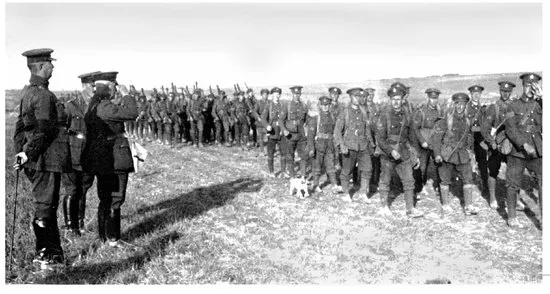
At the outbreak of war the Canadian regular army or, to give it its proper title, the Permanent Active Militia, numbered just over 3,000. It comprised two cavalry regiments: The Royal Canadian Dragoons and Lord Strathcona’s Horse; one infantry battalion, The Royal Canadian Regiment (RCR) and some artillery, engineer and service support units. This small force was strengthened a few days after the declaration of war by the forming of a new infantry unit, Princess Patricia’s Canadian Light Infantry (PPCLI). Named after the daughter of the then Governor General, it was rapidly brought to full strength with veterans volunteering from all over Canada. When it first paraded virtually every single regiment of the British Army was represented in its ranks. The PPCLI was the first Canadian unit in the front line when it went into the trenches with 80 Brigade, 27th Division on 6 January 1915 some two months before the 1st Canadian Division took over its first sector of the front. Ironically, the only pre-war regular infantry unit, the RCR, was sent to Bermuda to relieve 2/Lincolns and did not get to France until November 1915.
Behind the small regular force stood the Non-Permanent Active Militia, equivalent to the Territorials in the UK. Numbering some 60,000, it included 36 cavalry and 106 infantry regiments. Although improvements had been put in hand in the years immediately prior to 1914, Canada’s armed forces were still ill-equipped and only partially trained when war broke out, but they provided a basis on which to build. A mobilization plan existed whereby a division and a mounted brigade would be made available for active service overseas. The activities of Sam Hughes, the controversial Minister of Militia, is not part of this brief outline, but he should take much of the credit for the enormous increase...
Table of contents
- Title Page
- Dedication
- Copyright Page
- Table of Contents
- ACKNOWLEDGEMENTS
- CANADIAN INTRODUCTION
- GERMAN INTRODUCTION
- Chapter One - VISITING VIMY RIDGE
- Chapter Two - THE CANADIAN CORPS: AN OUTLINE OF EVENTS AT VIMY RIDGE
- Chapter Three - THE PRELIMINARIES: HOLDING THE LINE, RAIDING AND PATROLLING OCTOBER 1916 TO MARCH 1917
- Chapter Four - THE CANADIAN CORPS IN THE BATTLE FOR VIMY RIDGE 1 – 14 APRIL 1917
- Chapter Five - THE GERMAN DEFENCE OF VIMY RIDGE 1 MARCH – MID-APRIL 1917
- Chapter 6 - A TOUR OF THE VIMY AREA
- Chapter Seven - A WALKING TOUR OF THE VIMY MEMORIAL SITE AND NEIGHBOURING AREA
- GERMAN – BRITISH COMPARISON OF RANKS
- CASUALTY ANALYSIS: RESERVE INFANTRY REGIMENT 261
- INDEX
Trusted by 375,005 students
Access to over 1.5 million titles for a fair monthly price.
Study more efficiently using our study tools.
Frequently asked questions
Yes, you can cancel anytime from the Subscription tab in your account settings on the Perlego website. Your subscription will stay active until the end of your current billing period. Learn how to cancel your subscription
No, books cannot be downloaded as external files, such as PDFs, for use outside of Perlego. However, you can download books within the Perlego app for offline reading on mobile or tablet. Learn how to download books offline
Perlego offers two plans: Essential and Complete
- Essential is ideal for learners and professionals who enjoy exploring a wide range of subjects. Access the Essential Library with 800,000+ trusted titles and best-sellers across business, personal growth, and the humanities. Includes unlimited reading time and Standard Read Aloud voice.
- Complete: Perfect for advanced learners and researchers needing full, unrestricted access. Unlock 1.5M+ books across hundreds of subjects, including academic and specialized titles. The Complete Plan also includes advanced features like Premium Read Aloud and Research Assistant.
We are an online textbook subscription service, where you can get access to an entire online library for less than the price of a single book per month. With over 1.5 million books across 990+ topics, we’ve got you covered! Learn about our mission
Look out for the read-aloud symbol on your next book to see if you can listen to it. The read-aloud tool reads text aloud for you, highlighting the text as it is being read. You can pause it, speed it up and slow it down. Learn more about Read Aloud
Yes! You can use the Perlego app on both iOS and Android devices to read anytime, anywhere — even offline. Perfect for commutes or when you’re on the go.
Please note we cannot support devices running on iOS 13 and Android 7 or earlier. Learn more about using the app
Please note we cannot support devices running on iOS 13 and Android 7 or earlier. Learn more about using the app
Yes, you can access The Battle for Vimy Ridge, 1917 by Nigel Cave,Jack Sheldon in PDF and/or ePUB format, as well as other popular books in Histoire & Première Guerre mondiale. We have over 1.5 million books available in our catalogue for you to explore.